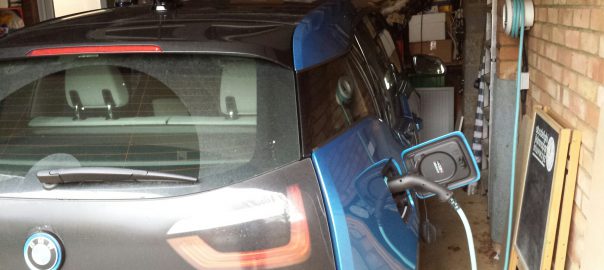
One feature of the i3 that wasn’t available on my previous Renault ZOE is the ability to change at very low powers. Of course that means charging can be very slow.
The benefit of this option, which may not be obvious, is that it means the current draw is a good match for solar panels. In other words the car can be entirely charged by solar with nothing being drawn from the grid. Free fuel!
Klaus Jacob, a German professor affiliated with Columbia’s University’s Lamont-Doherty Earth Observatory, is a geophysicist by profession and a doomsayer by disposition.
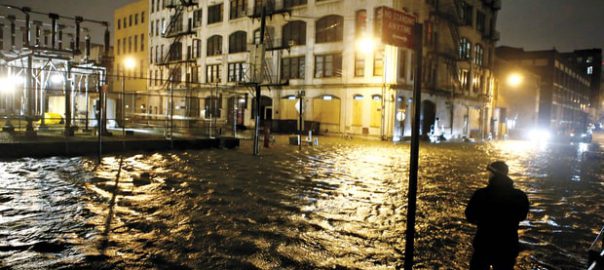
Hurricane Sandy flooded huge parts of Lower Manhattan and downtown Brooklyn (Image: J. Countess/Redux)
I’ve gotten to know him over the past few years, as I’ve sought to understand the greatest threat to life in New York as we know it. Jacob has a white beard and a ponderous accent: Imagine if Werner Herzog happened to be a renowned expert on disaster risk. Jacob believes most people live in an irrational state of “risk denial,” and he takes delight in dispelling their blissful ignorance. “If you want to survive an earthquake, don’t buy a brownstone,” he once cautioned me, citing the catastrophic potential of a long-dormant fault line that runs under the city. When Mayor Bloomberg announced nine years ago an initiative to plant a million trees, Jacob thought, That’s nice — but what about tornadoes?
For the past 15 years or so, Jacob has been primarily preoccupied with a more existential danger: the rising sea. The latest scientific findings suggest that a child born today in this island metropolis may live to see the waters around it swell by six feet, as the previously hypothetical consequences of global warming take on an escalating — and unstoppable — force. “I have made it my mission,” Jacob says, “to think long term.” The life span of a city is measured in centuries, and New York, which is approaching its fifth, probably doesn’t have another five to go, at least in any presently recognizable form. Instead, Jacob has said, the city will become a
“gradual Atlantis.”
The deluge will begin slowly, and irregularly, and so it will confound human perceptions of change. Areas that never had flash floods will start to experience them, in part because global warming will also increase precipitation. High tides will spill over old bulkheads when there is a full moon. People will start carrying galoshes to work. All the commercial skyscrapers, housing, cultural institutions that currently sit near the waterline will be forced to contend with routine inundation. And cataclysmic floods will become more common, because, to put it simply, if the baseline water level is higher, every storm surge will be that much stronger. Now, a surge of six feet has a one percent chance of happening each year — it’s what climatologists call a “100 year” storm. By 2050, if sea-level rise happens as rapidly as many scientists think it will, today’s hundred-year floods will become five times more likely, making mass destruction a once-a-generation occurrence. Like a stumbling boxer, the city will try to keep its guard up, but the sea will only gain strength.
Scientists’ warnings that the rise of the sea would eventually imperil the United States’ coastline are no longer theoretical
NORFOLK, Va. — Huge vertical rulers are sprouting beside low spots in the streets here, so people can judge if the tidal floods that increasingly inundate their roads are too deep to drive through.
Highway 80, the only road to Tybee Island, Ga., in June. High tides are forcing the road to close several times a year (Image: S. Morton/New York Times)
Five hundred miles down the Atlantic Coast, the only road to Tybee Island, Ga., is disappearing beneath the sea several times a year, cutting the town off from the mainland.
And another 500 miles on, in Fort Lauderdale, Fla., increased tidal flooding is forcing the city to spend millions fixing battered roads and drains — and, at times, to send out giant vacuum trucks to suck saltwater off the streets.
For decades, as the global warming created by human emissions caused land ice to melt and ocean water to expand, scientists warned that the accelerating rise of the sea would eventually imperil the United States’ coastline.
Now, those warnings are no longer theoretical: The inundation of the coast has begun. The sea has crept up to the point that a high tide and a brisk wind are all it takes to send water pouring into streets and homes.
Federal scientists have documented a sharp jump in this nuisance flooding — often called “sunny-day flooding” — along both the East Coast and the Gulf Coast in recent years. The sea is now so near the brim in many places that they believe the problem is likely to worsen quickly. Shifts in the Pacific Ocean mean that the West Coast, partly spared over the past two decades, may be hit hard, too.
These tidal floods are often just a foot or two deep, but they can stop traffic, swamp basements, damage cars, kill lawns and forests, and poison wells with salt. Moreover, the high seas interfere with the drainage of storm water.
In coastal regions, that compounds the damage from the increasingly heavy rains plaguing the country, like those that recently caused extensive flooding in Louisiana. Scientists say these rains are also a consequence of human greenhouse emissions.
“Once impacts become noticeable, they’re going to be upon you quickly,”
said William V. Sweet, a scientist with the National Oceanic and Atmospheric Administration in Silver Spring, Md., who is among the leaders in research on coastal inundation.
MPs warn that the uptake of ultra-low emission vehicles is too low to meet national climate change targets
The government target is for electric cars to make up 9% of the fleet by 2020 (Image: S. Lee/Guardian)
The government is falling behind on its commitments to switch a proportion of Britain’s car fleet to electric vehicles, an influential committee of MPs said on Thursday.
Take-up of electric vehicles has been slower than hoped in the UK, but the technology is essential to reducing greenhouse gas emissions from transport, and tackling the air pollution produced by the increased number of diesel cars on the road.
According to the guideline target recommended by the government’s climate advisors, ultra-low emission vehicles such as electric cars should make up 9% of the fleet by 2020, but current forecasts by the Department for Transport (DfT) show the figure by the end of the decade is likely to be about half that. Ministers have not said what should happen if the target is not met, nor produced a plan for beyond 2020.
Parliament’s environmental audit committee said ministers were failing to put forward the incentives and infrastructure needed to encourage drivers into electric cars, while air pollution was breaching regulations, with 38 of 43 clean air zones exceeding acceptable levels of nitrogen oxides.
In addition, the committee said the lessons of the Volkswagen emissions scandal, in which the manufacturer was found to have cheated on tests to make vehicles seem greener than they really were, had not been learned. Affected models were only starting to be withdrawn from the market, the MPs were told.
Mary Creagh, chairwoman of the committee, said:
“The uptake of ultra-low emission vehicles is too low to meet the UK’s climate change targets at the lowest cost to the public. Air quality targets that were supposed to be met in 2010 won’t be hit until 2020 at the earliest. And it’s been almost a year since we discovered VW had fitted cars with cheat devices, but the government has still to decide what action to take against the company.”
Blink and you missed the announcement. But last Friday, the UK’s much criticised energy supply grid system entered what is being seen as a “new era” with the announcement that eight large battery systems are being built to cope with the growing influx of wind and solar power.
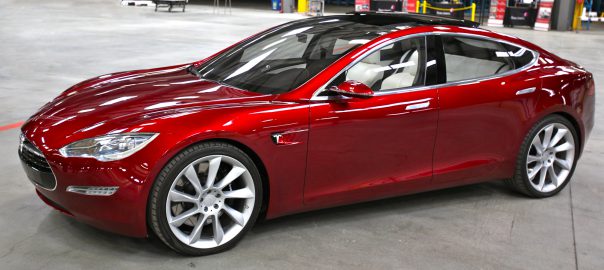
Tesla Model S
The deal – the largest of its kind in Europe – will see seven companies, including Sweden’s Vattenfall and UK-based Renewable Energy Systems, install eight lithium-ion battery systems around Britain.
“This is the single largest contract in Europe we’ve ever seen for storage and the largest of its kind globally since August last year,”
said Logan Goldie-Scot, head of energy storage at the Bloomberg New Energy Finance research group told the Financial Times.
Storing electricity in batteries has long seen as the “holy grail” for renewables as battery storage of electricity helps to supply power on the days that the wind is not blowing or the sun is not shining.
And the move is aimed at helping the UK cope with the growing prevalence of renewables, which now account for a quarter of UK electricity generation, up from 9 per cent in just five years.
If renewables can provide electricity to the grid which can be stored when demand is needed it will help the electric car revolution that is taking place. Just as the electricity supply network needs storage in batteries so do electric cars, and it is a shortage of batteries which is threatening to keep the price of electric vehicles high for the time being.
But Tesla is changing the game on electric vehicles, a subject explored in today’s Financial Times, which asks what it calls a profound question: “Could electric cars ever cut the world’s thirst for oil enough to depress crude prices significantly?”
Many things have gotten harder as the world settles into a protracted spell of low oil prices and sluggish growth — from avoiding deflation to creating jobs. One thing has gotten easier, as well as more urgent: eliminating fossil-fuel subsidies.
At these prices, who can refuse? (Image: G. Osodi/Bloomberg)
Governments have long paid lip service to this idea. The G-20 has been promising to phase out fuel subsidies since 2009, but the measures remain widespread and resilient.
Nations from the U.S. to the U.K. to Russia continue to spend billions on tax breaks and other subsidies for the production of oil, gas and coal. Japan, South Korea and China support massive fossil-fuel projects outside their borders. For years, many countries — including some of the world’s biggest energy producers — have also used subsidies to lower gasoline and diesel prices, supposedly to help the poor.
The sums involved are huge. The International Energy Agency estimates that countries spent $493 billion on consumption subsidies for fossil fuels in 2014. The U.K.’s Overseas Development Institute suggests G-20 countries alone devoted an additional $450 billion to producer supports that year.
These ridiculous outlays would be economically wasteful even if they didn’t also harm the environment. They fuel corruption, discourage efficient use of energy and promote needlessly capital-intensive industries. They sustain unviable fossil-fuel producers, hold back innovation, and encourage countries to build uneconomic pipelines and coal-fired power plants. Last and most important, if governments are to have any hope of meeting their ambitious climate targets, they need to stop paying people to use and produce fossil fuels.
Less than six months after Australia received its first shipment of Tesla Powerwalls, plans for what could be the world’s first “Tesla town” – a mini-suburb on the outskirts of the Melbourne CBD whose new-build homes will include rooftop solar and Tesla battery storage as standard design features – are being unveiled by local property group Glenvill, as the green development’s first 60 homes go on sale this week.
The new 16.46 hectare suburb, which will be called YarraBend for its 300 metres of Yarra River frontage, will include around 2,500 new dwellings – a mix of free standing houses, townhouses and apartments with three to five bedrooms, ranging in price from $1.48 million to $2.1 million.
The project is being designed, developed and built by Glenvill, which bills it as a “world first Tesla suburb” for its inclusion “within houses” of the iconic US company’s sleek-looking 7kWh lithium-ion Powerwall batteries, presumably to store energy from the houses’ rooftop solar systems, the sizes of which are not yet disclosed.
Houses in the development will also feature electric car recharging points, while residents will have access to high-speed internet, a “tech-concierge”, and a YarraBend app, that will connect them to a variety of amenities and information within the community, including public transport timetables, home delivery menus, carpooling arrangements and social events.
Eight new battery storage projects are to be built around the UK after winning contracts worth £66m to help National Grid keep power supplies stable as more wind and solar farms are built.
EDF Energy, E.On and Vattenfall were among the successful companies chosen to build new lithium-ion batteries with a combined capacity of 200 megawatts (MW), under a new scheme to help Grid balance supply and demand within seconds.
National Grid wants the batteries to help it cope with the challenges of more wind and solar power (Image: PA)
Power generation and usage on the UK grid have to be matched as closely as possible in real-time to keep electricity supplies at a safe frequency so that household electrical appliances function properly.
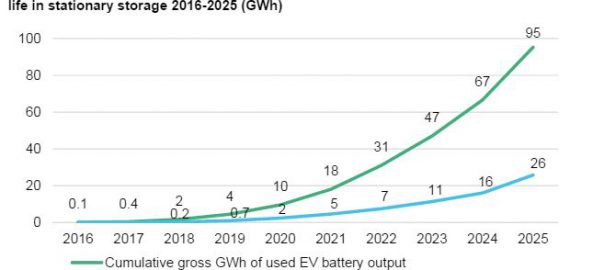
The electric vehicle market is set to grow quickly, but so far there has been no consensus on the ‘second-life’ of the used EV batteries.
In this report, senior analyst Claire Curry has compiled the first data and shows that low-cost energy storage could be here sooner than previously thought.
She projects:
There will be 29 GWh of used EV batteries coming out of cars in 2025. This far exceeds the size of the current stationary storage market.
Of this, almost a third will get a second life as stationary storage. (10GWh)
Today, a new stationary storage system can cost up to $1000/kWh. In contrast, repurposing used EV batteries could cost as little as $49/kWh in 2018, with an additional $400/kWh cost to convert to stationary.
The auto industry is divided on the issue. While Tesla won’t be involved in second life, BMW, Nissan and Mercedes Benz have second-life stationary storage projects in place.
Nuclear energy’s cost, and a focus on alternative technology, including research on a new generation of hi-tech battery storage, is leading observers outside the green lobby to question the project’s value
Should Theresa May take the axe to the troubled Hinkley Point nuclear project, it will propel wind and solar power further into the limelight. And for renewable technologies to become really effective, Britain and the rest of the world need breakthroughs in electricity storage to allow intermittent power to be on tap 24/7, on a large scale and for the right price.
Cheap, light and long-life batteries are the holy grail, and achieving this requires the expertise of people like Cambridge professor Clare Grey. The award winning Royal Society fellow is working on the basic science behind lithium-air batteries, which can store five times the energy in the same space as the current rechargeable lithium-ion batteries that are widely used today.
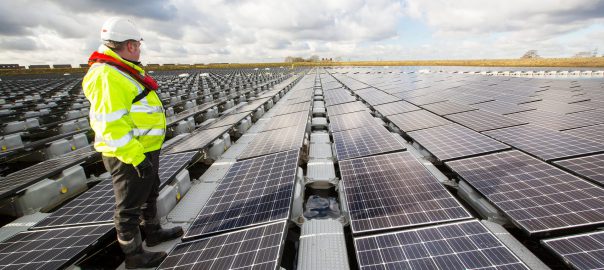
The floating solar farm on Godley Reservoir near Manchester (Image: A. Cooper/Guardian)
She is also focusing on sodium-ion and redox flow batteries; the latter store power in a liquid form, contained in vats or tanks that in theory can easily be scaled up to power-grid sizes.
“There has been an amazing transformation in this field. There is an explosion of interest and I am extremely lucky to have decided early on to concentrate on this area,”
she says, although she is keen to play down the idea that a eureka moment is just around the corner.
She is also thankful for Hinkley – if only because of the government’s long-term funding deal with EDF Energy that it gave rise to.
“It has put a price on [future] electricity in the market which is high, and this has potentially opened up further commercial space for new technologies such as batteries. But independent of Hinkley we do need better batteries and my chemistry will hopefully help find them,” she says.
The wisdom of bringing in the Chinese to help EDF, the French state-owned utility company, construct the proposed new Somerset reactors has been highlighted as a key factor behind the government’s reluctance to push the go button.
But ministers are also aware that, in the last 18 months, many experts in the field have concluded that the biggest argument against the plant is not that it is too expensive, at £18.5bn, but that the kind of “on-all-the-time” power it delivers is no longer what is required.