Small to medium sized wind turbines that could, given the right financial and planning environment, make an enormous impact in these Windy Islands.
And these are made in England.
More info: http://www.britwind.co.uk/
Small to medium sized wind turbines that could, given the right financial and planning environment, make an enormous impact in these Windy Islands.
And these are made in England.
More info: http://www.britwind.co.uk/

375 National Academy of Sciences members sign an open letter expressing frustration at political inaction on climate change

Yesterday, 375 of the world’s top scientists, including 30 Nobel Prize winners, published an open letter regarding climate change. In the letter, the scientists report that the evidence is clear: humans are causing climate change. We are now observing climate change and its affect across the globe. The seas are rising, the oceans are warming, the lower atmosphere is warming, the land is warming, ice is melting, rainfall patterns are changing and the ocean is becoming more acidic.
These facts are incontrovertible. No reputable scientist disputes them. It is the truth.
Despite these facts, the letter reports that the US presidential campaign has seen claims that the earth isn’t warming, or it is only a natural warming, or that climate change is a hoax. These claims are false. The claims are made by politicians or real estate developers with no scientific experience. These people who deny the reality of climate change are not scientists.
These claims aren’t new. We see them every election cycle. In fact, for the Republican Party, they are a virtual litmus test for electability. It is terribly sad that the party of Lincoln (the president who initiated the National Academy of Sciences) has been rebuked by the National Academy today. It is sad that the party of Teddy Roosevelt, who created the National Park System, is acting in a way antithetical to his legacy. It is also sad that the party of Nixon, who created the Environmental Protection Agency, now is trying to eliminate that very organization.
What is perhaps most sad is that the party of “fiscal conservatism” is leading us on a path that will result in higher economic and social costs for all of us.
What we don’t know is what the future will bring. Will the warming be gradual or sudden? Will ocean rise increase at a faster rate or not? Will we continue to see major ice shelf collapse? Increased droughts and heat waves? Will we be able to adapt?
Read more: The Guardian
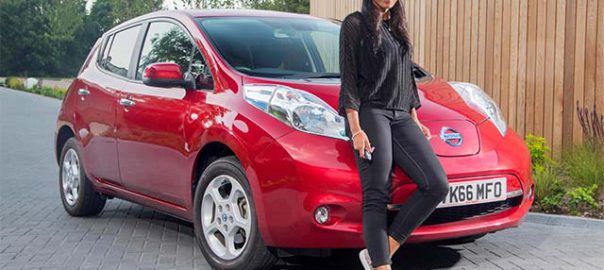
More than three quarters of millennials (76 percent) consider driving an eco-friendly car as the best choice to make their lives more environmentally friendly, according to a Nissan European study investigating millennials’ attitudes towards electric and hybrid vehicles.
Revealed exclusively by Gareth Dunsmore, Nissan’s Director of Electric Vehicles at FutureFest in London, the study probed the views of 2,500 European millennials (aged 18 to 34) across the UK, France, Italy, Germany, and Spain.

The study found that as a generation, millennials are willing to try new things, challenge processes, and think differently about the future. As such, the report showed that the environmental concerns of millennials aren’t smaller scale issues like recycling (24 percent) or overflowing landfills (14 percent) but global issues such as climate change (53 percent) and air pollution (42 percent). To help solve these issues, they are willing to make bold changes such as switching to an energy provider dedicated to eco-friendly solutions (62 percent), or supporting brands that are committed to being more environmentally friendly (53 percent).
Perhaps surprisingly, the majority of millennials surveyed owned a car (77 percent). Although they might not be driving electric vehicles now, they are in the market for future driving technology with over half saying they would buy an electric car in the next 10 years.
With a focus on Intelligent Mobility solutions that have an ultimate goal of zero emissions and zero fatalities, Nissan has been pioneering the pure electric vehicle market since the introduction of the 100 percent electric, zero emission Nissan LEAF in 2010. There are now more than 230,000 Nissan LEAFs on the road worldwide, securing it as the world’s best-selling EV. Nissan recently introduced the third generation model that delivers 26 percent more range versus the previous model, and up to 250 km of driving range on a single charge.
Gareth Dunsmore, Director of Electric Vehicles, Nissan Europe, said:
“We’ve always known that millennials are the challenger generation but our European study has also revealed that they’re the future ‘change-makers’ – willing to make drastic lifestyle choices to make a meaningful difference to the world they live in. It gives me immeasurable hope to see that millennials believe electric vehicles, such as the Nissan LEAF and e-NV200 that are already on the road today, are part of the solution for a more sustainable future. As an industry we must work harder to engage the interests and needs of this group.”
Source: Electric Cars Report
Watch Model S and Powerwall owner Clint outline the benefits of combining the Tesla Powerwall with solar and integrated software aggregation for control, savings and a change towards a more sustainable future.
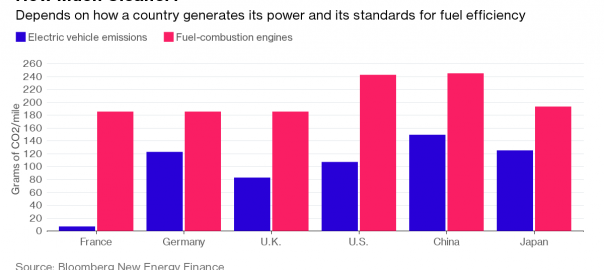
A new study of CO2 emissiosn per mile driven in both a regular and electric car to find out the average differences between countries has been undertaken by Bloomberg New Energy Finance

The indirect EV emissions put out are near-zero in countries like Norway and France, where (respectively) renewable energy sources, or nuclear, provides near clean electricity.
While in other countries, average CO2 emission differences obviously varies, but in general are still significantly lower taking into consideration the energy mix.
“The London-based research arm of Bloomberg LP and the Union of Concerned Scientists both have analyzed the ultimate contribution that electric cars make to emissions and found that on average they’re 40 percent to 50 percent cleaner than those that fuel from gasoline or diesel.
Those estimates — and the forward view on where emissions from the power generation industry are going — are crucial to understand how much global-warming pollution will come from transportation in the decades ahead.”
Source: Inside EVs
Diesel cars by Fiat, Suzuki and Renault among makers emitting up to fifteen times European standard for nitrogen oxide

A year on from the “Dieselgate” scandal that engulfed Volkswagen, damning new research reveals that all major diesel car brands, including Fiat, Vauxhall and Suzuki, are selling models that emit far higher levels of pollution than the shamed German carmaker.
The car industry has faced fierce scrutiny since the US government ordered Volkswagen to recall almost 500,000 cars in 2015 after discovering it had installed illegal software on its diesel vehicles to cheat emissions tests. But a new in-depth study by campaign group Transport & Environment (T&E) found not one brand complies with the latest “Euro 6” air pollution limits when driven on the road and that Volkswagen is far from being the worst offender.
“We’ve had this focus on Volkswagen as a ‘dirty carmaker’ but when you look at the emissions of other manufacturers you find there are no really clean carmakers,” says Greg Archer, clean vehicles director at T&E.
“Volkswagen is not the carmaker producing the diesel cars with highest nitrogen oxides emissions and the failure to investigate other companies brings disgrace on the European regulatory system.”
Read more: The Guardian
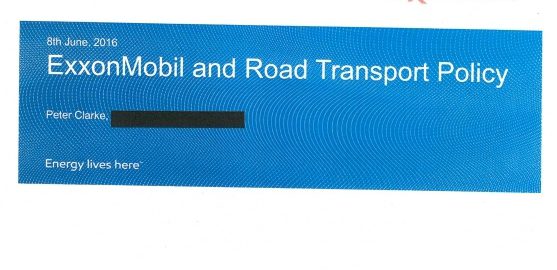
“Switching transportation from petroleum to renewable or alternative fuels is not the most cost-effective way to reduce GHG [greenhouse gas] emissions.”
This is the message that ExxonMobil has delivered to the UK Department for Transport (DfT) in three separate presentations since the Paris climate deal was agreed last December, reveal documents obtained by DeSmog UK.

Exxon appears to be the only major fossil fuel company currently heavily lobbying the British government against greener transport policies, according to the DfT’s response to DeSmog UK’s Freedom of Information (FOI) request.
The presentations by Exxon and correspondence between Peter Clarke, a director at Exxon, and the Department Secretary Patrick McLoughlin show the oil giant lobbying on biofuels, transport and carbon reduction, and the Fuels Quality Directive – all policy issues that impact the decarbonisation of our transport system and up-take of electric vehicles.
The document release comes as the government’s environmental audit committee warned the UK is “falling behind” on its electric vehicle targets.
The committee criticised ministers for failing to implement the proper incentives and infrastructure needed to encourage the growth of the sector. Increasing the number of electric vehicles is critical if the UK is to tackle both climate change and harmful air pollution.
Read more: DeSmog Blog
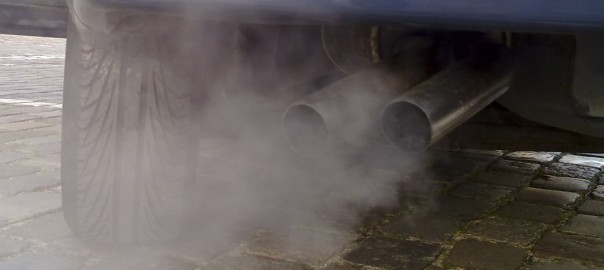
Renault, the French car maker, may stop offering diesel engines in most of its cars sold in Europe.

The move is a reaction to the cost of ensuring that diesel engines comply with tighter emissions regulations.
The crackdown follows last year’s diesel emissions scandal involving German car maker Volkswagen.
Renault’s move was reported by Reuters and has not yet been officially announced.
Senior Renault executive Thierry Bollore has said that tougher emissions standards and testing methods would make diesel engines uneconomic to make.
He told a meeting of Renault bosses in July that diesel engines had already been removed from the company’s smallest cars, such as the Twingo, even before the Volkswagen scandal.
By 2020, when more stringent EU emissions standards come into force, larger Renault cars such as the Clio and the Megane are unlikely to have diesel engine variants.
More than 60% of the 1.6 million cars Renault sold in Europe last year were diesels.
Volkswagen’s chief executive, Matthias Mueller, said in June that his company was now wondering
“whether it still makes sense to invest a lot of money in further developing diesel”.
Read more: BBC
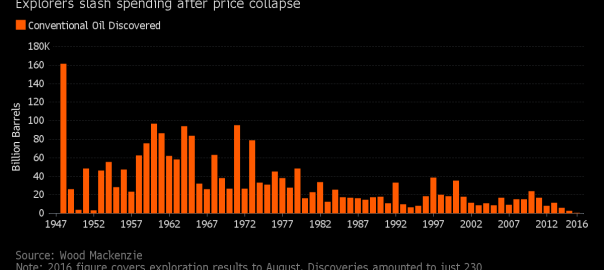
Explorers in 2015 discovered only about a tenth as much oil as they have annually on average since 1960. This year, they’ll probably find even less, spurring new fears about their ability to meet future demand.

With oil prices down by more than half since the price collapse two years ago, drillers have cut their exploration budgets to the bone. The result: Just 2.7 billion barrels of new supply was discovered in 2015, the smallest amount since 1947, according to figures from Edinburgh-based consulting firm Wood Mackenzie Ltd. This year, drillers found just 736 million barrels of conventional crude as of the end of last month.
That’s a concern for the industry at a time when the U.S. Energy Information Administration estimates that global oil demand will grow from 94.8 million barrels a day this year to 105.3 million barrels in 2026. While the U.S. shale boom could potentially make up the difference, prices locked in below $50 a barrel have undercut any substantial growth there.
New discoveries from conventional drilling, meanwhile, are “at rock bottom,” said Nils-Henrik Bjurstroem, a senior project manager at Oslo-based consultants Rystad Energy AS.
“There will definitely be a strong impact on oil and gas supply, and especially oil.”
Read more: Bloomberg

National review prompted by severe flooding in recent winters anticipates 20-30% more extreme downpours than before

The UK’s new flood defence plans anticipate significantly higher extreme rainfall, after new research was published as part of the government’s National Flood Resilience review.
The government, which had been criticised for not taking full account of the impact of climate change in driving up flood risk, will now plan for 20-30% more extreme downpours than before.
The review, prompted by severe flooding in recent winters, also found that 530 critical infrastructure sites, such as water and telecoms, are at serious risk from floods, each potentially affecting at least 10,000 people. Utility companies have pledged to have new protection in place by the end of the year.
The government’s official climate change advisers recently warned that flooding could cause a cascade of emergencies by knocking out energy, transport, water and communications links.
The review allocates £12.5m for more temporary defences, such as barriers and pumps, at strategic locations around the country. By this winter, the government said, four times more temporary barriers will be available.
“Last winter we saw just how devastating flooding can be. This review sets out clear actions so we are better prepared to respond quickly in the event of future flooding and can strengthen the nation’s flood defences,” said the environment secretary, Andrea Leadsom.
Ben Gummer, Cabinet Office minister, said:
“The government has made clear that we expect water and telecoms companies to work ever closer together to improve their preparation and response to flooding, making sure lifelines such as mobile phone masts and water treatment works continue to function.”
Bob Ward, policy director at the Grantham Research Institute on Climate Change at the London School of Economics and Political Science, said:
“This review was launched because the government was caught out by [recent] flooding. It deserves credit for admitting that ministers have previously misunderstood and significantly underestimated the probability of flooding.
“However, it is disappointing that the government chose to ignore surface water flooding during the review, even though it poses a threat to more properties in the UK than does coastal and river flooding.”
Read more: The Guardian