Category Archives: Energy and Climate Change

News and articles on climate change, vehicle pollution, and renewable energy.

Ubitricity Electric Avenue project lamppost charging (Image: Siemens)

Electric Vehicle Interest Surges 500% In UK On News Of 2030 Fossil Fuel Car Ban

2030 is a little more than 9 years away, but news of the UK’s plan to ban sales of new gas/diesel cars in 2030 has reportedly led to a surge in interest in electric vehicles (EVs).
Practically speaking, there’s one decent reason for that, but the core reason is probably just increased awareness that electric vehicles are becoming mainstream and will eventually take over the market — something that is extremely old news to CleanTechnica readers but still largely unknown to the broader public. Helping the public to learn that the future (the medium-term future even) is electric leads to many more people thinking about their existence and viability right now.

Among other things, this just shows the power of strong country targets.

According to BuyaCar.co.uk, electric vehicle inquiries increased by 500% following the news of the stronger timeline. The website, which has more than 60,000 cars available for sale, saw searches for electric cars rise from about 300 a day to “1,679 in the 24 hours following Boris Johnson’s announcement.” They represented 6.5% of vehicle searches in the previous 30 days, and then 10.3% in the day following the announcement from UK Prime Minister Boris Johnson.

UK plugin vehicle sales rose above 12% in October (6.6% fully electric/BEV share), and was above 9% in the first 10 months of 2020 (5.5% BEV share). If a five-fold increase in EV interest translated to a five-fold increase in plugin vehicle sales, we’d see rocket grow to around 50% of the UK’s auto market! Of course, a search surge in 24 hours after a major national announcement does not mean sales will follow the same surge in interest. However, it’s a good sign — growth in consumer exploration of the superior technology should lead to an increase in sales.

Ubitricity Electric Avenue project lamppost charging (Image: Siemens)

Also noteworthy, being a used vehicle site, BuyaCar.co.uk does not see the interest in electric vehicles that the new car market sees. The company shares that not even 1% of its 2020 sales of used cars were full electrics.

Naturally, electric vehicles benefit from instant torque, a completely smooth & quiet powertrain, zero emissions, a simple powertrain that results in very low cost operation and much less maintenance, and the glamor of new tech.

One of the biggest advantages of a good electric car is that it holds its value well — something demonstrated over and over again, especially when it comes to Tesla models. As noted at the top, there is also a practical reason for a surge in interest following the 2030 ban announcement — gas and diesel cars could really see high depreciation as we get closer to 2030. If someone wanted to avoid being stuck with a used fossil fuel vehicle that had depreciated a great deal, resulting in a high total cost of ownership, it seems that it would be smart to go electric sooner rather than later.

BuyaCar.co.uk focused on the fact that the vast majority of buyers are still buying diesel and petrol cars, especially on the used market. While the crew there may think it’s for logical reasons, I would argue that it’s mostly due to cultural inertia, psychological inertia, and limited availability. All of those barriers can be overcome rather swiftly, especially considering the pace of change in the new-car market. The good news is that people seem to have an increasingly open mind about the new powertrain (which isn’t actually new, but that’s a story for another day). Even the BuyaCar.co.uk team seemed open minded about the transition, despite being probably less optimistic about the growth potential than you or I am.

Read more: Clean Technica

It’s Time to Go Green!

If you would like to know more about Solar Panels and the PowerBanx range of home battery systems, and get a free instant quote, please complete our online form:

Charging Station in Sunderland (Image: Fastned)

Boris Johnson’s green plan brings ban on petrol cars forward to 2030 and promises UK’s first hydrogen-powered town

Boris Johnson has set out plans for green investment over the coming decade, including a target to generate enough offshore wind to power every home in the UK and a ban on new petrol and diesel cars and vans from 2030.

The prime minister’s long-awaited 10-point plan for a “green industrial revolution” also promised the UK’s first hydrogen-powered town, four carbon capture “clusters” to suck 10 megatons of carbon dioxide out of the atmosphere and a new generation of advanced nuclear reactors.

But green campaigners warned that the £12bn in public funding promised by Mr Johnson fell well short of the scale of ambition needed, while there was dismay at his inclusion of “pie-in-the-sky” plans for zero-emission jet planes.

The decision to bring forward by five years the phase-out date for polluting cars and vans – with new hybrids granted a stay of execution until 2035 – is designed to kick-start the electric vehicle (EV) market, which despite recent growth still accounts for just 7 per cent of the sector in the UK.

It was backed by new investment of £1.3bn to instal charge points in homes, streets and motorways across England in a bid to overcome consumer reluctance to adopt the cleaner technology.

Charging Station in Sunderland (Image: Fastned)

Environmentalists hailed the move as a breakthrough which Greenpeace said could “put the government back on track to meeting its climate commitment” of net-zero carbon emissions by 2050.

It puts pressure on other countries to follow suit ahead of the COP26 UN climate change summit hosted by the UK in Glasgow next year, and will send a signal to manufacturers to invest in production of greener models.

But the CBI warned the new target date was “undoubtedly challenging” and would require support for the automotive sector to adapt.

Coming as the PM attempts to “reset” his government following the fractious departure of aide Dominic Cummings, Mr Johnson’s plan aimed to target investment at former industrial heartlands in the Midlands, north of England, Scotland and Wales which he has promised to “level up” with the prosperous south.

The PM claimed the programme could create and support up to 250,000 high-skilled green jobs and leverage in more than £36bn in private sector investment over the next 10 years. He said: “Although this year has taken a very different path to the one we expected, I haven’t lost sight of our ambitious plans to level up across the country. My 10-point plan will create, support and protect hundreds of thousands of green jobs, whilst making strides towards net zero by 2050.

“Our green industrial revolution will be powered by the wind turbines of Scotland and the northeast, propelled by the electric vehicles made in the Midlands and advanced by the latest technologies developed in Wales, so we can look ahead to a more prosperous, greener future.”
But shadow business secretary Ed Miliband warned that the funding announced “doesn’t remotely meet the scale of what is needed to tackle the unemployment emergency and climate emergency we are facing”, paling in comparison to the tens of billions committed by France and Germany or the £30bn of capital investment in low-carbon sectors demanded by Labour over the next 18 months.

“Only a fraction of the funding announced today is new,” said Mr Miliband. “We don’t need rebadged funding pots and reheated pledges, but an ambitious plan that meets the scale of the task we are facing and – crucially – creates jobs now.”

And Green Party co-leader Jonathan Bartley said Mr Johnson should be aiming for billions more investment and millions of green jobs.

“Any action to address climate change is welcome, but this is nowhere near the scale or speed of what is needed,” he said. “This 10-point plan is essentially business as usual, with a few half-hearted measures and some wishful thinking about pie-in-the-sky technologies such as Jet Zero which don’t even exist yet.”

Read more: Independent

It’s Time to Go Green!

If you would like to know more about Solar Panels and the PowerBanx range of home battery systems, and get a free instant quote, please complete our online form:

2020 Renault Zoe (Image: Renault)

New petrol and diesel cars banned from sale after 2030 under government’s green plan

The plan also includes developing the first town heated entirely by hydrogen by the end of the decade.

New petrol and diesel cars will be banned from sale after 2030, the government has announced.
The ban had been planned for 2040 but has been brought forward under Boris Johnson’s 10-point plan to tackle climate change.

The plan also includes producing enough offshore wind to power every home, developing the first town heated entirely by hydrogen by the end of the decade, and developing the next generation of small and advanced nuclear reactors.

Currently fewer than 1% of cars on UK roads are powered entirely by electricity, so the prime minister’s plan to end the sale of new petrol and diesel cars will require an enormous investment in the infrastructure needed for electric vehicles.
Edmund King, president of the Automobile Association, told Sky News only about 6% of local authorities have installed on-street charging facilities in residential areas.
Without a commitment to developing the right infrastructure, the plan was “optimistic”, he said.

“Everyone wants to move to electric vehicles but you can’t just pick a date out of the air. We need better infrastructure particularly for the third of people who can’t charge at home.
“We also need a better supply of cars and they need to be affordable.”

2020 Renault Zoe (Image: Renault)

The prime minister claims that his plan for a green industrial revolution will create and support up to 250,000 British jobs.
The government says it will spend £12bn on the plan but analysts have told Sky News only £4bn of that is new money.
It includes £1.3bn to accelerate the roll-out of charge points for electric vehicles in homes, streets and on motorways across England.

Some £582m will help people afford zero or ultra-low emission vehicles and nearly £500m is to be spent in the next four years on the development and mass production of electric vehicle batteries.
The prime minister said: “Our green industrial revolution will be powered by the wind turbines of Scotland and the North East, propelled by the electric vehicles made in the Midlands and advanced by the latest technologies developed in Wales, so we can look ahead to a more prosperous, greener future.”
And Business Secretary Alok Sharma told Sky News’ Kay Burley: “This is a package which is part of turbocharging the green industrial revolution, levelling up across our country.
“It is £12bn of public money which will then leverage in three times as much from the private sector and, of course, support and create high-value added jobs – around 250,000 jobs by 2030.
“If you look at the UK, we are a leader when it comes to green growth.
“Since 1990 we have managed to grow our economy by 75% and at the same time cut our emissions by 43%, so we are world-leading in this area.”

Labour said the announcement fell short of what is required, but the independent Committee on Climate Change, which advises the government how to get to net zero, has welcomed the plan.
Chris Stark, chief executive of the Committee on Climate Change, said the prime minister’s plan was “a bold statement of ambition” but added: “What’s missing is the road map to achieving it.”

Read more: Sky News

It’s Time to Go Green!

If you would like to know more about Solar Panels and the PowerBanx range of home battery systems, and get a free instant quote, please complete our online form:
Ubitricity Electric Avenue project lamppost charging (Image: Siemens)

Electric car jargon buster:

Do you know your mild hybrid from your PHEV ahead of the accelerated ban on sale of new petrol and diesel motors from 2030?

Boris Johnson has confirmed a new deadline for the ban on sale of new petrol, diesel and hybrid cars in 2030
Some hybrids will be on sale longer, with a later ban on new models from 2035
We outline the differences between electric and hybrids cars and when they will likely disappear from showrooms

The ban on the sale of petrol, diesel and hybrid cars has been accelerated.

All new cars with internal combustion engines will be prohibited from sale in 2030, while new hybrid vehicles than can, in the words of Boris Johnson, ‘drive a significant distance without emitting carbon’ will be removed from showrooms five years later in 2035.

With many different types of hybrid cars and a swirling of acronyms being used across the sector, here’s an easy guide and jargon buster to help you through the minefield of electric vehicle terms and which motors will be banned and when…

Ubitricity Electric Avenue project lamppost charging (Image: Siemens)

Battery Electric Vehicle (BEV)
Also referred to as: Electric Vehicle (EV), pure electric, fully electric
Banned in: Never
Example models: Tesla Model 3, Volkswagen ID.3, Nissan Leaf, Jaguar I-Pace, Audi e-tron.
Battery Electric Vehicles are those that are entirely powered by a battery and electric motors 100 per cent of time.
The vehicle itself produces zero emissions, has no fuel tank, no exhaust pipe and no internal combustion engine whatsoever.

All BEVs need to be plugged in to have the batteries replenished, which in most modern examples are packs built into the car’s floor.
Recharging takes considerably longer than refuelling a conventional vehicle, though improvements to infrastructure means you can get up to 80 per cent charge in around half an hour in the best-performing models.
There are considered the greenest type of car, though many question the environmental impact of battery sourcing and manufacturing as well as the production of electricity.
MPs want to encourage drivers to use BEVs, which is why it has scheduled a ban on sale of other car types to speed up the transition to electric vehicles.

Plug-in Hybrid Electric Vehicle (PHEV)
Also referred to as: Plug-in hybrids
Banned in: 2035
Example models: Ford Kuga PHEV, Mitsubishi Outlander PHEV, Volkswagen Golf GTE, BMW 330e, Peugeot 508 PHEV.

Plug-in Hybrids are seen as the stepping stone between petrol and diesel cars we’ve always known and battery electric vehicles.
They use an internal combustion engine – usually petrol – and an onboard battery and electric motor(s).
The battery can be charged to full capacity by plugging the vehicle into the mains or a charging device, though these cars also have energy regenerating brakes and systems that help to trickle a little extra capacity to the battery on the move.
The battery pack is not as large as that in a BEV, though when fully charged can provide anywhere between 25 and 55 miles of range using just electric power and the petrol or diesel engine not having to be used.
When the Prime Minister says ‘hybrid vehicles than can drive a significant distance without emitting carbon’ will be on sale until 2035, these are the models he is most likely referring to.
Charging times are shorter than BEVs, too.

Read more: This Is Money

It’s Time to Go Green!

If you would like to know more about Solar Panels and the PowerBanx range of home battery systems, and get a free instant quote, please complete our online form:

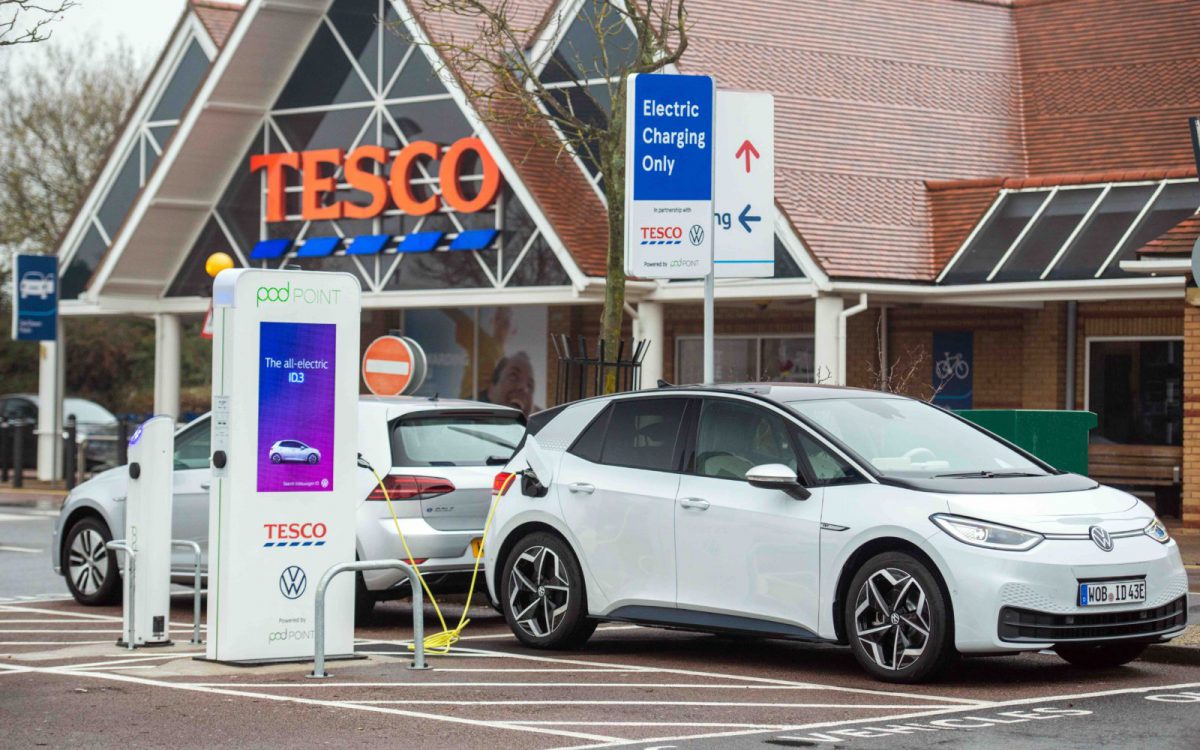
POD Point Rollout at Tesco Stores (Image: Tesco/POD Point)

What Biden’s environmental plans mean for electric vehicles

The Green New Deal has received a lot of attention since it was introduced in the U.S. House of Representatives in early 2019. But how many people have actually read it and know what’s in it?

The bill isn’t long, as bills go, but it’s dense. I’ve tried to pull out the main points below. You can read the complete text of the bill here.

President-elect Joe Biden has a lengthy description of his ambitious climate plan on his website. It’s based on the Green New Deal and contains many specific proposals. I walk you through it below.

In the interests of space and clarity, I am using an outline format with bullet points in some parts of this post.

The Green New Deal
The Green New Deal, H.RES.109, is not a law—It’s a framework for dealing with the climate crisis while also boosting job creation and addressing systemic racism and discrimination. It was named in the spirit of President Roosevelt’s New Deal, which helped pull America out of the Great Depression in the 1930s. It also is meant to reflect the efforts and sacrifices that the United States made during World War II.

On February 7, 2019, Representative Alexandria Ocasio-Cortez, the bill’s sponsor, introduced the Green New Deal in the U.S. House of Representatives of the 116th Congress, 1st Session, along with 68 other cosigners.

To back up its climate change proposals, the bill references the October 2018 Special Report on Global Warming of 1.5 degrees by the UN’s Intergovernmental Panel on Climate Change and the November 2018 Fourth National Climate Assessment Report.

POD Point Rollout at Tesco Stores (Image: Tesco/POD Point)

The reasons given for presenting the bill were:

Human activity is the dominant cause of climate change.
Climate change leads to many catastrophic results, including sea level rise, wildfires, storms, droughts.
Global warming more than two degrees Celsius will create even greater issues, such as mass migrations, lost economic output, destruction of coral reefs and damage to infrastructure.
The stated climate goal is to keep global temperature rise below 1.5 degrees C. This means reducing greenhouse gases by 40 to 60 percent by 2030 with the longer-term goal of net zero global emissions by 2050. These numbers reflect the latest scientific consensus and commitments now being made by large corporations and other nations, as built into the Paris Climate Accord of 2015. The United States is officially out of the Paris Agreement as of November 4, 2020, but will presumably re-enter it next year under a Biden presidency.

The actions described in the Green New Deal would commit the United States, a major emitter, to taking a leading role in fighting climate change. It lays out a 10-year plan to achieve net-zero greenhouse gas emissions through a “fair and just” transition, creating millions of good new jobs building a sustainable infrastructure and industries, as well as securing clean air and water, climate resiliency, healthy food, access to nature and a sustainable environment.

The Green New Deal also promotes justice and equity for people of colour, indigenous communities, migrant communities, deindustrialize communities, depopulated rural communities, the poor, low-income communities, women, the elderly, the unhoused, disabled and youth.

Climate action goals
The bill contains a long menu of goals and tasks, but the main ones for climate action include:

Building climate change resiliency against disasters
Repairing U.S infrastructure
Moving to 100 percent clean, renewable, zero-emission power, including smart power grids
Upgrading existing buildings
Growing clean manufacturing
Working with farmers and ranchers to remove pollution and greenhouse gases
Overhauling transportation systems to remove pollution and greenhouse gases
Mitigating and managing the effects of climate change
Removing greenhouse gases from the atmosphere and restoring natural ecosystems
Cleaning up hazardous waste
Sharing technology, products, and services with other countries
Protecting public lands, water and oceans

Read more: The Next Web

It’s Time to Go Green!

If you would like to know more about Solar Panels and the PowerBanx range of home battery systems, and get a free instant quote, please complete our online form:

Government ‘no longer has any excuses’ as analysis shows 2030 ICE ban could create 32k jobs

Bringing in a 2030 ban on the sale of new petrol and diesel vehicles could create 32,000 new jobs and increase GDP by 0.2%, equivalent to £4.2 billion.

This is according to a new report written by Cambridge Econometrics, supported by Element Energy and on behalf of Greenpeace.

The report used the Department for Transport’s transport model and a macroeconomic model to assess impact of a faster transition.

Under both the 2030 and 2035 scenarios analysed, electric vehicle (EV) adoption undergoes “a rapid increase”, however with a 2035 ban only 60% of the new car market would be made up of EVs compared to almost 100% with the 2030 ban. This results in there being almost 6.5 million more zero emissions vehicles on the road by 2040.

To support a 2030 phase-out date, Greenpeace is calling for additional policies that deliver a network of sufficient charging infrastructure across the whole of the UK, as well as for a zero emissions vehicle mandate to be introduced that sets bindings targets for manufacturers to increase sales of EVs.

The majority of the 32,000 jobs that would be created by 2030 would be in the service industries, such as retail, entertainment and leisure although jobs would also be created in energy, battery manufacturing and the rollout of EV charging infrastructure.

The increased economic activity – also by 2030 – comes as a result of lower costs of owning and running an EV, lower demand for imported oil and its replacement by UK-generated electricity, meaning have increased disposable income and spending is reallocated, frequently towards industries that are currently struggling under COVID-19 restrictions, the report said.

“The government no longer has any excuses. We need a firm commitment to ban new polluting cars and vans by 2030, along with an active industrial strategy to boost manufacturing and support re-skilling, so workers can benefit from new jobs that will be created across the economy,” Doug Parr, UK policy director at Greenpeace, said.

“The rewards are there for the taking. It’s time for the Prime Minister to plug in and put electric vehicles on a fast track to 2030.”

The report comes after the government consulted on bringing the date forward to 2035 or sooner if feasible, with Greenpeace stating it expects a decision to be made on this in an announcement from the Prime Minister Boris Johnson on Thursday 12 November.

Last week, the UK’s four biggest vehicle fleet operators – Centrica, DPD UK, Royal Mail and BT and Openreach – joined the calls for a 2030 ban as part of the UK Electric Fleets Coalition.

Read more: CURRENT

To Save the Planet, Get More EVs Into Used Car Lots

To reduce carbon emissions, electric vehicles need to stay on the road as long as possible. That means developing a robust trade in secondhand cars.

ELECTRIC VEHICLES ARE getting more popular. Now they’re getting flashy too: new electric pickup trucks, new electric semis, new electric sports cars, a new electric G-Wagen.

But all that zippy sexiness only matters to a small slice of the US. Seventy percent of the vehicles sold in the country last year were used, according to data from Edmunds. So when Americans go electric, most will do it in a used vehicle.

There’s more than thrift involved. “If we’re serious about meeting climate change goals, we need to get rid of every internal combustion engine in the next 15 to 20 years,” says Ryan Sclar, who researches electric mobility at the World Resources Institute. “We’re not going to get there without utilizing the used market.” It’s critical, he says, that electric vehicles stay on the road as long as possible—no matter how many times the keys change hands.

Until now, though, there hasn’t been much of a market for used electric vehicles. For one, there haven’t been many used electric vehicles to buy. EVs didn’t reach even 1 percent of US vehicle sales until 2017. If you’re looking for an older EV, the pickings can be slim.

But there wasn’t much demand for used electrics, either. Most new EVs were leased, and when the leases expired, dealerships complained that they languished on the lot. The anxiety about range that afflicts new-car shoppers affects used shoppers too—but worse, as prospective buyers fret that the expensive batteries inside the vehicles might degrade all at once. The first generation of electric vehicles had a reputation for poor performance. That stuck around for a while.

“The notion was that someday this battery—this giant, expensive battery—is going to die for good, and that the owner is going to be on the hook for the replacement,” says Joe Wiesenfelder, executive editor at the online car marketplace Cars.com. “People were very afraid that a used car was much closer to the graveyard in ways internal combustion engine cars weren’t. But that was a false assumption on a lot of people’s parts.”

Now, more capable electric vehicles, with ranges exceeding 100 miles, are making their way to used car lots, like BMW i3s, Nissan Leafs, and Volkswagen E-Golfs from 2014 and later. As the market develops, some say it’s not too early to think about ways to support it.

The electric market may be like a flywheel: Get it spinning and you won’t have to worry about keeping it spinning. “Will a lot of the concerns and barriers to entry on electric vehicles erode in the next three to five years? Absolutely,” says Karl Brauer, an executive analyst at the vehicle research company iSeeCars.com. “It’s just kind of an inevitable trend.”

Ranges for new vehicles keep increasing, and batteries (which cost upwards of $5,000 to replace) have not degraded in the way some folks had feared. Some of the EV-curious also seem to be realizing that they don’t need an expensive car with a 300-mile range to get through their daily routines, especially if they have another car for longer trips.

Omar Islam got interested in electric vehicles because of Tesla, but he knew he couldn’t afford one. So he purchased a used 2013 Nissan Leaf two years ago. When the car was new—and cost $36,000—its range maxed out at 75 miles; by the time Islam bought it off Craigslist for $6,000, it got 69 to 71 miles per charge. That was more than enough for his daily driving around Marietta, Georgia, where he lives. He adored the car—until a collision took it out of service. “If I had the funds, I would buy that same car all over again,” he says.

Today, those like Islam interested in used EVs can generally find a good deal—in part, for the reason that makes some in the electric vehicle industry nervous. Thus far, electric vehicles have depreciated pretty quickly. (The exception is Tesla; its luxury cars tend to hold their value better.) If you don’t think you’ll be able to sell your car at a good price, you might not buy one to begin with. “The used car market is critical for the adoption of new cars,” says Gil Tal, who directs the Plug-in Hybrid & Electric Vehicle Research Center at UC Davis.

Tal has done research on buyers of used electrics in California, which suggests that they’re likelier to have lower incomes and rent their homes than the folks who are buying the cars new. Other research, led by University of Washington civil and environmental engineering professor Don MacKenzie, finds used EV buyers are likelier to be what they call “garage orphans”—people who park on the street or in a parking lot, making it harder to charge the car. That raises questions about the infrastructure needed to support them, such as public charging stations.

A federal program that for years handed out $7,500 in subsidies to battery electric buyers does not apply to used cars (it is now winding down), and many state subsidies only apply to new EVs. Now California, the nationwide leader in all things electric vehicle, has started to think about creative ways to help out the used car market, and potential used EV buyers. One two-year-old program offers grants and financing to low- and moderate-income drivers—for a family of four, those with annual incomes up to $105,000—to help them purchase or lease EVs, including used ones. Another, in the works but not yet funded, could finance battery or fuel cell replacements in cars that are past their prime.

Read more: Wired

It’s Time to Go Green!

If you would like to know more about Solar Panels and the PowerBanx range of home battery systems, and get a free instant quote, please complete our online form:

Ubitricity Electric Avenue project lamppost charging (Image: Siemens)

‘No deal’ Brexit will increase price of electric vehicles

A ‘no deal’ Brexit will increase the price of electric vehicles in the UK, warns the Society of Motor Manufacturers and Traders (SMMT).

The SMMT has warned that a no-deal Brexit would be the worst possible outcome for the UK’s automotive industry.

The UK and EU automotive industries are deeply integrated, with around two-thirds of all battery-electric cars on sale in the UK built in European factories.

According to the organisation, the immediate imposition of blanket tariffs under World Trade Organisation (WTO) rules would add billions to the cost of trade and, crucially, to the cost of building and buying electric vehicles.

Ubitricity Electric Avenue project lamppost charging (Image: Siemens)

The 10% no-deal WTO tariff would add at least £4.5bn to the annual cost of fully assembled cars traded between the UK and the EU, with an average increase of £1,900 per EU-built vehicle sold in the UK.

For electric vehicles the cost increase is even higher, at £2,800, effectively making the £3,000 plug-in car grant for these vehicles pointless.

The tariff would also add around £2,000 to the average cost of UK-built battery electric cars (BEV) exported to the EU, making the UK’s products less competitive and attractive.

The organisation has said this would further hamper the UK’s ambition to become a global leader in zero-emission vehicle development, production and deployment.

UK car buyers are expected to register 78,000 EVs this year, however, SMMT has estimated that the price shock caused by these tariff increases could reduce the increased demand next year by at least 20%.

Mike Hawes, SMMT Chief Executive, said: ‘Just as the automotive industry is accelerating the introduction of the latest electrified vehicles, it faces the double whammy of a coronavirus second wave and the possibility of leaving the EU without a deal.

‘As these figures show, ‘no deal’ tariffs will put the brakes on the UK’s green recovery, hampering progress towards net zero and threatening the future of the UK industry.

‘To secure a truly sustainable future, we need our government to underpin industry’s investment in electric vehicle technology by pursuing an ambitious trade deal that is free from tariffs, recognises the importance of batteries in future vehicle production and ensures consumers have a choice in accessing the latest zero-emission models. We urge all parties to re-engage in talks and reach an agreement without delay.’

Read more: Air Quality News

It’s Time to Go Green!

If you would like to know more about Solar Panels and the PowerBanx range of home battery systems, and get a free instant quote, please complete our online form:

Dacia Spring 2021 (Image: Dacia.co.uk)

New 2021 Dacia Spring revealed as Europe’s cheapest electric car

The Dacia Spring will take on electric city car rivals like the SEAT Mii Electric with a sub-£20,000 asking price

This is the Dacia Spring. When orders open in spring 2021, it’s set to become the cheapest new electric car available to buy in Europe. That means it’ll undercut the SEAT Mii Electric, which is priced at £19,800.

The styling is near-identical to the Spring Electric concept car first shown back in March – itself related closely to the Renault Kwid sold in India. That means the city car shape is bulked up with some SUV styling cues like chunky wheel arch cladding, roof rails and an above-average ground clearance.

The charge port is hidden behind a panel in a flush front grille, which is flanked by twin headlamp units with a slim LED lighting signature. The wheels look like alloy items, but are actually pressed steel. Launch versions of the Spring get a contrasting orange finish for the door mirrors, roof bars and trim beneath the front grille.

Dacia Spring 2021 (Image: Dacia.co.uk)

Despite the SUV look, the Spring’s proportions are appropriate for urban driving: at 3,734mm long and 1,622 mm wide, it’s just marginally longer and wider than a Volkswagen up!, and much more compact than a typical supermini.

Dacia claims plenty of space inside the spring, with even the rear seats being accommodating enough for two adults. The glovebox, door pockets and a central storage box provide 23.1 litres of storage for front occupants, with further door cubbies in the back, too. For more substantial storage, the Spring gets a 300 litre boot – well above average for the city car segment.

Up front, the functional dashboard is lifted from the Renault Kwid. There’s blue trim highlights on the doors and air vent surrounds, while an optional seven-inch touchscreen multimedia system, available with a reversing camera, Apple CarPlay and Android Auto, sits below the centre vents. Also among the extra-cost features are air conditioning, electric door mirrors and a full-size spare wheel, while all-round electric windows, central locking and a 3.5-inch digital display between the dials are all standard.

Under the skin, Dacia has equipped the Spring with a 43bhp electric motor with 125Nm of torque. It’s paired with a 26.8kWh battery, which according to official WLTP testing allows for a range of 140 miles on a single charge – though this could increase to 183 miles in the type of urban driving it’s designed to do. No acceleration figures have been released, but Dacia states a top speed of 78mph.

More relevant to urban driving than its top speed is its manoeuvrability, an area where the Spring promises to excel. A turning radius of 4.8 metres is only 20cm greater than that of a Honda e, and should ensure that it’s very easy to park.

The Spring will offer DC charging as an option – 30kW charger tops the battery to 80 percent in under an hour. A 7.4kW wallbox fully replenishes the Spring in five hours, a 3.7kW archives the same in 8h30, and it takes 14 hours to top up through a standard plug.

Dacia will also offer a smartphone app which allows users to monitor charging status from their mobile device, locate the car in real time, and pre-heat or cool the car in vehicles equipped with air conditioning.

Read more: AutoExpress

BMW i3 and i3S 120Ah (Image: BMW Group)

Retired batteries stripped from high-mileage electric BMWs and Minis to be used in a mobile charging station for other plug-in vehicles

One of the biggest concerns about electric cars is what happens to the batteries
They are historically difficult to recycle and could result in waste mountains . BMW UK has partnered with Off Grid Energy to provide second-life solutions for batteries decommissioned from its electric cars. Batteries are being used by the energy storage firm for mobile charging stations. Prototype device has been built using lithium-ion modules from a Mini Electric.

One of the biggest criticisms of electric cars is what happens to their high-powered batteries once they degrade and have to be decommissioned from plug-in vehicles.

Not only are EV batteries expensive for owners to replace, high-skilled workforces are required to extract valuable metals inside them, and even then they are difficult to recycle – and this could lead to huge waste mountains, experts have warned.

German car maker BMW says it has found a resolution for its high-mileage electric vehicles, giving their batteries a second-life use as mobile power units to provide charging solutions for other plug-in cars.

BMW i3 and i3S 120Ah (Image: BMW Group)

The auto brand will supply a British energy storage firm with decommissioned battery modules from electric BMW and Mini models that can be used in mobile power units.

The aim is to provide a sustainable second-use model for the batteries, which lose capacity over time and after years of use are deemed no longer efficient for electric cars.

As part of a new partnership with the car giant, Off Grid Energy has produced its first prototype mobile charging device, which is powered by lithium-ion battery modules extracted from a Mini Electric development vehicle.

It has a 40kWh capacity delivering a 7.2kW fast charge and will be used at BMW and Mini UK events over the next year.

As more battery modules become available over time, it says it can produce combined systems with a capacity of up to 180kWh from multiple electric vehicle batteries, which will be able to provide charges at rates of up to 50kW.

‘When these units are used to displace conventional ways of generating temporary power, the battery modules will at least double the CO2 reduction achieved in their original use in the car, continuing their positive impact in reducing carbon emissions,’ says the energy storage company.

Commenting on the partnership, Graeme Grieve, ceo at BMW Group UK, said: ‘BMW Group will have 25 electrified models on the roads by 2023 – half of them fully electric.

‘We are delighted to work with Off Grid Energy to find a sustainable way of continuing to use these valuable batteries, even after they have put in many years of service in our electrified cars.’

Like many electric models on the market, batteries in BMW and Mini cars have a warranty of eight years or 100,000 miles.

After this period the battery could still retain up to 80 per cent of its initial capacity, according to the vehicle maker.

However, it concedes that it is ‘inevitable’ that as EVs get older their batteries will no longer function at an optimum level for the car.

According to battery degradation calculations by Canadian firm Geotab, the average capacity loss for electric and plug-in hybrid cars is an estimated 12 per cent after six years – essentially dropping 2 per cent capacity annually.

BMW says despite its car batteries declining in performance – significant enough to retire the unit from a vehicle – it can continue to serve a secondary use purpose as a mobile power source as part of its sustainability and resource efficiency strategy.

BMW Group ceo, Oliver Zipse, said: ‘How we use resources will decide the future of our society – and of the BMW Group. As a premium car company, it is our ambition to lead the way in sustainability. That is why we are taking responsibility here and now.’

Earlier this year, Warwick University announced it had created a ‘fast grading’ system for second-life car batteries to determine if they could be purposed after being decommissioned from vehicles, using Nissan Leaf EV power supplies for the study.

If the battery’s end of life capacity is less than 70 per cent, the report says they can be reused for less demanding second life applications such as domestic and industrial energy storage.

The university said: ‘Graded second-life battery packs can provide reliable and convenient energy storage options to a range of customers: from electric roaming products – providing electricity for customers on the move, to home storage products – enabling customers with solar panels to store their energy generated.

‘More crucially, the packs can be used for storage allowing increased intermittent renewable energy sources on the grid, without putting security of supply at risk.’

Professor David Greenwood from WMG, University of Warwick, added: ‘Automotive batteries deliver some great environmental benefits, but they consume a lot of resources in doing so.

‘Opening up a second life for batteries improves both the environmental and the economic value we draw from those resources before they need recycling.’

Read more: This Is Money

It’s Time to Go Green!

If you would like to know more about Solar Panels and the PowerBanx range of home battery systems, and get a free instant quote, please complete our online form: