Category Archives: Oil

G7 leaders in Krun, Germany (Image: White House/P. Souza)

End of fossil fuel use on horizon

Finally the G7 world leaders are waking up to what needs to be done

(From 13 June) This past week, the Group of Seven (G7) world leaders met in Germany for the group’s 41st annual summit.

Needless to say, much was discussed, from the threat of international terrorism to the stability of national economies and, of course, climate change.

G7 leaders in Krun, Germany (Image: White House/P. Souza)

In relation to that final point, the leaders made an ambitious declaration.

The group’s members will use their collective influence to try to stop fossil-fuel consumption by the end of this century.

A goal of reducing consumption by 40 to 70 percent from 2010 levels by 2050, and eliminating it completely by 2100, was set in the summit declaration.

The G7 comprises the world’s seven largest economies–including Canada, France, Germany, Italy, Japan, the U.S., and U.K.–as well as representatives from the European Council, EU Commission, and the International Monetary Fund (IMF).

Read more: Green Car Reports
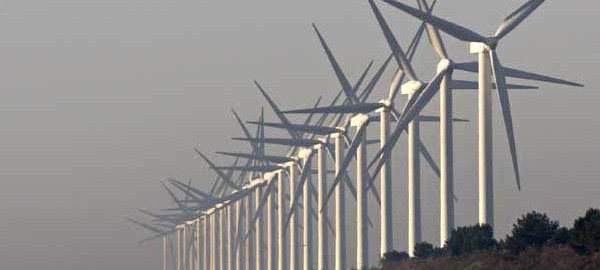
Wind farm in Europe (Image: EV World)

Renewable Energy reaches the end of the beginning?

A positive view of renewables from an oil publication

In April, 2010, BP took the front page, and held it for months, as it struggled to plug the blowout on the bottom of the Gulf of Mexico that would cough up 3 or 4 million barrels.

The Deepwater Horizon disaster was a bitter reminder of the coming difficulties and risk involved in getting what is left of the world’s oil reserves up and out of places that are a lot harder to get at – deep sea, where pressures are extreme; the arctic, where conditions are even more challenging; tar sands, the poster child for too much carbon; and in thousands of small, disparate patches, where ‘tight oil’ comes from driving water, sand and a few chemicals into fissures miles underground. In the U.S., these wells average around 100 barrels a day (see chart below). Herding cats does not seem a likely way to make the U.S. the swing producer to knock Saudi Arabia off its perch.

Things got harder for explorers as 2014 came to an end, and the price of Brent, the international benchmark, was well on its way to a total 61 percent fall in under 12 months. The question is not so much whether the price of oil will be high enough to get the next trillion barrels out of the ground (roughly the current world rate of consumption for another 30 years); it is whether or not the climate can “afford” to have that happen. Peak oil, whether from insufficient supply or demand, makes for an interesting cocktail party discussion. It has even become a political litmus test. However, it is largely irrelevant. Sheik Yamani’s dictum, that the Stone Age did not end because we ran out of stones, should not be dismissed.

Read more: Oil Price

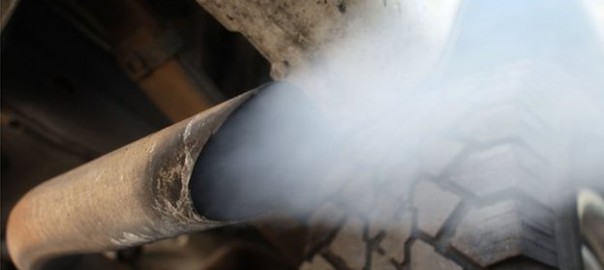
Car exhaust (Image: BBC)

Diesel cars may get pollution penalty from 2016

This sounds like good news for London’s pollution problem, and for electric car sales

DRIVERS OF diesel cars could be hit with a “pollution penalty” every time they enter London from as early as next year in an attempt to clean up the capital’s air quality.

The charge would be the first of its kind in Britain and comes after new evidence revealed that diesel cars are far more polluting than official figures suggest. A Sunday Times investigation last month found that even diesel cars certified under EU rules as the cleanest yet built are emitting exhaust fumes at up to 9.9 times the official limit.

Diesel cars have traditionally been more fuel-efficient than petrol counterparts but produce higher levels of particulates and nitrogen oxides, which are thought to contribute to respiratory illness and have been blamed for more than 50,000 early deaths in Britain each year.

As previously reported in Driving, London is currently in breach of EU air-pollution rules and the government must submit new air-quality plans to the European Commission by the end of the year or face mounting fines for failing to hit its targets.

Members of the London assembly passed a motion last week calling on the capital’s mayor, Boris Johnson, to investigate new ways of bringing down the city’s pollution levels.

The Liberal Democrat assembly member Stephen Knight said:

“To help tackle the problem, every tool in the public policy toolbox needs to be used, and one option that could be investigated is adapting the congestion charge to add a modest levy on all diesel vehicles entering central London from 2016.”

Source: Driving

Fossil fuels still going in 2100

Some rather controversial views on fossil fuel usage – not just as a fuel – and particularly on carbon capture; it makes depressing reading

The most powerful leaders in the West used the G7 summit in Germany to make a big statement on the environment. Their stated goal is to cut carbon emissions by 40% to 70% by 2050 and then end all fossil-fuel use by 2100. They announced a US$100bn (£65bn) fund by 2020 comprising public and private money to help smooth the transition. My response to David Cameron, Angela Merkel and the rest is pretty simple: good luck with that.

When people talk about decarbonisation, they tend to make the mistake of thinking about energy only in terms of electricity. If you ask how to wean us from fossil fuels, they will say build more solar power, more wind farms and so forth. There are several problems with this. We are already struggling with capacity on the grid and have a huge task to add as much renewable energy as it can cope with. To cover the extra requirements to make heat and domestic transport electric, we would need five times more. I don’t know anyone who thinks this is remotely realistic.

Because most forms of renewable energy only work when the power source is available, be it wind, sun or whatever, we will need large amounts of storage capability to allow them to replace electricity powered by fossil fuels. And while it’s easy to see how you can store kilowatts and megawatts of green power in the batteries of the future, getting up to gigawatts is another matter. The huge engineering requirement makes it almost impossible to get the costs to a point where this is viable.

Electricity is also the least of the big drains on energy. The big challenges are transport fuels, especially for long-distance haulage and trans-ocean shipping. We really don’t have any smart ideas for replacing diesel for these yet, and it’s difficult to see where they will come from. The Royal Academy of Engineering did a study in 2013 looking at the options for low-carbon fuelling of shipping. The best it could come up with was LNG (liquefied natural gas).

You can conceive of running large numbers of domestic cars on green electricity by charging them on the grid. But the idea that anybody is going to be able to produce a battery big enough to store the electricity to power a passenger aircraft or a major container ship is laughable.

Read more: The Conversation

Electric cars take over the market

A view on electric vehicles taking over – possibly a pessimistic one?

What would the world look like if electric cars took the lead in market share by 2030? “Couldn’t happen,” you say?

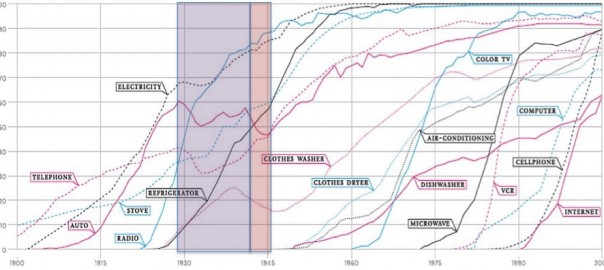
Consider the ramping up of some of the most basic items that have conquered the American market over the past century. Refrigerators went from a luxury item to 60 percent household penetration during the Depression and World War II. Technologies we used to live without including PCs, the Internet, and cell phones have become an integral part of daily life.

Once a breakthrough gets its footing, the rise to mainstream requirement is meteoric and, for reasons unknown (Copernicus has yet to weigh in), the rocket burn lasts about 15 years as the chart above indicates. Trace the rise of both electricity and automobiles. Radios had the sharpest rise of all, which may be why the 1920s were known as the Radio Days. Since the war, color TVs, microwaves, VCRs, PCs, the Internet and cellphones have all caught on as fast as radio. The air-conditioning vector appears to have been bent by the oil embargo in 1973. Auto production sputtered and coughed during the Depression, and throughout the war years, as factories churned out tanks and airplanes. It is not a coincidence that when the stock market peaked in 1929, auto production did too; neither would exceed the 1929 level until 1953.

We are about to find out if electric vehicles can make their mark and become mainstream. The launch sequence and liftoff phase (now barely underway) will soon reveal the extent of their fuel supply, i.e. How much interest will consumers have in EVs when a 200-mile-per-charge car costs less than $25,000? When a 60 kilowatt-hour (kWh) battery costs $9,000, there will be plenty of room in the budget to build a lightweight car around it. (UBS says that at $150 per kWh, the key variable in the calculation above, the EV market will take off.

Read more: Oil Price

Car exhaust (Image: BBC)

1300 deaths from London’s air

The London Evening Standard continues its campaign on London’s poor air quality

More than 1,300 Londoners have already died prematurely due to toxic air so far this year, campaigners warned today.

The shocking death toll includes over 60 estimated fatalities linked to “killer” pollution in Barnet, Croydon and Bromley, and more than 50 in Ealing, Enfield and Havering.

In Wandsworth, Lambeth, Brent, Bexley, Greenwich, Lewisham, Hillingdon, Redbridge and Waltham Forest it was at least 40.

Shadow environment minister Barry Gardiner said:

“So far this year 1,337 people have already died as result of air pollution yet the mayor’s proposals will not bring this down to safe levels until 2030.

“We need a new national framework of low and ultra-low emissions zones within which London must roll out the electrification of buses and the highest vehicle standards for all new fleet vehicles within four years. We need decisive action now to protect our children not vague promises for 15 years down the line.”

Read more: Standard

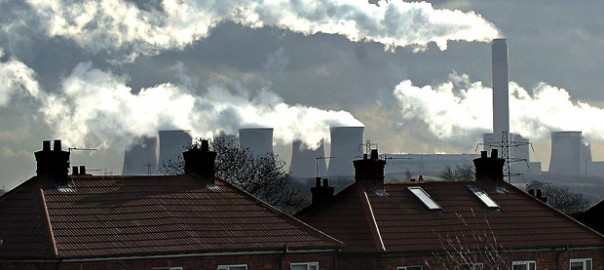
Pollution at Drax Coal Power Station near Selby (Image: J. Giles/PA)

Fossil industry faces a perfect political and technological storm

Fossil industry faces a perfect political and technological storm

The IMF says we can no longer afford the economic wastage of fossil fuels, turning the green energy debate upside down as world leaders plan a binding climate deal in Paris

The political noose is tightening on the global fossil fuel industry. It is a fair bet that world leaders will agree this year to impose a draconian “tax” on carbon emissions that entirely changes the financial calculus for coal, oil, and gas, and may ultimately devalue much of their asset base to zero.

The International Monetary Fund has let off the first thunder-clap. An astonishing report – blandly titled “How Large Are Global Energy Subsidies” – alleges that the fossil nexus enjoys hidden support worth 6.5pc of world GDP.

This will amount to $5.7 trillion in 2015, mostly due to environmental costs and damage to health, and mostly stemming from coal. The World Health Organisation – also on cue – has sharply revised up its estimates of early deaths from fine particulates and sulphur dioxide from coal plants.

The killer point is that this architecture of subsidy is a “drag on economic growth” as well as being a transfer from poor to rich. It pushes up tax rates and crowds out more productive investment. The world would be richer – and more dynamic – if the burning of fossils was priced properly.

This is a deeply-threatening line of attack for those accustomed to arguing that solar or wind are a prohibitive luxury, while coal, oil, and gas remain the only realistic way to power the world economy. The annual subsidy bill for renewables is just $77bn, trivial by comparison.

Read more: Telegraph

A Petrol Pump is the Filthiest Thing We Touch

Warning: This story might make your skin crawl.

A new study has found that the gas pump is the germiest, filthiest thing we touch in everyday life. That’s according to Dr. Charles Gerba of the University of Arizona — and he should know. A microbiologist, he’s known by the nickname “Dr. Germ.”

The research results released Tuesday found that 71% of gas pump handles and 68% of corner mailbox handles are “highly contaminated” with the kinds of germs most associated with a high risk of illness. The study by Kimberly-Clark Professional, and reported on in USA Today, says that 41% of ATM buttons and 43% of escalator rails are similarly teeming with germs.

Other highly contaminated places that many people probably never considered before, and now might fear using, are parking meters and kiosks, about 40% of which are fouled by germs. Crosswalk buttons and vending machines were tied at 35%.

As part of the study, hygienists swabbed suspected germ hotspots and then analyzed the findings. They used general industry sanitary standards as their benchmark.

Gerba analyzed the results for Kimberly-Clark’s Healthy Work Place Project, a subsidiary of the manufacturer of tissues, hand sanitizer and the like. (The project’s website says sick employees cost the average business about $1,320 per employee.)

So what are we supposed to do? Apparently, it’s all about “hand hygiene” — washing your hands throughout the day — and wiping down your work station with a cleaning product (naturally) because a desktop, keyboard and computer mouse can be a breeding ground for germs, says Gerba and the folks at Kimberly-Clark.

“As your computer boots up, wipe down your desk and mouse,” Brad Reynolds, leader of Kimberly-Clark’s Healthy Workplace Project, said in the USA Today article. He also advised swabbing conference tables between meetings.

Source: LA Times

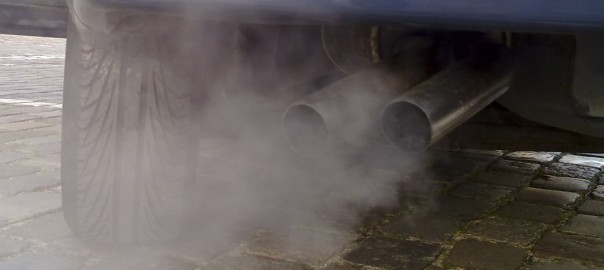
Car exhaust pollution (Image: Wikipedia)

Evening Standard Comment: Time to transform London’s air quality

[From 26 May] Today this paper launches a new initiative to encourage Londoners to adopt, develop and promote the kind of green technology that could help clean our air. It is backed by the chairman of  the Committee on Climate Change, Lord Deben, who urges us to embrace change: there are, he says, “a whole lot of things we can do which mean that we can live exactly the same lifestyle at half the impact on the environment”. Electric cars are one example; remote-controlled heating systems are another.

Meanwhile, the Mayor has announced £8 million support for pioneering schemes to improve air quality, such as pollution-absorbing walls and zero-emission car clubs. This coincides with a World Heath Organisation meeting today in Geneva to combat air pollution.

These are excellent moves and signs of hopeful change. Yet they come less than a month after the Supreme Court ordered ministers to come up with a new plan for tackling air pollution. Britain is in breach of EU-mandated pollution levels for both nitrogen dioxide and PM10 diesel particulate (the tiny particles of soot emitted by diesel exhausts). Our filthy air is estimated to cause around 29,000 premature deaths a year in the UK and is a major contributor to lung diseases such as asthma.

London’s problem is how to clean up its air at the same time as meeting the demands of transport in Europe’s largest and busiest city. Despite increasing numbers of Londoners cycling, and increased passenger numbers on public transport, pollution from road transport remains well above EU limits. The Mayor’s long-term solution is the Ultra Low Emission Zone, which aims to encourage drivers of the most polluting vehicles to change their vehicles by charging a new daily levy for those entering the congestion charge zone from 2020.

Yet this represents a watering-down of the Mayor’s original plans in this respect: critics charge that it is too little, too late. Clearly air pollution is no respecter of land boundaries like those of the congestion charge zone. Air pollution readings from test sites outside the central zone — for instance in Brixton — are worryingly high. Other European cities are pressing ahead with more drastic plans for eliminating the biggest culprits in air pollution, diesel engines. Refitting existing bus engines would help too. Above all, the problem simply needs to be given a much higher political priority than it has to date. Air pollution kills: London needs to tackle it urgently.

Source: London Evening Standard

Will Cort, 13, who lives in central London, says he frequently finds it difficult to breathe (Image: F. Guidicini)

The great diesel car deception speeding us to a toxic death

Drivers and pedestrians have been misled by EU tests aimed at cutting lethal air pollution

WHEN Victoria Kelly sets off around her home city of Manchester she finds the fastest roads — and then goes out of her way to avoid them.

Instead she plots a route that will take her around the clouds of diesel air pollution found along those busier roads, sticking to the leafiest and smallest streets she can find.

It means simple journeys can double in length, but for Kelly, 23, the detours are vital to avoid the airborne toxins that have twice put her into intensive care with asthma attacks like those that have killed two of her friends.

“An attack is like breathing out through a straw into a bucket of sand with an elephant sitting on your chest,” she said. “Air pollution is one of the most likely things to set it off — so I do all I can to avoid it.”

Kelly is one of 5.4m people in Britain diagnosed with asthma. The condition kills three people a day — and traffic pollution, mainly from diesel vehicles, is a key cause. A fifth of those are children — such as Will Cort, a 13-year-old whose childhood in central London has been blighted by asthma.

“I normally get attacks at night and wake up because I can’t breathe. It can go on for days,” he says.

Will Cort, 13, who lives in central London, says he frequently finds it difficult to breathe (Image: F. Guidicini)

Asthma can be triggered by many factors but it is no coincidence that whenever air pollution levels rise, Britain’s hospitals and GPs see a surge of patients with asthma. Last month Public Health England published research showing that thousands of people suffered attacks when smog laden with tiny “particulate” particles and nitrogen dioxide (NO2) gas typical of diesel emissions hit Britain last spring.

Read more: The Sunday Times