Category Archives: Oil

If Paris succeeds Citigroup sees $100 trillion of stranded assets

The business world is finally waking up

If you hear a lot of noise about climate policies and climate action over the next few months in the lead up to the Paris climate conference, it is because there is a lot at stake. According to Citigroup analysts: $US100 trillion of potential stranded assets in the fossil fuel industry.

A new Citigroup report values the fossil fuel reserves that need to be left in the ground if the world is to meet its targets of trying to limit global warming to 2°C – a target that, according to a new Climate Council report, is actually a lot less “safe” for humankind than the science thought it was just 10 years ago.

Nevertheless, that is the stated target of all governments – including Australia’s – and Paris will endeavour to put in place a mechanism that will allow the world to meet that goal.

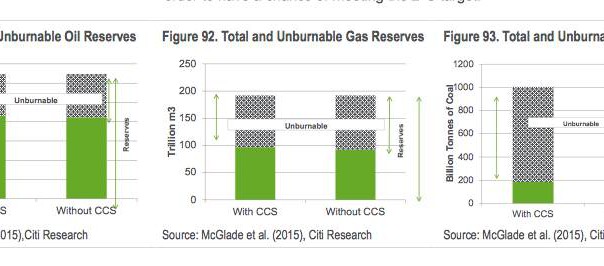
But if the world is serious about meeting this target, it needs to respect its “carbon budget” – and that calls for one-third of global oil reserves, one half of global gas reserves, and 80 per cent of global coal reserves to remain in the ground.

This graph sums up the findings of a new analysis published this year in Nature by McGlade and Ekins. The green represents the percentage of the various fossil fuel types that could be extracted under a 2C scenario.

graph_unburnable_reserves_citi

Translating that into dollar terms, and using metrics of $US70 per barrel of oil, $US6.50/MMBTU of gas (an average weighted price of US, European and Asian prices) and $US70 per tonne of coal, that amounts to a lot of money.

“We estimate that the total value of stranded assets could be over $US100 trillion based on current market prices,” Citigroup notes in the report. And coal bears the brunt, accounting for more than half the value of stranded assets, even in the unlikely event that carbon capture and storage becomes a viable technology.

Read more: Renew Economy
Oil’s place in the global energy mix is transforming, including in mobility, which uses three-fifths of world oil (Image: Thinkstock/curraheeshutter)

Oil Industry Frets About Another Lost Decade

Oil is an inherently cyclical business. The point is remarkably simple but it is amazing how often it gets forgotten by forecasters and investors.

In the century and a half since the modern oil industry was founded with the drilling of Edwin Drake’s well in 1859, real prices have doubled in the space of three years on no fewer than six separate occasions, and halved on four.

Oil’s place in the global energy mix is transforming, including in mobility, which uses three-fifths of world oil (Image: Thinkstock/curraheeshutter)

If prices remain around $50 for the rest of the year, 2015 will be the fifth time real prices have fallen more than 50 percent in the space of less than three years.

Sharp price changes over short periods have therefore been the norm and the long period of relative stability between 1931 and 1969 was the exception.

It follows that any attempt to predict where prices will go in the medium term (two to five years) or long term (beyond five years) based on current prices or recent changes is bound to fail.

The cyclical, unpredictable nature of prices has not stopped an army of prognosticators from trying to guess where they will go, but most forecasts have an endearing backward-looking quality.

When prices are high and have been rising, most forecasts predict they will rise even further on increasing scarcity. When they are low and have been falling, most forecasts predict a further slide on continued oversupply.

In 2008, and again in 2011/12, as prices were peaking at more than $140 and $120 per barrel respectively, most forecasters were predicting prices would remain high more or less forever.

Not one major forecaster saw prices sinking back to less than $60 per barrel but on both occasions it happened in less than three years.

Now prices have fallen, it seems no major forecaster is predicting they will rise sharply again within the foreseeable future.

But the current bearishness about the medium-term outlook is no more likely to be accurate than the former bullishness was between 2008 and 2011.

Read more: Maritime Global News

It’s time to call Peak Oil

I’ve been thinking a lot about Peak Oil recently, and am increasingly convinced that we are seeing its effects already starting to play out in world news, in low oil prices, flat economies, etc.

AAEAAQ_Oil_RollerCoaster_LinkedIn

It is widely accepted that Peak Oil occurred for conventional oil in 2005/6 and that led via very high oil prices to the global financial crisis of 2007/8. However, the high oil prices had an important side-effect, and that was to allow oil that was hard to extract to become potentially profitable and so we had the dash for shale and tar sands oil that has been booming since. This growth in unconventional oil increased the total annual oil extraction figures such that ‘Peak Total Oil’ looked to be moved into the future.

The Saudis, however, put a spoke in the wheel in October last year when they decided they were better off with low oil prices – since they can extract oil very cheaply – and so get back their reducing market share. This led to the current price tumble and oil glut.

While the notoriously optimistic U.S. Energy Information Administration (EIA) has been talking up the US shale oil industry for years, recently it has been moderating its view and suggesting that there may be a peak in unconventional oils as soon as 2020. I believe even this to be over-optimistic.

It is in this context that I see the currently unfolding Chinese stock market crash as being the key turning point, and in particular the week beginning 24 August 2015 – Black Monday – when the Chinese stock market lost 16% of its value. Given that China is currently the world’s economic engine this faltering is a major warning sign, and will likely lead to a softening of demand over the next few years (and perhaps indefinitely).

Putting these things together – a reduction in supply from unconventional oil and a reduction in demand from a faltering global economy – means I’m going to call it:

I think the conditions required for Peak Oil occurred together in August 2015.

This doesn’t mean that Peak Oil has itself just occurred since production drops will lag the economic situation – not least because shale oil production is heavily hedged and credit is currently cheap. Rather, that the peak is imminent – it cannot be avoided unless there is a major increase in either supply or demand in the short term, and neither seems likely.

Longer term, if the Saudis hold their nerve, the US shale industry is likely to implode* from insufficient revenue to service its debts – I think this will occur before the end of 2016, and very likely before the end of 2017 – and shale oil production will drop like a stone. Then Peak Unconventional Oil will have occurred, and therefore Peak Oil itself.

In summary:

In the future, we will be able to look back and see that Peak Oil occurred in 2016/17 and followed naturally and inevitably from the collision of supply and demand reductions in the summer of 2015.


*I think if this plays out we will have another Global Financial Crisis within three years from now, but that’s a topic for another day.

(Image: D. Bacon/Shutterstock/Economist)

Oil and Gas Industry to Lose Credit Supply

The screws are being tightened on the debt-laden US shale industry

More U.S. oil and gas companies could come under financial distress in the coming months as crucial hedging protection begins to expire.

Many companies had locked in high prices for their oil sales last year, allowing them a degree of protection as oil prices collapsed precipitously over the second half of 2014. Few, if any, hedged all of their production though, so revenues declined along with the oil price. Still, with some protection, the vast majority of companies (aside from a tragic handful) have not missed debt payments and have stayed out of bankruptcy.

That could become an increasingly tricky feat to pull off. As time passes, more and more hedges are expiring, leaving oil companies fully exposed to the painfully low oil price environment.

“A lot of these smaller guys who had bad balance sheets have pretty good hedge books through full-year 2015,” Andrew Byrne, an analyst with IHS, told the Houston Chronicle. “You can’t say that about 2016.”

In fact, about one-fifth of North American production is hedged at a median price of $87.51 per barrel. Smaller companies rely much more heavily upon hedging as they are more vulnerable to price swings and are not diversified with downstream assets. Across the industry, IHS estimates that smaller companies had about half of their production hedged at a median oil price of $89.86 per barrel in 2015.

But as those positions expire, any new hedges will be linked to current oil prices, which are now trading around $45 per barrel (although prices are fluctuating with great intensity and ferocity these days).

More worrying for the oil and gas companies that are struggling to keep their lights on is the forthcoming credit redeterminations, which typically take place in April and September. Banks recalculate credit lines for drillers, using oil prices as a key determinant of an individual company’s viability. With oil prices bouncing around near six-year lows, more companies will find themselves on the wrong side of that equation.

Banks were more lenient in April when oil prices were a bit higher and many analysts expected prices to rise. This time around the pain is mounting and there will be a lot less leeway. Somewhere around 10 to 15 percent credit offered to drillers could be cut back on average, a move that could slash $15 billion in credit capacity, according to CreditSights Inc.

With other financial avenues cut off, indebted drillers could be left with no way out.

“Nobody is in good shape with oil at $39,” CreditSights Inc. analyst Brian Gibbons told Bloomberg in an interview. “Most energy companies are shut out of the debt markets. There are few companies that can get a deal done right now.”

Read more: Oil Price

Mildred Lake Extension: Forest-clearing, as part of a process known as overburden removal, in preparation for the expansion of the North Mine (Image: L. Helbig)

Canada’s tar sands landscape from the air

A new book of aerial photographs, Beautiful Destruction, captures the awesome scale and devastating impact of Alberta’s oil sands with stunning colours, contrasts and patterns. The book also includes 15 essays by prominent individuals from environment and industry, sharing their insights, ideas and opinions. Photographs by Louis Helbig

Mildred Lake Extension: Forest-clearing, as part of a process known as overburden removal, in preparation for the expansion of the North Mine (Image: L. Helbig)

Read more: The Guardian

The parallel between food and oil prices (Image: FoodDownTheRoad.ca)

Peak Oil Primer

An introduction to Peak Oil

Contrary to popular opinion we do not live in the Information Age. What we live in is the Oil Age. Look around you and you’ll have a virtually impossible task of trying to find something that isn’t tied back to oil – be it hip replacement surgery, the little pieces of plastic wrapped around the ends of your shoelaces, or the vast infrastructure that makes the so-called “Information Age” possible.

But not only is the relatively superfluous dependent on oil, but so is the very non-superfluous, such as food we eat. Not simply an issue of food being shipped around the world on the back of fossil fuels, the fact of the matter is that fossil fuels are used to plant and harvest our foods, and upon much else, the very fertilizers we spread on our fields are mined from the ground and even derived from fossil fuels themselves (the ammonia and urea we apply to our fields for nitrogen are products of nitrogen atoms paired in the air around us of which were split and combined with hydrogen from natural gas). Simply put, oil and the rest of the fossil fuels are the “lifeblood” of industrial civilization and our modern way of life.

The parallel between food and oil prices (Image: FoodDownTheRoad.ca)

Enter peak oil.

Read more: From Filmers to Farmers

Can these new Greek gods (minus the ties) conjure energy from thin air?

Is Greece Planning to Print Energy?

My first repost – I suspect of many – on the subject of Peak Oil

Over the past couple of months the story keeping many people on the edge of their seats has been the ongoing dilemma of Greece’s detested debt burden, its Great Depression-worthy 25% contraction of its economy, and its voluntary or even forced withdrawal from the eurozone – the fabled “Grexit.”

Can these new Greek gods (minus the ties) conjure energy from thin air?
Can these new Greek gods (minus the ties)
conjure energy from thin air?

For about five years now, heavy austerity policies (cutbacks in government spending) have contributed to what is being described by some as a “humanitarian crisis.” As per stated in the conditions of €240 billion in loans that Greece has received over these years, the Greek government has had to significantly cut back on expenditures, which has included laid off government workers, reduced pensions, a gutted minimum wage, and the selling of state institutions. Partially as a result of this, general unemployment is a bit above 25% while youth unemployment is at nearly 60%; suicide rates are up by 35%; rates of divorce, depression, children suffering from malnutrition, children suffering from physical and emotional abuse, and hospitals lacking basic equipment and medicines are all up; infant mortality has increased 43%; and married women are begging brothels to let them work, but who are then turned away because, well, it’s apparently illegal to sell oneself for sex if one is already betrothed.

Nonetheless, and to the acclaim of many alternative media outlets, late-January saw the stunning election-win of what is called a far-left political party, Syriza. The prime mandate on which it was voted in on by the Greek electorate was to reverse the five-year policy of austerity and to essentially tell its Troika creditors (the European Union, the European Central Bank, and the International Monetary Fund) to shove it where the sun don’t shine.

With Syriza promising to repeal all the aforementioned discomforts, accolades came pouring in, possibly the most astoundingly hyperbolic drivel coming from the online magazine Truthdig.

Read more: From Filmers to Farmers

Oil’s place in the global energy mix is transforming, including in mobility, which uses three-fifths of world oil (Image: Thinkstock/curraheeshutter)

Oil Prices are on a Roller Coaster

Why do oil prices go down? Because they went up. Why do oil prices go up? Because they went down. That’s what they do. To avoid oil-price volatility, you must kick the oil habit.

You can do this by switching to efficiency and renewables. You’ll get cheaper energy services at steady prices; free price insurance; and lower risks to climate, health, environment, global development and security, and America’s independence and reputation.

In contrast, the oil for which the U.S. pays $1 billion a day — and paid $2 billion a day until mid-2014, when $100+ per-barrel prices halved — comes with price risk and far bigger hidden costs that at least triple the real societal cost to upwards of $4 billion a day.

So why, after four relatively placid years, did the world oil price tumble starting in mid-2014, and what’s next?

Why Oil Prices Fluctuate

People burn 1.3 cubic miles of oil a year, or 93 million barrels a day (each barrel equal to 42 U.S. gallons or 159 liters). Scott Pugh, energy advisor to the Department of Homeland Security, visualizes those barrels, each 20 inches in diameter, laid end-to-end and joined to form a pipeline. It’d stretch 1.8 times around the earth. To traverse that pipeline in 24 hours, the oil must flow at 1,835 miles per hour — 2.44 times the speed of sound.

Crude oil’s price fluctuates at more like the speed of light, varying with global, regional, local, and firm-specific market conditions. Despite many complexities, some broad observations are usually valid.

Oil prices tend to rise with instability in major exporters — Persian Gulf, Nigeria, Venezuela, Russia — though diversified supplies, suppliers, and delivery routes have made markets more placid. Strong economic growth also tends to raise prices — until they get high enough to dampen or reverse the economic growth. Conversely, oil prices fall when major exporters do what John D. Rockefeller used to do regularly: “sweat the market” with oversupply to bankrupt high-cost producers and thus raise one’s own monopoly rents.

Read more: Medium

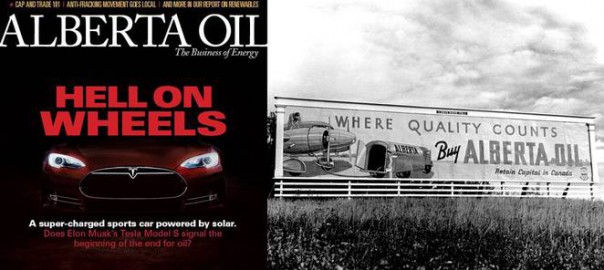
Tesla on industry magazine - end for oil? (Image: Wikipedia)

Tesla is the beginning of the end for oil?

A good find by our friends at EV Obsession, apparently a trade magazine from the oil industry, Alberta Oil, has put a Tesla Model S electric car on its cover (“Hell on wheels”) and published an article with this title and sub-title: “Is Tesla’s Model-S the Beginning of the End for Oil? Why battery technology could drive the electric vehicle to new heights – and disrupt the fossil fuel industry in the process”.

You get the feeling that the thinking of many inside the oil industry is starting to change; for the longest time, most of the comments and official forecasts from the industry basically said that, yes, electric vehicles are coming, but they won’t be a big deal for many decades, and that maybe in 30-40 years they’ll represent a few percents of the vehicles out there.

Tesla on industry magazine - end for oil? (Image: Wikipedia)
Tesla on industry magazine – end for oil? (Image: Wikipedia)

This reassuring (for them) prognostication about the status quo was repeated like a mantra until even most people who heard it over and over in the media accepted it as truth. But that’s not how things work. We can’t know that far in advance how things will be, and if you had asked someone in 2006 whether billions of people were going to own super-powerful internet-connected smartphones within less than a decade, they’d have thought you were crazy. What looks obvious in hindsight isn’t obvious at all looking forward. Why? Because change is non-linear. Things move slowly for a long time, and then you reach a special tipping point where change accelerates. For example, solar power adoption was relatively slow until the price per watt of solar started getting close to other sources (first with incentives, and now without). That changed the game and things shifted in a higher gear. And as we get close to solar being cheaper than all other sources of energy, things will shifter in even higher gear…

Read more: Treehugger