Category Archives: Oil

Oil Giants Band Together to Add Voice to Climate Debate

Europe’s largest oil companies are banding together to forge a joint strategy on climate-change policy, alarmed they’ll be ignored as the world works toward a historic deal limiting greenhouse gases.

Royal Dutch Shell Plc, Total SA, BP Plc, Statoil ASA and Eni SpA are among oil companies that plan to start a new industry body, or think tank, to develop common positions on the issues, according to people with knowledge of the matter. So far the largest U.S. companies — Exxon Mobil Corp. and Chevron Corp. — have decided not to participate, the people said, asking not be named before a public announcement expected as early as next month.

Efforts to reduce fossil-fuel investments and spur renewables such as solar and wind power have gathered pace in the past two years with oil companies sitting largely outside the debate. One aim of the European producers will be to push natural gas as more climate friendly in generating power than coal, the people said. Of the most used fossil fuels, gas is the one that pollutes the least while coal tops emissions.

“There are companies that are now going beyond the industry’s traditional defensive position by at least appearing to rethink strategy and practices,” said Carole Mathieu, research fellow at the French Institute for International Relations in Paris.

‘Strong Statement’

The heads of the biggest European oil producers have been pushing the idea of more active engagement with climate policy in recent weeks.

On Thursday, Shell Chief Executive Officer Ben van Beurden said his company would “put a really strong statement out on what we think should happen.” He cited the increased use of gas in power generation as key to tackling emissions.

“Targets will not be enough,” he said. “We will argue for what we think should be done to bring carbon down.”

The industry is slowly waking up to the existential danger to their operations emerging from policies designed to limit climate change. With global temperatures and carbon emissions at a record, governments are looking for a way to clamp down on pollution. The International Energy Agency, a policy adviser to industrial nations, says half of all fossil-fuel reserves may have to remain in the ground to prevent overheating.

Common Language

“We’re trying to put together a group of people to begin to speak the same language” on climate, BP CEO Bob Dudley said at a meeting hosted by IHS Inc.’s CERA consulting unit in Houston in April. “There’s a bit of different language coming out of different companies and therefore our voice is lost in this.”

His counterpart at Total, Patrick Pouyanne, said in Paris on Wednesday that the industry needs to work together. “If each of us is attacked separately, we will be stronger as a group.”

Statoil CEO Eldar Saetre has embraced the United Nations’ goal to limit global warming to 2 degrees Celsius, a level beyond which scientists say disastrous climate change will bring more violent storms and rising sea levels. He set up a renewable-energy unit and described steps the industry should follow, starting with a shift to cleaner fuels such as gas, reducing flaring and support for carbon pricing.

“If we don’t, we risk becoming an industry that neither gets access nor acceptance — and that’s not a good thing,” Saetre said at the CERA gathering.

Investments Scrapped

Shell is urging the industry to get out of its defensive crouch and make its views understood. It wants alternative arguments to counterbalance the divestment campaign, which has persuaded institutions such as the Rockefeller Brothers Fund and Stanford University to scrap fossil-fuel investments.

“In the past we thought it was better to keep a low profile on the issue,” Van Beurden said in February. “It’s not a good tactic. We have to make sure that our voice is heard by members of government, by civil society and the general public.”

The European companies are more sensitive to environmental issues because governments in the region are leading the way on climate and voters are demanding action. The 28-nation European Union plans to cut carbon emissions 40 percent by 2030, double the commitment it made for 2020.

Exxon, Chevron

For their part, Exxon and Chevron say there’s little difference in the approach between them and their European competitors. Exxon CEO Rex Tillerson has said he’ll speak more openly about the issue and has acknowledged that the risks of climate change warrant action. He is urging policy makers to consider a global price on carbon emissions and since 2007 included carbon prices in his company’s business planning.

Chevron said Wednesday in a statement that it shared the concerns of governments and the public about climate change and action was needed to address the risks. Exxon declined to comment.

While Europe’s big oil groups present a friendlier position toward climate change, they are continuing with investments that environmental groups sharply criticize, including drilling in the Arctic.

Emissions data released through the Carbon Disclosure Project show little difference between the U.S. and European oil companies over the past four years. All have reduced pollution “slightly” since 2011, with BP in the lead mainly because of asset sales needed to pay more than $40 billion in costs associated with the Gulf of Mexico disaster in 2010.

“All companies need to be low-carbon or zero-carbon by 2050,” said Paul Simpson, CEO of the Carbon Disclosure Project, which helps 822 institutional investors with $95 trillion in holdings analyze risks from sustainability issues. “The oil and gas sector is one that doesn’t yet show a clear transition. The longer that goes on, the more concern investors will have.”

Source: Bloomberg

Shell’s Arctic voyage marks beginning of peak oil era

Anglo-Dutch company’s search for resources in the Arctic is a sign that the world is running out of options for new oil reserves

In his critically acclaimed 2005 book ‘Twilight in the Desert’, the prominent oil economist Matthew R. Simmons predicted that Saudi Arabia’s oil wells would soon run dry.

His argument was based on the age of the seven main fields, which the kingdom still to this day depends upon to pump the bulk of its 10m barrels per day (bpd) of crude. These fields in the main have been producing for over a generation and, despite official figures placing Saudi Arabia’s proven reserves at over 260bn barrels, Mr Simmons argued that the kingdom would struggle to increase its output to keep pace with the projected increases in the demand over the next half century marking the beginning of a period known as “peak oil”.

The kingdom, which enjoys some of the lowest production costs in the world, has the capacity to pump 12m bpd if required and shows no signs of slowing down. However, the big question remains whether the Middle East’s energy superpower along with the world’s other major oil producers will be able to keep up with the expected increases in demand over the next 25 years?

Protests won't halt rush for Arctic oil (Image: REUTERS/J. Redmond)
Protests won’t halt rush for Arctic oil (Image: REUTERS/J. Redmond)

By 2040, the Organisation of the Petroleum Exporting Countries (Opec) predicts the world will need to produce 111m bpd of crude to meet world demand. That represents another 20m bpd on top of existing output which means the world needs to find and develop and additional 800,000 bpd of oil a year on average to keep up with supply. To put that challenge into perspective, this figure represents repeating the US shale oil boom all over again, or finding a developing a new North Sea 20 times over.

Although, Mr Simmons was perhaps wrong in focusing on a potential collapse in Saudi Arabia’s oil production he was right in warning about the dangers of “Peak Oil” but too early in predicting its onset. That time is now upon us. Despite, oil prices being forced lower over the last six months the world is entering into a “peak oil” scenario whereby the cost of a barrel could feasibly quadruple to around $200 per barrel over the next 10 years.

Read more: Telegraph

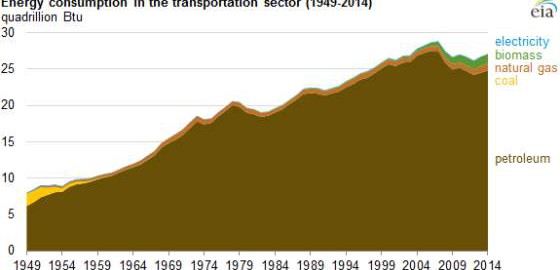
Energy consumption in the transportation sector, 1949-2014 (Image: US EIA)

How The Transportation Sector Is Moving Away from Petroleum

More than 8% of fuel used by the transportation sector came from non-petroleum sources in 2014

The transportation sector is moving away from oil slowly but surely. Driven by growth in the use of biofuels and natural gas, non-petroleum energy now makes up the highest percentage of total fuel consumption for transport since 1954, according to a new report from the U.S. Energy Information Administration (EIA).

In total, 8.5% of fuel used by the transportation sector came from non-petroleum sources in 2014. Biomass from corn-based ethanol—still supported by generous government subsidies—represented the largest non-petroleum energy source and was used primarily to fuel cars and other light vehicles. Use of natural gas to operate pipelines followed close behind. The report also shows smaller but still significant increases in the use of electricity, biodiesel and natural gas in vehicles.

Climate change and fluctuating oil prices has made moving away from petroleum when possible a priority for governments and corporations alike. But it’s still uncertain which fuel will be the best and greenest replacement, according to Christopher R. Knittel, an MIT professor of energy economics . Ethanol, natural gas, hydrogen and electricity are all possibilities.

“We don’t know where we’ll be 50 years from now,” said Knittel. “There are four potential replacement for petroleum, and, ultimately, we don’t what’s going to win out.”

Energy consumption in the transportation sector, 1949-2014 (Image: US EIA)

While the overall trend away from petroleum is encouraging—petroleum accounts for over a third of global greenhouse gases—the newfound reliance on biomass might be seen as a double-edged sword. Using ethanol, which is currently mixed with petroleum and represents around 10% of the gas sold for most cars in the U.S., provides only “marginal benefit” over petroleum in terms of greenhouse gas emissions, according to Knittel. Using electricity in the transport is generally better and cleaner, but the technology is still in its early stages. Where it does exist, as in Tesla cars, it’s often expensive and impractical for large-scale use.

Source: Time

Fossil fuels subsidised by $10m a minute, says IMF

‘Shocking’ revelation finds $5.3tn subsidy estimate for 2015 is greater than the total health spending of all the world’s governments

Fossil fuel companies are benefitting from global subsidies of $5.3tn (£3.4tn) a year, equivalent to $10m a minute every day, according to a startling new estimate by the International Monetary Fund.

The IMF calls the revelation “shocking” and says the figure is an “extremely robust” estimate of the true cost of fossil fuels. The $5.3tn subsidy estimated for 2015 is greater than the total health spending of all the world’s governments.

The vast sum is largely due to polluters not paying the costs imposed on governments by the burning of coal, oil and gas. These include the harm caused to local populations by air pollution as well as to people across the globe affected by the floods, droughts and storms being driven by climate change.

Nicholas Stern, an eminent climate economist at the London School of Economics, said:

“This very important analysis shatters the myth that fossil fuels are cheap by showing just how huge their real costs are. There is no justification for these enormous subsidies for fossil fuels, which distort markets and damages economies, particularly in poorer countries.”

Lord Stern said that even the IMF’s vast subsidy figure was a significant underestimate:

“A more complete estimate of the costs due to climate change would show the implicit subsidies for fossil fuels are much bigger even than this report suggests.”

The IMF, one of the world’s most respected financial institutions, said that ending subsidies for fossil fuels would cut global carbon emissions by 20%. That would be a giant step towards taming global warming, an issue on which the world has made little progress to date.

Ending the subsidies would also slash the number of premature deaths from outdoor air pollution by 50% – about 1.6 million lives a year.

Furthermore, the IMF said the resources freed by ending fossil fuel subsidies could be an economic “game-changer” for many countries, by driving economic growth and poverty reduction through greater investment in infrastructure, health and education and also by cutting taxes that restrict growth.

Read more: The Guardian

US Crude Oil Consumption Peaked a Decade Ago

A world without crude oil is almost unthinkable. And yet, there are indications that such a transition is happening.

OPEC is jockeying for market share. Russia is increasing production and US tight oil producers as well as their Canadian oil sands counterparts have found themselves priced out of the market.

So what is going on?

As humans, we tend to like to place things in neat little boxes. So we look at coal and natural gas and think electricity generation. We look at crude oil and think transportation sector. And all this is correct. But trends are emerging that are likely to turn this on its head. For instance, on shore wind and solar are gaining traction as viable energy production means. Costs are falling rapidly and Lazard now estimates that onshore wind is the cheapest provider of electricity on a levelized cost basis. Solar is not far behind due to a rapid and precipitous drop in costs and is expected to compete with onshore wind as soon as 2018. This means that coal and natural gas will then be the higher cost producers and almost certainly lose market share for electricity generation. Investment going into new capacity additions is already hinting at this trajectory in that investment in renewable capacity has outpaced hydrocarbons each year since 2011. This is occurring globally. Michael Liebreich, founder of BNEF, recently stated:

“The electricity system is shifting to clean. Despite the change in oil and gas prices there is going to be a substantial buildout of renewable energy that is likely to be an order of magnitude larger than the buildout of coal and gas.”

And 2015 started strong right out of the gate. According to FERC, total new generating capacity additions in January and February amounted to 89% renewables, 11% natural gas. March was even stronger with about 94% of new capacity coming from renewables.

Now you may be wondering what this has to do with crude oil. In a word, everything.

It used to be that nothing could compare to crude oil for transportation use. And yet that is changing now. Electric vehicles (EVs) are already cheaper to run than internal combustion engine (ICE) automobiles. The U.S. Department of Energy, using data from the Idaho National Laboratory, estimates that the cost to run an ICE car is just under 16 cents/mile whereas the cost to run an EV is about 3 cents/mile. And EVs are not anywhere near scale so we can reasonably assume that these costs could fall further.

Now suppose that wind and solar continue to gain market share and costs continue to plunge. Those cost savings will be translated into cheaper electricity costs which in turn makes running an EV that much cheaper. And yet EVs are already about five times cheaper than a traditional car. You begin to get the picture. Simple economics tell us that it is in our best interest to buy an EV rather than an ICE automobile. Hence we do not need crude oil to the extent that we have in the past. And crude oil is overwhelmingly used only for transportation.

Automakers like BMW have grasped this reality and have announced that they will no longer make a stand alone ICE automobile by 2022, a mere seven years away. All of their vehicles will be either pure EVs or hybrids.

Interestingly, crude oil consumption in the US has stalled over the past decade. This is attributed to a large degree to greater fuel efficiencies in vehicles worldwide. Demand has essentially flatlined beginning about 2004-2005. At the same time this was happening, shale production began in earnest in the US. As production ramped up in tight oil, supplies flooded into the international market. But this was a market that was already struggling due to lesser demand. With burgeoning supplies, a tipping point was reached last summer and prices began their current plunge.

Perhaps what is most interesting, however, is that the roles played by major actors in this story have changed dramatically in the past six months. OPEC decided to protect market share and not stabilize prices as they had typically done in the past. Indeed for many decades. So why would they choose to change their policy?

The answer is actually quite simple.

If the world is indeed moving away from hydrocarbons then it makes sense if you have abundant hydrocarbon sources, you would want your source to be last to be used.

Tight oil is expensive to produce. So are deep water and oil sands. These are the marginal producers and can fairly easily be removed from the picture with low pricing. We are seeing this happening right now. Interestingly, however, other producers like Russia, which desperately need cash, have stepped up production. According to the Wall Street Journal quoting the IEA:

“…other non-OPEC producers continue to ramp up production. Russia’s output jumped an unexpected 185,000 barrels a day year-on-year in April and Brazilian production was up 17% in the first quarter…Meanwhile, production in China, Vietnam and Malaysia has also shown persistently strong growth. The IEA expects Chinese oil production to increase by 100,000 barrels a day this year to 4.3 million barrels a day.”

This may prove an interesting phenomenon in that producers worldwide are now locked into a battle for market share in a market that may be dying. Only time will tell. But simple economics like cheaper electricity costs speak loudly to consumers. Combine that with cheaper driving costs too and the combination is that much more powerful. And symbiotic.

The days of crude oil’s strangle hold on the transportation market may be coming to an end as incredible as that may seem. Producers appear to be acting like a snake swallowing its tail. They are dumping more and more crude into a market with less and less demand.

Source: Resilience.org

Shell Assures Nation Most Arctic Wildlife To Go Extinct Well Before Next Spill

HOUSTON—Stating that any damage would be limited to just a handful of species that somehow managed to survive that long, officials from the Shell Oil Company assured the public Wednesday that most of the Arctic wildlife living near their proposed drilling site will be extinct well before their next oil spill.

“After conducting several environmental impact studies, we can confidently say that our offshore drilling operations pose absolutely no threat to the Arctic’s hundreds of native species, which will have already been completely wiped out by the time any drilling mishap or crude oil spill takes place,”

said Shell spokesman Curtis Smith, adding that the region’s polar bears, walruses, and bowhead whales will most likely be eliminated by some combination of overfishing, ocean acidification, and melting ice shelves long before the first drops of unrefined petroleum begin gushing into the Chuchki Sea.

“We can assure you that there will be no repeat of the BP oil spill, in which a complex, thriving ecosystem was destroyed. At most, only some algae and maybe a few mackerel will still be around when our rig explodes and spews millions of gallons of oil into their habitat, and we believe those species will pretty much be on their last legs by then anyway.”

Smith added that the environmental hazards associated with the initial installation of the rigs will also go a long way toward ensuring most of the fauna has died off prior to any future spills.

Source: The Onion

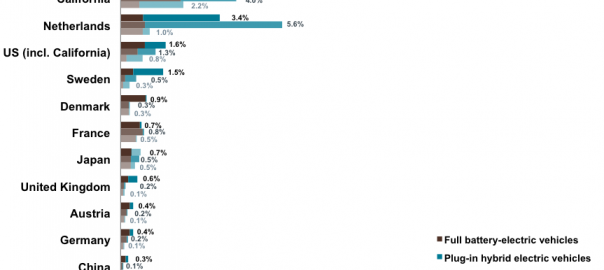
Market share (new sales) of electric passenger cars (Image: Business Spectator)

Fuel price turbulence hasn’t pulled the plug on EVs

Among the biggest stories of 2014 was the crash in global oil prices. Just when it looked like the world had started to take $100/barrel oil for granted, prices plunged by 50 percent. Some speculated that lower oil prices would translate into reduced consumer enthusiasm for electric vehicles (EVs). Now that we have EV sales for 2014 tallied up, let’s look at how the story actually played out.

As it turns out, EVs, including battery electric vehicles (BEVs) and plug-in hybrid electric vehicles (PHEVs), continued to sell consistently around the world. The EV market share in Norway is still far ahead of other countries, at 13.8% of new car sales in 2014. However, in Sweden, the United Kingdom, Denmark, and China the EV market tripled, while in Austria and Germany the EV sales share nearly doubled. The Netherlands is the only country that saw a big drop in EV sales, from 5.6% to 3.4%, likely due to a decline in fiscal incentives. Electric vehicle market share in other countries, including the US, France, and Japan, remained consistent in comparison to 2013.

Further, compared to the first half of 2014, the dramatic drop in global fuel prices during the second half of 2014 did not have any measurable impact on EV sales, and some markets even saw EV sales spike towards the end of the year. There are two main reasons for this: (1) Savings from fuel/electricity costs are only part of all EV incentives, which mainly consist of a variety of fiscal or non-fiscal benefits, and (2) in some countries, particularly in the European Union, fuel taxes already account for a large share of total fuel price, so even during times of fluctuation in global oil price the price at the pump remains relatively stable.

Market share (new sales) of electric passenger cars (Image: Business Spectator)

Read more: Business Spectator

Inconveniences of Gasoline 1: Gas Station (Image: Clean Technica)

Big Oil To ‘Lose Control Of Auto Industry’

It’s not uncommon for media commenters to look at electric-car sales numbers, only to conclude that the segment is teetering on the brink of death.

Electric cars will never become mainstream, they argue, because of fickle consumers who base their-car purchases on what the price of gas happens to be the moment they walk into a dealership.

Yet while the media engages in a tug of war over gas-price analysis, there are encouraging signs pointing to continued growth of electric-car adoption.

Sales have steadily increased since the Chevrolet Volt and Nissan Leaf first went on sale in December 2010, and the cost of the batteries that power these cars is decreasing.

Those trends inspired the provocative title “Big Oil Is About to Lose Control of the Auto Industry,” for a recent article by Bloomberg (via Charged EVs).

The article promotes the Bloomberg New Energy Finance (BNEF) conference held two weeks ago, where optimism about electric cars was in abundance.

Read more: Green Car Reports

(Image: D. Bacon/Shutterstock/Economist)

Bad News About Oil Prices

I have very bad news about oil prices. In the foreseeable future (12 months), their most likely trajectory is… volatile. That is right, bullish and bearish oil price narratives will be proven to be unsatisfactory and overly simplistic. The best bet would be to invest in volatility plays.

What explains this heightened volatility in oil prices? The short answer is the death of OPEC. The U.S. geopolitical deleveraging out of the Middle East has created a disequilibrium, with Iran and Saudi Arabia engaged in a competition for regional hegemony. This competition is unlike anything investors have seen in the Middle East because it takes place in the context of global multipolarity. The U.S. is no longer willing to expend increasingly scarce resources to micromanage the Middle East and no other power is going to step in to fill the vacuum. OPEC cannot survive in this environment because a cartel cannot be maintained when its members are openly at war with each other.

How important is the death of OPEC for oil prices? My colleague Robert Ryan, Chief Strategist of BCA’s Commodity & Energy Strategy, and I think that it is transformative. In our report – titled End Of An Era For Oil And The Middle East – we argue that the salient feature of the global oil market for the past 85 years has been coordinated control of production. Oil markets will see truly free-market pricing for the first time since 1930, when amidst a chaotic production free-for-all spawned by the oil boom the Texas Railroad Commission began pro-rating production in the state to control prices.

In addition to free-market pricing, oil prices are also no longer directly proportional to geopolitical risks in the Middle East. Geopolitics will now fatten both the left and right tails of the oil price probability distribution curve. Gone are the days when geopolitics of the Middle East played an obvious, unidirectional role that simply raised the risk premium on oil prices. The new paradigm, one of disequilibrium, will create headwinds and tailwinds to oil prices.

Read more: Linked In

The sun sets on drilling (Image: Pexels)

War, hedge funds and China: why oil will hit $100 a barrel

Oil prices are heading higher and could soon return to $100 per barrel as war in the Middle East and speculators drive market

It wouldn’t be the first time that oil experts have got it spectacularly wrong when predicting the price of crude.

Goldman Sachs went against the prevailing mood in 2008 when it famously predicted that crude would hit $200 per barrel within months. Instead, oil crashed to levels around $40 per barrel as the global financial crisis punctured world demand.

This time around, the US investment bank decided to follow the consensus view on Wall Street when earlier this year it downgraded its short-term forecast for the price of a barrel to around $40 per barrel.

But instead of falling, oil has rallied strongly. Brent crude now trading above $63 per barrel is up 36pc since reaching its year low in early January. At this rate oil will be back at $100 per barrel by the end of the summer driving season in the US when middle-class America hits the great open roads to visit their ‘Aunt Agatha’ in Pennsylvania.

The sun sets on drilling (Image: Pexels)

So why has the short-term outlook for oil changed overnight?

Lower prices have started to filter through to boosting growth in the world’s most advanced economies and with it demand for gasoline, which is once again on the rise.

Here are six reasons why oil is heading back to $100:

The market is tighter than you think: World demand for crude oil is beginning to rebound. After growth in consumption slowed last year the early signs are that demand is beginning to pick up led by developed markets that are responding to a period of lower prices. The Organisation of Petroleum Exporting Countries (Opec) expects demand for oil to grow by 1.17m barrels per day (bpd) in 2015 but this is a conservative estimate. Another 500,000 bpd of crude would erase the current 1.5m bpd surplus in the market. Remove this tight surplus and oil is back above $100 in a heartbeat.

Read more: Telegraph