Category Archives: Energy Storage

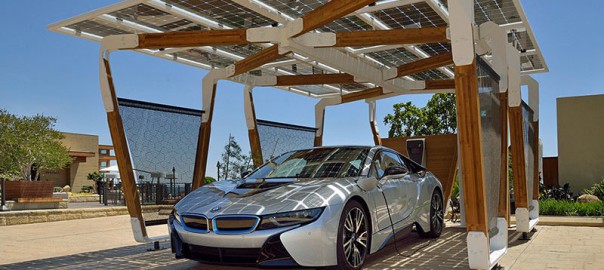
BMW i8 and Solar Car Port (Image: BMW)

Rethink the Grid: Personal Power Stations

Rethinking the grid is quickly emerging as one of the hottest topics. The concept of our own personal power stations can be seductive…and just might save us a whole lot of money too.

“Get big or get out!” Those were the famous, and controversial, words of Earl Butz, Secretary of Agriculture in the seventies. Considering the combination of renewable technology and battery storage, a new popular mantra may emerge: get small and be free.

Much ado about all things renewable together with the objections that technologies can never fully replace fossil fuel generation is popular among a certain set. Here in Texas, among arch conservatives, Solyndra lives on…and on…and on. But the truth is that Solyndra is ancient history. New technologies are ramping up and have been highly successful and may change the way we use the grid forever. Perhaps most interesting of all, however, is the way in which new ways to think about the grid and electricity are prompting entrepreneurs worldwide to rethink, remake and reuse. For instance, what if we all had the ability to transform our homes into micro personal power stations?

The grid is an interesting beast. It typically operates using several different power options together with some back up reserve. Oddly, it runs with virtually zero storage capacity because large amounts of electricity are difficult to store. So nobody really addressed that problem. Until now.

What if we decided to think outside our box and imagine that instead of myriad wires joining each of our houses, there were solar panels on the roof. These in turn pumped electricity into an array of batteries in our garages next to the work bench. Or into our EV which could also act as a storage vehicle. No pun intended.

Large scale storage is a problem because it is large scale. The needs of a utility are vastly different than the needs of an individual home. So tackling the problem of storage would seem to make the most sense if done on a small scale. GTM Research expects home battery storage to grow into a billion dollar a year money generator by 2018. That’s only three years away. Solar City, a large solar installer, is already offering battery storage for home use. They describe their system as:

“…a cost-effective, wall-mounted storage appliance that is small, powerful and covered by a long lasting full 10 year warranty.”

So our homes become a micro-grid. Having said all this, there will still be a need for large scale utility generation. Industrial users for instance would probably be better off using the grid system. This is where the larger scale storage solutions currently being tried and offered are coming into their own.

Electricity supply is never constant. It fluctuates throughout the day. To use renewable energy on a large scale, battery storage is needed. While lithium ion batteries have taken center stage, other less sexy technologies are being employed with success. If lithium ion batteries are the Tesla’s of the energy storage world, then flow batteries are the pick up trucks: hard working and reliable. Lead acid batteries too are gaining traction. All of these technologies perform different functions which are critical to grid reliability.

Navigant Research stated:

“Flow batteries have been shown to excel at long-duration energy storage applications and advanced lead-acid batteries have proven to be excellent performers in power-intensive applications.”

Further, these markets are expected to grow quickly. Navigant forecasts:

“…the annual revenue of cell sales for advanced batteries for utility-scale applications will grow from $221.8 million in 2014 to $17.8 billion in 2023.”

And equally interesting, Navigant projects:

“…the annual energy capacity of advanced batteries for utility-scale energy storage applications will grow from 412 megawatt-hours (MWh) in 2014 to more than 51,200 MWh in 2023, at a compound annual growth rate of 71 percent.”

Other aspects of storage are also being proactively addressed. One of the most common arguments heard is “what do we do with the spent automotive batteries”? Interestingly enough, BMW, and others, are working on that. Apparently an EV battery can have as much as 70% of its storage capacity still intact after its automotive life. So BMW has partnered up with Bosch and Vattenfall, a Swedish company, to repurpose used battery packs into grid storage. Home storage is also a possibility. So rethink, remake and reuse is really happening.

Another example of rethink is the recent announcement by Nissan that they have entered into a deal with Endesa, a Spanish utility behemoth. This arrangement would allow motorists to sell the unused power stored in their EV’s back to the grid. Such access to additional power could potentially provide extra stability for the utility and thereby the grid.

The grid doesn’t have to be run the way it has always been run. We can innovate. And innovation is precisely what is occurring. Perhaps the most important “rethink” of all is in our own heads as we learn to open our minds to using the grid in a whole new way.

Personal pizzas, personal computers, personal trainers…and now our own personal power stations.

Source: Energy Policy Forum
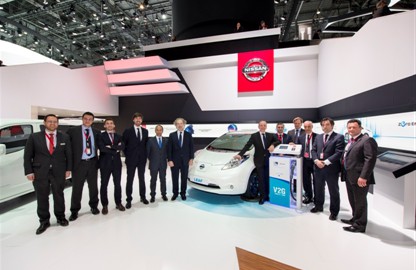
Power to spare - Nissan and Endesa sign pledge to promote Europe's first mass market vehicle-to-grid system (Image: Nissan)

Power to Spare – Nissan and Endesa Sign Vehicle to Grid Pledge

POWER TO SPARE – NISSAN AND ENDESA SIGN PLEDGE TO PROMOTE EUROPE’S FIRST MASS MARKET VEHICLE TO GRID SYSTEM

    • Nissan and Endesa, an Enel Group subsidiary, collaborate on bringing key technologies to market
    • Game-changing technology unlocks the potential of two-way charging and allows customers to reduce costs by selling power from electric vehicle batteries to the grid
    • First step towards integration of electric vehicles with the renewable energy sector
    • Madrid to host real-life demonstration of the system in March 2015

    Nissan and Endesa, an Enel Group subsidiary,  signed a ground-breaking agreement at the 85th Geneva International Motor Show that paves the way for a mass-market vehicle-to-grid (V2G) system.

    The two companies have pledged to work together to deliver a V2G system and an innovative business model designed to leverage this technology.

    Nissan- the world leader in EV sales with over 160,000 Nissan LEAF sold globally- is turning a page in zero emission mobility, and releasing the full potential of electric vehicle (EV) batteries with the Endesa two-way charging technology. It’s all part of Nissan’s commitment to support the entire EV ecosystem, not just the car..

    The two companies have agreed to collaborate on the following activities:

    • – Introduction of V2G services in the European market;
    • – Exploring the use of ‘second life’ EV batteries for stationary applications (including households, buildings, grid);
    • – Designing and evaluating potential affordable energy and mobility pack offers;

    Paul Willcox, Chairman of Nissan Europe, praised the innovative two-way charging system and the step-change towards a further acceleration of the EV market:

    We believe this innovation represents a significant development for Nissan Leaf and e-NV200 customers. Every Nissan electric vehicle battery contains a power storage capability that will prove useful in contributing towards smarter and responsible management of the power demand & supply of local power grids, thus reducing our EV total cost of ownership. Not only does this represent an opportunity for Nissan’s EV private and fleet owners, it could also support grid stability and fully demonstrate that each Nissan EV represents a tangible social asset.’

    Power to spare - Nissan and Endesa sign pledge to promote Europe's first mass market vehicle-to-grid system (Image: Nissan)
    Power to spare – Nissan and Endesa sign pledge to promote Europe’s first mass market vehicle-to-grid system (Image: Nissan)

    Indeed, one of the main challenges for electricity management systems is to assure grid stability. This situation is especially relevant in countries with a high level of renewable energy generation, and this will only increase in the future. The longer term zero-emission vision is for EVs to be at the center of a fully integrated system whereby owners can participate in wholesale energy markets using the power stored in the batteries of their electric vehicles, and thus significantly reduce their cost of operation. In a not-so-distant scenario, the EV user not only decides when and where they want to charge their EV, but how best they spend and re-sell the energy stored in their EV; receiving tangible financial benefits in terms of energy savings, while at the same time maximizing the use of green energy.

    The flexibility offered by V2G implementation in terms of storing and releasing green energy into the grid will further enhance the already significant and tangible benefits of electric mobility. This is why Endesa, together with its parent company Enel and partner Nissan, have decided to join efforts in promoting this technology.” said Javier Uriarte, Head of Market Iberia at Endesa.

    For Information

    This Vehicle to Grid (V2G) system consists of the Endesa two-way charger and an energy management system that can also integrate such off-grid, and renewable, power generation as solar panels and wind turbines. Using this equipment, a Nissan LEAF or e-NV200 owner can connect to charge at low-demand, and cheap tariff periods, with an option to then use the electricity stored in the vehicle’s battery at home when costs are higher, or even feed back to the grid with a net financial benefit. Electricity generated by solar panels or wind turbines can be used to charge a vehicle, to power the home or business, or to feed back to the grid.

    This unprecedented agreement between Nissan and Endesa means that European countries can now review their current energy management policies in order to respond to the technological innovation of the V2G system.

    Endesa has developed the ultimate low-cost V2G technology ready for the mass market after years of real-life testing. The company first showcased its V2G technology in 2008 in Smartcity Malaga, the Enel Group testing ground for smart cities. Later on, in 2012, Endesa presented the evolution of such technology at the ZEM2ALL demonstrator.

    On March 12, 2015, as the culmination of the V2G system development, together with Nissan as automotive partner, Endesa will host a full demonstration of the market-ready and low cost system in Madrid.

    ENDS

    About Nissan in Europe

    Nissan has one of the most comprehensive European presences of any overseas manufacturer, employing more than 17,600 staff across locally-based design, research & development, manufacturing, logistics and sales & marketing operations. Last financial year Nissan plants in the UK, Spain and Russia produced more than 675,000 vehicles including award-winning crossovers, small cars, SUVs, commercial vehicles and electric vehicles, including the Nissan LEAF, the world’s most popular electric vehicle with 96% of customers willing to recommend the car to friends. Nissan now offers a strong line-up of 23 diverse and innovative models in Europe under the Nissan and Datsun brands.

    About Nissan Motor Co.

    Nissan Motor Co., Ltd., Japan’s second-largest automotive company, is headquartered in Yokohama, Japan, and is part of the Renault-Nissan Alliance. Operating with approximately 236,000 employees globally, Nissan sold more than 4.9 million vehicles and generated revenue of 9.6 trillion yen (USD 116.16 b

    illion) in fiscal 2012. Nissan delivers a comprehensive range of over 60 models under the Nissan and Infiniti brands. In 2010, Nissan introduced the Nissan LEAF, and continues to lead in zero-emission mobility. The LEAF, the first mass-market, pure-electric vehicle launched globally, is now the best-selling EV in history.

    Source: Nissan Newsroom

    Citi: Battery storage to hasten demise of fossil fuels

    Investment bank says wide deployment of battery storage will hasten the demise of fossil fuels and utilities that remain focused on centralised generation. It tips rapid fall in costs and a $400bn storage market by 2030.

    citi reportInvestment bank Citigroup predicts that the wide deployment of battery storage technologies will hasten the demise of fossil fuels across the globe in the coming decade, including oil, coal and gas.

    And it also warns that the battery phenomenom will be even more profound than the solar revolution currently sweeping the globe, and will sweep aside any traditional utilities that remain focused on centralised generation.

    The predictions of Citigroup analysts are a reprise of predictions it made in August last year, when it predicted that battery storage costs could fall to around $230/kWh by 2020, and eventually be as low as $150/kWh. The global market for battery storage could be worth more than $400 billion by 2030.

    The significance of its latest update is that these forecasts, and their potential impacts, are included as part of its analysis of the 10 major investment themes for 2015.

    The issue is therefor rapidly moving beyond those with a narrow focus on utilities and energy markets, it is now part of mainstream financial thinking, and because of that will have a profound influence on capital flows across the globe.

    Citi says improvements in battery storage both in terms of operational performance and economic terms should expand and accelerate the trend for corporates and households to become self-sufficient in terms of electricity generation.

    It cites six areas where fossil fuels and traditional utilities focused on centralised generation are at risk.

    These are

    1. Renewables: Storage would reduce both the cost of intermittency and the physical grid constraints that prevent deeper renewables penetration. The result would be a boost to the growth of renewables.
    2. Coal: If storage can be competitively used to “firm” intermittent resources, renewables can become a true substitute for baseload generation. In many markets, baseload is dominated by coal-fired power. And because of growing policy pressure to displace coal in markets ranging from the US to China, policy is likely to emphasize the substitution of firm renewables for coal-fired generation.
    3. Oil: Where oil is still used in the global power sector, it is often used in a peaking capacity. If storage is also deployed as a utility-scale peak shaving asset, storage might start to push out the stubborn oil-based generation still holding on as peaking capacity.
    4. Natural gas: In the near to medium term, natural gas’s complementarity with renewables makes gas a winner in any scenario with increased renewables, as gas continues to be the best option to balance intermittency in many places. But it too would pose challenges to the utility model in many countries, as any former base load fuel supply would bring lower returns to the utility based on lost peak/ high priced demand load.
    5. Gasoline: If storage were developed that promoted the growth of electric vehicles, this would significantly erode gasoline demand let alone demand growth, which, along with strong North American production of oil and gas, would put pressure on oil prices.
    6. The structure of power markets: Electricity is one of the few non-storable commodities. Large scale storage could change that, linking spot prices to forward prices in a transformation that would make electricity markets trade more like oil or gas markets. The implications for power forward curves and asset finance would be significant.

    Picking the winners in battery storage is a bit more complicated, because – like the solar industry – battery makers will be squeezed by severe pricing pressure from users on the demand side, and unavoidably high procurement costs on the supply side.

    That means that profits will come from new business models, away from the simple sales of hardware, towards a service model that includes after-market services, in the same way that the biggest profits are being made in the solar leasing business rather than manufacturing.

    Citi says the storage battery market is likely to develop as an infrastructure business that involves the supply of services and solutions, not just hardware and the winners will be those who come up with solutions that increase the convenience for users and make a long-term commitment to infrastructure.

    It says that the rise of distributed solar generation and battery storage does not necessarily mean the death of the utility model.

    It notes, for instance, that energy distributors could be well placed, as SA Power networks recently suggested. But those who rely on the dispatch of power generators in the grid are at risk. This is partly behind the thinking of European utility giant E.ON and NRG in the US in adapting their business models.

    “Our key takeaway is that US utilities will eventually adapt and join the party,” the Citi analysts write.

    “Why? Three main reasons include

    1) it makes economic sense to do so,

    2) it helps diversity the utilities fuel mix to help insulate them from volatility and

    3) it is a good hedge against upcoming EPA environmental legislation.”

    In its report last year, Citigroup suggested that many countries would be at “grid parity” for solar systems with battery storage by 2030, including Australia, parts of the US, Italy, Spain, Germany, and Portugal, while Japan, South Korea and the UK may not be far away.

    Its latest report underlines the main themes that are likely to influence battery storage.

    Chief among these is the potential of a global and binding agreement on greenhouse gas emissions being reach in December at the UN Climate Change Conference in Paris. That would require a bigger push for energy efficiency, demand response, renewables and e-mobility, making battery storage a crucial piece of the energy system puzzle.

    But even if that agreement was not reached, new environmental targets in the US, and battery storage mandates in the US (over and above the 1.3GW plan for California) will drive deployment.

    And on the technology front, the increased penetration of electric vehicles should continue to push down the cost of batteries for cars with parallel effects for energy systems battery costs.

    It cited projects such as Tesla’s Giga-factory in Nevada with plans for 2020 battery production (in GWh) from that plant alone to exceed today’s global production. Over and above this, a number of independent companies all have ambitious commercial plans.

    “The more they grow in customer numbers and partnerships, the more likely it is that battery storage costs will be declining,” the analysts write.

    Source: RenewEconomy.au

    A trial deployment of Moixa's residential storage systems have been supported by the UK government in a competitive demonstration scheme. (Image: Moixa)

    UK energy minister defends record on energy storage

    The UK’s minister for energy has said that her government is not planning any framework of incentives for energy storage, but said nonetheless that public funds can help “bridge the gap” between ideas and commercialisation.

    Amber Rudd, a minister at the Department for Energy and Climate Change (DECC), attended an event hosted in Westminster, London by the Electricity Storage Network, a UK trade association which has suggested the country needs a target of 2GW of energy storage deployed by 2020.

    The UK currently has a few programmes in place to examine the feasibility of energy storage as well as several pilot projects at residential and larger scales. In terms of programmes currently running, a small amount of funding, around £3 million, has been put into research and feasibility studies into early stage technologies. Meanwhile, four different energy storage technologies will compete in an £18 million trial funded by the department.

    However as Ray Noble of the Renewable Energy Association recently pointed out, there is no unifying national policy framework in place to support increased deployment in the UK as yet. This looks unlikely to change drastically in the short term with the country heading for a general election in May this year. Rudd’s chief scientific adviser at DECC, John Loughhead, also said at the event that setting a national a target for energy storage, or for any specific storage technology type could be a less useful mechanism than “targets for the services storage can provide”.

    ‘Under review’

    The minister was asked questions by attendees on topics including the possibility of feed-in tariffs (FiTs) for energy storage, the failure of recent capacity market auctions intended to shore up UK energy security to award a significant number of contracts to storage and the scope for developing a ‘national storage strategy’ in line with similar moves in solar and community energy.

    Referring directly to the 6MWh battery inaugurated late last year in Leighton Buzzard by companies including Younicos and S&C Electric, Rudd defended the government’s targeted funding of a handful of projects and research schemes rather than setting up overarching subsidies or mandates as have been introduced in Germany, California or Japan. Rudd said the Leighton Buzzard project was

    “a very good example where the public purse plays an important role, bridging that venture capital gap in terms of an idea and something commercial and the bit in between is just too expensive for the market to support”.

    On most topics Rudd remained resolutely non-committal, replying for the most part with assurances that the topic in question would be “under review”.

    Rudd discussed the four current trial schemes at the event. The selected project developers included Moixa Technology, a provider of battery storage and energy management systems mostly for the residential market and RedT, a flow battery system company which is trialling integration of renewables at remote communities on islands off the coast of Scotland.

    A trial deployment of Moixa's residential storage systems have been supported by the UK government in a competitive demonstration scheme. (Image: Moixa)
    A trial deployment of Moixa’s residential storage systems have been supported by the UK government in a competitive demonstration scheme. (Image: Moixa)

    Supporting framework

    Simon Daniel, chief executive of Moixa, behind one of the four competitive demonstration projects, asked Rudd what kind of support storage could see lent to it in the form of FiTs or similar schemes. Rudd replied that it was a question for the future, once trials have been underway for longer and said this topic too was “under review”.

    One attendee alluded to the recent failure of the capacity market auctions to foster significant levels of storage deployment before asking what specific incentives might be applied to storage as a flexibility resource for electricity networks. In the wake of the auction, one developer of pumped hydro storage had described the capacity auction as “evidence of a broken market”.

    Rudd said it had been decided by her department not to use the capacity market to finance and support storage, since the use of storage for supply-demand balancing is at an early stage. The minister’s reply appeared to contradict words her cabinet colleague, energy and climate change secretary of state Ed Davey, who, prior to the capacity market auction, had touted the potential for storage to benefit from that process.

    International picture

    Dr Jonathon Radcliffe, a senior research fellow in energy storage at the University of Birmingham, asked Rudd what could be done to ensure the UK did not fall behind competitively to other markets. Radcliffe said it was understandable the government did not want to back a specific technology at this early stage of the market, but said other territories had already gained a head start and could further extend their lead.

    Again Rudd said the topic would be “under review”.

    Later, Radcliffe told PV Tech Storage that he did have

    “…a bit of concern that the government targeted energy storage as one of the ‘eight great technologies’ a couple of years ago as an area to support because there’s good capability in the UK to develop the technologies and we can make some money out of it, as well as improve the energy system, essentially from deploying it in the UK”.

    Source: PVTech Storage

    Energy storage paves way for electricity independence

    Renewables have the power to transform not just the world’s energy markets, but global economics and geopolitics.

    But wind and solar alone cannot deliver a world of clean and free fuel. Both are, by their very nature, variable, so to realise their true potential other technologies need to be harnessed.

    Improving connectivity to other countries is one relatively simple solution, but in a world where governments are becoming increasingly preoccupied with energy security, its attractions are somewhat limited.

    Managing demand more effectively using smart grids and appliances is another.

    But the technology with the most revolutionary potential is energy storage.

    As Jimmy Aldridge at the UK’s Institute of Public Policy Research think tank says:

    “This is the most exciting area within the energy sphere and it’s totally transforming the way we interact with the grid.”

    ‘Huge disruption’

    There are some very obvious ways in which storage can help communities and companies across the world.

    Blackouts in developing economies can cause havoc.

    In South Africa in 2008, for example, power cuts caused some of the country’s biggest gold and platinum mines to close, leading to a rise in global commodity prices, not to mention huge disruption to the lives of millions. Such unreliable power grids also hamper foreign investment.

    Energy storage can not only provide back-up power in case of power cuts, but also help electricity grids run at average rather than peak load, therefore reducing the chances of cuts in the first place.

    To this end, Puerto Rico, for example, has set a 30% storage requirement for any new renewable capacity.

    But it’s not just developing countries that can benefit. The US government estimates that hundreds of power cuts between 2003 and 2012 cost the country up to $70bn (£45bn) a year. Tens of storage systems are already operating in many states, while California has set a target of 1.3GW to help meet its renewable objectives.

    The UK has already built its first grid-level storage battery while Italy, Hungary and Saudi Arabia among others are likely to follow suit.

    Storage is also proving invaluable for isolated communities that have no access to the national grid, with islanders in particular enjoying continuous power without the need for additional diesel generation.

    Read more: BBC

    Tesla Powerwall display (Image: T. Larkum)

    Why Tesla’s battery for your home should terrify utilities

    Elon Musk’s electricity empire could mean a new type of power grid

    Earlier this week, during a disappointing Tesla earnings call, Elon Musk mentioned in passing that he’d be producing a stationary battery for powering the home in the next few months. It sounded like a throwaway side project from someone who’s never seen a side project he doesn’t like. But it’s a very smart move, and one that’s more central to Musk’s ambitions than it might seem.

    To understand why, it helps to look not at Tesla, but at SolarCity, a company chaired by Musk and run by his cousin Lyndon Rive. SolarCity installs panels on people’s roofs, leases them for less than they’d be paying in energy bills, and sells surplus energy back to the local utility. It’s proven a tremendously successful model. Founded in 2006, the company now has 168,000 customers and controls 39 percent of the rapidly expanding residential solar market.

    Fueled by financing systems like SolarCity’s, government subsidies, and a rapid drop in the price of photovoltaics, solar has been growing fast. But with that growth, some of solar’s downsides are coming to the fore. Obviously, the sun isn’t always shining when you need power, and sometimes the sun is shining when you don’t need power. The former is a problem for the user, who needs to draw on the grid when it’s cloudy or dark; the latter is a problem for the grid, which needs to find a place for that excess energy to go. When there’s a lot of solar in the system, it can get hard to keep the grid balanced.

    That’s part of the reason that California, with one of the most aggressive renewable energy mandates in the country, recently declared the most aggressive energy storage mandate as well, with a goal of 1.3 gigawatts of storage by 2020. As other states adopt intermittent renewables like solar and wind, they’ll need to install energy storage too, providing a ready and waiting market for Tesla’s batteries.

    Tesla Powerwall display (Image: T. Larkum)
    Tesla Powerwall display (Image: T. Larkum)

    This has been part of the plan for the Gigafactory all along. At an event in New York last fall announcing plans for SolarCity to build a gigantic PV-panel factory, Musk and Rive mentioned that every SolarCity unit would come with battery storage within five to ten years, and that the systems would supply power at a lower cost than natural gas. Those batteries will come from the gigafactory, currently being built in Nevada. Once the factory comes online, the strong demand for energy storage will allow it to immediately ramp up production and achieve economies of scale. Tesla CTO JB Straubel (who has said that he “might love batteries more than cars”) says that the market for stationary batteries “can scale faster than automotive” and that a full 30 percent of the gigafactory will be dedicated to them.

    Indeed, SolarCity has already begun installing Tesla batteries, mostly on commercial buildings like Walmart stores, which have to pay higher rates when they use lots of power during peak hours. Tesla’s batteries let them store up solar power when they don’t need it, then use it when rates are high, shaving 20-30 percent off their energy bills, according to Ravi Manghani, an analyst at GTM Research.

    SolarCity is also running a pilot project with 500 homes in California, according to the company’s director of public affairs, Will Craven. The project uses Tesla’s 10-kilowatt-hour battery packs and can power homes for about two days in the event of an outage, Craven says.

    The prospect of cheap solar panels combined with powerful batteries has been a source of significant anxiety in the utility sector. In 2013, the Edison Electric Institute, the trade group for investor-owned electric companies, issued a report warning that disruption was coming. “One can imagine a day when battery storage technology or micro turbines could allow customers to be electric grid independent,” the report said, likening the speed of the coming transition to the one from landlines to cellphones 10 years ago. Suddenly regulated monopolies are finding themselves in competition with their own customers.

    They haven’t had to deal with this on the residential side yet, primarily because people can sell excess power back to the utilities at fairly high rates — a practice called net metering. But that’s hurting utilities, too, and some have tried to lower the price at which they buy back power, which has been met by furious protests from people leasing panels. If utilities lower the buyback rate too much, however, and batteries get cheap enough, people may just unplug from the grid altogether — or more likely, install systems that let them rely on it only rarely — prompting what those in the industry call “the utility death spiral.” It’s quite a bind: by fighting net metering, utilities would help make battery storage more economically viable, driving the transition to a distributed grid.

    Manghani believes utilities aren’t doomed, but they may undergo a radical transformation, becoming something closer to service providers and minders of an increasingly distributed grid rather than the centralized power producers they are today. Such a system would require lots of batteries to help balance the load and supply extra power during peak times, which is why GTM estimates the market will grow from $48 million today to about $1 billion in 2018.

    This is the position SolarCity is taking as well. Last April, Peter Rive, SolarCity’s CTO, wrote that the company had no interest in prompting mass defections from the grid.

    “When batteries are optimized across the grid, they can direct clean solar electricity where (and when) it is needed most, lowering costs for utilities and for all ratepayers,” he wrote.

    Utilities are in the best position to direct that electricity, he said, inviting utility operators to contact him. Will Craven, Solar City’s director of public affairs, calls it “infrastructure as a service.”

    “Utilities aren’t doomed, but they may undergo a radical transformation”

    It would be a tricky transition, but some utilities may be open to it. During an earnings call last year, Straubel, Tesla’s CTO, said they were working with utilities.

    “The long-term demand for stationary energy storage is extraordinary,” he said. “We’ve done a huge amount of effort there and have talked to major utilities and energy service companies.”

    Another potential bright spot for utilities is Tesla itself. If electric vehicles take off, demand for power will go up, helping compensate for people whose homes are relying less on the grid.

    All this is very good news for Musk, who starts to look less like a carmaker and more like the architect of a vertically integrated energy company, with SolarCity making solar panels that send power to Tesla batteries, both in the home and on the road.

    “They’re not just carmakers,” Manghani says. “They’re part of the electricity network. At least folks in the energy industry are very well aware of Tesla as a battery maker.”

    Source: The Verge

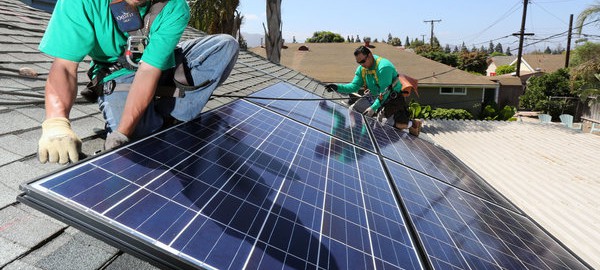
    Workers for SolarCity installing solar panels (Image: JE Flores/NYTimes)

    REA champions solar and storage with the launch of UK Solar and UK Energy Storage

    The Renewable Energy Association announces the official launch of UK Solar and its first storage representation body UK Energy Storage

    UK Solar will support and represent over 130 of its existing solar members and broadening its member base to become the trusted voice of solar power in the UK.

    With nearly fifteen years of experience in supporting the growth of the solar sector, the REA has built a strong reputation within the government, with regulators and with industry stakeholders.

    REA Chief Executive Dr Nina Skorupska said:

    “The REA is excited to announce the launch of UK Solar. Solar power is one of the first major renewable energy technologies set to compete with traditional energy sources without subsidy. The integration of solar as a major player in the UK energy mix will transform the power market. Businesses, households and the public sector will see their energy bills reduced. It is the mission of UK Solar to support and drive the transition to this solar future”

    The REA will be working with its existing solar members to develop a clear path to grid parity with wholesale and retail electricity prices across all sectors of the solar power market.

    Further exciting news is that the REA is to represent renewable storage technologies with UK Energy Storage. UK Energy Storage is the trade body for all storage technologies across the UK.

    Energy storage technologies offer huge potential for the UK’s energy supply mix. The ability to store renewable power which can then be used to meet demand when it is needed can deliver tremendous benefits for system stability and security of supply as well as decarbonising UK energy supplies.

    Using the REA’s experience of successfully bringing new technologies to market, UK Energy Storage will ensure that storage technologies have a smooth path to commercialisation in the UK through delivering and developing effective policy.

    REA Senior Advisor Ray Noble said:

    “The potential for energy storage to transform the UK energy mix is immense. Through representing all types and scale storage technologies the REA will drive the commercialisation of viable storage solutions in the UK. The integration of storage technologies will bring down costs and increase the capacity of renewable energy available on demand, which could revolutionise the energy mix.”

    The launch of UK Solar and UK Energy Storage will see exciting new developments in the REA, as it strengths and builds relationships with solar and storage members.

    Source: Renewable Energy Association

    Will 2015 Be a Breakthrough Year for Storage in the UK?

    Despite an unpromising legislative landscape, storage is gaining momentum in the U.K.

    The United Kingdom has no clear government policy on energy storage and offers no major incentives to companies and no subsidies at all to households to install energy storage. To date, only paltry sums have been invested in energy storage projects there.

    And yet, many are feeling optimistic about where the storage industry is headed.

    Several major manufacturers have either launched domestic solar-storage products in the U.K. in the last six months, or are planning to do so sometime this year. In the last week, the U.K. Renewable Energy Association has launched a new trade body dedicated to commercializing energy storage. The U.K. Electricity Storage Network is expecting a Minister from the Department of Energy and Climate Change (DECC) to participate in its annual meeting.

    And to crown it all, the U.K. currently has the biggest battery in Europe.

    So is storage really taking off? To date, according to the U.S. Department of Energy’s Global Energy Storage Database, the Brits currently have a grand total of 32 projects, providing 3,300 megawatts of storage, of which the vast majority comes from pumped hydro. Around 62 megawatts are (or soon will be) provided by batteries and 5 megawatts by mainly uninterruptible power supply flywheel systems. There are also experimental compressed air, cryogenic thermal and flow battery projects ongoing.

    That 3,300-megawatt total compares quite favorably with 7,600 megawatts in Germany and 6,560 megawatts in California, a state with similar energy requirements to the U.K. But there’s a push for much more.

    “Storing energy will become increasingly important in the move toward a low-carbon economy, and has the potential to save the energy system over £4 billion [$6 billion] by 2050,” said DECC Minister Greg Barker last year.

    The DECC has also stated that the energy storage market is forecast to reach $17 billion in 2020, and to be nearly $30 billion in 2030.

    Some argue that energy storage can help save consumers money by possibly reducing new grid buildout.

    Anthony Price, director of the Electricity Storage Network, explains: “[The UK electricity and natural gas regulator] Ofgem has calculated that it will cost £50 billion [$76 billion] to rewire Britain. This will be to provide flexibility in the grid and allow the integration of more renewables, add resilience to the grid, and to improve energy efficiency across the grid. If you look at energy storage, it can help meet all three of those requirements. So we can spend £50 billion on rewiring the country, or we can have more energy storage.”

    Price’s organization is lobbying for a minimum 2,000 megawatts of new network-connected electricity storage by the year 2020. A fairly modest figure, this represents less than 10 percent of the predicted increase in renewable generation capacity over the same time period. The question still remains whether the U.K. government will take investment in energy storage seriously. Price notes that while the current administration is happy to “pick winners” by promoting solar and wind, it refuses to do so in the case of storage.

    On the other hand, it has provided a modest £50 million ($76 billion) in backing for research projects around the country. The most prominent of these is the Smarter Network Storage project, better known as the biggest battery in Europe. A 6-megawatt/10-megawatt-hour system, the battery is designed to explore alternative revenue streams for storage, while deferring traditional network reinforcement.

    Numerous early-stage projects have emerged. Highview Power won funding for a demonstration of its liquid air storage technology. REDT is developing a vanadium redox flow battery for storing wind and wave power in Scotland. And Isentropic is building a demonstration project for its cryogenic energy storage technology.

    Domestic solar-plus-storage is also taking off in the U.K. Last September, SMA launched its Sunny Boy Smart Energy PV inverter and battery system. Sharp followed suit at the end of last year by offering a solar-and-storage device that uses Samsung batteries. Bosch is hoping for certification of a solar-storage inverter next month, and various other solar players, such as ReneSola of China, seem to be clamoring to enter the U.K. market.

    These companies could be looking to cash in on growth in U.K. solar installations. While much of the European solar market has suffered from a slowdown last year, Britain helped keep the overall picture a little rosier, with an estimated 3.2 gigawatts of PV installed in 2014.

    One solution for boosting domestic supply of residential storage systems is to leverage vehicle battery manufacturers, said Frank Gordon of the newly launched energy storage section of the U.K.’s Renewable Energy Association.

    “The U.K. is home to one of the only electric-vehicle battery plants in the world, the Nissan plant in Tyneside. These car batteries could offer good potential for small-scale energy storage applications,”

    said Gordon.

    In the meantime, storage supporters like Gordon are looking for clearer support signals from the government.

    “As solar storage is still a developing technology, the need to establish a policy and technical framework for it to operate within is paramount,”

    he said.

    Source: Greentech Media