Late Thursday night [30 April] in Hawthorne, California, Tesla revealed its “missing piece to building a sustainable future,” which the company says puts the world on the road to “enabling zero emissions power generation.”
Tesla notes that the world currently uses 20 trillion kWh of energy annually, which is:
“Enough energy to power a single family home for 1.8 billion years or supply energy to a nuclear power plant for 2,300 years (or launch the Falcon 9 rocket seventeen million times).”
The company says that the Tesla Energy products launched today will help to start to wean the world off fossil fuels.
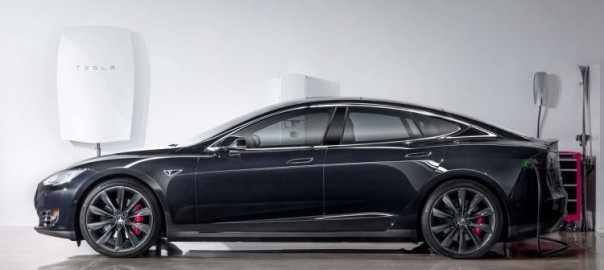
The Tesla Model S And The Powerwall (Image: Tesla)
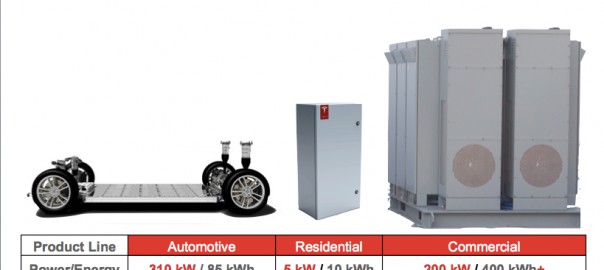
More specifically the company is offering “a suite of batteries” for residential, business and utility use. Those solutions are outlined below.
As for what was available before today, Tesla CEO Elon Musk was very candid, “The issue with existing batteries is that they suck. They are expensive, unreliable and bad in every way.”
The Tesla CEO said that the first residential units will start shipping in about three months, but that the initial ramp will be slow, as early batteries will be built at the company’s Fremont factory.
However, next year production will switch to Tesla’s Nevada Gigafactory, and things will quickly speed up.
As a special bonus, the whole presentation made from California was done off the grid, via the company’s new utility grade “Power Packs”.
Up to 200,000 business and household customers in New South Wales face extended blackouts of up to a week, or even more, following the dramatic storms in the Sydney region and to its north.
And the impact could have as galvanising an effect as Hurricane Sandy had on the New York region of the United States – causing utilities, business and household customers to consider battery storage and even micro grids.
NSW has more than 260,000 households with rooftop solar, but any houses with solar on their roof would still be without power, because their inverters are usually connected to the grid. So when the grid goes down, the inverters go down too.
The only way to be able to use that solar power is to have battery storage and a special battery storage inverter, which effectively creates its own mini grid, and can operate on its own when the main grid goes down.
“Every storm we get a surge of inquiries,” says Glen Morris, the vice president of the Australian Energy Storage Council, and the owner of a solar-storage business. (Morris also lives in an off-grid community).
“People realise that if they have got solar PV and a grid connected inverter it doesn’t work when the power goes down, so they must have storage.”
Muriel Watt, head of energy policy at renewable energy consultants IT Power Australia, says the number of customers looking at battery storage were likely to increase dramatically as a result of the blackout, and when an estimated 146,000 households in NSW come off their premium 60c/kWh tariff next year.
“With so many households now having PV, it is making even more sense for them to consider adding storage and an inverter which allows them to switch to off-grid mode,” Watt said.
“This would at least keep the lights on and prevent the ‘fridge defrosting. Japanese people have been very aware of this option after losing power for weeks after the Kobe earthquake, but prices for PV and batteries have fallen considerably since then.
“Cost effectiveness is never the only consideration for household investments – emergency power would rate quite high on the list if we are to have more frequent severe weather events.”
As for costs, Morris says it is currently making a 10-15 year payback. But like Watt, he says that is not the main consideration.
But, he notes, the cost of battery storage is coming down quickly – around 20 per cent in 2014 for lithium-ion batteries, and another 25 per cent fall expected in 2015, battery manufacturers tell him. That is the same price trajectory as solar modules over the past 5 years.
How much storage was needed depended on what the customer needed. One household recently installed a 4kWh battery storage system, but because they were careful with their energy use, that was enough for a full day.
Many households or businesses would want storage just to ensure the TV, lights and radio are kept on, and possibly the fridge. Others use storage to bank the output from their solar panels and use later in the day.
That’s because new owners are either getting paid little or nothing to export back to the grid, or are prevented from doing so.
Businesses, particularly those with refrigeration needs who find they are paying $40,000 to $50,000 for a back up generator with high maintenance, are also finding rooftop solar and battery storage is a cheaper and more effective alternative.
Some forecasts suggest that within a few years, it will be economic for households in city suburbs to disconnect from the grid. Some suggest one-third may do so within the next few decades.
Right now, though, Morris says even the market operator does not know how many battery storage systems are in place. That’s because most people installing storage are adding it to pre-existing solar systems.
Michael Anthony, from Solar360, says the bulk of his company’s business is now centred around storage. He says about 40-60 new storage systems are being installed each month, much of it in regional areas, but also in the city – both for businesses and households.
“Most dealers are trying to sell just solar, but they haven’t understood that adding storage gives a better result.”
Anthony says the levelised cost of energy for added battery storage systems is at the same level as grid power.
Ironically, Morris was speaking from the northern NSW town of Ballina, where he was hosting a course on battery storage for technicians from the local network operator.
The main grid operator in the Sydney, Hunter region, Ausgrid had to put out a warning on Wednesday in response to reports that desperate households and businesses – facing another week without power – were rushing to hardware stores to buy generators.
Morris said this was both illegal, and stupid. Generators could only work when powering appliances directly. If they are fed into a household wiring system, they can be incredibly dangerous, both for the occupants and network linesmen.
POMONA, Calif. — The future of American energy, according to one widely held view, will include solar panels and wind turbines continuing to proliferate, churning out ever more electricity and eventually eclipsing fossil fuels to help offset the forces of climate change.
With the cost of renewable technologies falling sharply, that vision is starting to take shape, especially in areas with abundant sunshine or steady wind. Here in California, the state is making such quick progress toward its goal of getting 33 percent of its electricity from renewable sources by 2020 that Gov. Jerry Brown raised the ante earlier this year, setting a target of 50 percent by 2030.
The shift sounds simple in theory — plug more solar and wind into the mix, and unplug more coal- or gas-burning power plants, sparing the world millions of tons of greenhouse gases.
But the reality is more complex. Because of the variable nature of these renewable sources — no electricity is generated when the sun goes down or the air is still — they add strains to the system of transmitting and distributing power.
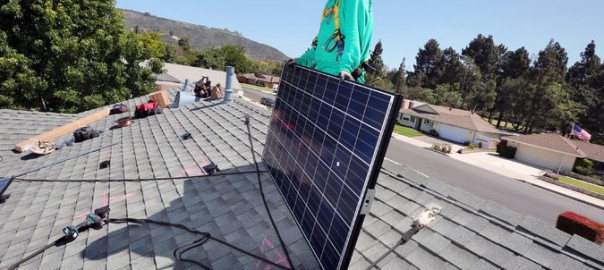
A solar panel being installed at a home in Camarillo, Calif. The state aims to get 50 percent of its energy from renewable sources by 2030. (Image: J.E. Flores/NYT)
Batteries have long been seen as one of the main ways to work more renewables into the electrical grid, by storing electricity during times of excess generation and releasing it when needed. Now, spurred by mandates in California and other states to deploy storage, by the rise of rooftop solar systems, and by falling prices as Tesla Motors and other companies make plans to produce vast numbers of lithium-ion cells, batteries are set to play a significant part in the nation’s power supply.
“We can see the role of batteries playing out in different locations around the grid,” said Ravi Manghani, an analyst with GTM Media and author of a recent forecast for the energy storage industry over the next five years. “We expect that every year, we’re going to see on average 100 to 250 percent growth,” he added. “And most of that will be in batteries.”
Challenges remain, however. Despite plummeting prices, large battery systems generally are not yet economical for helping to integrate renewables on a broad scale. Instead, utilities and other companies are using them for different purposes.
“Let’s call it a stretch goal,” Imre Gyuk, who directs a Department of Energy program that has sponsored demonstration projects for energy storage, said of plans for vast deployment of batteries for integrating renewables. Costs still have to come down more, he said, and not just for the cells, but for the control equipment as well.
There are several ways that the electrical grid can cope with more renewables — by large consumers of electricity agreeing to have their power reduced at critical times, for example, a concept called demand response. And there are other ways to store electricity, such as pumping water, compressing air, spinning flywheels, or even making ice.
Battery systems, which feature racks of cells wired together, and are capable of storing large amounts of power and releasing it over an hour or longer, have some advantages over other storage methods. They can supply power nearly instantaneously and handle continual cycling between charging and discharging. And as the manufacturing of batteries and control systems scales up, it will be easier and cheaper to deploy “plug and play” systems, rather than designs that are unique to each situation.
A large battery storage project in Notrees, Tex., illustrates the current economics. Built in 2013 for about $44 million by Duke Energy Renewables (with the Department of Energy contributing half of the amount), the project consists of thousands of lead-acid battery cells near a large wind farm.
Greg Wolf, the president of Duke Energy Renewables, said the company found it hard to sell large electricity users so-called firmed wind, in which stored power from the battery is used to supplement the wind turbines to provide assured blocks of electricity at certain times.
“There was little interest from customers willing to pay for that,” Mr. Wolf said. “That has not evolved as much as some folks, including ourselves, thought.”
Instead, he said, the grid operator in Texas was interested in the Notrees battery as a fast-response source to regulate the frequency of the electrical current, which keeps the grid stable.
Maintaining a reliable grid is a high-wire act for operators, who struggle to keep a balance between the supply of electricity from generation sources and demand for it from customers. Batteries are especially valuable because they can respond quickly, adding more power to the system in a second or less.
Fossil-fuel plants that are often kept on standby for this purpose can take a few minutes or more to reach a level where they can provide the same service, Dr. Gyuk said. And all the while, fossil-fuel plants are emitting greenhouse gases.
Here at a Southern California Edison laboratory in the shadow of the San Gabriel Mountains, scientists and engineers are doing some of the fundamental work to help make widespread battery storage happen.
Accompanied by the steady thrum of electric current, batteries — lithium-ion cells like those used in electric cars and other types — sit in rows of sealed testing chambers. The batteries are undergoing continuous charge-discharge cycles in heat and cold, dripping humidity and desert dryness, to simulate the conditions they may face when deployed on the electrical grid.
“We’re trying to better understand their performance,” said Loic A. Gaillac, who manages the utility’s advanced energy storage group. “Ultimately, we want to get a sense of what degradation you see on the system and how long they last in the field.”
In 2013, California mandated that by 2020, Southern California Edison and the state’s two other large investor-owned utilities add a huge amount of storage — about 1.3 gigawatts, or more than 10 times the amount of storage deployed worldwide in 2011.
“We felt there were enough opportunities now where storage could be cost effective,” said Carla Peterman, a member of the California Public Utilities Commission, which oversees implementation of the mandate. “But we still recognized that this was a nascent industry.”
Mark E. Irwin, Southern California Edison’s director of technology energy storage, said that for now, the utility is most likely to use batteries to relieve its distribution system of peak loads that would otherwise require expensive improvement of wires and other equipment.
California has also set a priority to develop distributed generation, in particular moving away from large centralized solar farms and toward residential or neighborhood-scale solar power. Batteries will no doubt play a greater role in this, Mr. Irwin said.
“It will make it easier for people to put renewable systems out on the local grid,” he said.
“But in the meantime, storage has to find a way to first walk,” he added. Helping to defer upgrading costs, he said, is one way to get storage started.
“It’s the first business case,” Mr. Irwin said. “But it won’t be the last.”
Good news for Tesla Motors and others in the battery energy storage market:
“IHS…announced that 9 percent of solar photovoltaic (PV) systems in North America will include attached storage in 2018. Led by commercial systems, IHS expects 700 megawatts (MW) of PV systems with energy storage will be installed by 2018, compared to just 30 MW in 2014.”
“The commercial PV energy storage market in the United States has gained huge momentum in recent months,” said Sam Wilkinson, research manager for solar and energy storage for IHS Technology.”
Tesla’s entry into this segment is mostly focused on residential, but rising usage in all segments will be a plus for the electric automaker and others who supply energy storage systems.
In the past few weeks, there’s been a battery of new studies on batteries. Not the kind in your cellphone, but a much more revolutionary make – the kind that is already powering many cars, and that might someday help power your home.
A recent study in Energy Policy, for instance, found that the cost of batteries for home systems (to store the energy collected by rooftop solar panels) is starting to decline – although even with these systems, it probably won’t be economically optimal for most people to ditch the grid entirely. Another report by the Rocky Mountain Institute similarly found that within 10 to 15 years in some places, the most economical choice for home energy could be a solar plus battery system, meaning that there could be a great deal of “load defection” from the traditional electricity grid.
Finally, a new study in Nature Climate Change documented that there has been a steep decline in the cost of lithium ion batteries for electric vehicles like Teslas – 14 percent per year plunge since 2007.
All of which is being hailed as pretty revolutionary. “Solar-plus-batteries is set to begin a dramatic transformation of human civilization,” wrote Bloomberg commentator Noah Smith recently, commenting not only on the declining price of batteries for electric vehicles, but also the potential for more batteries in homes.
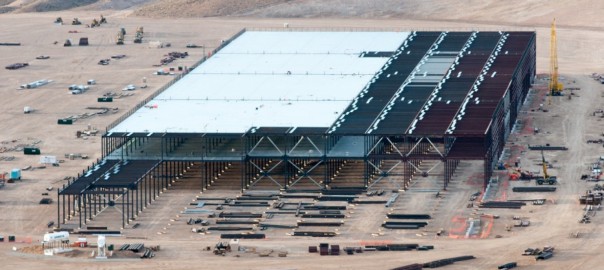
Construction on the Tesla Motors Gigafactory east of Reno, Nev., March 25, 2015 (Image: D Calvert/Washington Post)
But there’s a need for caution. People with home battery systems paired with solar panels certainly exist, but are quite rare for the moment. One problem is that right now, there just aren’t many ways to make a home energy storage system investment pay off.
So why do some analysts nonetheless think that solar plus battery systems could become quite prevalent in homes, and maybe sooner than we think?
JuiceBox Energy, Inc announces availability of a new 8.6kWh lithium-ion energy storage system for solar energy storage and smart home connectivity. With this product release, JuiceBox enters the rapidly growing residential energy storage market with a safe and reliable, web-connected product that can be installed on new and existing solar energy installations.
San Jose, CA (PRWEB) April 13, 2015
Today, JuiceBox Energy, Inc. announces availability of their new 8.6kWh lithium-ion energy storage system for solar energy storage and smart home connectivity. With this product release, JuiceBox enters the rapidly growing residential energy storage market with a safe and reliable, web-connected product that can be installed on new and existing solar energy installations.
Distributed energy generation is at a crossroad in many locations as renewable energy net metering policies evolve, requiring customers to sell their excess solar energy to the grid at wholesale rates during the day and buy back energy in the evening at peak retail rates. The JuiceBox Energy system is designed to extend the solar day by supporting self-consumption when rates are highest, saving customers money on a daily basis. It provides value to both the customer and the utility by reducing peak power consumption and fluctuations on the grid. And when the grid goes down, the JuiceBox customer can operate indefinitely in an off-grid mode with the solar and battery system providing power to the home’s critical loads.
“The JuiceBox system is an innovative new home energy storage and energy management system,”
said Mark Byington, President, Cobalt Power Systems in Mountain View, CA.
“Cobalt Power has multiple JuiceBox installations in progress, and we are excited to be at the forefront of delivering intelligent grid-tied energy storage to our solar customers.”
The JuiceBox Energy system is maintenance-free with a minimum 10-year life. The battery, system controller and web-interface are housed in a custom designed indoor/outdoor NEMA 3R enclosure. The system is highly integrated with a bi-directional inverter/charger to enable quick and simple installation while ensuring redundant safety controls and an extended operating life.
The product is designed for rapid wall-mounted installation and communicates to web-based applications via a robust cellular connection for cloud-based monitor, control and remote firmware update. The high-reliability connection enables JuiceBox to help customers keep up with evolving smart grid standards as well as tariff rate structures managed by utilities. And as an increasing number of JuiceBox systems come on line, customers can visually see their system connected within the JuiceBox Energy Network and also elect to participate in future aggregated demand response markets.
JuiceBox is providing regular sales and installation training, and systems are available for order to certified installers upon completion of the training.
“Our Silicon Valley engineering team comprised of automotive electric vehicle and power semiconductor industry veterans is on a mission to deliver the highest quality, long lasting energy storage systems available.” said Neil Maguire, CEO at JuiceBox Energy. “The JuiceBox 8.6 kWh system is a safe, reliable clean technology that puts the customer in charge of their renewable energy. We look forward to supporting solar installers and their customers nationwide with our new residential energy storage system.”
Sonnenspeicher was designed by Wolfram Walter and German firm ASD
Its lithium iron phosphate battery stores energy from solar panels
Cheapest model is €8,450 (£6,170), but it will save money on electricity bills
It also comes with ‘intelligent management system’ that controls current
In the past year solar power in the UK has more than doubled while in the US it has grown by 30 per cent.
But many current systems fail to solve the problem of how energy is managed and used overnight when the sun sets.
Traditionally, energy gathered during the day is sent back to the grid, but this can prove costly if you need to buy it back – unless you have a smart battery that stores the excess energy in your home.
With this in mind, German firm Automatic Storage Device (ASD) and designer Wolfram Walter have created the Sonnenspeicher.
It uses a lithium iron phosphate battery to store the energy harvested during the day by solar panels fitted to a roof.
Sonnenspeicher features an intelligent management system that automatically controls the charging and discharging current (Image: ASD)
This energy is used throughout the day, and any excess is stored for when the sun goes down.
Rather than selling this excess electricity to the grid, and potentially having to buy it back at a later date or time, homeowners can use this stored supply to power their home until the sun rises again.
Sonnenspeicher features an intelligent management system that automatically controls the charging and discharging current, to make it easier to manage how much energy is being used.
Tesla CEO Elon Musk took to his favorite source to disseminate breaking news (Twitter of course) on Monday to announce a “major new Tesla product line” will be debuting on April 30th at 8pm PT from the company’s Hawthorne, California Design Studio.
Mr. Musk stressed that it was “not a car” in the tweet.
No other hints were dropped at what this new product line could be by the CEO, but we are still free to speculate.
The most obvious choice would be standalone battery packs/”home energy storage” packages that are designed to independently power your home (or office) if need be.
Tesla/Solar City Energy Storage Solution System Is In The “Pilot Program” Stage Today
Of interest, Solar City (sister company to Tesla) already has a pilot “home energy storage solution” project running in conjunction with Tesla batteries and their own solar technology to over 300 clients today, and has promised to have that project be available to the masses by “late summer” with an announcement coming “mid-2015″ with all the finer details.
We think it is a good bet that Elon Musk’s announcement of an announcement in April will be related to this project.
In theory, this system could also allow for much higher speed residential/charging to the Model S (or future Model 3) with the aid of an external/auxiliary battery.
Then again, maybe it is just a line of Tesla-themed leisure wear, or personal use, James Bond inspired electric submarines.
San Diego Gas & Electric (SDG&E) announced a pilot project integrating electric cars and energy storage systems with California’s wholesale energy markets.
We don’t know the details, but there will be a group of energy storage systems and electric vehicle fleets at five separate locations, available for California Independent System Operator’s (CAISO). The first step for EVs is remote control of charging to avoid electricity peak demand.
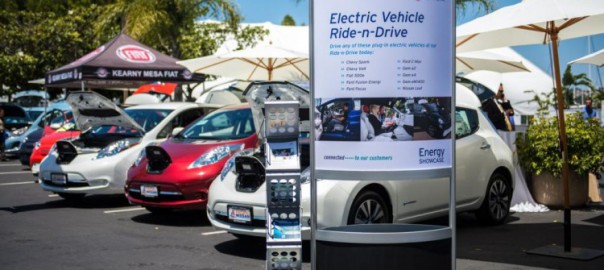
Electric cars on the SDG&E territory
There are over 13,000 plug-in electric cars in SDG&E’s service territory and, since the number of EVs is growing, charging power will be an important factor one day.
“The project currently aggregates stationary storage systems together with the charging demand of EV fleets at five separate locations throughout San Diego County. The assets are remotely controlled using software that both balances the participant’s charging needs, and identifies opportunities to provide demand response services at the grid level. Demand response is when customers don’t charge EVs or consume energy at peak hours, which alleviates stress on the grid and helps make sure adequate resources are available for the entire region. The project achieves this by correlating charging activity with wholesale energy prices. By agreeing to not charge in certain high price hours, the aggregated resource is paid the marginal energy price in those hours, similar to a conventional generator. The pilot project will end in late 2015.
Besides being among the first to integrate electric vehicles into California’s energy markets, the project is identifying both barriers and best practices for future, large scale integration and interaction of dispatchable distributed energy resources with wholesale markets, and creating tools to evaluate growth opportunities for those resources.”
Picking up the Leaf in Wolverton early in the morning (Image: T. Larkum)
Having had a try out with a Nissan Leaf, I was ready for a longer journey in one, and the Ecobuild Event in March gave me the perfect opportunity. It was located at the Excel Centre in London’s docklands so was a good distance from home in Northampton, but not far as to make me nervous in a new car.
I booked the car from the e-Car Club as before. However, there wasn’t one free in Northampton this time so I had to get one from Wolverton, near Milton Keynes. That wasn’t a problem, though, as it was on the way to London. An advantage was that this Leaf had a satnav, which was noticeably missing from the Northampton one.
The journey was relatively straightforward, though it turned out that I was overconfident in my knowledge of the Leaf. It appeared to indicate that it had enough range to get me from MK to Excel without charging. However, I hadn’t appreciated that the satnav was set to choose the shortest distance route. Instead I had planned to stay on the motorway as much as possible, around the M25 and down the M11. Therefore as I passed ‘shortcuts’ off the motorway at each junction the satnav kept recalculating the remaining distance, and of course it kept increasing. One to remember for next time!
Anyway, to cut a long story short I had to pull off just short of my destination to get a top-up in Ilford. As has happened before, I suffered from not knowing the foibles of the local charging infrastructure. There didn’t seem to be charge points where they were supposed to be according the Zap-Map, and one that did exist had tapes over it saying “QA Passed Awaiting Commission”!
So near yet so far – an Ilford charge point installed but not yet commissioned (Image: T. Larkum)
I finally got a charge in a local council office car park, courtesy of the staff, though I had to share the charge point with an employee’s Toyota Prius. However I was disappointed to hear that it wasn’t supposed to be on the public map and that they would now apply to have it removed!
The irony was that having arrived at the Excel car park, and hunting out the area marked out for public charge points, there were dozens to choose from. Since the Ilford charge point had only been a slow one, and so I had only got a partial charge, I was very grateful to plug in here.
Borrowing a slow charge in a council car park (Image: T. Larkum)
Ecobuild is marketed as ‘The sustainable design, construction and energy event for new build, refurb, commercial and domestic buildings’. My interest in it was primarily about looking for potential domestic energy solutions for Fuel Included customers. Essentially these were solar panel systems, and domestic energy storage systems (ESS), both of which fit well with an electric car household.
I began my visit by meeting up with a colleague and having lunch. Then we toured the hall just seeing what caught our eye. There were dozens of stands offering solar panel systems – it is clearly now a commodity product. Of more interest was the handful of stands offering home battery storage – a market that is obviously in its infancy, but which has great potential for the future.
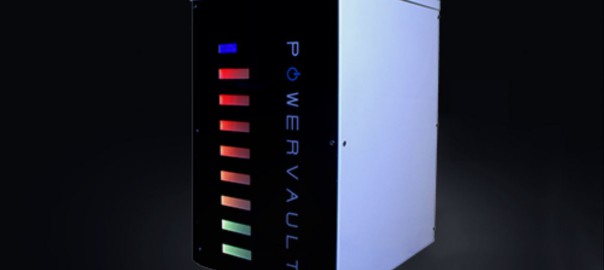
Powervault Energy Storage System (Image: Powervault.co.uk)
Most of the storage systems were unpriced, or had guide price that were very high – of the order of £5000-£10000 for a typical domestic system. However, we spoke at some length with Joe Warren, MD of Powervault, about their system and found it very interesting. It uses lead-acid batteries currently (to be economic) and so systems with capacities in the 2 to 4kWh range could be had for £1800 to £2200 respectively which is very encouraging. Later versions will have the option of Lithium Ion batteries.
After a loop of the hall we used our remaining time to attend a seminar entitled ‘Ask the expert: Energy storage masterclass’. This had five presentations, including ‘Energy Storage Systems’ by SMA Solar, ‘Optimising PV storage with electric vehicles’ by British Gas, and ‘Utilities perspective on storage’ by SSE.
Maslow Energy Storage System (Image: MoixaTechnology.com)
However, the standout presentation for me was ‘Distributed battery storage with Maslow’ by Simon Daniel, Founder and Chief executive of Moixa Technology. He talked about work done by Moixa on developing and trialling domestic storage systems, combined with a vision for using distributed storage at scale for network control and balancing. I think this strategy fits very well with Fuel Included’s philosophy of providing domestic electric vehicles, solar power and energy storage so perhaps our paths will cross again at some point in the future.
After the event was over for the day I returned to the Leaf and found it fully charged. Notwithstanding that, I planned to stop off on the way home for a quick charge. I did this uneventfully at South Mimms, after fighting through dreadful traffic to get away from Docklands. I then dropped the car in Wolverton before heading back home in my ZOE.
Grabbing a quick charge at South Mimms late in the evening (Image: T. Larkum)
It had been a very useful day, not just in terms of learning about future energy systems, but also in getting some real-world usage of a Leaf.