The energy storage market is set to soar, predicts Navigant Research.
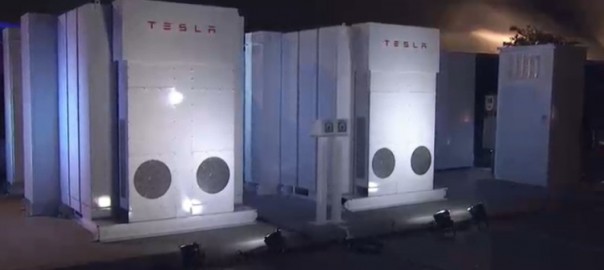
Tesla Energy “Power Packs” Using Solar PV Power
How big will the market become? According to Navigant, we can expect market revenue of nearly $75 billion for energy storage enabling technologies from 2015 to 2024:
Energy Storage Enabling Technologies Revenue is Expected to Total Nearly $75 Billion from 2015 to 2024, According to Navigant Research
Systems integration services are projected to be highest in the energy storage enabling technologies value chain, report finds
Where Australia leads – with its large amounts of sunshine – the UK should eventually follow
When Jane Whiltsher used to open her power bill it grated.
“I always felt that I was being ripped off,” she says.
“It’s just the way they operate. It keeps going up and up.”
Two months after having a rooftop solar and battery system installed, it’s a different story.
Lithium-ion batteries have been on offer to Australian homes and businesses for the last year or so
Whiltsher’s bill has more than halved. She enjoys the novelty of watching her “new toy” transforming the flow of energy around her house, leaving her largely independent of the wires outside.
At approaching $40,000, it hasn’t been a cheap investment. But that’s not the point.
“As far as I am concerned if it takes me off the grid then it’s paid for itself already,” she says.
Whiltsher’s enthusiasm to invest hard-earned cash for a home power system that may take as long as 12 years to pay for itself is being echoed around the country as Australians race to install batteries.
It’s encouraging to hear this kind of optimisim made public!
Tesla Motors CTO JB Straubel was the headliner at Intersolar North America last week. He talked about the transition to lithium-ion batteries and how that opened the floodgates for electric cars and stationary storage (eventually); the synergy between EVs, solar, and grid storage; the growth of solar power and grid storage; blah blah blah.
I know, I actually love all that stuff as much as the rest of you — it’s what I read, edit, & write about every day(!) — but it’s basically all general history and trends we know all about. But then JB dropped the awesome-bomb:
“I think we’re at the beginning of a new cost-decline curve, and, you know, this is something where there’s a lot of similarities to what happened with photovoltaics. Almost no one [would have predicted] that photovoltaic prices would have dropped as fast as they have, and storage is right at the cliff, heading down that price curve. It’s soon going to be cheaper to drive a car on electricity — a pure EV on electricity — than it is to drive a gasoline car. And as soon as we see that kind of shift in the actual cost of operation in a car that you can actually use for your daily driver, you know, from all manufacturers I believe we’re going to see electric vehicles come to dominate the whole transportation fleet.
“Also, that same battery cost decrease is going to drive batteries in the grid. There’s going to be much faster growth of grid energy storage than I think most people expected. You suddenly get to have energy that’s 100% firm and buffered from photovoltaics that’s cheaper than fossil energy. And we’re within sort of grasping distance of that goal, which is very, very exciting.
“Because once we get to that, and there really is no going back, it will make sense to do this economically without any environmental consideration whatsoever. So that’s the amazing tipping point that’s going to happen within I’m quite certain the next 10 years.”
Energy storage is heralded as the critical technology that will make widespread adoption of renewable energy possible. Storage bottles sunlight, addressing a key drawback to solar energy — that it can’t provide electricity when the sun isn’t shining. Energy storage also cures additional utility ailments from grid resiliency to power smoothing.
Due to a rise in incentives and a drop in storage costs, the market for this storage is heating up in the U.S. The market is expected to grow 250 percent just this year.
California is leading the energy storage market thanks to Assembly Bill 2514, which requires state utilities to procure 1.3 GW of storage by 2020. Now California’s three largest investor-owned utilities, Southern California Edison (SCE), Pacific Gas and Electric (PG&E) and San Diego Gas & Electric, are installing cost-effective storage solutions. SCE, for example, invested in a wind farm in the Mojave Desert equipped with giant lithium-ion batteries. The East Coast is following California’s example. New York recently budgeted $25 million to promote storage development.
While the utility-scale market gets most of the attention, a quietly growing storage market segment with a lot of potential is residential solar. After all, residential solar is a fast growing solar market segment — increasing 49 percent in 2014. Unsurprisingly it offers immense opportunity for storage.
The trend towards cheaper home energy storage shows no sign of slowing down
London startup tailors smaller, cheaper battery for UK households to use more of their own generated solar energy
When Elon Musk, the chief executive of Tesla, took to the stage in California in April to launch a solar battery for the home, the audience hollered and whooped at every detail. On the other side of the Atlantic, a more modest, quieter challenger plans to take on the US electric car giant.
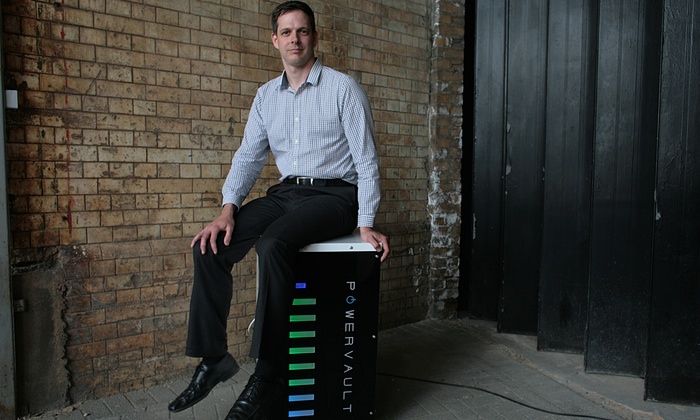
Based within a railway arch, with the sound of trains running overhead from nearby London Bridge station and surrounded by other ecologically minded startups, the offices of Powervault are a far cry from Tesla’s showpiece Californian stage. The similarity lies in the product – the Powervault battery, which stores energy from domestic solar panels.
“Some people, especially if they don’t have solar panels, just assume solar panels come with a battery,”
says Joe Warren, Powervault’s managing director. They don’t.
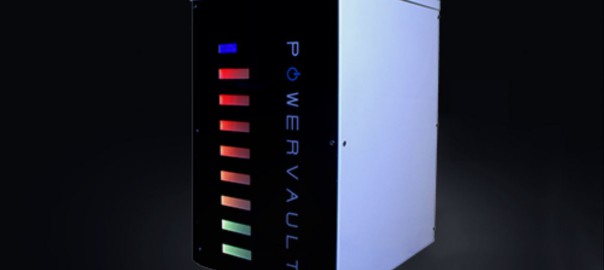
Joe Warren and his Powervault domestic solar power battery (Image: M. Godwin/Guardian)
Home energy generation has blossomed in the UK over the past four years, with an estimated 650,000 homes fitted with solar panels. In 2010, the government introduced the feed-in tariff scheme to pay householders who produce and supply energy. The scheme aims to push renewable energy in the UK towards 15% of total energy by 2020. In 2009, the figure stood at 2%.
Powervault, Tesla and other players in the emerging solar battery market aim to supply the means for householders to store energy produced during the sunniest part of the day for use at peak times, when more people are at home but the sun is down.
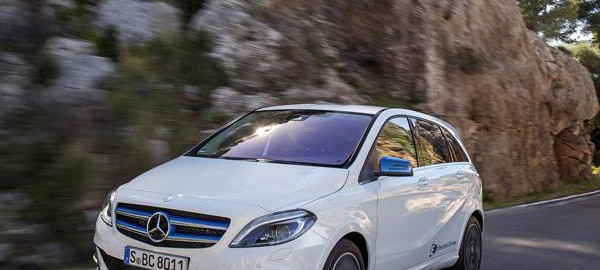
Tesla may be the automaker with the highest profile on energy storage, but they’re not the only ones. Now Mercedes goes public with its plans.
As the newest carmaker on the block, it’s perhaps not surprising that Tesla Motors likes to do things differently. That includes reaching beyond the automotive sector with its recently-announced plans to sell standalone battery packs for home and commercial energy storage. Yet that seems to be an idea the world’s oldest car manufacturer is pursuing as well.
Mercedes-Benz now plans to enter the energy-storage business as well. A division of parent company Daimler has been testing battery packs that can power houses, and plans to launch commercially in September, according to Australia’s Motoring.
Like Tesla, Daimler has tested quietly energy-storage systems for some time.
It looks like affordable home energy storage could finally be coming available in the UK
Maturing and more affordable storage technology promises to “revolutionise” the UK solar PV market, according to a panel at today’s Solar Finance and Investment Conference.
Ray Noble, consultant to the Renewable Energy Association, said that while some storage technologies were 10 to 20 years away from being realised, technological advancements in lithium ion batteries – driven largely by the automobile sector – had meant that storage batteries for residential installations could be affordable within two or three years.
The timeline fits well with projections conducted by industry analysts, with IHS having previously forecast grid-connected energy storage installations to surpass 6GW in 2017, almost treble the 2GW+ estimate for 2015.
This article argues that Australia has all the ingredients to be the world’s leading market on battery storage: Lots of solar, high prices, and a consumer base that is independent, cost conscious and distrustful of incumbents. It’s from Renew Economy.
There is no doubt that Australia is going to be at the leading edge of battery storage, that is because of the huge number of solar panels already on household rooftops, the high electricity costs (particularly network charges), and the excellent solar resources.
But there is more than that behind the reason so many global battery storage developers are targeting Australia as their first big market, and a test case to the world. It is also about the unique approach Australians have to their energy supplies, a healthy cynicism about the incumbent utilities, and a yearning for energy independence.
Australia, according to Greg Bourne, the chairman of the Australian Renewable Energy Agency, is about to enter the “iPhone” moment in battery storage.
“It would appear that energy storage has arrived!” Bourne told the Australian Energy Storage conference in Sydney. “Of course it’s been around for quite a time in some form or other but just like 2007 was the iPhone moment; 2015 might be seen as the Tesla moment!”
A houseowner in Lewes has become one of the first in the area to use state-of-the-art lithium battery technology to store energy from solar PV panels.
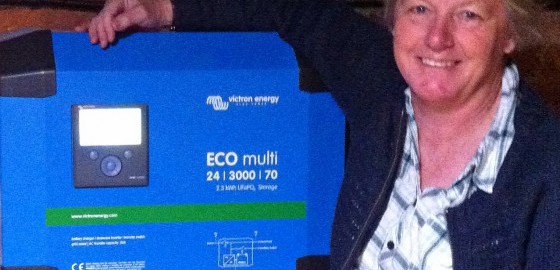
Jill Goulder has installed a lithium battery storage system linked to her solar PV panels. These recharge during sunlight hours and provide power in the evenings – very useful for households who use most of their electricity outside sunlight hours.
Jill Goulder with lithium battery for storing solar electricity (image: YouGen)
The system switches seamlessly between battery and mains supply as needed; a good system will cover a household’s normal needs, though major appliances such as washing machines and vacuum cleaners drain the batteries rapidly and will need mains top-up.
Jill says
“Lithium batteries are the new generation of energy storage, and they’re decreasing in price. My electricity bills are already very low, but I liked the idea of using all the electricity that I generate with my solar PV panels; and it gives me supply security in case of the mains power cuts.”
The system can be monitored online by the user on their own computer, with graphics showing consumption and battery usage throughout the day.
The system is housed in a blue metal box about the size of an airline carry-on bag, bolted to a wall, for example in an attic. The installed price for a small-to-medium system is likely to be £4,000 – £8,000, so it is not for everyone, though it’s becoming a favoured investment for householders with solar PV panels who are looking to take the next energy reduction step. Jill thinks that sooner or later Britain will follow Germany’s lead in providing a subsidy for householders investing in these systems.
Importantly, this particular system will also work in a power cut. Jill comments
“I do know that some companies are selling systems that don’t work during a power cut (and unscrupulously not telling customers), but it was a no-brainer for me to have that – it was a major factor in buying it, as outages are increasing.”
Jill adds
“Do use a reputable supplier for your installation – there are cold callers in this area offering quick sign deals that are less good value than they seem; and check too that the system you buy will continue to work during a power cut. Analyse your electricity use carefully beforehand: when are your peak times for using electricity each day, and can you install more energy efficient appliances or LED lighting? And ask around for advice – in Lewes the Transition Town Lewes Energy Group will be able to help you.”
Jill’s installation is a Victron EcoMulti Hub-2 (2.3kWh storage, 3kVA inverter) installed by Bright Green Energy Ltd of Beckenham, linked to her 1.29kWp solar PV system.
The appearance of Tesla’s new battery solution we wrote about here has not gone unnoticed by Jill. She comments
“I’m simply boggled at seeing front page stories last week in the UK about Tesla unveiling magical new technology which would allow you to store the energy from your solar panels. Hello, storage batteries have been around for 200 years… Certainly lithium is a new, better technology, but Tesla certainly aren’t the first by a long mile.”
On the plus side, she says
“It all helps generally in focusing on storage. As you doubtless know, some sunny countries are pressing solar panel owners to invest in storage as the daily surge into the grid from the panels are causing problems!”
Jill Goulder is an archaeologist and also a SuperHomer. Jill has refurbished her Victorian terraced cottage and achieved a radical 61% carbon saving. See Jill’s SuperHomes page for more about her continuing house improvements including this latest addition of lithium battery technology.
Earlier this year I saw an all in one inverter and domestic battery unit on display at the Bosch stand at CES.
2 years ago I stayed with my friend Simon Hackett in Adelaide, Australia and saw his line up of domestic batteries in sturdy cabinets outside his home. Simon’s house is covered in solar panels, he makes more electricity than he can use and he runs three electric cars from this power source.
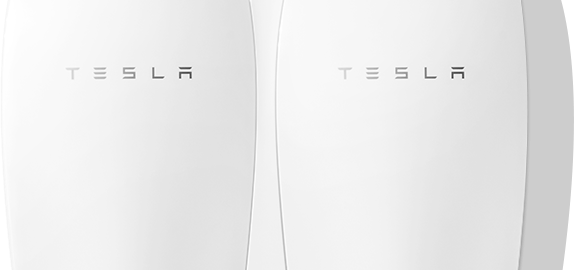
Yesterday Tesla announced its domestic battery range.
Tesla Powerwall home battery storage system (Image: Tesla)
So, is this yet further ‘playthings for the rich’ as so many suggest to me on the Twitters?
What role can a domestic battery have for the ordinary Joe/Joanne?
With the advent of ever cheaper and more effective lithium ion battery technology, something government supported scientists have been working on for the last 40 years, a new paradigm is beginning to emerge.
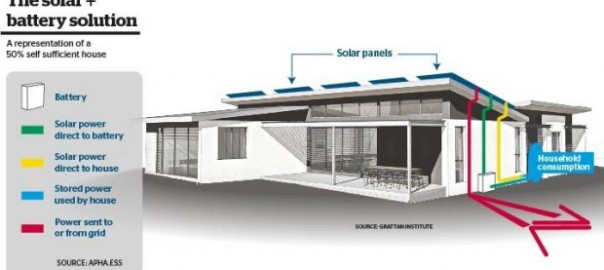
On a personal level, if you have a few solar panels and a battery in your home, this doesn’t mean you can ‘live off the grid’ but it does mean you can reduce your electricity bill by a much larger amount that you can at the moment. You can obviously store the electricity coming from your panels during the day when you are not home and use it in the evening when you return.
But that really isn’t the story.
If a thousand homes had solar panels and domestic batteries fitted, it wouldn’t make any difference to the national picture.
Those homeowners would benefit from greatly reduced bills and maybe feel smug, but that’s about it.
If ten thousand houses had them, it might be possible to register the reduction in peak demand at the National Grid control room I visited for a Fully Charged episode.
If a million homes had them, solar panels or not, it would make a very profound difference.
If 10 million homes had them, well, everything would change.