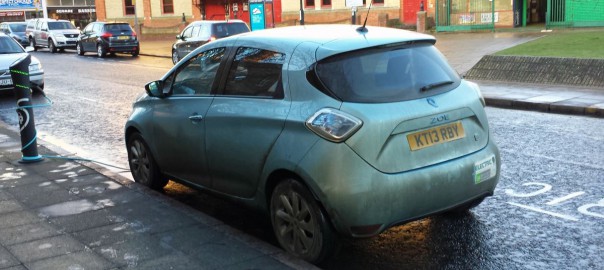
After Milton Keynes Council’s electric vehicle partner Chargemaster Plc announced that it was offering a free electric vehicle loan service to Milton Keynes businesses – the company has seen a surge of interest, with the vehicles now being in ‘high demand.’
Chargemaster has a small fleet of electric vehicles (EV) that can be loaned to companies (and their staff) within Milton Keynes to allow them to experience an electric vehicle for themselves and to see what the benefits of electric motoring are.
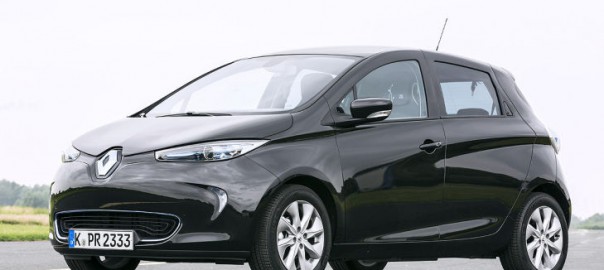
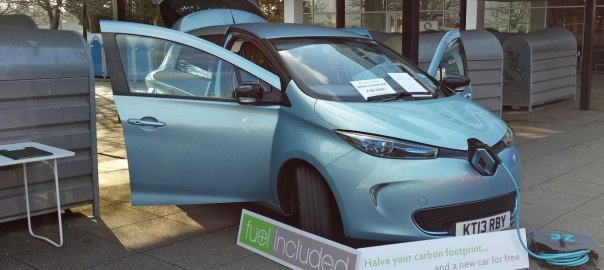
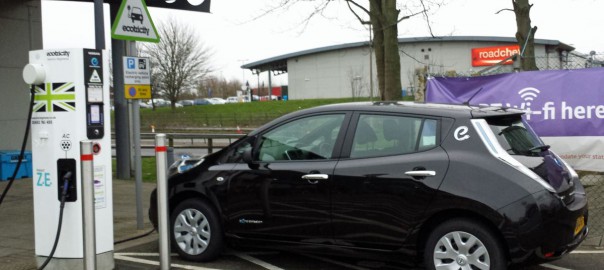
A Renault Zoe and two Nissan Leafs are available for loan to MK companies. No charges are levied and companies have the free use of over 200 charging points in the Milton Keynes area including 56 rapid chargers which recharge these cars in less than 30mins.
Businesses in Milton Keynes are being given the opportunity to test out electric cars
Loan cars are available typically for two weeks at a time and are subject to availability on a first come first served basis.
Chargemaster require copies of drivers’ driving licences but otherwise there is no formal paperwork to complete.
This is a great way for companies to sample the benefits of EVs for themselves without having to buy a vehicle first.
With over 20 electric cars on the market from manufacturers such as BMW, VW, Audi, Renault and Nissan, there is a lot more choice within the EV market.
Over the next five years it is predicted that EVs are likely to become the mainstream vehicle with virtually every car manufacturer producing either plug-in hybrids or pure electric EVs with increasing range of over 150 miles.
Electric vehicles provide huge benefits such as low fuel costs, quieter engines and low emissions which will improve air quality in the city.
There are also considerable economic benefits for both companies and employees with very low benefit in kind taxes.
For further information contact Trevor via email (sales@fuelincluded.com).
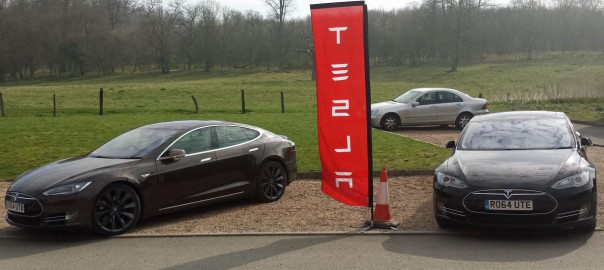
In April we organised a test drive of the Tesla Model S for a group of drivers. There was a Tesla Event scheduled for Warwick so we booked in for that. On the morning of the big day we headed over there in my ZOE.
Our very own Tesla Model S – for a while anyway (Image: T. Larkum)
We arrived a little early and they were still setting up so we waited with a coffee and Danish pastry before having a brief presentation on the Model S. Then we headed out with our guide, Adrian. We each took a turn of 10-15 minutes driving before swapping over, and overall took in a large loop around the local area.
The Model S touchscreen system (Image: T. Larkum)
I was very impressed with the car, both with the driving and the technology. It really does accelerate very hard and fast, yet quietly and smoothly. It feels a little unnerving, a bit like holding a loaded gun, as it can just take off at any moment. And this was only a standard performance model, the P85, not the new higher performance 4WD version, the P85D.
The boot – with the lift-up panel for the rear jump-seats just visible (Image: T. Larkum)
I very much liked the media system with its large 17” touchscreen. It seemed very futuristic, and was intuitive to use. Certainly I can appreciate the attraction of having such a large display for your satnav, or the option of the satnav and media player each having half the screen.
The famous ‘frunk’ (front trunk) resulting from the motor being between the rear wheels (Image: T. Larkum)
The time to return the car came only too quickly. After a quick debrief we headed back to Northampton in the ZOE. I very much enjoyed the test drive, and I know it definitely opened the eyes of a group of petrol-heads to the possibilities of driving on electricity – the Tesla grin was evident. One of the drivers has since bought a Leaf. Roll on the UK launch of the more affordable Tesla Model 3!
In answer to some questions about the back seat of the ZOE I did some experimentation on the fitting of car seats and head restraints (‘headrests’).
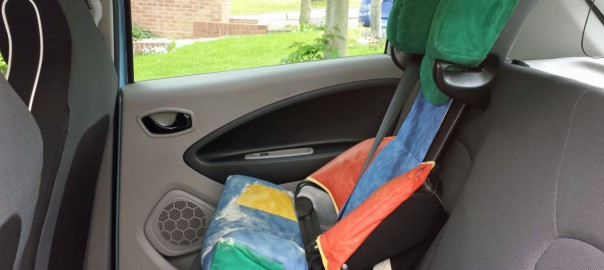
A large child’s car seat fitted in the rear of our Renault ZOE (Image: T. Larkum)
Our youngest daughter used a tall car seat in the back of the ZOE until she was about 11. I don’t know if it’s generally the case, but the seat we had (a ‘Concord Lift’ about 10 years old) fitted fine so long as the respective headrest was removed from the ZOE’s back rest. Then the seat fitted well, flush with the back of the backseat.
A large child’s car seat fitted in the rear of our Renault ZOE (Image: T. Larkum)
With regard to head restraints the ZOE has two for the outer positions on the back seat. Renault certainly provides the option for a third, central one, for example as part of the Luxe Pack. What is not clear is if this can be a post-delivery or even DIY option.
Today, after attending a customer test drive at a Renault dealership, I called into the parts office and enquired about buying just a head restraint. For that I was quoted £21.36 plus VAT (making £25.63) which seemed like a very reasonable price. Unfortunately there was not one in stock so I couldn’t see what parts were included.
The back seat zips are tucked into the corner as highlighted (Image: T. Larkum)
At home I was curious to learn more and so took apart the back of the seat. The back is held on with two zips. To make things a bit more difficult – presumably to discourage fiddling – the zips don’t have handles on them, and the loose ends are tucked into the hole formed where the zips come together. With a bit of patience it’s possible to pull out the ends of the zips and open them.
Inside the back seat showing an existing head restraint, left, and the fittings waiting for a central head restraint, right (Image: T. Larkum)
Inside the back of the seat it is clear that there are structural tube supports for a central head restraint so it should be straightforward to fit one, though of course it would be necessary to pierce the fabric on the top edge (which appears seamless otherwise). A bit more investigation is required, however, to find out if all the parts required for DIY fitting are included in the standard part set – for example, the plastic liners to the tube supports (these can be seen for the existing head restraint but are not in place for the central one).
We had the latest PCP prices for the Renault ZOE (effectively an electric Clio) confirmed today and they are looking very good. Renault recently rejigged its prices significantly, essentially reducing the monthly cost of the car while at the same time increasing the cost of the battery rental.
The end result is a substantial reduction in cost overall, particularly for low mileage drivers. Also, the PCP term was previously either 36 or 48 months, but now the term can be 24 months, and this is now the term with the lowest prices. This makes it seem like a particularly attractive and low risk deal.
750 miles per quarter: £75 deposit plus £145 per month, Fuel included*
7500 miles per year: £75 deposit plus £180 per month, Fuel included*
9000 miles per year: £90 deposit plus £190 per month, Fuel included*
10000 miles per year: £100 deposit plus £199 per month, Fuel included*
For clarity the monthly figure includes the battery rental. Renault will also pay for the installation of a home fast charge point (7kW/30A).
Road tax is, of course, free, and no MOT is required during the term of the contract.
A home 13Amp charge cable isn’t included, though it isn’t required if the charge point is used – it can, however, be taken as an option for £22 per month. Metallic paint (black, grey, blue) is also available and, again, adds about £22 per month on a standard white finish.
For comparison, consider the current deal for the Clio Dynamique S Nav TCE 90 for which the deposit is a massive £3571 and the monthly payment is £169. At 60mpg, if you could get it fuel included it would cost an additional £55 per month in fuel for 7000 miles per year. Therefore in total over 24 months it would cost £373 per month compared to the ZOE’s £183.
You could therefore run two ZOE’s for the price of a Clio, and still have some change left over. And being electric the ZOE is much nicer to drive, and can be run from a renewable energy supply.
It’s worth noting that you get a lot of car for your money. The ZOE Intens is a very high specification including satnav with traffic control, bluetooth, MP3, auto-lights, auto-wipers, electric mirrors and windows, reversing camera, cruise control, speed limiter, traction control, keyless entry, alloy wheels, air conditioning, etc. And being electric you can monitor the battery charge and remaining range, and control the heating or air conditioning, from your smartphone.
*Fuel Included
The following are included on a fuel included deal:
Fuel (electricity) for the given mileage on Economy 7
Registration and access cards for the biggest charging networks: Ecotricity and Chargemaster/Polar
Registration for London congestion charge exemption
Out of hours telephone and email support for the first 6 months
Office hours telephone and email support for the duration of the contract
One of the best benefits available for drivers of electric cars is that London Midland provides free car parking at its railway stations.
This is particularly attractive at two of its stations, Milton Keynes and Watford, as they have very high parking charges (an annual season ticket at these stations costs £1200 and £1093 respectively).
Fuel Included ‘pop-up shop’ outside Milton Keynes Central railway station (Image: T. Larkum)
The deal is that London Midland provides a discount off a car parking permit at its station car parks for what it calls an “ECO friendly vehicle”. The discounts are as follows:
50% discount on monthly, quarterly and annual parking permits if the vehicle emits no more than 120g of carbon dioxide every kilometre (120g/km).
100% discount on monthly, quarterly and annual parking permit, if the vehicle is registered with the DVLA and has “Electric” fuel type. This can be checked on the vehicle registration document (V5C) sent by the DVLA.
Full details are given on the London Midland website for the parking permits and their associated discounts; they are very generous. Clearly if someone pays £200 per month to lease one of our electric cars, for example, they can get back half that money just from savings in parking charges.
Rapid Chargers next to Milton Keynes Central railway station parking (Image: T. Larkum)
We used this idea recently as the basis for a marketing campaign, in two parts. Firstly we set up a small ‘pop-up shop’ outside Milton Keynes Central station. This was done in a similar way to the school event we did late last year, with the ZOE on display and me chatting to passers-by. It ran for a couple of hours in the early evening to catch commuters on their way home.
Renault ZOE in Milton Keynes Central railway station multi-storey (Image: T. Larkum)
Secondly, we did a pass through the station car park a couple of days later, putting fliers under the wipers of cars with season tickets in the windscreen to give information on the discount and our offers. While there I noticed there was a new pair of rapid chargers installed outside and awaiting commissioning, so it definitely looks like a welcoming location for electric cars.
Vauxhall Ampera in Milton Keynes Central railway station multi-storey (Image: T. Larkum)
Inside the multi-storey part of the car park there were already a couple of EVs in residence, a Renault ZOE and a Vauxhall Ampera. With a bit of luck there will be a lot more soon.
Picking up the Leaf in Wolverton early in the morning (Image: T. Larkum)
Having had a try out with a Nissan Leaf, I was ready for a longer journey in one, and the Ecobuild Event in March gave me the perfect opportunity. It was located at the Excel Centre in London’s docklands so was a good distance from home in Northampton, but not far as to make me nervous in a new car.
I booked the car from the e-Car Club as before. However, there wasn’t one free in Northampton this time so I had to get one from Wolverton, near Milton Keynes. That wasn’t a problem, though, as it was on the way to London. An advantage was that this Leaf had a satnav, which was noticeably missing from the Northampton one.
The journey was relatively straightforward, though it turned out that I was overconfident in my knowledge of the Leaf. It appeared to indicate that it had enough range to get me from MK to Excel without charging. However, I hadn’t appreciated that the satnav was set to choose the shortest distance route. Instead I had planned to stay on the motorway as much as possible, around the M25 and down the M11. Therefore as I passed ‘shortcuts’ off the motorway at each junction the satnav kept recalculating the remaining distance, and of course it kept increasing. One to remember for next time!
Anyway, to cut a long story short I had to pull off just short of my destination to get a top-up in Ilford. As has happened before, I suffered from not knowing the foibles of the local charging infrastructure. There didn’t seem to be charge points where they were supposed to be according the Zap-Map, and one that did exist had tapes over it saying “QA Passed Awaiting Commission”!
So near yet so far – an Ilford charge point installed but not yet commissioned (Image: T. Larkum)
I finally got a charge in a local council office car park, courtesy of the staff, though I had to share the charge point with an employee’s Toyota Prius. However I was disappointed to hear that it wasn’t supposed to be on the public map and that they would now apply to have it removed!
The irony was that having arrived at the Excel car park, and hunting out the area marked out for public charge points, there were dozens to choose from. Since the Ilford charge point had only been a slow one, and so I had only got a partial charge, I was very grateful to plug in here.
Borrowing a slow charge in a council car park (Image: T. Larkum)
Ecobuild is marketed as ‘The sustainable design, construction and energy event for new build, refurb, commercial and domestic buildings’. My interest in it was primarily about looking for potential domestic energy solutions for Fuel Included customers. Essentially these were solar panel systems, and domestic energy storage systems (ESS), both of which fit well with an electric car household.
I began my visit by meeting up with a colleague and having lunch. Then we toured the hall just seeing what caught our eye. There were dozens of stands offering solar panel systems – it is clearly now a commodity product. Of more interest was the handful of stands offering home battery storage – a market that is obviously in its infancy, but which has great potential for the future.
Powervault Energy Storage System (Image: Powervault.co.uk)
Most of the storage systems were unpriced, or had guide price that were very high – of the order of £5000-£10000 for a typical domestic system. However, we spoke at some length with Joe Warren, MD of Powervault, about their system and found it very interesting. It uses lead-acid batteries currently (to be economic) and so systems with capacities in the 2 to 4kWh range could be had for £1800 to £2200 respectively which is very encouraging. Later versions will have the option of Lithium Ion batteries.
After a loop of the hall we used our remaining time to attend a seminar entitled ‘Ask the expert: Energy storage masterclass’. This had five presentations, including ‘Energy Storage Systems’ by SMA Solar, ‘Optimising PV storage with electric vehicles’ by British Gas, and ‘Utilities perspective on storage’ by SSE.
Maslow Energy Storage System (Image: MoixaTechnology.com)
However, the standout presentation for me was ‘Distributed battery storage with Maslow’ by Simon Daniel, Founder and Chief executive of Moixa Technology. He talked about work done by Moixa on developing and trialling domestic storage systems, combined with a vision for using distributed storage at scale for network control and balancing. I think this strategy fits very well with Fuel Included’s philosophy of providing domestic electric vehicles, solar power and energy storage so perhaps our paths will cross again at some point in the future.
After the event was over for the day I returned to the Leaf and found it fully charged. Notwithstanding that, I planned to stop off on the way home for a quick charge. I did this uneventfully at South Mimms, after fighting through dreadful traffic to get away from Docklands. I then dropped the car in Wolverton before heading back home in my ZOE.
Grabbing a quick charge at South Mimms late in the evening (Image: T. Larkum)
It had been a very useful day, not just in terms of learning about future energy systems, but also in getting some real-world usage of a Leaf.
The most popular car we supply is, naturally, the Nissan Leaf – the most popular electric car in the UK and, in fact, the world. However, being a Renault ZOE driver, it is relatively unfamiliar to me. I’ve only driven it twice, once way back in 2012 and the second time more recently during the test drive day last December.
For a while I felt I ought to become more familiar with the Leaf and, having joined the e-Car Club, it seemed like the Club gave the perfect opportunity. I therefore decided on a free afternoon to book a Leaf from the Club for a couple of hours (it costs £6 per hour) and to take it for a spin.
There are three Leafs permanently parked up in Northampton town centre, close to the Derngate Theatre. They are connected to charge points so they are always ready for use. Having booked one online I went to pick it up, and that’s when things went a bit wrong.
e-Car Club Nissan Leafs outside Northampton Derngate (Image: T. Larkum)
The website gave instructions for unlocking the car which worked fine – you just need to use your access card on the windscreen sensor. However, it didn’t give clear instructions on the process for releasing the immobiliser – in fact, I didn’t even know there was one. Being unfamiliar with the Leaf things seemed to be going fine: it appeared to power up and then reverse gently out of its parking space. What I didn’t realise was that there was actually no power to the drivetrain and it was just rolling backwards down the slope from the pavement.
After an embarrassing time getting pushed to the kerb by passers-by I investigated further and found a PIN-machine in the glove box. Once given the correct number the drivetrain came to life and we were ready to go. I later found out that there were detailed instructions in a log book folder in the passenger door pocket.
Charging the Nissan Leaf at an Ecotricity Rapid Charger (Image: T. Larkum)
First of all we just took a quick trip back home, and then headed out for a longer run. I took it up and down the motorway for a while to get its charge level below 80%. That gave me the chance to try out a fast charge at Rothersthorpe Services (at Junction 15A of the M1). I found the Chademo connector very fiddly and it took a couple of attempts before I was comfortable inserting it correctly and getting the charge to work. I was also caught out by the fact the dashboard screen needs to be powered down to accept a charge (and you can monitor it by blue LEDs on the top of the dash). This is in contrast to the ZOE where you monitor the charging through the dashboard screen.
Anyway, learning about these issues and the differences from the ZOE was precisely the point of the exercise so I deemed it a success. After this time spent with the Leaf I felt much more comfortable driving and charging it, and felt ready to undertake a long journey in one.
Having used the FLIR camera to do an audit around the house I wanted to try a project where I could use it for a ‘before and after’ comparison. Since I only had a limited time before returning the camera, the project had to be fairly small. I decided on adding an insulating jacket to the hot water tank in our airing cupboard – something I had been meaning to do for some time.
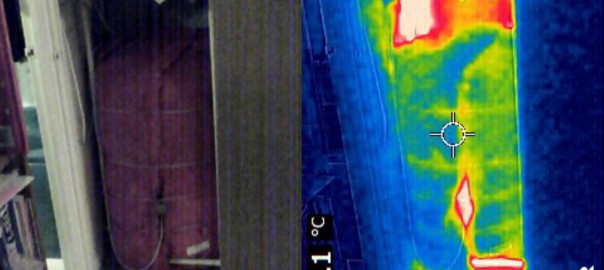
Figure 1 is the ‘before’ image showing the tank with its integral white foam insulation layer. In the IR image we can see that the tank shows up very hot in bright yellow and orange. We can also see a large amount of hot air above it, plus the hot pipes going into it show up white.
Figure 1: Composite image of hot water tank before insulating (Image: T. Larkum)
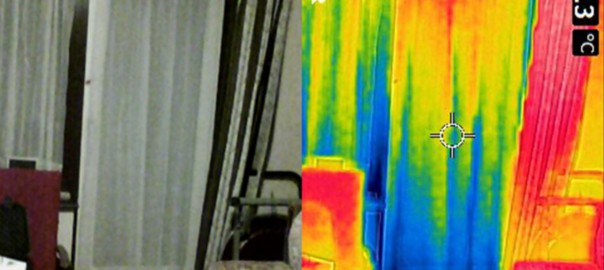
Figure 2 is the ‘after’ image showing the red insulating jacket I had tied around the tank – a standard jacket bought at a local DIY superstore for about £15. In the IR image we can see that the tank now shows up much cooler, mostly blue and green with some yellow patches. There is less hot air above it, while the hot pipes going into it still show up white – I’m planning to insulate those next. An intentional gap in the jacket around the thermostat can also be seen showing up in white.
Figure 2: Composite image of hot water tank after insulating (Image: T. Larkum)
Use of the FLIR camera clearly indicates the significant benefit of even this simple insulation project, with much less heat being lost from the hot water tank. This is confirmed by our experience in the following days that the hot water became noticeably hotter than it used to be so I was able to turn down the temperature on the thermostat, and so save money as well as waste.
Fuel Included isn’t just about electric cars, but about the transition to a low carbon lifestyle. One of the easiest ways to reduce your carbon footprint is to use less energy, and that can be as simple as wasting less energy around the home. A beneficial side effect is that you save money too.
A useful technique to investigate where heat is lost from your home is to use an infrared camera to show up areas that are cold and which typically indicate gaps around windows or doors, but which are not as obvious as draughts. The approach is known as Thermography but one of the most important early uses of infrared cameras was mounted on the nose of an aircraft for target location, so-called Forward Looking Infrared (FLIR) cameras. For this reason, and because the leading manufacturer of such cameras is known as FLIR Systems, the term FLIR is often used as a generic term for thermographic cameras.
Figure 1: FLIR Camera as delivered (Image: T. Larkum)
FLIR cameras have historically been very expensive to buy (though they are now coming down in price to typically about £1000) so there is a healthy rental market for them. Recently a group of colleagues at work clubbed together to hire one for a week and so I got a chance to try one out for a weekend for about £30.
Figure 2: FLIR Camera close-up (Image: T. Larkum)
The camera arrives in a big industrial box (see Figure 1) but it is actually quite small, about the size and shape of a radar gun (see Figure 2). It works much like a modern digital camera, with images recorded on internal memory that can be downloaded via a USB lead to a PC. A neat feature is that every image is recorded twice, as a conventional colour image and as an IR image.
Figure 3: Composite image of patio door showing cold spot along bottom edge (Image: T. Larkum)
I used the IR camera to do an ‘audit’ of the house, at night and in cold weather for maximum contrast. I imaged all the walls and doors, inside and out. I also checked each of the radiators to make sure they were working correctly. The IR images are coloured to show different relative temperature, from black (the coldest part of the image) through blue, green, yellow, orange, and red then to white (the hottest part of the image). So a gap around a door will show, say, dark blue while the rest of the door and frame are yellow and red. Similarly a cold spot in a radiator will show, say, green amongst mostly red.
Figure 4: Composite image of back door showing cold spot at cat flap and along right edge (Image: T. Larkum)
The images clearly showed up problems with our two back doors. The patio door had a very clear dark blue patch along the bottom (see Figure 3); we were already aware of a draught from this area. The main back door had a dark blue patch along the lock side, and another around the cat flap (see Figure 4). These are issues that I have noted to return to on another day to see if I can fix them with some draught proofing.
The FLIR camera was easy to use and I recommend it to anyone who wants to know more about where their home is leaking energy.
It doesn’t happen often, but we recently took a long trip in my ZOE that was easier than if we had taken a petrol or diesel car. We needed to travel to Peterborough Passport Office to renew my daughter’s passport at short notice.
Plan A was very straightforward – drive to Peterborough and slow charger there for the return journey. The beauty of this was that, with a bit of advance research, I found out that there was an electric car charging point and parking space on the same road as the Passport Office and very close to it.
Ecotricity Rapid Chargers at Haddon Services (Image: T. Larkum)
As ever, I had a Plan B, a contingency in case of problems. That was to charge at Haddon Services on the A1(M) just outside Peterborough. Therefore on the way to Peterborough we called in at Haddon. However, the AC rapid charge point wasn’t working so we just headed straight on to Peterborough.
In fact, we needn’t have worried. We found the parking space and charger by the Passport Office very easily and it was operating fine. It worked first time – we then headed into the Office to do the necessary paperwork. We then headed around Peterborough, visiting the various shops and restaurants to kill the requisite four hours until the passport was ready.
Slow Charging near Peterborough Passport Office (Image: T. Larkum)
Afterwards we unplugged and headed home. As the EV parking area was very close to the Passport Office and was neither occupied nor blocked (and, if memory serves me right we didn’t have to pay for parking), it turned out to be a long trip that was easier with an EV than if we had had a conventional car.