The Emirates Electric Road Trip was an amazing experience.
A combination of educational exercise, motivation to open new charging stations throughout the Emirates and a wonderful tour of an incredible area of the world.
The Emirates are investing more in renewables than you can literally poke a stick at.
They extract huge amounts of oil that they sell to us and they are using the money to create a long term, viable and sustainable energy infrastructure.
Okay, and they are building some ridiculously tall towers.
Not cheap, but charming, fun and with seriously practical performance and range.
It’s funny how perceptions change. When I was young in a sepia-toned world the drivers who were on the receiving end of most abuse were those behind the wheels of BMWs. Arrogant, aggressive and antagonistic with an addiction to tailgating was the accepted caricature of this firm’s car owners.
Times have changed though. BMW, for all its massive sales success in Ireland in the past 15 years, now has a slightly less combative image, one of classiness and desirability with a little less of the disdain from those unable to afford one.
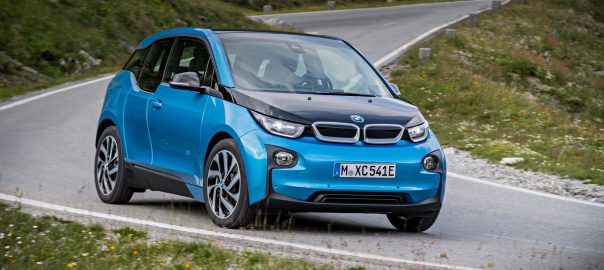
BMW i3
With the i3, there is the chance for BMW to slip seamlessly into full-on caring and sharing mode. The little electric car has been around since 2014, but had failed to make much of a dent in Irish buyers’ collective consciousness, mostly down to a combination of being small, with a big price tag and, well, electric.
For all the talk of Ireland being a perfect test case for the introduction of electric motoring, few brave souls have taken on the mantle of early adopter. A combination of cost, lack of infrastructure and that ever-present spectre of range anxiety has held people back.
Fortunes
Well, BMW has answered that in part by boosting the range of the i3 to a much more acceptable level. While the lithium-ion battery pack hasn’t been made physically larger, it has increased in capacity, to a very healthy 33kWh (up from 22kWh) and the i3’s part-carbon-fibre structure, light but strong and costing BMW several fortunes to develop, was always there to make the most of any extra range.
In fact, one-charge range climbed to 300km on the European NEDC (New European Driving Cycle), but cognisant that the official test has been thoroughly undermined in the public eye, BMW says 200km is a more realistic day-to-day figure.
So it proves. A writer must write of what they know, so I can only speak of how the i3 performed on my own regular driving cycle, but it is significantly improved.
I was testing the ‘REX’ version, the range-extender, which uses a tiny two-cylinder moped engine and a seven-litre tank of petrol to keep the batteries alive should you run out of charge with mileage still to go to get home. It adds, generally, around 100-120km of extra range, easing many the furrowed brow.
When buying an electric car it is nearly always worthwhile to get a dedicated charge point installed at home.
It’s more convenient than an ‘occasional use’ or ‘granny’ (13 Amp) charge cable because you don’t need to reel it up and put it away each time.
Charging a Renault ZOE with a Home Charge Point (Image: Charging Solutions)
It will also be significantly faster because a dedicated charge point can provide more power without the risk of overheating. Also some electric cars, such as the Renault ZOE, don’t come with such a cable and buying one yourself can be very expensive (£500+).
The good news is that the installation of domestic charge points is subsidised by the UK government.
There are 3 decisions to be made when selecting the type of charge point for your car:
Tethered or Untethered
Connector Types
Power Level
Tethered or Untethered
There is usually the choice of a ‘tethered’ cable (it is fixed to the charge point) or an ‘untethered’ cable (it plugs into and can be removed from the charge point).
Untethered and Tethered Charge Points (Image: Chargemaster)
Untethered has the advantage of allowing different cables to be connected (for example you can use the same charge point for a Nissan Leaf and a Renault ZOE). However, most people choose tethered because it avoids the inconvenience of connecting a cable whenever you need to charge (usually daily). It also reduces the risk of the cable being stolen.
A charge point with a tethered cable will usually cost more than an untethered one (typically about £50 more) because of the cost of its cable.
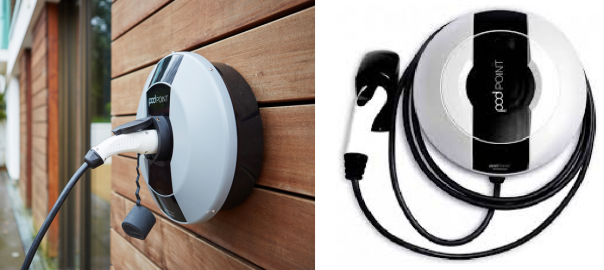
Untethered and Tethered Charge Points (Images: POD Point)
If you choose untethered you will need to use your own cable to connect to the car; it is the same cable that would be used to connect to a public charging point. It may come free with the car, for example the Renault ZOE or the Nissan Leaf with the 6.6kW charge option come with one. Otherwise you will need to buy one (we can advise you on suppliers).
Connector Types
All untethered domestic charge points supplied in the UK come with a Type 2 socket on the charge point, just as all public charge points now have (or at least officially should have) Type 2 sockets. Similarly all charge cables have a Type 2 plug at the charge point end.
Type 1 (5 pin) and Type 2 (7 pin) connectors
If the cable is tethered then you need to tell the installer the type of plug you want at the car end. This will depend on the car:
Type 1 socket: Nissan Leaf, Mitsubishi Outlander PHEV, Kia Soul EV
Type 2 socket: Renault ZOE, BMW i3, Tesla, VW e-Golf and Hyundai IONIQ
The Type 2 or ‘Mennekes’ connector is the official standard in Europe and should eventually replace the Type 1.
Power Level
A dedicated charge point can provide higher powers than a typical occasional use charging cable which will run at 10 Amps, equivalent at 230 Volts to 2.3 kilowatts. The charge will take place at the highest power that both the charge point can provide and the car can use.
There are two common power levels:
16A = 3.5kW: This is the maximum charge level of the Nissan Leaf 3.3kW, the Mitsubishi Outlander and the VW e-Golf.
30A/32A = 7kW: This is the maximum charge level of the Nissan Leaf 6.6kW, BMW i3, Kia Soul EV and Hyundai IONIQ. The standard Renault ZOE can use this level, in fact anything up to 22kW.
The higher power reduces the charge time so a typical EV battery will charge in about 8 hours at 16A but in about 4 hours at 32A.
It may be best to install the highest power charge point you can afford; even if your current car can’t use all the power, the next one almost certainly will be able to.
Niro Plug-in Hybrid model on sale across Europe during Q3 2017
8.9 kWh High-capacity lithium-polymer battery pack and 1.6-litre GDI engine
Development engineers target pure-electric range over 55 kilometres
CO2 emissions targeted to fall below 30 g/km
Plug-in Hybrid crossover offers 324-litre cargo space and spacious cabin
Advanced energy-saving measures and unique styling features
Optional Towing Pack with 1,300 kg capacity
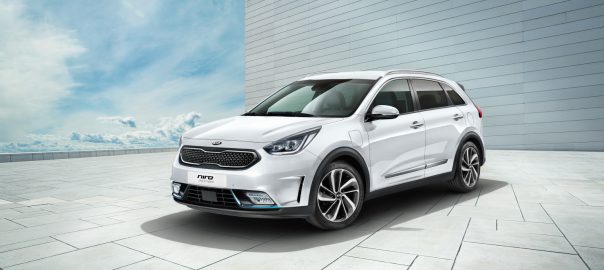
Kia Motors has today unveiled the Niro Plug-in Hybrid at the Geneva International Motor Show. The new derivative combines high versatility and crossover design appeal with maximum fuel efficiency from its advanced new plug-in hybrid powertrain.
The Niro Plug-in Hybrid will go on sale across Europe during Q3 2017, pairing an economical 1.6-litre GDI (gasoline direct injection) engine with a 8.9kWh high-capacity lithium-polymer battery pack. The latest addition to Kia’s hybrid crossover range substantially reduces emissions over the more conventional Niro hybrid – engineers are targeting CO2 emissions below 30 g/km (combined, New European Driving Cycle) and a zero-emissions pure-electric driving range of over 55 kilometres. Final electric range and CO2 emissions figures will be published closer to the car’s on-sale date.
Kia Niro PHEV, Plug In Hybrid, Geneva Motorshow 2017 (Image: Kia)
Michael Cole, Chief Operating Officer, Kia Motors Europe, commented:
“Annual sales of plug-in hybrid models in Europe are expected to grow to more than 600,000 units by the end of 2023, while the crossover market is also forecast to expand in the coming years. There is a clear demand from customers for a vehicle which combines the practicality and ‘cool’ image of a compact crossover with the ultra-low emissions of an advanced plug-in powertrain. The Niro Plug-in Hybrid will be the only car on the market to offer this combination.”
“The Niro Plug-in Hybrid is one of the latest low-emissions cars from Kia which will help the company achieve its global target for 2020 – to improve fuel efficiency by 25% compared with 2014 levels.”
The Niro Plug-in Hybrid is one of two low-emissions vehicles unveiled by Kia at the Geneva International Motor Show, alongside the new Optima Sportswagon Plug-in Hybrid.
Nissan has taken to social networking and microblogging site Twitter to announce the reveal of its next-generation all-electric vehicle.
The Japanese auto manufacturer tweeted on Friday, March 10, that the company’s all-new Nissan Leaf EV will be officially revealed in September and will go on sale before the year ends.
This is a screenshot of a video featuring the all-new Nissan Leaf EV (Image: HouseBear/YouTube)
Nissan tweets about the official release of its all-new Nissan Leaf. A September unveiling of its new Leaf means that excited fans could possibly see the all-electric vehicle at the Frankfurt Motor Show. The design of Nissan’s all-new EV is said to take inspiration from the IDS concept. The IDS concept debuted at the 2015 Tokyo Motor Show.
The Japanese auto manufacturer’s tweet specifically said that the all-new Leaf “will be globally revealed” in September. The tweet also mentioned that the vehicle will “go on sale before the end of the year.”
The current Leaf model has a range of 107 miles on a single charge. The next generation model is said to have increased mile range, possibly close to the Chevrolet Bolt EV’s range of 238 miles.
Asked if the all-new Nissan Leaf electric vehicle would be able to compete with Chevrolet’s Bolt EV at the 2017 Consumer Electronics Show, Nissan research and advance engineering Vice President Takao Asami answered,
“We can get to 200 or even 300. We can.” He further added, “The question is cost.”
The technology behind of the electric vehicle will most likely be the same one on the Renaut Zoe EV. The Renaut Zoe EV debuted at the Paris Motor Show in the previous year. The electric vehicle uses a lithium-ion battery pack supplied by LG Chem who also supplied Chevrolet with the Bolt EV’s battery. The Renaut Zoe EV, however, only boasts of a humble range of 189 miles compared to the Bolt EV.
The world is moving faster than we think towards more automated vehicles powered by renewable energy
Gone are the days when cars made in Britain were British. Monday’s sale of Vauxhall/Opel to Peugeot meant only the transfer of two large English factories from the German subsidiary of an American firm to a French company, accompanied by the ritual promises that jobs would be safe. These seem insubstantial, given that the new management plans to save €1.7bn a year from the old Opel operation, while the Vauxhall factories made a heavy loss after the pound’s post-referendum slide. Yet the contortions of government policy which once accompanied threats to the car industry went quite unseen this time. But there is one small aspect of the deal in which it appears that Mrs May’s industrial strategy might be an intelligent deployment of very limited resources. The future of the car industry is clearly electric, and the development of battery technology – something the government plans to support – will be vital.
Electric cars charging in Milton Keynes (Image: T. Larkum)
Against the protectionism practised by the Chinese government, which is determined to dominate the world market, and to supplant the Japanese and Korean firms which now provide most of the world’s batteries, any effort by the British government is likely to prove inadequate. Especially a British government which has ended its own participation in the single market; but at least it is playing in the right game.
At the moment, wholly electric cars are still a tiny minority of those on the road, but their number is growing very fast as they become more affordable and more practical. Their advantages to society are obvious: they pollute far less than internal combustion engines, and use less energy too. A city of electric cars will be cleaner and quieter than our present stinking streets. And at some stage in the next decade, their advantages to private drivers will become overwhelming. The electric car will become a mainstream status symbol and it is the buyers of internal combustion vehicles who will feel like weird outsiders. The Dutch parliament has considered a measure which would make all cars sold there electric by 2025. A recent thinktank report suggests that 10 years after that a third of all the vehicles sold in the world will be electric.
New electric cars must travel further and need less time to recover from their journeys than those that can be bought today, when long journeys are still fraught with anxiety. This means lighter batteries that hold more charge and can be charged more quickly; they are appearing already and the huge amounts of global investment make it likely that progress will continue and technology will supply what the market needs.
Stepping back for a moment, the rise of electric and largely automated cars might change the world around us almost as profoundly as the internal combustion engine did. Part of this is their obvious role in transportation. All-electric traffic will be faster, reversing the trend of the last century. Lighter cars will accelerate and brake more quickly, while increasing automation will mean traffic moves more freely. If those trends continue, the private car might disappear altogether, replaced by a network of hired autonomous vehicles, at least within cities. The beginnings of this development are already visible in the reluctance of young people to learn to drive.
Less obvious, but just as important, are all the symbolic values of cars. It’s not just for Bruce Springsteen that they embody freedom, autonomy and power. The car that you own says almost as much about your social position and your aspirations as the clothes you wear. Car ownership was for much of the world a mark of status in the way that owning a horse made you a knight. The coming revolution threatens far more than the vehicle manufacturing industry. If cars do come to be valued for their usefulness, not as means of ostentation, the motor car would become only a status symbol for the rich, as useless, if still as loved, as the private horse now is.
Specialist management consultancy Baringa Partners has responded to the UK Chancellor’s Budget announcement of support for electric vehicles (EVs) saying the support doesn’t go far enough.
Policies should be designed to support the roll-out of rapid charging access across the UK, according to Baringa. While the Chancellor’s announcement of support for the development of batteries for electric cars will go some way to alleviating customers’ fears about range, more work is needed to change the perception that electric vehicles are not as reliable as their petrol and diesel peers.
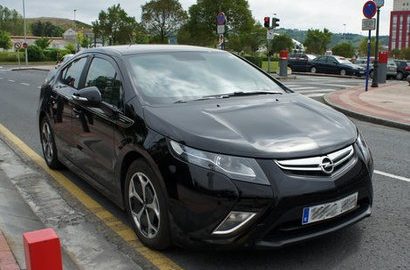
Vauxhall Ampera EREV
“The Chancellor’s announcement of funding for research into batteries for electric vehicles is a positive first step, but it doesn’t go far enough” said Natalie Bird, Senior Consultant at Baringa. ““The transport sector trails the energy and industrial sectors on decarbonisation. Despite significant uptake in electric cars since 2011, the rate of eligible vehicle registrations slowed substantially last year. Although the UK’s 2050 Greenhouse Gas target theoretically allows for later action, the combination of pressing air quality issues, consumer interest in electric vehicles and advances in self-driving technology provides a real opportunity today to kick-start the decarbonisation of the transport sector, which will reap long-term benefits.”
Ms Bird added that in these early stages, bolder policies that reduce costs and influence public perception are needed if the Government wants to see more people get behind the electric wheel. This means providing more certainty to investors, producers and consumers about the vision for the future of the market. In the longer run, the Government may need to shift the balance of policy away from direct subsidies and towards more technology neutral mechanisms such as a wider carbon tax for the transport sector, to discourage the use of conventional vehicles.
The Government should also recognise the ongoing evolution of the wider transport landscape and the potential shift away from private vehicle ownership towards greater use of ‘on-demand’ flexible modes of travel such as car sharing schemes, and ensure policies take this into account. This may be accelerated by self-driving technology, which in turn could dramatically transform road transport demand patterns, and it would be good to recognise that link in the Industrial Strategy Challenge Fund.
Spring Budget 2017: The government will invest in the development, design and manufacture of batteries to power the next generation of electric vehicles.
The investment will form part of the Industrial Strategy Challenge Fund (ISCF), which will receive an initial investment of £270 million in 2017-2018.
In his Spring Budget 2017 speech, Chancellor Philip Hammond announced that the £270 million investment will be used to develop disruptive technologies, such as robotic systems and driverless vehicles.
The ISCF forms part of the National Productivity Investment Fund (NPIF), which was announced in the Autumn Statement 2016. This includes an investment of £390 million in ultra-low emission vehicles (ULEV), renewable fuels, and connected and autonomous vehicles by 2020-21. This funding also includes an £80 million investment in ULEV charging infrastructure.
Claire Evans, head of fleet consultancy at Zenith, said:
“We saw £270 million allocated to keep the UK at the forefront of disruptive technologies that will include funding for the development, design and manufacture of batteries to power the next generation of electric vehicles. Increased range on new battery technology will speed their adoption by fleets.
“The £16 million made available for a new 5G mobile technology hub will also support the move toward driverless vehicles. A £690 million competition for local authorities to tackle urban congestion and get local transport networks moving again is a welcome addition.”
Hyundai’s first dedicated alternative fuel car is now on sale in all three specifications
The Hyundai Ioniq plug-in (PHEV) model has made its debut at the Geneva motor show, joining the recently launched hybrid and electric versions that are already on sale priced from £19,995 and £24,495 respectively.
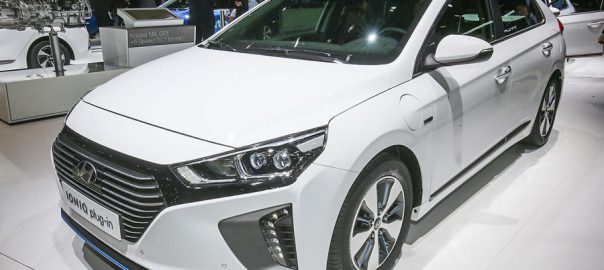
Hyundai IONIQ Plug-in Hybrid (PHEV)
The Ioniq is Hyundai’s first dedicated hybrid and full-electric model and also the first car from any manufacturer to be offered with three electric powertrain options within a single body type.
Engines and gearbox
The Ioniq PHEV combines a 104bhp 1.6 GDI direct-injection petrol engine that’s mated to a 55bhp electric motor. The motor is powered by a 8.9kWh lithium ion polymer battery to enable 39 miles of pure electric driving. The car produces CO2 emissions of 26g/km and offers up to 257mpg, according to the New European Driving Cycle.
It joins the hybrid comprised of a 1.6-litre Kappa GDi engine that produces a peak of 103bhp and 108.5lb ft of torque, and a lithium ion battery-powered, permanent magnetic electric motor which contributes a maximum of 43bhp and 125lb ft of torque. The Ioniq hybrid is claimed to have a thermal efficiency of 40% – which conveniently matches its arch-rival, the Toyota Prius.
This efficiency is possible thanks to the combustion engine’s use of optimised cooling and a 200 bar six-point direct fuel injection system, while the electric motor benefits from declination coils that allow it to work with a claimed 95% efficiency.
Drive is sent to the front wheels via a six-speed DCT dual clutch transmission that’s been optimised to offer as much as 97.5% efficiency – another class leading feature, according to Hyundai.
The Ioniq Electric features an uprated lithium-ion battery pack, and is good for an estimated 155 miles of pure electric driving. Its electric motor produces 118bhp and 218lb ft of torque, with drive channelled through a single-speed transmission. In this form, the Ioniq has a top speed of 103mph.
A key standard feature of the electric model is rapid charge compatibility: it can be charged to 80% capability in 33min from a 50kW CCS Combo Rapid public charger. Owners can also plug their car into a conventional domestic charger. To help boost energy when on the move, the Ioniq Electric features regenerative braking which can be adjusted via steering column-mounted paddles.
In just a few weeks time there will be a big change in the car tax (‘vehicle excise duty’ or VED) arrangements for plug-in hybrid electric vehicles (PHEVs) such as the Mitsubishi Outlander PHEV; here’s a brief summary.
The government has changed the basis on how the tax rates for cars are calculated – previously it was just on carbon dioxide emissions, so many low emission vehicles (such as small cars and all PHEVs) had no tax to pay. Now all cars with emissions that are non-zero, so all cars that aren’t 100% electric, have to pay tax. In the first year the amount depends on the level of emissions; in subsequent years it is £140 across the board.
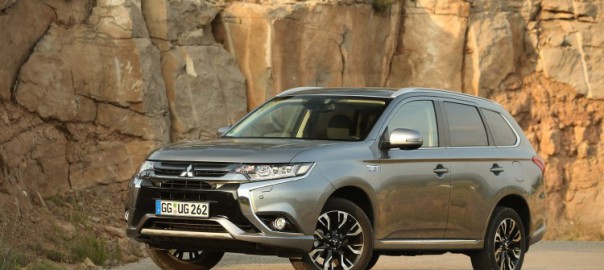
Mitsubishi Outlander PHEV 4×4
The most popular plug-in hybrid in the UK is the Mitsubishi Outlander PHEV so it will be most affected. However, there remains just enough time to buy one from stock and get it registered before the deadline. In this case it gets free car tax for life; if registered after the deadline it pays tax for life.
Furthermore, there is an additional tax element for cars with a value over £40000; this is know as the ‘Premium Rate’ and adds an additional £620 over three years. Top-end Outlanders, typically above the GX4h spec, would get hit with this on top.
Edit 22/3/17: Having looked into this a little further, I think NextGreenCar may have made a mistake. They are considering PHEVs to be petrol whereas they should probably be considered to be Alternative Fuel Vehicles which include hybrids (though in what sense any car running 100% on fossil fuels can be considered ‘alternative fuel’ beats me). Anyway, if so, the first year cost would be £0 rather than £10 and the follow-on years would cost £130 not £140. The overall message, however, is unchanged. The official guidance is here: Vehicle tax rate tables.