All posts by Trevor Larkum

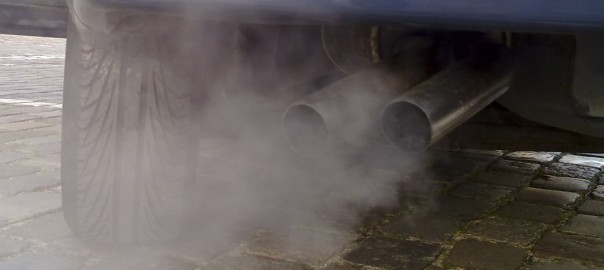
Car exhaust pollution (Image: Wikipedia)

Auto industry urges London rethink on Ultra Low Emission Zone

  • UK automotive industry totally committed to air quality improvement and carbon reduction.
  • Ultra Low Emission Zone (ULEZ) needs to be more ambitious says SMMT.
  • Diesel vehicles built today the cleanest ever made capturing over 99% of particulates.

Welcoming plans for an Ultra Low Emission Zone (ULEZ) in London by 2020, the Society of Motor Manufacturers and Traders (SMMT) today said London should set the benchmark for the world’s great cities by implementing a scheme which demands the very best in vehicle technology. In an open letter to the Mayor of London, SMMT has called for a rethink of the current proposals set out by Transport for London (TfL) to enforce the latest emission standards for both petrol and diesel vehicles. This reflects the step change in clean diesel technology, and helps to ensure similar schemes across the UK and Europe are harmonised.

Mike Hawes, SMMT Chief Executive, said,

“The implementation of the ULEZ will accelerate the take-up of ultra low and low emission vehicles, but a harmonisation of standards – a technology neutral approach – for petrol and diesel vehicles would strengthen the initiative. Currently the proposed requirements differ for cars and vans. SMMT is urging London to be more ambitious with a universal (Euro-6) standard for both petrol and diesel vans and cars which would remove any confusion, strengthen the uptake of cleaner technology and bring air quality benefits sooner.

“The automotive industry is investing billions of pounds in the UK and abroad to develop technologies to lower vehicle emissions. The ULEZ can accelerate the take up of these cleaner technologies and bring air quality and carbon reduction benefits to London sooner.

“Today’s diesel vehicles are light-years away from those built just a decade ago. Intelligent engine design and highly efficient exhaust aftertreatments, including particulate filters, capture over 99% of particulates and around two-thirds of NOx emissions. ULEZ proposals should support the introduction of these technologies now, technologies which are being introduced ahead of the ever-tougher legislative requirements which will be implemented over the next few years.”

The current proposals for an ULEZ for London dictate the 2006-standard Euro-4 for petrol vehicles and the latest Euro-6 for diesel vehicles. Given the introduction date of 2020, it would therefore allow petrol vehicles of up to 14 years of age to enter without penalty. By this date the European fleet average will be approaching 95g/km of CO2, whereas a typical petrol car of Euro-4 vintage would have CO2 emissions some 72% higher. Euro-6 petrol and diesel vehicles are on sale now and mandatory from next year meaning that under SMMT’s proposals, by 2020, qualifying vehicles would be up to six years old and would be reasonably affordable, potentially on their third owner. Crucially, regulators can be assured that they will be delivering the air quality benefits as Euro-6 vehicles have engine management systems which constantly monitor and manage emission performance – a major advance on earlier models’ technology. Underlining the progress made by car makers, SMMT also said that it is vital that the ULEZ actually delivers on congestion reduction to allow the automotive industry’s new technologies to work effectively. There must be no side effects to the ULEZ which actually increase congestion or else any air quality benefits will be negated.

The success of the automotive industry’s commitment to improved emissions is indisputable. Average CO2 emissions for new cars in the UK in 2013 were 128.3g/km, down 29.1% since 2000. The 2013 figure marks a milestone as it exceeds the pan-European 2012-2015 target (sub 130g/km). Work on CO2 reduction has been matched by technology to cut other pollutants, resulting in filters which capture over 99% of particulate (PM10) emissions. Nitrogen oxide (NOx) levels from diesel cars have also been cut by 64% since 2000. Criticisms that vehicles fail to deliver real world improvements compared to ‘controlled test cycle conditions’ are also being addressed, with the Euro-6 standards to include ‘real world’ driving emission testing for the first time. This will give confidence to regulators and consumers alike that these new vehicles are delivering real benefits.

Those benefits include carbon reduction as diesel engines are key to reducing road transport CO2 emissions. Diesel cars emit up to 20% less carbon than their petrol equivalents – essential if the UK and Europe are to meet their climate change ambitions.

Looking to the future, Mike Hawes added,

“We need an integrated approach on air quality at local, regional, national and European level. Fleet renewal, or the uptake of new vehicles on the road, is critical in reducing emissions. Proposals such as London’s ULEZ can help deliver this goal. Air quality is often a local issue so we need a flexibility that allows for focused initiatives like the ULEZ but which sit within an overall framework of harmonised standards across Europe. The automotive sector must have certainty in policy direction so technology investments can be targeted on addressing key issues such as air quality and climate change.”

Engine manufacturing is a crucially important part of the UK automotive industry with more than 2.5 million engines built in the UK in 2013. Engine manufacturers include Ford in Dagenham and Bridgend, Bentley in Crewe, BMW at Hams Hall, Honda in Swindon, Jaguar Land Rover in Wolverhampton, Nissan in Sunderland, Toyota in Deeside and Cummins in Darlington.

Significant new investment into the manufacture of engines in the UK has been announced over the last few years. Ford announced in the last month that it will invest £190m in diesel engines at its Dagenham plant, creating 318 jobs. Jaguar Land Rover’s new engine manufacturing centre in Wolverhampton, recently opened by HM The Queen, marks an investment of more than £500m, creating 1,400 jobs.

Source: SMMT
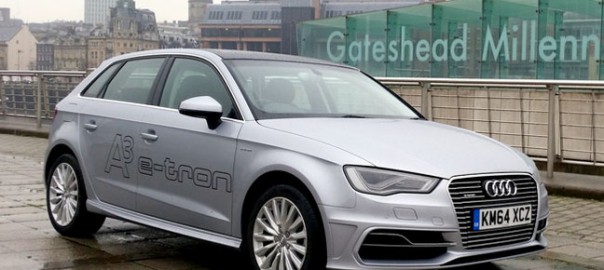
Audi A3 e-tron plug-in hybrid (Image: The Register)

The STEALTH Plug-in Hybrid: Audi A3 e-tron Sportback

You wouldn’t know it was an EV … except it might use NO petrol

Vulture at the Wheel It would have been difficult for Audi to launch an electric car differentiated more from BMW’s. Whilst the BMW i3 has been styled and engineered to look and perform like something from another planet, the new A3 e-tron most definitely has not.

This is Audi’s first production ‘leccy car since it announced it would not be mass producing the all-electric concept e-tron coupe or the design-study Wankel rotary-engined A1 e-tron range extender.

What we have here is something that – if you removed the e-tron badges, taped over the interior decals and didn’t rummage around too deeply in the display menus – you could get in and drive from John O’Groats and Land’s End and not notice it was an EV at all.

Of course, this is entirely deliberate. Audi thinks the path to electric motoring is not to scare the horses but still to bundle some cutting edge drivetrain technology under the bonnet. That’s why the A3 e-tron looks just like any other A3, right down to hiding the charge socket under the four-circles badge at the front – a place you’d never notice it unless you were looking for it and had been told its whereabouts to begin with.

The only clue to what’s in play here is under the bonnet. Pop the hood, as the Americans say, and you’ll see the high power electric cabling and associated 75kW electric motor which is coupled to a slightly modified 150ps 4-cylinder 1.4L turbocharged TFSI petrol engine.

The electric motor draws its power from a 96-cell 8.8kWh Li-Ion battery pack that’s buried beneath the rear seats. The 12V battery and its associated electrics, evicted from under the bonnet by the electric drive motor, now snuggle up alongside the fuel tank at the back. This means the new drive train set-up doesn’t have any noticeable impact on the A3’s front-to-back weight distribution

Read More: The Register

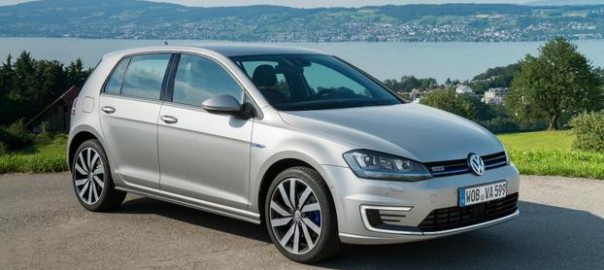
Volkswagen Golf GTE (Image: VW)

VW says Golf GTE plug-in hybrid offers the ‘best of both worlds’

Volkswagen says its Golf GTE plug-in hybrid offers eco-friendly buyers the “best of both worlds” — a compact hatchback that can be driven up to 50km in cities using electric power or up to 940km on highways with additional power from its gasoline engine.

The Golf GTE is VW’s second plug-hybrid after the low-volume XL1. Others will follow, including a Passat plug-in hybrid. VW is touting the Golf GTE’s sportiness. The plug-in has the same performance as a Golf GTI and is “both eco-friendly and sporty,” said Hans-Jacob Neusser, VW brand’s r&d head.

VW says the Golf GTE will complement the all-electric e-Golf, which went on sale in February. The e-Golf has a maximum range of 190km so it is more suited to urban driving than long distances, VW says. The Golf GTE costs 2,000 euros more than the 34,900 euro e-Golf in Germany. VW is not disclosing any production or sales forecasts for the Golf GTE.

Neusser said the car can be built on the same production lines as other Golfs so the company can react very flexibly to demand. IHS Automotive forecasts that VW will sell 24,233 Golf GTEs next year, with volume reaching a peak of 52,356 in 2021. VW says the Golf compact family now has the widest choice of powertrains in the segment with the GTE adding to the gasoline, diesel, CNG and EV versions.

Read more: AutoNews

Natural gas: The fracking fallacy

The United States is banking on decades of abundant natural gas to power its economic resurgence. That may be wishful thinking.

When US President Barack Obama talks about the future, he foresees a thriving US economy fuelled to a large degree by vast amounts of natural gas pouring from domestic wells. “We have a supply of natural gas that can last America nearly 100 years,” he declared in his 2012 State of the Union address.

Obama’s statement reflects an optimism that has permeated the United States. It is all thanks to fracking — or hydraulic fracturing — which has made it possible to coax natural gas at a relatively low price out of the fine-grained rock known as shale. Around the country, terms such as ‘shale revolution’ and ‘energy abundance’ echo through corporate boardrooms.

Companies are betting big on forecasts of cheap, plentiful natural gas. Over the next 20 years, US industry and electricity producers are expected to invest hundreds of billions of dollars in new plants that rely on natural gas. And billions more dollars are pouring into the construction of export facilities that will enable the United States to ship liquefied natural gas to Europe, Asia and South America.

All of those investments are based on the expectation that US gas production will climb for decades, in line with the official forecasts by the US Energy Information Administration (EIA). As agency director Adam Sieminski put it last year: “For natural gas, the EIA has no doubt at all that production can continue to grow all the way out to 2040.”

But a careful examination of the assumptions behind such bullish forecasts suggests that they may be overly optimistic, in part because the government’s predictions rely on coarse-grained studies of major shale formations, or plays. Now, researchers are analysing those formations in much greater detail and are issuing more-conservative forecasts. They calculate that such formations have relatively small ‘sweet spots’ where it will be profitable to extract gas.

The results are “bad news”, says Tad Patzek, head of the University of Texas at Austin’s department of petroleum and geosystems engineering, and a member of the team that is conducting the in-depth analyses. With companies trying to extract shale gas as fast as possible and export significant quantities, he argues, “we’re setting ourselves up for a major fiasco”.

That could have repercussions well beyond the United States. If US natural-gas production falls, plans to export large amounts overseas could fizzle. And nations hoping to tap their own shale formations may reconsider. “If it begins to look as if it’s going to end in tears in the United States, that would certainly have an impact on the enthusiasm in different parts of the world,” says economist Paul Stevens of Chatham House, a London-based think tank.

If natural-gas prices were to follow the scenario that the EIA used in its 2014 annual report, the Texas team forecasts that production from the big four plays would peak in 2020, and decline from then on. By 2030, these plays would be producing only about half as much as in the EIA’s reference case. Even the agency’s most conservative scenarios seem to be higher than the Texas team’s forecasts.

“Obviously they do not agree very well with the EIA results,”

says Patzek.

Read more: Nature

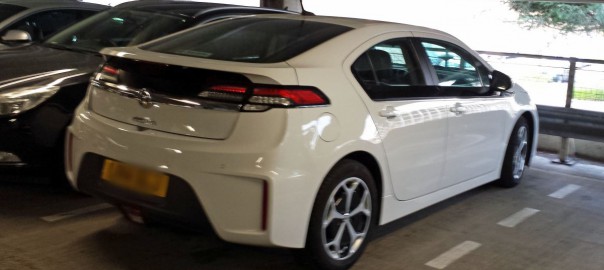
Vauxhall Ampera in Milton Keynes Central railway station multi-storey (Image: T. Larkum)

Why Plug-In-Hybrid Vehicles May Be The Car Of The (Near) Future

Owning a car provides freedom. Drive hundreds of miles if you want. When you’re low on gas, fill up in five minutes. Electric cars don’t work that way. Most modern models can travel fewer than 100 miles on a full charge, and gas tanks fill much faster than batteries charge. But one type offers a compromise that combines the benefits of an electric car with the convenience of a combustion-powered vehicle.

“I come to the conclusion that the main competitor of electric cars is the plug-in hybrids because they offer the best of both worlds,” said Ricardo Daziano, who studies the way engineering and economics affect the adoption and improvement of new technologies at Cornell University in Ithaca, New York.

“So you can go electric on your daily commute and then you feel good about the environment.”

Plug-in hybrids, such as the Chevrolet Volt (= Vauxhall Ampera), offer battery power sufficient for commuting. The battery power is often paired with a gas-powered engine that provides either direct propulsion or on-the-go battery charging during long-distance travel. In some cases a plug-in hybrid’s gas engine only charges the battery.

Vauxhall Ampera in Milton Keynes Central railway station multi-storey (Image: T. Larkum)

Current battery costs keep electric vehicles expensive and limit their range. But, electric cars don’t require gas and the vehicles themselves emit no greenhouse gases or other fumes. Of course, gas is relatively cheap right now, with oil at about $70 per barrel. Low gas prices could slow the adoption of new auto technology because the most direct benefit of using battery power to propel a vehicle is probably the money they’ll save at the gas pump.

Electric vehicles, in many ways, require a new approach to travel. Drivers can charge at home while they sleep, or at charging stations while at work. They don’t need to go to gas stations. But, if they expect to approach the limits of their range, they need to plan their daily trips carefully. They may even purposely choose busy, stop and go traffic instead of free-flowing highways.

“If people were to use some of these more congested areas, they can regenerate some of that battery charge,” said Srinivas Peeta, a transportation engineer at Purdue University in West Lafayette, Indiana. “In some sense, what we are saying is that the range can get extended a little.”

Hybrids, plug-in hybrids, and electrics typically recapture as much of the car’s energy as they can. When the driver applies the brakes, a portion of that energy is sent back into the battery for later use.

While traditional vehicles use extra fuel for heating and cooling the cabin, with an electric, all that energy has to come from the battery, further limiting the range.

Recharging an electric or plug-in hybrid is different than the typical routine of filling up a traditional vehicle. There’s not just one pump, like for gas. There are multiple types of charging, ranging from the trickle of a normal household outlet, which takes hours to fill a battery, to fast charging stations such as Tesla’s supercharger that add about half a charge to a battery in 30 minutes. It’s as if some gas pumps drip into the tank, and some are fire hoses. For electrics or plug-in hybrids, the additional time required to charge the car encourages businesses to offer expanded services at highway rest stops, in order to make it more engaging for people who would have to linger to charge a car’s battery.

“You have to come up with compatible services. People wouldn’t just wait there or stand there for 20 minutes, right? Because that doesn’t make sense,” said Eric Huang, a civil engineer at Clemson University in South Carolina, who led a session on electric vehicles and charging at the annual meeting of the professional society INFORMS this fall. He suggested that a company like Starbucks might begin offering outlets to electric vehicle drivers making intercity trips.

“Those fast chargers have to be strategically located along the highway with appropriate services.”

Developing the infrastructure to support intercity travel for electric vehicles will take time. There are other types of engines out there, including hydrogen fuel cells and compressed natural gas, but electrical power is generally easier to access. Developing an electric vehicle with both a moderate cost and a more robust range will take some time.

“You look at a car, whether it’s electric, or fuel cell, or an internal combustion car, you want it to be affordable and you want it to have adequate driving range,” said Cosmin Laslau, a technology researcher at Boston-based Lux Research, a firm that studies emerging technologies. “You can get a very affordable electric vehicle, but it has poor driving range. You can get one with astonishingly good driving range, maybe 300 miles or more, but it is going to be very, very costly. The challenge is to make a car that can drive 300-500 miles for the purchase price of $20,000-25,000. That’s not going to happen for another 10 or 15 years.”

Some experts think it might take longer. But many agree that in the next couple of decades, plug-in hybrids are going to be an important vehicle option. Why? Consumer demand.

Jonn Axsen, who studies the relationship of human behavior, energy technology and environmental policy at Simon Fraser University in Burnaby, British Columbia, said that one reason people are attracted to plug-in hybrids is because the first 10-30 miles are completely electric. But, he found that relatively few people are interested in all-electric vehicles.

“It seems no matter how I present it, there are far more consumers that are willing to buy a plug-in hybrid rather than a pure electric vehicle,” he said.

When drivers commute to work in a plug-in hybrid, it’s possible to use gas very rarely.

“Usually Chevy Volt owners drive on the battery alone,” said Laslau. “It’s a really high percentage of their driving pattern that’s battery power alone.”

Currently, these technologies are new to consumers, so experts don’t know how people will adapt to these choices. Also, the relative costs of use for electrics and plug-in hybrids are difficult to project into the future.

“There is so much uncertainty,” said Axsen. “Because you have to have perfect foresight about what the fuel costs are going to be over the next 15 years. And we have no idea.”

“If you’re looking at the whole picture, [a plug-in hybrid vehicle] has greater potential at least in the near term,” said Zhenhong Lin, a senior researcher at Oak Ridge National Laboratory in Tennessee.

Huang and Peeta, both indicated that electric vehicles will eventually win out. One factor is that by including a gas-powered generator in a plug-in, means that there are two systems of propulsion in the same car.

“Because they have two different power trains and so on, the cost associated with them in the long run is one thing to factor,” said Peeta.

Huang called plug-ins a transition model, and suggested that when the batteries and infrastructure are ready,

“I think battery vehicles are the way to go.”

How far into the future can we expect to observe that transition? As of today, it’s unclear.

Source: Physics Central

Carbuyer Reviews Tesla Model S – Video

Carbuyer gets its hands on the Tesla Model S… Prepare to hear the word “brilliant” a lot throughout the video.

Like is typically the case when someone reviews the Tesla Model S, they instantly feel like a kid in a candy store.

Mat, the Carbuyer reporter, mentions that the charging network is not all there (UK), so you may find yourself in a pickle, but we’ll point out that the charging network (especially Tesla’s Supercharger network) is rapidly growing and you can surely charge at home, so this is a non issue.

Aside from that little mistake by Carbuyer, we enjoyed this review of the Model S!

Source: Inside EVs

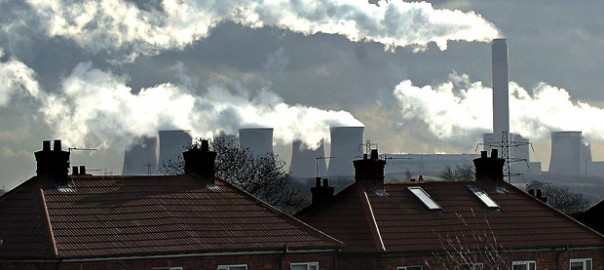
Pollution at Drax Coal Power Station near Selby (Image: J. Giles/PA)

How Solar Power Could Slay the Fossil Fuel Empire by 2030

In just 15 years, the world as we know it will have transformed forever. The ​age of oil, gas, coal and nuclear will be over. A new age of clean power and smarter cars will fundamentally, totally, and permanently disrupt the existing fossil fuel-dependent industrial infrastructure in a way that even the most starry-eyed proponents of ‘green energy’ could never have imagined.

These are not the airy-fairy hopes of a tree-hugging hippy living off the land in an eco-commune. It’s the startling verdict of ​Tony Seba, a lecturer in business entrepreneurship, disruption and clean energy at Stanford University and a serial Silicon Valley entrepreneur.

Seba began his career at Cisco Systems in 1993, where he predicted the internet-fueled mobile revolution at a time when most telecoms experts were warning of the impossibility of building an Internet the size of the US, let alone the world. Now he is predicting the “inevitable” disruption of the fossil fuel infrastructure.

Seba’s thesis, set out in more detail in his new book Clean Disruption of Energy and Transportation, is that by 2030 “the industrial age of energy and transportation will be over,” swept away by “exponentially improving technologies such as solar, electric vehicles, and self-driving cars.”

Tremors of change

Seba’s forecasts are being taken seriously by some of the world’s most powerful finance, energy, and technology institutions.

Last November, Seba was a keynote speaker at JP Morgan’s Annual Global Technology, Media, and Telecom Conference in Asia, held in Hong Kong, where he delivered a stunning presentation on what he calls the “clean disruption.”

Seba’s JP Morgan talk focused on the inevitable disruption in the internal combustion engine. By his forecast, between 2017 and 2018, a mass migration from gasoline or diesel cars will begin, rapidly picking up steam and culminating in a market entirely dominated by electric vehicles (EV) by 2030.

Not only will our cars be electric, Seba predicts, but rapid developments in self-driving technologies will mean that future EVs will also be autonomous. The game-change is happening because of revolutionary cost-reductions in information technology, and because EVs are 90 percent cheaper to fuel and maintain than gasoline cars.

The main obstacle to the mass-market availability of EVs is the battery cost, which is around $500 per kilowatt hour (kWh). But this is pitched to fall dramatically in the next decade. By 2017, it could reach $350 kWh—which is the battery price-point where an electric car becomes cost-competitive with its gasoline equivalent.

Seba estimates that by 2020, battery costs will fall to $200 kWh, and by 2024-25 to $100 kWh. At this point, the efficiency of a gasoline car would be irrelevant, as EVs would simply be far cheaper. By 2030, he predicts,

“gasoline cars will be the 21st century equivalent of horse carriages.”

It took only 13 years for societies to transition from complete reliance on horse-drawn carriages to roads teeming with primitive automobiles, Seba told his audience.

Lest one imagine Seba is dreaming, in its new quarterly report, the leading global investment firm Baron Funds concurs: “We believe that BMW will likely phase out internal combustion engines within 10 years.” (Investors at rival bank Morgan Stanley are making a similar bet, and are financing Tesla.)

Two days after his JP Morgan lecture, Seba was addressing the 2014 Global Leaders’ Forum in south Korea, sponsored by Korean government ministries for science and technology, where he elaborated on the prospects of an energy revolution. Within just 15 years, he said, solar and wind power will provide 100 percent of energy in competitive markets, with no need for government subsidies.

Over the last year Seba has even been invited to share his vision with oil and gas executives in the US and Europe.

“Essentially, I’m telling them you’re out of business in less than 15 years,”

Seba said.

Revolutionary economics of renewables

For Seba, there is a simple reason that the economics of solar and wind are superior to the extractive industries. Extraction economics is about decreasing returns. As reserves deplete and production shifts to more expensive unconventional sources, costs of extraction rise. Oil prices may have dropped dramatically due to the OPEC supply glut, but costs of production remain high. Since 2000, the oil industry’s investments have risen threefold by 180 percent, translating into a global oil supply increase of just 14 percent.

In contrast, the clean disruption is about increasing returns and decreasing costs. Seba, who dismisses biomass, biofuels and hydro-electric as uneconomical, points out that with every doubling of solar infrastructure, the production costs of solar photovoltaic (PV) panels fall by 22 percent.

Seba said:

“The higher the demand for solar PV, the lower the cost of solar for everyone, everywhere,”

“All this enables more growth in the solar marketplace, which, because of the solar learning curve, further pushes down costs.”

Read more: Motherboard.vice.com

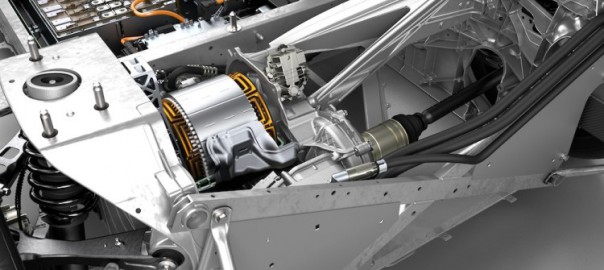
BMW i3 Motor (Image: BMW)

BMW i3 Electric Motor Among Ward’s “10 Best Engines Of 2015″

The 127-kW (170 HP) electric motor that propels the rear-wheel-drive BMW i3 has received a coveted “Best Engines” award from Ward’s Auto.

Here’s the eligibility criteria for selection by Ward’s Auto:

To be eligible for the Ward’s 10 Best Engines competition, an engine or propulsion system must be all-new or significantly re-engineered and available in the U.S. market with a base price not exceeding $60,000. This year’s pool of 37 nominees includes last year’s 10 winners and 27 new entries. Eight WardsAuto editors drove the vehicles in October and November in their routine daily commutes around metro Detroit. Editors scored each engine based on power, torque, technology, observed fuel economy, relative competitiveness and noise, vibration and harshness characteristics.

The i3′s electric motor was the only electric winner this year, though the 100-kW fuel cell in the Hyundai Tucson FCV did receive an award too.

Source: Inside EVs

"Nissan Leaf got thirsty" (Image:Mariordo/Wikimedia)

More than half of Nissan Leaf owners insist they will never buy conventional cars again

More than half of Nissan Leaf owners insist they will never u-turn and buy conventional cars again

Auto giant’s customer research finds feared barriers to electric vehicle adoption have not materialised

Nissan will today publish the results of customer research suggesting a majority of customers for its Leaf have become electric vehicle converts and have no intention of buying conventional fuelled cars in the future.

The auto giant undertook the research using a relatively small sample of 76 current Leaf owners from among the 6,500 customers to purchase the vehicle in the UK.

More than half of respondents said they would not go back to conventional cars, while 95 per cent said they were happy with the Leaf and would recommend it to a friend.

Source: Business Green

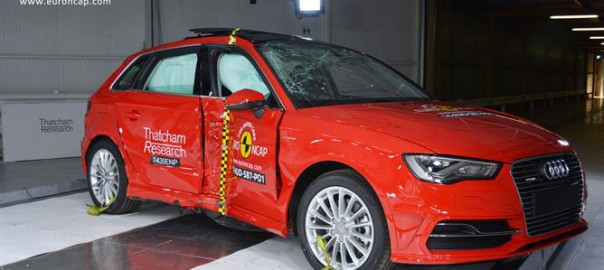
Audi A3 e-tron crash testing (Image: Euro NCAP)

Electric Audi gains top honours in Euro NCAP safety tests

Euro NCAP has awarded the Audi A3 Sportback e-tron five stars in the latest round of crash tests.

The Kia Soul and electric Soul EV both scored four stars, while Jeep’s new Renegade compact SUV scored five stars.

Euro NCAP’s testers gave the Audi A3 Sportback e-tron an adult safety rating of 82%, noting good body protection for both driver and passenger during front impact tests. The electric Audi scored a 66% rating for pedestrian protection, and a 78% rating for child safety.

Kia’s Soul EV scored an adult safety rating of 84%, plus 82% for child safety. Testers noted that the Soul EV scored particularly well during side impact tests, with good body protection throughout.

The standard Soul fared slightly less well, gaining an adult safety rating of 75% and a child rating of 82%.

Jeep’s baby Renegade impressed Euro NCAP’s testers, offering good protection during both front- and side impact tests. The model was given an 87% rating for adult protection, and 85% for children.

BMW also earned a Euro NCAP award for its advanced pedestrian warning and city braking systems.

Source: What Car