All posts by Trevor Larkum

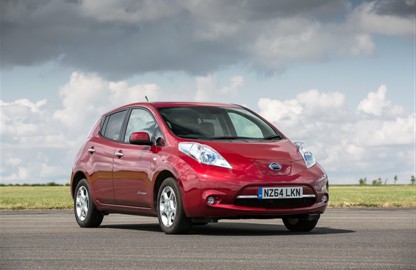
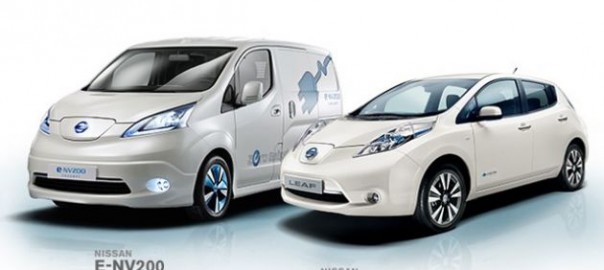
Nissan e-NV200 electric van and Leaf electric car (Image: Nissan)

2014: A bumper year for Nissan in the UK

NISSAN Motor GB Limited recorded its best ever sales year in 2014 with 138,338 cars sold in the last 12 months. This represents a 17% increase over 2013’s figure of 117,967.

Nissan also bolstered its position as the fastest growing top 10 brand in the UK, commanding a market share of 5.6% in 2014 – smashing yet another record. This increased share in the car market puts Nissan in sixth position in the UK.

Boosting this sales success was Nissan’s UK-built stars – the new Juke and the 100% electric LEAF and the Note – all of which broke sales records for another year.

The all-electric LEAF clocked up 4,051 sales in the UK, more than doubling the volume sold in 2013 (1,812), confirming that the British-built Nissan LEAF remains the nation’s electric model of choice. The Nissan LEAF boasts 55% of the pure EV market and outsold its nearest competitor by more than 2:1.

Nissan’s extraordinary sales success comes as Nissan’s Sunderland Plant broke the half a million production barrier again for the third year running, building a staggering 500,237 vehicles.

James Wright, Managing Director, Nissan Motor GB, said:

“Key to Nissan’s success in 2014 is the onslaught of new and updated products launched in the last year and I am immensely proud of the hard work and dedication displayed by the Nissan team in the UK.

“Our British-built offering continues to capture the attention of UK motorists and I am particularly delighted to see that the all-electric LEAF is still dominating the pure EV market, doubling its sales volume last year.”

Nissan has launched no-less than nine new and updated products, starting with the multi-award winning British-built Qashqai in January. This was then followed by the MY14 GT-R, new Juke, all-new X-Trail, GT-R NISMO and the all-electric e-NV200.

Including Light Commercial Vehicles (LCVs), Nissan sold 148,607 vehicles in the UK, up 16% from 128,586 in 2013.

Source: Nissan Insider

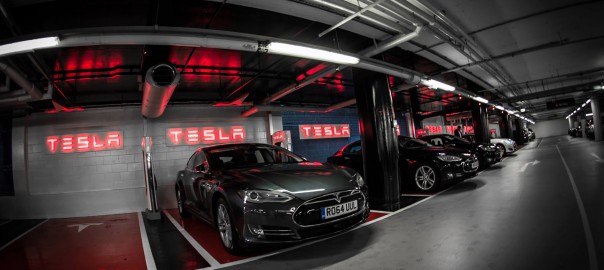
Tesla Supercharging Station at Westfield, London (Image: Tesla)

Tesla Unveils Largest Underground Supercharger Station

Tesla Supercharging Station at Westfield, London (Image: Tesla)

Now this is one sweet Supercharger station.

Located in Westfield London, Tesla Motors says this site is the automaker’s largest underground Supercharger station in all of Europe:

Our largest underground Supercharger station in Europe, located in Westfield London, just got its final touch. Have a look.

Sources: Inside EVs, Tesla on Facebook

Nissan LEAF is the Best-Selling Electric Car in Europe For Fourth Year in a Row

Nissan LEAF is the Best-Selling Electric Car in Europe For Fourth Year in a Row

  • 2014 European sales rise 33% over 2013 as  UK-built car accelerates sales
  • Nissan LEAF leads with 26% of the rapidly growing electric car market
  • UK sales top 4,000 units, more than doubling 2013 volumes
  • Sales driven by strong customer advocacy with 95% recommendation rate

Rolle, Switzerland, 19 January 2015: The all-electric Nissan LEAF has smashed its own sales record with a 33 percent increase in European sales in 2014 over the previous year, taking more than a quarter of the burgeoning electric car market with 14,658 sales.

This year the Nissan LEAF has been joined by an unprecedented number of new entrants into the EV market and has emerged as the leader on a global, US and European basis. Last year was the fourth year in a row that the electric family car has topped the zero-emission sales charts in Europe.

Moreover, the all-electric LEAF clocked up 4,051 sales in the UK, more than doubling the volume sold in 2013 (1,812). The British-built Nissan LEAF remains the nation’s electric model of choice, boasting 55% of the pure EV market and outselling its nearest competitor by more than 2:1.

Nissan Europe senior vice president of sales and marketing, Guillaume Cartier explains the increase in sales, commenting:

“We can now see the impact that word of mouth is having on our sales, with 95 percent of our customers happy to recommend their car to a friend and 50 percent saying they would never go back to diesel or petrol. This kind of powerful advocacy, combined with an increasing awareness of the massive running cost savings electric car drivers experience, is why our Nissan LEAF sales continue to grow.”

“Data from our CarWings telematics system* shows us that Nissan LEAF drivers drive 40% more kilometres than the European average for petrol or diesel cars, covering over 16,500 km per year. This data demonstrates that this car is the primary car for many households and that is changing the consumer perception of electric cars.”

The Nissan LEAF was launched in early 2011 in the European market, followed by a revised version introduced in mid-2013 with over 100 improvements led by customer feedback.The Nissan LEAF is built in Sunderland, UK, with batteries constructed in a new purpose-built facility on the same site. In June 2014 the 100 percent electric Nissan e-NV200 light commercial vehicle was launched, built at Nissan’s Barcelona factory, with batteries from Sunderland.

Ranking January-December 2014 Volume EV Passenger Car Segment share
Total  Pure EV Passenger Car Volume 56,393 100%
1 Nissan LEAF 14,658 26%
2 Renault Zoe 11,227 20%
3 Tesla Model S 8,734 15%
4 BMW i3 5,804 10%
5 Volkswagen e- Up! 5,365 10%
6 Volkswagen e-Golf 3,328 6%

*Figure used is industry standard registrations sourced from official national sources. Nissan recorded retail sales for the Nissan LEAF in 2014 was 15,096 cars

** European owners of its 100 percent electric car, the Nissan LEAF, travel more than 40 percent further per year (10,307 miles) than the European average for a traditional internal combustion-powered vehicle (7,170 miles). Average is calculated from 2013 market specific annual average statistics using data from the UK, France, Spain Italy, Sweden and Norway. An even weighting was applied to each country to find a ‘European Average’. A German statistic was not used in the European average as the raw data is not available and all average figures quoted are estimates.

Country Total Miles Recorded Per Week (LEAF) Total Miles Recorded Per Annum (LEAF)
Spain 228 11,858
Sweden 211 10,954
UK 201 10,468
Norway 197 10,242
Italy 190 9,854
France 188 9,790
Germany 173 9,014

Diesel and Petrol Passenger Car Average (miles)

UK Average 7,900
France Average 7,890
Spain Average 6,168
Italy Average 5,940
Sweden Average 7,245
Norway Average 7,872
European Average 7,170

Source: Nissan Europe

Tesla crack open Knutsford dealership

Tesla is opening a new store in Knutsford, Cheshire. The store strengthens Tesla’s presence for customers in the North West, alongside the Warrington Supercharger station at The Park Royal.

The Canute Place store features the Model S design studio, the dual motor Model S rolling chassis and selected merchandise, and it will also serve as a base for test drives.

Tesla Knutsford continues the company’s unique approach to car retailing. Tesla’s stores, frequently located in city centres and shopping malls, are set up to help customers learn more about electric vehicles and the unique experience of driving Model S. Tesla has also announced plans to open a service centre in the North West to complement the Knutsford store.

Model S

Model S is an uncompromised electric car that delivers 285 miles of range at 65mph on a single charge. With a17-inch touchscreen, an outstanding safety record, and an acceleration of 0-60mph in 3.2 seconds, the fully electric Model S breaks the mould. Tesla and Model S have received numerous accolades, including Autocarmagazine’s Sturmey Award for Automotive Excellence and Motor Trend’s 2013 Car of the Year. Top Gear Magazine called the Model S “the most important car Top Gear has tested.”

Model S also has associated Android and iPhone apps, available in the UK iTunes and Google Play stores. The apps put Model S owners in direct communication with their cars anytime, anywhere. Owners can use the app to check on charging progress, start or stop charging, and heat up or cool down Model S before driving.

In the UK, prices for the Model S start at £49,380 on the road, including the £5,000 government plug-in grant. UK Model S customers can also benefit from other government incentives including zero road tax, zero showroom tax and exemption from London Congestion Charge. The car is also eligible for the 100 percent First Year Allowance for company purchase and 0 percent Benefit in Kind, both of which last until April 2015.

Source: Diesel Car Magazine

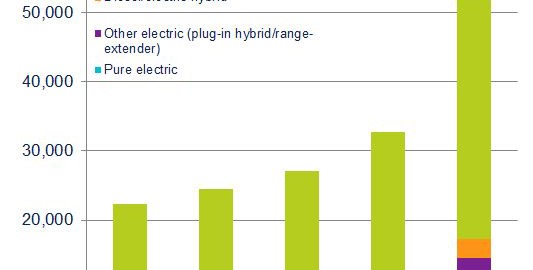
Alternative Fuel Registrations (Image: SMMT)

Green vehicle demand revs up as electric car sales quadruple

There has been a ‘remarkable surge’ in demand for ultra-low emission vehicles in the UK, with sales of plug-in hybrid cars increasing four-fold in 2014.

New annual figures from the Society of Motor Manufacturers and Traders (SMMT) have revealed that sales of alternatively-fuelled vehicles (AFVs) – including electric cars and hybrids – rose by 58% last year, with 51,739 new AFVs registered.

AFV sales accounted for a market share of 2.1% in 2014 – up from 1.4% a year earlier. Overall car sales increased by 9.3% to just south of 2.5 million.

“The year was particularly strong for alternatively-fuelled vehicles as increased choice, coupled with a growing desire for reduced costs and greater efficiency, resulted in a quadrupling of plug-in car registrations over 2013,”

explained SMMT chief executive Mike Hawes.

“With a variety of new plug-in models expected in 2015, this area of the market will continue to grow significantly,” added Hawes. “For the market as a whole, we expect a more stable 2015 as demand levels off.”

Alternative Fuel Registrations (Image: SMMT)

Leading the charge

At the start of 2014, Deputy Prime Minister Nick Clegg unveiled Go Ultra Low, a £2.5m campaign encouraging UK motorists to adopt ultra low emission vehicles.

Sales of plug-in cars have since increased from 3,586 in 2013 to 14,498 in 2014. There are now more than 20 plug-in models available to buy compared with just six in 2011, with each of the 10 best-selling brands in the UK now having a ULEV in its range.

Clegg said:

“The extremely low running costs of these cars help drivers save money. Electric cars are one of the most promising of our green industries and we want to secure the UK’s position as a global leader in both the production and adoption of these vehicles.”

The Government aims for ULEVs to account for every new vehicle on the road by 2040. As such, it will invest £500m between 2015 and 2020 to boost the ultra-low emission vehicle industry even further and help drivers ‘both afford and feel confident using electric cars’.

Source: Edie

Inconveniences of Gasoline 1: Gas Station (Image: Clean Technica)

Lower Oil Prices in an EV World

What do declining oil prices mean for alternative fueled vehicles, plug-in hybrids and EVs? If anything is to be learned from the past periods where gasoline prices have dropped precipitously it is that they spell death for alternative fuels. Dropping oil prices are a very bad thing for all alternative fuels and most likely will be a very bad thing for electric vehicles and plug-ins as well.

From 1981 to 1986 reduced demand and overproduction created a large amount of oil not being consumed in the open market. I remember going to an area that had refineries at the time and seeing a large number of oil tankers just sitting, anchored out on the bay waiting for their turn to hook up to the refineries. The refineries were not operating at full capacity and when they shipped out their inventory as product, then and only then would they allow for the oil tankers to hook up. This five-year-long period has a direct correlation to the improved fuel economy that vehicles were required to achieve by the CAFE (Corporate Average Fuel Economy) standard laws passed in the 1970s. These laws took effect during the later part of the 1970s and the first part of the 1980s. Fuel economy for automobiles reached somewhere around 27 miles per gallon on average in 1986. Even though these laws may have been put in place during that period of time, it was consumers that rapidly embraced smaller more fuel efficient cars coming from Japan. It was a natural reaction after rising gasoline prices hit them hard in the pocket book and spurred deep recessions in the 1970s. It was a reaction that the US automobile manufacturers were slow to embrace.

Consumers also embraced alternative fuels. Even though the sales of such vehicles were small in number, electric cars made the scene with Bob Beaumont’s Sebring Vanguard Citicars and other brands in the mid 1970s. Although electric vehicles had some impact for alternative fuels it was ethanol that was the biggest entry for alternative fuels, typically blended with gasoline. Demand and pricing was such that independent stations selling ethanol blended gasoline sprang up to sell the stuff starting in the corn belt of the Midwest. By the end of the 1970s major oil companies jumped in the game. Despite being heavily subsidized the number of biomass ethanol producers dropped 47% by 1985. Gasohol as a readily used term to describe 10% ethanol blended gasoline disappeared from America’s vocabulary, and the gasohol independent stations disappeared from the gas station landscape.

I remember a Freedom Gasohol station on route 1 south of Alexandria, Virginia that stood abandoned for over a decade. It stood there as a reminder to me of how fortunes can change very rapidly for investors in alternative fuels. It was also a reminder to me that history is an important teacher. Those who don’t know history are likely to make the same mistakes as others have in the past. The United States by allowing for oil and gasoline prices to drop again without a price floor is reliving a past where alternative fuels were pushed from public awareness.

What is causing the prices to drop today is largely an over supply similar to that of the 1980s. Probably also caused by an anticipated dramatic increase in the CAFE gas mileage requirements signed into law in 2009, but that is not all. John Maynard Keynes referred to a phenomena that tended to keep prices high even though demand drops as “the sticky nature of prices.” Let me explain it to you in a more understandable way. Let’s say you have a house that you borrowed $90,000 for and put $10,000 as a down payment. Let’s say later you want to move from the area and want to sell your house. However, in the in-between time prices of houses comparable to yours have dropped to $70,000. Let’s say you still owe the bank $85,000 and you want to get back the cash you put into the home. You are going to be reluctant to drop the price to $70,000. You most likely will list your home at $95,000, where you will at least get back your down payment. However, the market demands a lower price. Once you get over the shock and accept the reality of the new price being $70,000 you will still have to deal with the bank. The bank is going to not accept a sale that is below what you owe them. So the price again can’t go below the $85,000. When the bank finally comes to grip with the reality of the market and accepts market pricing they will still want to have a say in what they will accept in terms of an offer. Basically, people and businesses get used to prices being a certain amount and have locked in their expenses and expected profits at that price. It is hard for them to move off of that expected price. When prices drop fast like they have with oil and gasoline lately, there are other factors at play. There has to be a willingness by the oil companies to sell at lower prices. The question is what are those other factors for the oil producers that have them willing to sell oil for far less money? Demand has lowered by 13%, so why are we seeing a 50% or more drop in oil prices and why are oil producers willing to accept that asking price when demand exists above that 50% drop in price?

There are odd other factors in the oil markets that make them not react to typical economic conditions, however, surplus crude oil is going to have a strong downward pressure on prices, and when coupled with other factors we get the big price drop. Wall street analysts point out that the price move by OPEC and in particular Saudi Arabia has to do with them believing that the cost factors in US fracking shale oil are high and that by dropping the price of oil OPEC might be able to stop US production since at a certain price per barrel of oil US shale oil becomes unprofitable. Saudi Arabia hopes that by maintaining market share they will be able to increase prices at some later date after the shale oil producers leave the market. Analysts point out that this is flawed thinking, because as soon as prices rise again to where shale oil becomes profitable these producers will comeback online to produce oil again. Since this idea is easily viewable as flawed this may not be the reason for dropping oil prices. I just don’t think the Saudis are stupid.

Other analysts think that the price drop might be a coordinated political move by Europe, Saudi Arabia and the United States to have an affect on global politics. They say that Europe has a desire to weaken Vladimir Putin’s meddling in the Ukraine, Saudi Arabia wants to keep Iran from attaining nuclear weapons and destabilizing the region, and the United State wants to keep Venezuela from influencing Cuba. The high price of oil funds all of Russia, Iran and Venezuela’s extracurricular activities. For the US, Europe and Saudi Arabia a drop in oil prices keeps Russia, Iran and Venezuela in check. If it were true, it seems to be working. Russia’s economy is on the verge of collapse, which, we would hope would curb Putin’s meddling in Ukraine. Iran seems to be coming around to the idea of negotiating a nuclear deal with the west, without oil propping them up they may be more willing to negotiate their nuclear ambitions away for a removal of the sanctions restricting their sale of oil. Venezuela has stopped subsidizing oil to Cuba and, despite other reasons given, many experts say that that is the main reason behind Cuba’s push for better relations with the US. I have already seen an article about US oil companies working with Cuba to do oil exploration there. However, this seems far fetched to me and rather complicated given the entities past cooperation. Also, the United States government and in particular this administration have very little influence on oil companies that are humongous international entities. Although Saudi Arabia might be able to control its oil output, Europe and the United States most likely would not be able to do much in this alliance to influence the price of oil. Which leads me to think that it is probably something else entirely that is leading to the willingness to accept a much lower price for oil.

It could be that oil companies maybe trying to reconstruct demand that was destroyed because of high oil prices and the deep recession it triggered. Oil companies and oil producing nations are hoping that consumers will abandon their thrift ways and go back to overusing petroleum in the form of big cars and trucks, or they may be hoping that consumers will not keep fleeing petrol powered vehicles for alternatively powered ones. This is, I believe, a very important possibility.

What is the one thing that can change the oil demand landscape where it would become irretrievable if it were to actually take hold? Alternatives. For example, we are multi-food consumers. If the price of a single food goes dramatically upward, we simply don’t purchase that food and choose an alternative food to eat. Therefore one source of food can’t jack up its prices and remain in the market for long. In real world economics prices always settle at an equilibrium between price and supply, and the price of whatever can be substituted for that item. The ability for consumers to choose a comparably priced alternative keeps the price of any item in the food market in check. Electricity in most of the United States is far cheaper than gasoline and therefor electric cars provide a competitive alternative to gasoline powered vehicles. This has proven to be a threat to the monopoly like hold that oil has had over the market of car fuels. When electric cars were just a novelty, oil producing nations and oil companies were unconcerned with electric cars and other alternatives and therefor jacked up prices. However, electric cars have sold well over a quarter of a million vehicles last year. That constitutes a real threat that oil sales can’t recover from.

My feeling is that oil companies and oil producing nations don’t want their gravy train to end and they are taking a momentary hit on extreme profits to kill alternatives. That is why I believe there is so much willingness to accept such a precipitous drop in the price of oil of 50% or more for a mere 13% drop in demand.

Source: EV World Blog
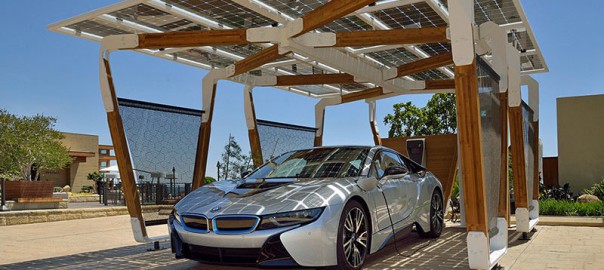
BMW i8 and Solar Car Port (Image: BMW)

BMW solar roof helps i8 drivers even when sun isn’t shining

Connected Box Keeps An Eye On Lower Electricity Prices

At the Consumer Electronics Show, BMW has announced a release window for its i Wallbox Pro that unites domestic solar power and the electricity grid. The box itself was shown off during last year’s i8 drives and it rests inside a solar carport to control the simultaneous delivery of both solar power and the electric grid energy to recharge an i8. One drive attendee wrote how the Wallbox Pro display showed that it was providing 3.4 total kW to the coupe, with 2.8 kW from the sun and 0.6 kW from the grid.

At CES, BMW said the i Wallbox Pro, brought to life by BMW DesignWorks, will be available in 2016. For homes that aren’t equipped with solar power, or when solar isn’t available, the system will draw power from the grid when it’s least expensive.

The Munich manufacturer also announced a concept storage solution using discarded batteries from its electric cars, where excess energy from solar or other sources could be held for later use for a vehicle or the home itself. BMW will be demonstrating the i Wallbox Pro at CES.

BMW i8 and Solar Car Port (Image: BMW)

Source: Autoblog

Electric Cars Fast Charging (Image: BusinessCarManager.co.uk)

Free? Why Electric Cars may soon be even more Cost Effective

Eco-friendly cars have long been a good investment for Londoners. Driving an electric vehicle means you are exempt from both congestion charges and VED (road tax) both pet hates of the average motorist. There are an abundance of charging points around the City and local government offer a grant that will give you up to 75 per cent off the cost of installing a domestic charge point. With no fuel charges and the majority of car journeys in and around London covering less than 10 km, an EV will often prove to be the most efficient choice.

Of course, depending on the model, they can be expensive to buy new, even with the local government grant of up to £5,000 towards the purchase of an electric car. It is my belief however that this won’t be the case for much longer. Some industry commentators believe that by 2020 only 2 or 3 per cent of the cars on our roads will be electric. The CEO of Renault-Nissan, Carlos Ghosn, believes the take-up will be much faster, with ten per cent of all new cars being electric-powered by 2020. Ford goes further still: Derrick Kuzak, Ford Group’s Vice President of Global Product Development has said that electric drive models could account for a quarter of Ford’s global automotive sales by 2020.

Not only will electric cars become more prevalent on our roads, but they will also become more cost-effective, to the point that they will eventually be free. Yes, free.

How? My reasoning is one of simple economics. Although oil prices fluctuate and at the moment are currently dropping, in the medium term, oil prices are only ever going to go up. Meanwhile, the price of an electric car is consistently falling. Eventually, the cost of leasing an electric car will be cheaper than the cost of putting fuel into a conventional car. At that point, the cost of the electric car itself is effectively zero.

Throughout the world, top economists have been talking about how business and buying patterns will evolve over the next thirty years. Chris Anderson, author of Free; The Future of a Radical Price argues that the economics of abundance forces the devaluation of products and services to the point where they are virtually free. Zero pricing is changing the face of business. For a product to be free, there has to be a related product or service that can be charged for. The free product must also be low-maintenance and have negligible ongoing costs associated with it.

A good example of a free product that we all have and use are cell phones.

By removing the dependency on oil, this sales model will be able to work for electric cars in the future. The cars themselves will be free and customers will choose a usage tariff that suits them. Usage tariffs will directly replace the fuel bills that everyone has to pay to use their existing cars. They will be calculated to work out at either the same cost or slightly cheaper than putting fuel into an equivalent combustion engine car.

So instead of paying £200 per month for fuel at service stations, you would pay a similar amount each month for the usage plan on your electric car. The electric car itself would be free. At the start of your contract, you’d be able to go into the car showroom, choose the car that you want and simply drive it away.

Given the choice between buying a £15,000 car with a combustion engine and then paying £200 per month on fuel, or just paying the £200 a month on a usage plan and getting the equivalent electric car for free, which would you choose?

So why aren’t electric cars already being sold like this? It’s simply a case of presentation and marketing. It took the mobile phone industry around fifteen years to get to the point where phones were given away free of charge, but the car industry has got to the same point, just four years after the first mainstream manufacturers launched their first electric models.

Expect the change to happen and expect it to happen soon, particularly in Europe, where the cost of fuel is so high. Walking into your local car dealership will be like walking into your local mobile phone store. Choose your electric car and drive it away.

Source: The London Economic

An EV Queue at Cobham (Image: T. Larkum)

Charge Your Car helps UK’s drivers recharge in Europe

Users of electric vehicles in the UK will soon find it much easier to recharge their vehicles in Europe, thanks to a new agreement between two of the largest networks of publicly-accessible charge points.

Charge Your Car, the UK’s largest EV charge point network with over 2,000 units, has formed an interoperability agreement with The New Motion, the leading charge-point network in mainland Europe. It means that Charge Your Car members in the UK can now access over 15,000 points located in the Netherlands, Germany, Austria, Luxembourg and Belgium. Similarly, members of The New Motion travelling to the UK will be able to use any of the charge units forming part of the Charge Your Car network.

As well as enabling the UK’s EV drivers to drive more electric kilometres overseas, the agreement also accelerates moves to create ‘open roaming interfaces’ between international charge-point networks. The goal is to make it much easier for EV drivers to travel further afield in the knowledge that they will have unfettered access to roadside recharging units.

Alexandra Prescott, Operations Director at Charge Your Car, says of the landmark agreement,

“This agreement is a logical step to enhance services for both The New Motion and CYC drivers. Continental roaming is easier, opening up new e-mobility opportunities across Europe for our drivers.”

Ritsaart van Montfrans, Founder of The New Motion, commented:

“It is important for EV drivers to be able to take their car wherever they want, and through this agreement with Charge Your Car, we have added the UK to our expanding European infrastructure. This will open up new routes and new adventures for EV drivers on both sides of the Channel, in line with our mission to continue to facilitate and enable more electric kilometres to be driven by more EV drivers across Europe.”

To celebrate the new collaboration, four customers of Charge Your Car and The New Motion will be offered a refund on a meal for two, eaten by Charge Your Car customers in Europe and The New Motion customers in Great Britain[1]. Customers can enter the competition by sending a picture of their electric car charging at either a Charge Your Car or The New Motion charging point as well as the receipt from their meal[2].

[1] Offer valid between 15/12/2014 and 28/02/2015

[2] Up to the value of 125 euro / £100.00

Source: Charge Your Car