All posts by Trevor Larkum

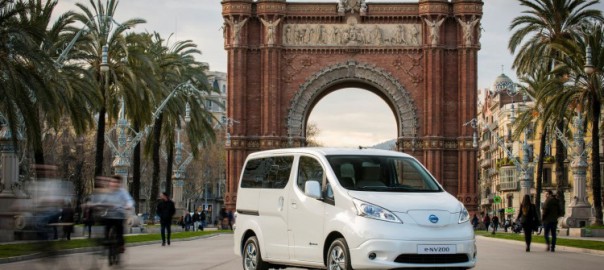
Nissan 7 seat e-NV200 (Image: Nissan)

Nissan Launches 7-Seat e-NV200 In Europe

Nissan is introducing at the 2015 Geneva Motor Show a new 7-seat version of the all-electric e-NV200, which will go on sale in Europe in April.

Previously, e-NV200 was only available in a 5-seat version or cargo van (at last in Europe).

In the new 7-seat version, the second row has three seats, while the third row has two, and both can be folded down to increase capacity if needed to 2.94 cubic metres.

Luggage capacity with all 7 seats up is 443 liters under the tonneau cover or 870 liters when measured to the roof line.

“Thanks to growing requests from companies and fleets alike, Nissan has announced it is bringing forward the introduction of the latest iteration in its electric vehicle line-up – a seven seat version of the all-electric e-NV200.

Since its inception, a seven seat version of the revolutionary van has always been part of Nissan’s plans, fulfilling an unmet need for an electric vehicle that can move a larger number of people. From taxi fleets to shuttle services and even to large families, the seven seat e-NV200 Evalia offers a zero-emission solution. For those with a more regular need to move cargo and an occasional need for seven seats, the Combi version of the e-NV200 can also be specified with the larger seating capacity.”

Nissan Europe’s director of electric vehicles, Jean-Pierre Diernaz stated:

“We have always planned to offer a higher-seating capacity version of the Nissan e-NV200. Marketplace demand has meant we have moved this introduction forward by several months to satisfy this need. Nissan has had requests from taxi companies, VIP transfer services, hotels and private motorists who are interested in buying this uniquely flexible and capable vehicle.”

Read more: Inside EVs

2015 BMW i3 Interior

2015 BMW i3 Video Road Test


If there were ever a brand-reset button in the automotive business, the BMW i3 electric car is it.

It’s both a compact hatchback and an all-electric car, from the brand that claims to build ultimate driving machines.

How does it measure up to that lofty standard? Hi, I’m Joel Feder, and I’ll give you our verdict on the BMW i3 in our latest video road test.

Strip away the simulated twin-kidney grills and roundel badges, and you’d really never know the i3 is a BMW. It has skinny tires, and an odd side view with a dipped window line.

Inside, it’s unlike any BMW you’ve seen before—it’s more like a loft living room than a cockpit.

It’s dominated by a big screen that displays infotainment functions, controlled via the iDrive knob on the console. A smaller screen behind the steering wheel provides all the other driving information, including the speedometer.

Overall the interior is elegant and well put together, except for the renewable-fiber kenaf material. It’s fine on the far part of the dashboard, but the door panels look like they’ve been stripped of their covering. It’s the one sour note in the car.

This interior is far more spacious than you’d think. While the front seats have extremely thin backs, they’re comfortable and bolstered well. The seating position is upright and higher than some other small cars, and you get good view of the road.

The rear seats are a bit tight for full-sized adults, and it’s awkward getting in and out because the rear passengers can’t open their own doors. The front-seat passenger has to open the front door first.

The i3 breaks completely new ground in its drivetrain. It’s a battery-powered electric car with a 22-kilowatt-hour lithium-ion battery pack mounted under the floor. That powers a 125-kilowatt (170-horsepower) electric motor in the rear that sends up to 184 pound-feet of torque to the rear wheels.

The EPA rates the i3 at 81 miles of electric range with an efficiency rating of 124 MPGe. That makes it the most efficient car of any kind sold in the U.S. today. BMW says you’ll see a real-world range of 75 to 90 miles.

Have range anxiety? Want another 80 miles as a safety net (give or take)? You can opt for the range-extending REx engine, as fitted to our test car. It’s a little two-cylinder gasoline-powered generator in the rear of the i3, next to the electric motor.

It kicks in to act as a generator when you deplete the battery, but it’s not connected to the drive wheels. You should know that opting for the REx model drops your battery range rating to 73 miles – and it’s only rated at 34 mpg while the range extender is on.

Read more: Green Car Reports

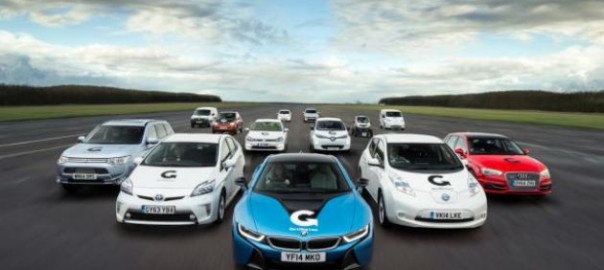
Go Ultra Low members boast 15 ULEVs across a range of segments (Image: OLEV)

Plug-in Electric Car Sales Surge in UK

Plug-in electric car sales have undergone a huge rise in many key European markets according to figures released by the European Automobile Manufacturers Association (ACEA).

The biggest gains came in the UK, where a 300 per cent rise in electric cars has taken place compared to this time last year.

In total 75,331 new electric cars have been registered according to the ACEA, with Norway leading the way with just under 20,000 new registrations.

In Germany electric car registrations are up by 70 percent, while in France they had climbed by almost 30 per cent compared to the 2013 figures.

Read more: Electric Vehicle News

Car exhaust (Image: BBC)

The Health Care Industry Has A Moral Obligation To Divest From Fossil Fuels

Hospitals, health-oriented nonprofits, and other members of the health sector need to divest from fossil fuels because of the risk they pose to human health, according to a new report.

The report, published this week by multiple U.K.-based health care organizations, called on the health sector commit to cutting its investments in the world’s top 200 fossil fuel companies in the next five years. The report compared the choice to divest from fossil fuels to the decision made by many hospitals and health care providers to divest from tobacco companies in the 1990s.

“It is arguably both immoral and inconsistent for the health sector to continue to invest in industries known to harm health, given its clear responsibility to protect health,”

the organizations write of fossil fuel investments in the report.

“Continued investment in these companies runs directly counter to the health sector’s repeated calls for action on climate change.”

The report outlines the impacts continued reliance on fossil fuels have on human health. Changes in temperature and rainfall are already contributing to the spread of some vector-borne diseases, especially those spread by mosquitos, since the insect lays its eggs in standing water, and standing water can increase as humidity and rainfall increases. In the Southwestern U.S., an increase of incidence of valley fever — a disease that’s found in desert soil — has been blamed by some experts on climate change. And climate change’s impact on crops around the world will also likely worsen hunger, which can take a toll on a person’s health.

Then there are the more direct health impacts of fossil fuels. Exposure to air pollution has been tied to myriad health effects, including ADHD, kidney disease, heart attack, stroke, and death. Fossil fuel extraction and production can cause major health problems too: coal miners are at risk of developing deadly black lung disease, and oil and gas wells have been found to emit toxic, cancer-causing chemicals, making living near these wells risky.

“People worldwide are already dying as a result of the health impacts of fossil fuels, but tomorrow’s doctors will have to cope with the full extent of climate change’s health cost,”

Alistair Wardrope, one of the report’s co-authors, told the Guardian.

“We have a responsibility to our future patients to ensure that health organisations are not funding the biggest global health threat of the 21st century.”

Last year, a group of U.K. doctors called on the World Health Organization to declare climate change a public health emergency, saying that it could end up killing more people than ebola. U.K. doctors also wrote in the British Medical Journal last year that doctors should push their hospitals and universities to divest from fossil fuels.

“Those who profess to care for the health of people perhaps have the greatest responsibility to act,” the doctors wrote.

The British Medical Association — which publishes the British Medical Journal — divested from fossil fuels last year.

Health care organizations in the U.S. have also called for fossil fuel divestment. One of them, Health Care Without Harm, has also compared divesting from fossil fuels to divesting from tobacco, and has said it’s a a way for hospitals and other health care providers to stand up for health and wellness.

So far, according to 350.org, 24 universities and university systems around the world have pledged to divest from fossil fuels, along with multiple other cities, foundations, and organizations.

Source: Climate Progress

Volkswagen Releases Series Of e-Golf Videos

[January 2015]

https://www.youtube.com/watch?v=pbVgP8nwkLo

Would you like an overload of info on the new Volkswagen e-Golf? These multiple videos will provide you with more info on the e-Golf than you likely care to know.

The first video discusses different driving and regenerative braking modes.

Check out this e-Golf commercial. e-Golf is 2015 Motor Trend Car of the Year.

https://www.youtube.com/watch?v=LCCHcZabs_s

Like the other BEVs, you can control your e-Golf with a sophisticated smart phone app.

https://www.youtube.com/watch?v=kSZRsi5CG-g

Read more: Inside EVs

Big Oil’s business model is broken

Many reasons have been provided for the dramatic plunge in the price of oil to about $60 per barrel (nearly half of what it was a year ago): slowing demand due to global economic stagnation; overproduction at shale fields in the United States; the decision of the Saudis and other Middle Eastern OPEC producers to maintain output at current levels (presumably to punish higher-cost producers in the U.S. and elsewhere); and the increased value of the dollar relative to other currencies. There is, however, one reason that’s not being discussed, and yet it could be the most important of all: the complete collapse of Big Oil’s production-maximizing business model.

Until last fall, when the price decline gathered momentum, the oil giants were operating at full throttle, pumping out more petroleum every day. They did so, of course, in part to profit from the high prices. For most of the previous six years, Brent crude, the international benchmark for crude oil, had been selling at $100 or higher. But Big Oil was also operating according to a business model that assumed an ever-increasing demand for its products, however costly they might be to produce and refine. This meant that no fossil fuel reserves, no potential source of supply — no matter how remote or hard to reach, how far offshore or deeply buried, how encased in rock — was deemed untouchable in the mad scramble to increase output and profits.

In recent years, this output-maximizing strategy had, in turn, generated historic wealth for the giant oil companies. Exxon, the largest U.S.-based oil firm, earned an eye-popping $32.6 billion in 2013 alone, more than any other American company except for Apple. Chevron, the second biggest oil firm, posted earnings of $21.4 billion that same year. State-owned companies like Saudi Aramco and Russia’s Rosneft also reaped mammoth profits.

How things have changed in a matter of mere months. With demand stagnant and excess production the story of the moment, the very strategy that had generated record-breaking profits has suddenly become hopelessly dysfunctional.

To fully appreciate the nature of the energy industry’s predicament, it’s necessary to go back a decade, to 2005, when the production-maximizing strategy was first adopted. At that time, Big Oil faced a critical juncture. On the one hand, many existing oil fields were being depleted at a torrid pace, leading experts to predict an imminent “peak” in global oil production, followed by an irreversible decline. On the other, rapid economic growth in China, India, and other developing nations was pushing demand for fossil fuels into the stratosphere. In those same years, concern over climate change was also beginning to gather momentum, threatening the future of Big Oil and generating pressures to invest in alternative forms of energy.

A “Brave New World” of tough oil

No one better captured that moment than David O’Reilly, the chair and CEO of Chevron. “Our industry is at a strategic inflection point, a unique place in our history,” he told a gathering of oil executives that February. “The most visible element of this new equation,” he explained in what some observers dubbed his “Brave New World” address, “is that relative to demand, oil is no longer in plentiful supply.” Even though China was sucking up oil, coal, and natural gas supplies at a staggering rate, he had a message for that country and the world: “The era of easy access to energy is over.”

To prosper in such an environment, O’Reilly explained, the oil industry would have to adopt a new strategy. It would have to look beyond the easy-to-reach sources that had powered it in the past and make massive investments in the extraction of what the industry calls “unconventional oil” and what I labeled at the time “tough oil”: resources located far offshore, in the threatening environments of the far north, in politically dangerous places like Iraq, or in unyielding rock formations like shale. “Increasingly,” O’Reilly insisted, “future supplies will have to be found in ultradeep water and other remote areas, development projects that will ultimately require new technology and trillions of dollars of investment in new infrastructure.”

For top industry officials like O’Reilly, it seemed evident that Big Oil had no choice in the matter. It would have to invest those needed trillions in tough-oil projects or lose ground to other sources of energy, drying up its stream of profits. True, the cost of extracting unconventional oil would be much greater than from easier-to-reach conventional reserves (not to mention more environmentally hazardous), but that would be the world’s problem, not theirs. “Collectively, we are stepping up to this challenge,” O’Reilly declared. “The industry is making significant investments to build additional capacity for future production.”

On this basis, Chevron, Exxon, Royal Dutch Shell, and other major firms indeed invested enormous amounts of money and resources in a growing unconventional oil and gas race, an extraordinary saga I described in my book The Race for What’s Left. Some, including Chevron and Shell, started drilling in the deep waters of the Gulf of Mexico; others, including Exxon, commenced operations in the Arctic and eastern Siberia. Virtually every one of them began exploiting U.S. shale reserves via hydro-fracking.

Only one top executive questioned this drill-baby-drill approach: John Browne, then the chief executive of BP. Claiming that the science of climate change had become too convincing to deny, Browne argued that Big Energy would have to look “beyond petroleum” and put major resources into alternative sources of supply. “Climate change is an issue which raises fundamental questions about the relationship between companies and society as a whole, and between one generation and the next,” he had declared as early as 2002. For BP, he indicated, that meant developing wind power, solar power, and biofuels.

Browne, however, was eased out of BP in 2007 just as Big Oil’s output-maximizing business model was taking off, and his successor, Tony Hayward, quickly abandoned the “beyond petroleum” approach. “Some may question whether so much of the [world’s energy] growth needs to come from fossil fuels,” he said in 2009. “But here it is vital that we face up to the harsh reality [of energy availability].” Despite the growing emphasis on renewables, “we still foresee 80 percent of energy coming from fossil fuels in 2030.”

Under Hayward’s leadership, BP largely discontinued its research into alternative forms of energy and reaffirmed its commitment to the production of oil and gas, the tougher the better. Following in the footsteps of other giant firms, BP hustled into the Arctic, the deep water of the Gulf of Mexico, and Canadian tar sands, a particularly carbon-dirty and messy-to-produce form of energy. In its drive to become the leading producer in the Gulf, BP rushed the exploration of a deep offshore field it called Macondo, triggering the Deepwater Horizon blow-out of April 2010 and the devastating oil spill of monumental proportions that followed.

Over the cliff

By the end of the first decade of this century, Big Oil was united in its embrace of its new production-maximizing, drill-baby-drill approach. It made the necessary investments, perfected new technology for extracting tough oil, and did indeed triumph over the decline of existing, “easy oil” deposits. In those years, it managed to ramp up production in remarkable ways, bringing ever more hard-to-reach oil reservoirs online.

According to the Energy Information Administration (EIA) of the U.S. Department of Energy, world oil production rose from 85.1 million barrels per day in 2005 to 92.9 million in 2014, despite the continuing decline of many legacy fields in North America and the Middle East. Claiming that industry investments in new drilling technologies had vanquished the specter of oil scarcity, BP’s latest CEO, Bob Dudley, assured the world only a year ago that Big Oil was going places and the only thing that had “peaked” was “the theory of peak oil.”

That, of course, was just before oil prices took their leap off the cliff, bringing instantly into question the wisdom of continuing to pump out record levels of petroleum. The production-maximizing strategy crafted by O’Reilly and his fellow CEOs rested on three fundamental assumptions that, year after year, demand would keep climbing; that such rising demand would ensure prices high enough to justify costly investments in unconventional oil; and that concern over climate change would in no significant way alter the equation. Today, none of these assumptions holds true.

Demand will continue to rise — that’s undeniable, given expected growth in world income and population — but not at the pace to which Big Oil has become accustomed. Consider this: In 2005, when many of the major investments in unconventional oil were getting under way, the EIA projected that global oil demand would reach 103.2 million barrels per day in 2015; now, it’s lowered that figure for this year to only 93.1 million barrels. Those 10 million “lost” barrels per day in expected consumption may not seem like a lot, given the total figure, but keep in mind that Big Oil’s multibillion-dollar investments in tough energy were predicated on all that added demand materializing, thereby generating the kind of high prices needed to offset the increasing costs of extraction. With so much anticipated demand vanishing, however, prices were bound to collapse.

Current indications suggest that consumption will continue to fall short of expectations in the years to come. In an assessment of future trends released last month, the EIA reported that, thanks to deteriorating global economic conditions, many countries will experience either a slower rate of growth or an actual reduction in consumption. While still inching up, Chinese consumption, for instance, is expected to grow by only 0.3 million barrels per day this year and next — a far cry from the 0.5 million barrel increase it posted in 2011 and 2012 and its 1 million barrel increase in 2010. In Europe and Japan, meanwhile, consumption is actually expected to fall over the next two years.

And this slowdown in demand is likely to persist well beyond 2016, suggests the International Energy Agency (IEA), an arm of the Organization for Economic Cooperation and Development (the club of rich industrialized nations). While lower gasoline prices may spur increased consumption in the United States and a few other nations, it predicted, most countries will experience no such lift and so “the recent price decline is expected to have only a marginal impact on global demand growth for the remainder of the decade.”

This being the case, the IEA believes that oil prices will only average about $55 per barrel in 2015 and not reach $73 again until 2020. Such figures fall far below what would be needed to justify continued investment in and exploitation of tough-oil options like Canadian tar sands, Arctic oil, and many shale projects. Indeed, the financial press is now full of reports on stalled or cancelled mega-energy projects. Shell, for example, announced in January that it had abandoned plans for a $6.5 billion petrochemical plant in Qatar, citing “the current economic climate prevailing in the energy industry.” At the same time, Chevron shelved its plan to drill in the Arctic waters of the Beaufort Sea, while Norway’s Statoil turned its back on drilling in Greenland.

There is, as well, another factor that threatens the well-being of Big Oil: Climate change can no longer be discounted in any future energy business model. The pressures to deal with a phenomenon that could quite literally destroy human civilization are growing. Although Big Oil has spent massive amounts of money over the years in a campaign to raise doubts about the science of climate change, more and more people globally are starting to worry about its effects — extreme weather patterns, extreme storms, extreme drought, rising sea levels, and the like — and demanding that governments take action to reduce the magnitude of the threat.

Europe has already adopted plans to lower carbon emissions by 20 percent from 1990 levels by 2020 and to achieve even greater reductions in the following decades. China, while still increasing its reliance on fossil fuels, has at least finally pledged to cap the growth of its carbon emissions by 2030 and to increase renewable energy sources to 20 percent of total energy use by then. In the United States, increasingly stringent automobile fuel-efficiency standards will require that cars sold in 2025 achieve an average of 54.5 miles per gallon, reducing U.S. oil demand by 2.2 million barrels per day. (Of course, the Republican-controlled Congress — heavily subsidized by Big Oil — will do everything it can to eradicate curbs on fossil fuel consumption.)

Still, however inadequate the response to the dangers of climate change thus far, the issue is on the energy map and its influence on policy globally can only increase. Whether Big Oil is ready to admit it or not, alternative energy is now on the planetary agenda and there’s no turning back from that. “It is a different world than it was the last time we saw an oil-price plunge,” said IEA Executive Director Maria van der Hoeven in February, referring to the 2008 economic meltdown. “Emerging economies, notably China, have entered less oil-intensive stages of development … On top of this, concerns about climate change are influencing energy policies [and so] renewables are increasingly pervasive.”

The oil industry is, of course, hoping that the current price plunge will soon reverse itself and that its now-crumbling maximizing-output model will make a comeback along with $100-per-barrel price levels. But these hopes for the return of “normality” are likely energy pipe dreams. As van der Hoeven suggests, the world has changed in significant ways, in the process obliterating the very foundations on which Big Oil’s production-maximizing strategy rested. The oil giants will either have to adapt to new circumstances, while scaling back their operations, or face takeover challenges from more nimble and aggressive firms.

Source: Tom’s Dispatch via Grist
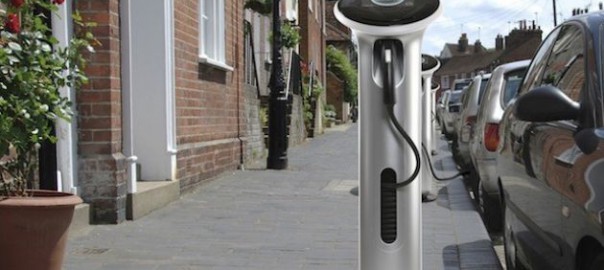
General Electric Watt Station Charge Post (Image: GE)

OLEV plug-in car and charging grant revisions April 2015

The government has pledged to continue its support of plug-in vehicles and their integration into the mainstream. This means that grant schemes in place such as the plug-in car grant and the EV Homecharge scheme will continue to run.

Importantly, the guidelines for these grants are being revised by the government, so there are some differences.

Plug-in car and van grant

From 1st April 2015, buyers of eligible electric cars will be able to claim 35% of the vehicle’s OTR price as opposed to the 25% currently offered. The grant cap of £5,000 remains, however.

To take account of rapidly developing technology, and the growing range of ULEVs on the market, the criteria for the Plug-in Car Grant is also being updated.

From April 2015, eligible ULEVs must meet criteria in one of the following categories depending on emission levels and zero-emission-capable mileage:

  • Category 1: CO2 emissions of <50g/km and a zero emission range of at least 70 miles;
  • Category 2: CO2 emissions of <50g/km and a zero emission range between 10 and 69 miles;
  • Category 3: CO2 emissions of 50-75g/km and a zero emission range of at least 20 miles.

EV Homecharge Scheme

The cap on the Homecharge scheme will be reduced on 13th April to £700. Eligible applicants will be able to get a grant to cover 75% (capped at £700) of the installation costs for a domestic charging point.

So far, the UK government has attributed almost £1 billion of funding to plug-in vehicles up to 2020, cementing their support for the uptake of electric vehicles into the mainstream.

Source: Zap Map

Rate Of Climate Change To Soar By 2020s, With Arctic Warming 1°F Per Decade

New research from a major national lab projects that the rate of climate change, which has risen sharply in recent decades, will soar by the 2020s. This worrisome projection — which has implications for extreme weather, sea level rise, and permafrost melt — is consistent with several recent studies.

The Pacific Northwest National Laboratory (PNNL) study, “Near-term acceleration in the rate of temperature change,” finds that by 2020, human-caused warming will move the Earth’s climate system “into a regime in terms of multi-decadal rates of change that are unprecedented for at least the past 1,000 years.”

In the best-case scenario PNNL modeled, with atmospheric carbon dioxide concentrations stabilizing at about 525 parts per million (the RCP4.5 scenario), the four-decade warming trend hits 0.45°F (0.25°C) per decade. That means over a 4-decade period, the Earth would warm 1.8°F (4 x 0.45) or 1°C (4 x 0.25). This is a faster multi-decadal rate than the Earth has seen in at least a millennium.

Because of Arctic amplification, the most northern latitudes warm two times faster (or more) than the globe as a whole does. As this figure from the study shows, the rate of warming for the Arctic is projected to quickly exceed 1.0°F (0.55°C) per decade.
DecadalWarming

The decadal rate of temperature change for 40-year periods over various regions — if humanity takes moderate climate action. Rates of change are averages over land plus ocean in each region. Via PNNL.

Such rapid Arctic warming would be ominous for several reasons. First, it would likely speed up the already staggering rate of loss of Arctic sea ice. Second, if, as considerable recent research suggests, Arctic amplification has already contributed to the recent jump in extreme weather, then the next few decades are going to be utterly off the charts.

Third, such rapid Arctic warming implies that the rapidly-melting Greenland ice sheet — already made unstable by human-caused warming — is likely to start disintegrating even faster, which in turn will push sea level rise higher than previously estimated, upwards of six feet this century.

Fourth, such rapid warming would serve to accelerate the release of vast amounts of carbon from defrosting permafrost — the dangerous amplifying carbon cycle which has already been projected to add up to 1.5°F to total global warming by 2100.

There is, of course, “internally generated variability” in the Earth’s climate system — which has been linked to variability in the Pacific Ocean — that can cause the rate of warming to slow down or speed up for a decade (and occasionally longer). That was the point of a February study on what has mistakenly been called the “hiatus” in global warming.

That hiatus was in fact merely an apparent slowdown in the rate of warming, primarily found in the U.K. Met Office’s dataset. But the Met Office uses the Hadley temperature record, which excludes the Arctic (!) — the very place on the planet that has been warming the fastest. When scientists incorporated Arctic warming into the Met/Hadley record using other data sources (such as the satellites), the slowdown all but vanished.

Read more: Climate Progress

Go Ultra Low members boast 15 ULEVs across a range of segments (Image: OLEV)

12 cities shortlisted for ULEV funding

Today, government announced details of 12 UK cities shortlisted to share £35 million of funding to promote ultra-low emission vehicles (ULEVs).

Bidding to be the UK’s first ‘Go Ultra Low Cities’, the shortlisted authorities have until 31 August 2015 to finalise their submissions, with the winning cities announced in the autumn.

Set up by The Office for Low Emission Vehicles (OLEV) and the Department for Transport (DfT), the £35 million Go Ultra Low City Scheme will deliver a step-change in the uptake of ultra-low emission vehicles. The programme will reward cities that demonstrate most potential to achieve ‘exemplar status’ – becoming internationally outstanding examples for the adoption of ULEVs in a local area.

The 12 cities and authorities shortlisted for official Go Ultra Low status and a share of the £35 million funding are: City of York Council; Department for Regional Development of Northern Ireland; Dundee City Council; Greater London Authority; Leicester City Council; Milton Keynes Council; North East Combined Authority; Nottingham City Council; Oxford City Council Sheffield City Council; West of England; West Yorkshire Combined Authority.

Minister of State for Transport Baroness Kramer said,

“This funding is an unequivocal signal from government that we are committed to making ultra-low emission vehicles a practical and viable choice for more people.

“Today’s shortlist of 12 Go Ultra Low Cities from across the country is an important part of our effort to improve air quality and establish the UK as a global leader in the uptake of low and ultra-low emissions vehicles. This can help to transform people’s quality of life in their cities and is an important step towards our 2050 vision when almost every car, bus and van in the UK will be an ultra-low emission vehicle.”

The scheme rewards cities that show how their plans could be rolled out across the UK, and how their initiatives complement other schemes in their city, such as wider transport policies like the Low Emission Bus and Taxi Schemes.

Those cities that address local air quality issues, particularly in relation to NO2 and other particulate matter, will also be considered favourably.

The Go Ultra Low campaign is the first of its kind, bringing together the Department for Transport (DfT), the Office for Low Emission Vehicles (OLEV), the Society of Motor Manufacturers and Traders (SMMT) and a consortium of seven car manufacturers – Audi, BMW, Mitsubishi, Nissan, Renault, Toyota and Volkswagen.

Source: Next Green Car, 11 March 2015

2015 BMW i8 Video Road Test

The BMW i8 is sleek and stunning, but it’s no V-8-powered supercar. Is it the car that will give plug-in hybrids sex appeal?

First, you need to know what makes the i8 go. This is no straightforward supercar: The i8 gets power in a complex way–it can be front-wheel drive, rear-wheel drive, or all-wheel drive, depending on the situation.

Here’s how: Between the front wheels there’s a 96-kilowatt electric motor–the equivalent of 131 horsepower. It sends power to the front wheels through a two-speed transmission.

That electric motor taps into a 5.1-kilowatt-hour lithium-ion battery mounted in the tunnel between the seats. It can run the car’s front wheels in its electric-only “Max e-Mode” up to 75 mph.

In the back, there’s a turbocharged 1.5-liter three-cylinder gasoline engine producing 231-horsepower. That power goes to the rear wheels through a six-speed automatic transmission.

Combine them, and you have 362 horsepower, and a 0-62 mph time of 4.4 seconds when using both powertrains together.

Put the BMW i8 into Comfort mode, and the i8 behaves like a hybrid, blending gas and electric power as needed. Go faster than 40 mph, and it sends power to every wheel, for all-wheel drive.

Flip into Sport mode, and the gauges glow red, a tachometer replaces the power meter, and the powertrains go into beast mode.

Can the i8 really be an eco-friendly sports car? The EPA says it can run in pure electric mode for 15 miles; in hybrid mode, the i8 earns ratings of 28 mpg combined and 76 MPGe.

Drive it like a sports car, and you might only see 50 mpg on average. But when you do, you’ll get attention. A lot of it.

Let’s be clear: The i8 really isn’t a track car. It strikes a nice balance between sporty performance and high efficiency. It has really neutral handling, and precise electric power steering with decent simulated feedback.

It also has what we call “engineered” noise: BMW pipes in simulated power noises to make the i8 sound more sporty. Those noises get louder in Sport mode…but the i8 never is really, truly, blindingly fast. It’s just quick.

The drivetrain is exotic, but the i8’s shape is truly outrageous. Sure, there’s a BMW grille and something like a 6-Series shape, but it’s all swept up in huge futuristic swoops and scoops and wings–which all help smooth out its aero profile.

It’s something of a chore to get into the i8, but once you’re in, the usual iDrive controller and infotainment screens will be familiar.

The climate control and stereo both feature actual knobs, which is nice, and the gauge cluster is an LCD screen, which reconfigures itself based on the driving mode you’ve chosen.

These front seats are very comfortable, with heavy contouring. You sit low in the car, but visibility is just fine. BMW may say the i8 is a 2+2, but don’t expect to put average-sized humans back there if an actual adult sits up front.

The BMW i8 hasn’t been crash-tested yet, and frankly we want to see it happen–its bodyshell is made of carbon-fiber-reinforced plastic on an aluminum rolling chassis, and little crash-test data exists for cars made that way.

The i8 gets the standard suite of safety tech, from six airbags to the usual electronic safety systems, plus such active safety systems as a forward-collision warning system and surround-view cameras.

Priced from about $135,000, the i8 comes well-equipped, with iDrive and a 10.2-inch screen, navigation, BMW’s i Remote App, six-way power front seats, heated seats, LED headlights, and satellite radio. There are few options other than color.

So what’s the bottom line with the BMW i8? It’s a ground-breaking sports coupe with an advanced hybrid powertrain that has super economy and style, if not quite supercar performance.

Source: Green Car Reports