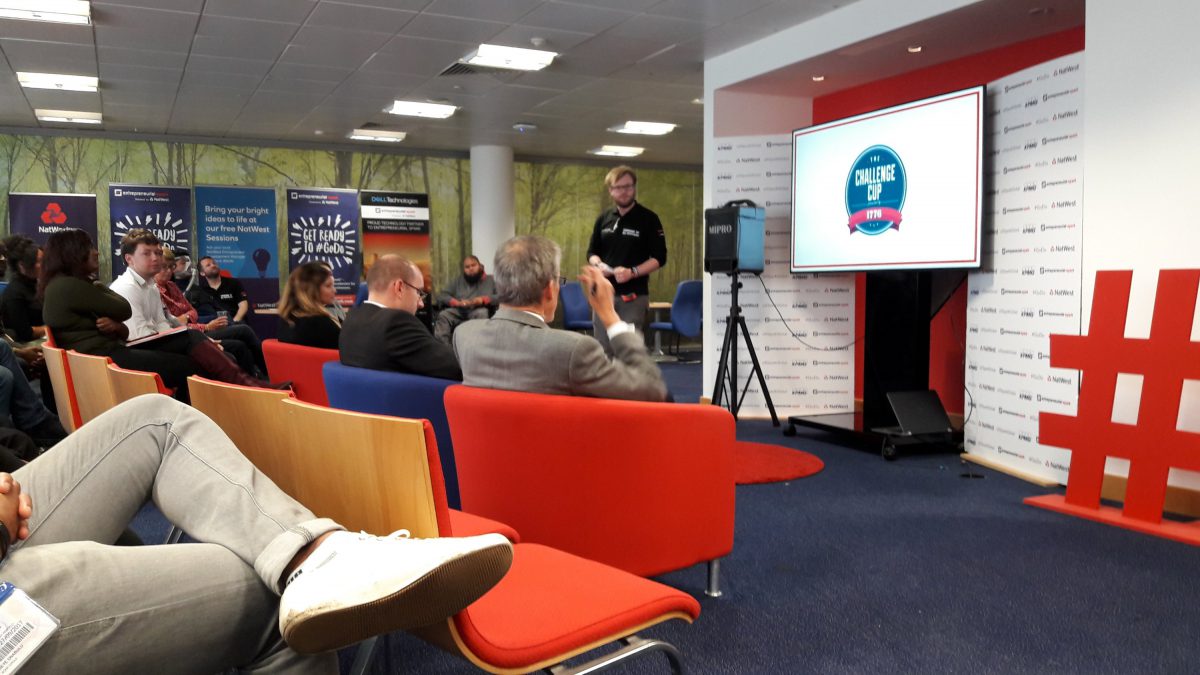
We have started the process of growing Fuel Included Limited by looking for investment opportunities. Today we are in Birmingham having got through the preliminary rounds of the Challenge Cup organised by 1776.
Jason pitched our business plan to four investment judges and I’m pleased to announce we got through to the shortlist.
I’ll follow up with more news, and hopefully a video of our pitch, soon.
We’re in Skegness for the aquarium, our youngest is diving with the sharks! While she waits to go in I’m off to get the car charged.
The i3 has plenty enough range to get back to the Peterborough services. In fact it’s suggesting we could get 160 miles out of this charge which theoretically could get us all the way back to Northampton.
However Zap-map.com says there’s a free POD Point charger in Skegness so I’m going to investigate.
It’s in the Aura Business Park and it turns out to be easy to find. I plug in and it’s charging immediately, nothing else required.
While in the Aquarium the car gets fully charged. The dive has just finished and we’ll be heading back to the car in a minute. There’s a Pizza Hut next to it so I suspect that’s what we’ll be having for dinner tonight!
Update: We did eat in Pizza Hut. We also got home all the way from Skegness to Northampton without needing to charge (in fact, with about 40 miles left on the clock) – and for free!
We’ve just had A1 Service from Ecotricity. We’re on our way from home in Northampton to the Skegness Aquarium and charged up at the A1 Services at Peterborough.
We used an Ecotricity CCS rapid charger. There was no queuing and it worked first time.
It was quick, with the i3 fully charged in half the time it took us to have lunch. A1 service!
I’m on my way down the M1 from Northampton to Milton Keynes and the motorway has come to a halt. It’s not clear exactly what’s happened, but a bit of Googling on my phone indicates there’s an on going ‘police incident’. Apparently a suspicious object has been found under a bridge near Newport Pagnell. This started an explosive device incident. However, further investigation seems to have turned it into a chemical spillage incident. Anyway, the motorway is shut both ways between Junction 15 and J14. I joined the back of the queue about 8.30am and it’s now 11.30. People are milling around and chatting, and generally behaving well. However it’s shocking how many drivers keep their engines running. For the first couple of hours you couldn’t walk around without being assaulted by the noise, smell and fumes from three rows of diesel. Now, three hours in, most are off with just a few diehards keeping them on continuously.
Being in an electric car saves me from the noise, but unfortunately I can’t avoid breathing the fumes. I look forward to the day when we can all leave poisonous fumes in the past.
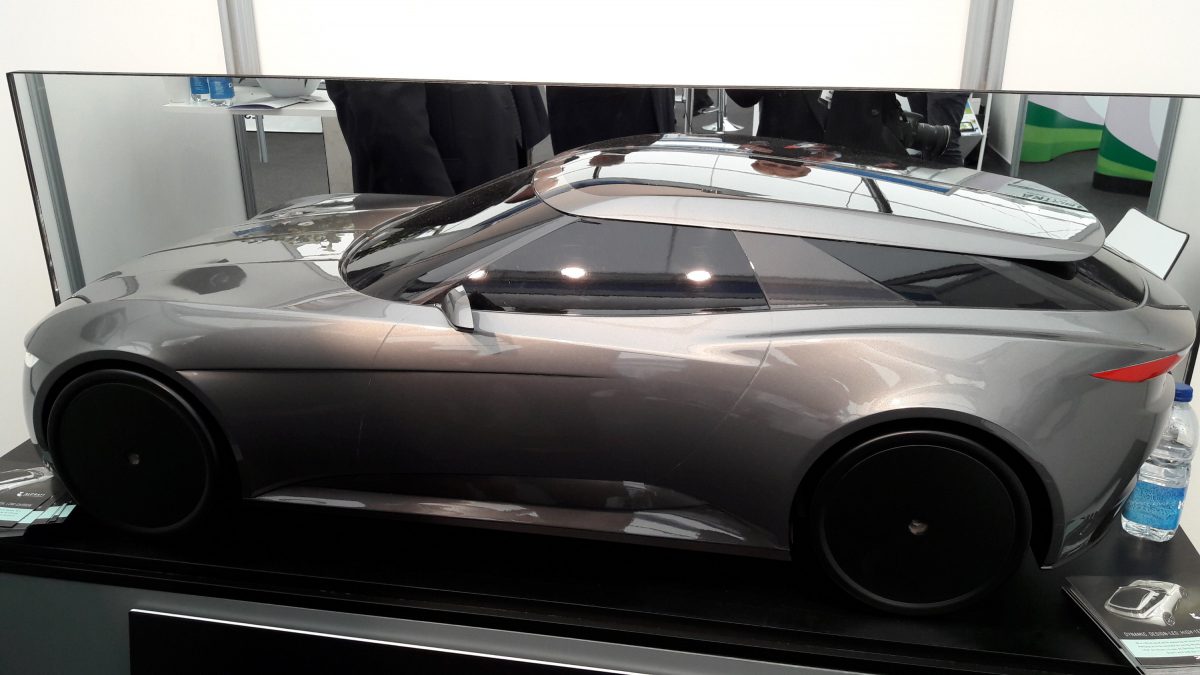
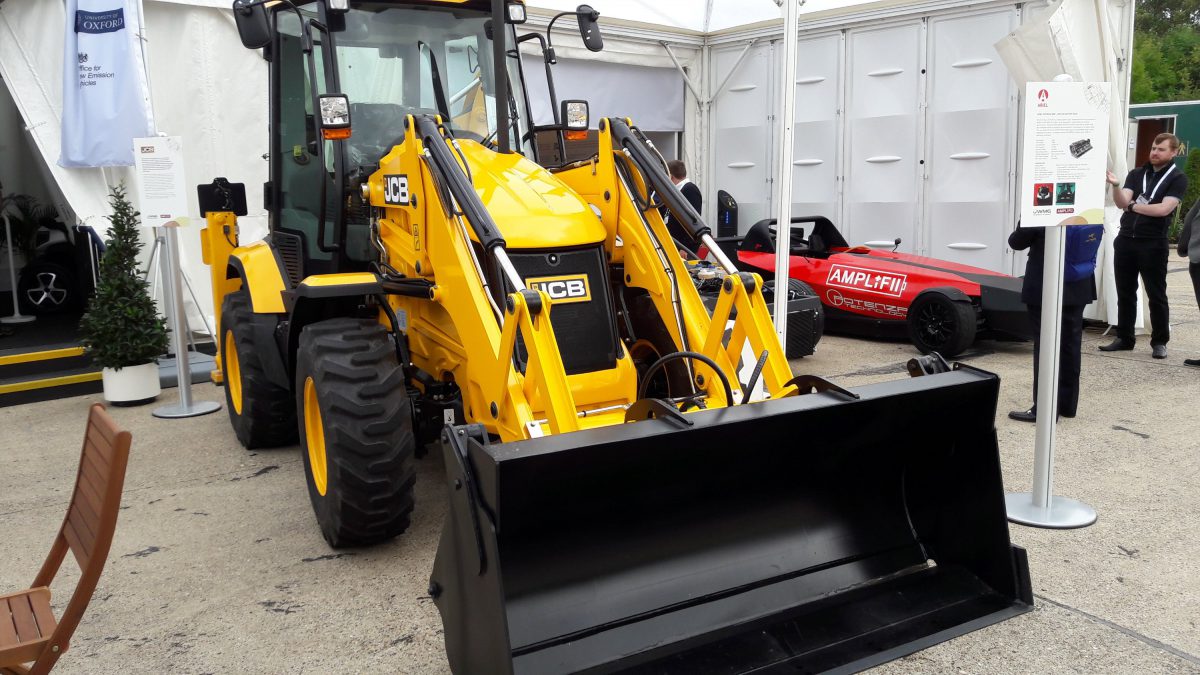
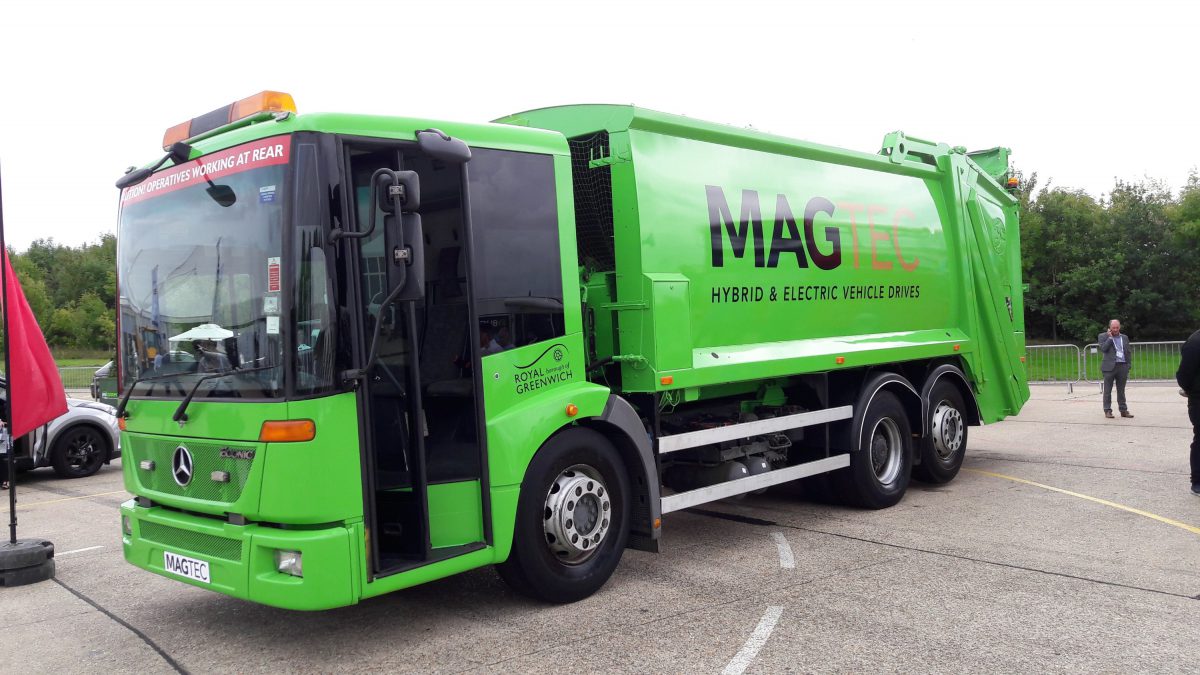
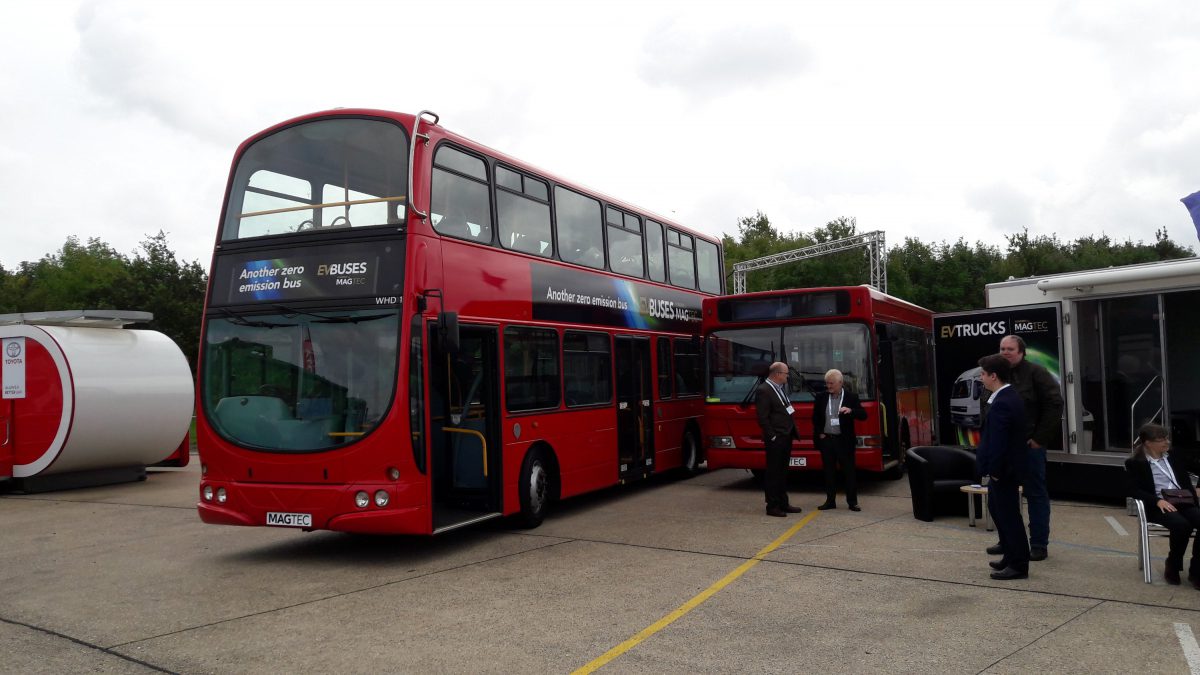
Just arrived at the Cenex LCV 2017 event and having a first look around. There are lots of interesting innovations on show, here are just a few examples.
The Solar Charge Points at Devon Cliffs – and only 2/3 of the cars shouldn’t be parked there! (Image: T. Larkum)
On arrival we found a pleasant surprise – a solar powered charging bay in the main reception car park. I have since learned that it was installed about a year ago in a joint venture with Bourne Leisure (owners of the park), Solarplicity and POD Point.
Having last charged at Sedgemoor, about 60 miles back, we didn’t need to charge again for the first few days. Then I started looking into how to start a charge – doing some Googling, searching on the POD Point online map (which didn’t show the charge point), installing the POD Point app, etc.
However, it all turned out to be unnecessary – I called POD Point and they explained that it was a private charge point – hence not on the public map – and that it was free to use. In hindsight I should have just plugged in and tried it!
The POD Point charge points at Devon Cliffs (Image: T. Larkum)
We have since made good use of the charge point, leaving the car on charge overnight most days. It is marked as a 7kW point which should charge our i3 in about 4 hours. In fact I am seeing charge times significantly longer than that so I would guess it is actually running at about half that, 3.5kW. Perhaps that has something to do with being solar powered, e.g. a reduced charge outside sunny hours, I don’t know. Anyway, the car is fully charged every morning so it doesn’t really matter.
The charge point has been a real boon – allowing us to go on long trips out most days without needing to find anywhere else to charge.
After four years of driving electric I would much prefer to take an electric car on a long journey than a piston car. Most people wouldn’t expect that, except those experienced with driving long distances in an electric vehicle.
Charging at Sedgemoor Services on the M5 (Image: T. Larkum)
Some of the benefits are obvious, of course, such as the cheap fuelling costs and reduced environmental impacts (both local pollution and reduced greenhouse gases). However, it’s worth looking at the other aspects as they aren’t often spelled out.
An electric car is much better to drive for a number of reasons. The electric motor itself is quiet and smooth so you don’t have to put up with the noise and vibration of a combustion engine. As well as being less stressful, this also means it’s more enjoyable listening to music, radio, audiobooks, etc.
Further, the lack of a gearbox is a big benefit. Compared to a manual gearbox, there is no need to operate a clutch or gear lever – this is a particular advantage in stop-and-go traffic. Compared to an automatic gearbox, there is smooth acceleration from zero to full speed without the annoying jumps as the gearbox changes its gear or the sound of the gear changes.
Best of all, electric cars have braking regeneration, meaning the motor can act as a brake (and in so doing recharge the battery). This feels like ‘engine braking’ but can be considerably stronger. Electric vehicles with strong ‘regen’, like the Tesla Model S and BMW i3, are best of all as they allow for ‘one-pedal driving’.
Releasing the accelerator pedal causes the car to slow down all the way to a stop. This means it isn’t necessary to use the brake pedal at all, except in an emergency. Using the accelerator alone for speed control makes the driving very easy and relaxing. This is such a benefit that Nissan are promoting it heavily, as the e-Pedal, for the next version of their Leaf.
Of course, if the electric car isn’t a Tesla then it will have less range than most piston cars and this has to be taken into account as there will be a need to charge on a long journey. However, as the range of all electric cars increases, and the infrastructure improves, charging isn’t the issue it used to be.
Even in going from the 80 mile range of my previous Renault ZOE to the 120 mile range of my current BMW i3 I have found charging to become much easier. I now have to stop to charge only after about 2 hours of driving, which is as long as my family is prepared to go without a break anyway.
We’re currently holidaying in Devon, having driven from Northampton. On the way down we stopped twice to charge. The first time we stopped for lunch, so the car just charged while we ate. The second time we stopped for a comfort break, and then just waited an extra 15 minutes or so for the charge to complete.
Quarter of an hour is a small time cost in a journey of 7-8 hours. It would have been quicker if it hadn’t been for some terrible Friday afternoon traffic around Bristol, and the one-pedal driving and other benefits outlined above more than made up for small time spent charging.
The charging itself went really easily both times. The first time we had just a brief delay (although we saw a queue as we left). The second time we were the only EV there and just started and stopped charging as we wanted. And each charge cost me less than £5.
Overall the benefits of driving an EV on a long journey far outweigh the minor inconveniences of charging, so I personally could not go back to driving a piston car. As EV ranges continue to increase, the benefits will become obvious to all drivers.
As sales of electric cars keep increasing we are seeing more and more of them on the road. That simply reflects the rising demand as everyone now knows they will be transitioning away from fossil-fuel cars.
We saw one result of that today. We’re on our way to Devon on holiday in our i3, and called in at Chieveley Services to charge.
On arriving, there was a Tesla Model S charging at one of the Ecotricity pumps, the one with the CCS connector that the i3 needs. After a brief discussion he kindly agreed to move to the other pump so we could charge.
Once we were charging we went inside for lunch, and I monitored the charging on my phone. As it approached 100% we headed back to it only to find a charging queue for the first time ever!
The Tesla had gone and been replaced by a Nissan Leaf. Waiting to charge were a second Leaf and a Renault ZOE. We moved out of the way for the second Leaf, but the ZOE probably had a half hour wait ahead of it.
This type of situation will probably become increasingly common as more EVs hit the road, at least in the short term. Eventually it is hoped that we’ll see all petrol stations, and perhaps most parking spaces, changed over to be charging points.
Following the success of our first eBook we have decided to do another one. The first one was a guide to charging your electric car at home. This one is specific to the Milton Keynes area, where we are based (though of course we deliver nationwide). Milton Keynes is the best city in the world for giving incentives to electric car drivers.
If you are considering an electric car and you live near, work in or visit Milton Keynes, then this is the guide for you.
Red Tesla Model S in the new Milton Keynes showroom (Image: T. Larkum)
This eBook tells you all you need to know about the benefits of an electric car in Milton Keynes:
Charging in and around Milton Keynes
How to get free parking in Central Milton Keynes
How to get free parking at MK railway station
The Experience Centre, with free test drives and lessons
Planned future benefits, e.g driving in bus lanes
Click on the image, enter your name and email, and download your free guide.
If it leaves any questions unanswered, just get in touch (contact details here and in the eBook).
In January 2016, Milton Keynes was awarded Go Ultra Low City status alongside Bristol, London and Nottingham and secured multi-million pound investment from the UK Government. The cities and regions each received a share of £40 million funding by proposing innovative ideas to encourage drivers to choose an electric car.
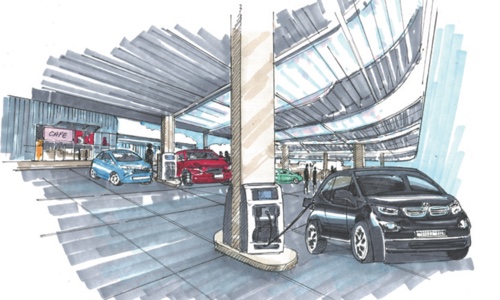
Electric Avenue: MK City Centre Hub
Milton Keynes Council received £9 million funding to further its work developing modern vehicles to tackle harmful emissions, reduce its carbon footprint, and continue to make Milton Keynes one of the most sustainable cities in Europe.
Future plans for the funding in Milton Keynes include:
Charging Hubs, where electric vehicles can be fully recharged in around 30min: EV Rapid Charging Hubs are being established at the Coachway at M1 J14 and in the City Centre
Charging posts close to residential areas: Milton Keynes will commit to providing a charging point to any resident of the City who buys an EV, either at home or on a nearby street if the buyer does not have off-street parking
Priority for EVs in bus lanes
Destination charging at popular locations including supermarkets, hotels and leisure facilities
Trialling the latest developments in technology such as inductive charging
Information and signage: Signage will be provided giving motorists clear information on facilities for EVs.
With regard to the Charging Hubs, this project will see Chargemaster supply its latest charging infrastructure to set up two filling-station-style EV rapid charging hubs and 50 destination chargers across the town.



 Apparently a suspicious object has been found under a bridge near Newport Pagnell. This started an explosive device incident. However, further investigation seems to have turned it into a chemical spillage incident. Anyway, the motorway is shut both ways between Junction 15 and J14. I joined the back of the queue about 8.30am and it’s now 11.30.
  People are milling around and chatting, and generally behaving well. However it’s shocking how many drivers keep their engines running. For the first couple of hours you couldn’t walk around without being assaulted by the noise, smell and fumes from three rows of diesel. Now, three hours in, most are off with just a few diehards keeping them on continuously.