It was 6 weeks ago, early December 2018, that European reservation holders were asked to configure their Tesla Model 3’s.
The expectation was deliveries would begin somewhere in second half of the first quarter of 2019, but many were also doubtful of that timeline.
Last week, reservation holders received an invitation to experience the Model 3 at a local showroom. I was one of those reservation holders, and after years of reading and writing about the Model 3, after just sitting in it at the Paris Motor Show, we could not wait for the change to drive it.
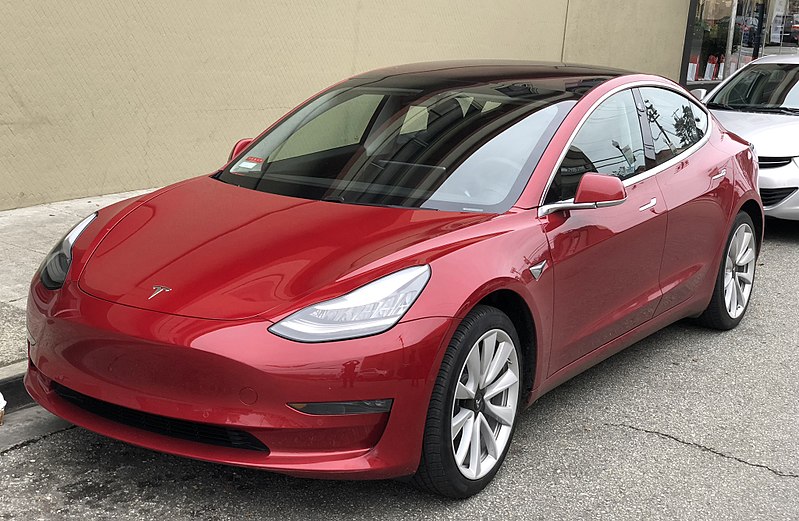
Tesla Model3 (Image: Wikimedia/Carlquinn)
A small number of Model 3 Performance cars for test driving were sent ahead of the first shipload of customer Model 3’s that will arrive in early February in Zeebrugge, Belgium. Those cars arriving soon are for those who did not wait and ordered their cars untested, as will be the case for the next 2 or 3 shiploads of cars. (And as many a Wall Street analyst can explain, selling thousands of the highest trim levels sight unseen is clear proof that there is no demand for the Model 3 in Europe, but that is for another article. </sarcasm mode>)
Let us state that it is not fair to have the Long Range Performance with the Premium Upgrade Package for a test drive when your budget would really like a Standard Range basic version. Now, there are serious questions. For example: Is the Standard Range with rear-wheel drive just as sticky to the road as the all-wheel drive? Is the cornering just as effortless as in this Performance model? Is the Performance chill mode comparable to the Standard Range normal mode?
Renault ZOE wins ‘Best Electric Car for less than £30,000’ at the What Car? Awards 2019
All-electric Renault ZOE has taken the award every year since 2014
ZOE sales were up 1.25 per cent in 2018 to 1993 vehicles
Renault is the number one EV manufacturer in Europe
At this evening’s What Car? Awards the Renault ZOE won the ‘Best Electric Car for less than £30,000’ title for the sixth consecutive year. The What Car? Awards have been presented for the past 41 years and are recognised as being among the most prestigious in the industry. The award adds to the ZOE’s growing list of industry accolades.
2018 – Renault ZOE
Steve Huntingford, Editor of What Car? magazine, said:
“Our 2017 Electric Car of the Year remains a compelling proposition two years on, which is some achievement given the pace at which things are moving in this class. Unlike other sub-£30k pure electric options, you don’t have to put up with a feeble range. In fact, in our Real Range tests, the ZOE outperformed many much pricier options.”
Vincent Tourette, Managing Director of Renault UK, said:
“Electric cars are becoming more popular every month and the Renault ZOE has been at the forefront of the market since it was launched in the UK six years ago. ZOE is available with a choice of trims and motors, giving our customers the opportunity to choose the ZOE that best fits their lifestyle. That’s a key reason why the ZOE has been presented with a strong list of awards and it’s gratifying to see the model recognised by What Car? for a sixth successive year.”
Renault’s ZOE has proven popular with customers with 1993 sold in the UK last year, an increase of 1.25 per cent over 2017. The car continues to be available to purchase in two ways. First, under a battery hire scheme, where ZOE pricing starts at £18,420 (on the road) after the Government Plug-in Car Grant, with battery leasing from £59 per month. And second, under the ‘full purchase’ option, which allows the customer to buy the car and the battery from £25,020 (OTR). Whichever purchase option is chosen, the Renault ZOE is one of the most affordable electric cars on sale following Renault’s mantra of providing sustainable mobility for all.
In addition, Renault offers retail customers that purchase a ZOE a free 7kW wall box charger fully-installed in their home to ensure the best possible electric experience.
Two versions of the ZOE supermini are available and both have a real-world range of 186 miles (WLTP¹). With the R110 motor the ZOE has faster mid-range acceleration and 16hp more power than the R90 version it replaced. The second option is the Q90 motor, which allows faster charging. The ZOE Q90 Quick Charge can be charged from zero to 80 per cent in 65 minutes with a 43kW charger that can typically be found at most motorway service stations.
The customer can also choose between two trim levels: ZOE Dynamique Nav and ZOE Signature Nav. Included with the ZOE Dynamique Nav is 16-inch ‘black shadow’ alloy wheels, a hands-free keycard, automatic headlights and wipers, rear parking sensors and seven-inch colour touchscreen for the R-LINK 2 infotainment system with navigation.
Renault’s R-Link infotainment system utilises Android Auto™ to link the driver or passenger’s smartphone to the ZOE and mirrors the phone display onto the vehicle’s touchscreen to enable easy use of the smartphone’s functionality in the car.
ZOE Signature Nav adds a BOSE® 3D sound system, heated front seats, a rear reversing camera and bronze coloured interior detailing. It also features 16-inch ‘grey shadow’ alloy wheels and unique ‘Signature’ upholstery.
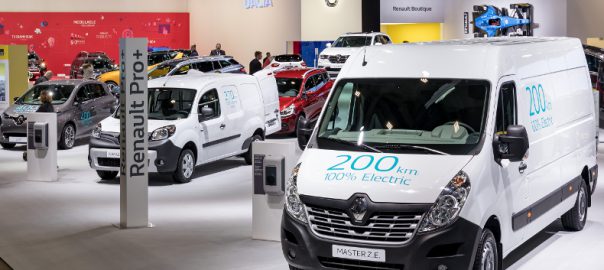
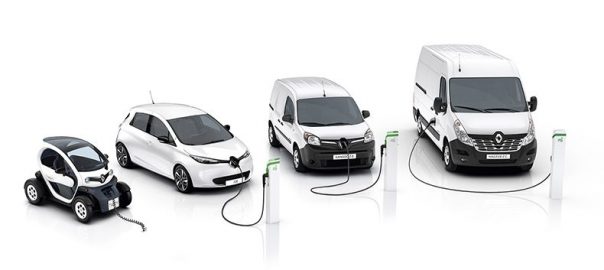
Renault has a strong line-up of 100 per cent electric vehicles that are in Renault dealerships nationwide. The ZOE is Renault’s popular electric supermini and is joined by the Twizy quadricycle, the Kangoo Z.E. 33 Van and the New Master Z.E. Van.
UK Power Networks and delivery giant UPS are among the partners on a new pilot aimed at demonstrating the commercial viability of cutting edge, wireless EV chargers.
The duo are to work with High Speed 1 and the Warwick Manufacturing Group on the project, which will see wireless charging technology deployed in three live locations in London and Tamworth.
The project, funded by the Office for Low Emission Vehicles and Innovate UK, will run for the first three months of this year and is aimed at broadening the understanding of how wireless EV chargers can become commercially viable.
Example Renault Electric Vans (Image: Renault)
UPS delivery vans will be charged at the company’s depot in Tamworth while they are being loaded with parcels, while electric taxis will receive charge wirelessly while waiting for passengers outside St Pancras International railway station in central London.
UK Power Networks’ fleet of electric vans will also take part in the trial.
It is hoped that wireless EV charging technologies could provide a significant boost for the adoption of electric vehicles in commercial fleets and fleet managers, in turn helping decarbonise the transport sector.
The feasibility study could also lead to a second round of funding from OLEV and Innovate UK should it demonstrably rove the viability of the technology and commercial model surrounding it.
EVs emit less lifetime CO2 than cars with internal combustion engines, even in countries reliant on coal for electricity generation
Electric vehicles (EVs) are better for the environment than internal combustion engine (ICE) models even when charged up with electricity generated by coal-fired power stations, according to new research.
Data from BloombergNEF (BNEF) shows CO2 emissions from EVs were about 40 per cent lower than those from ICE models in 2018. Furthermore, the UK saw the biggest difference in emissions between the two categories of car due to its large renewable energy industry.
Even in countries like China, which are more reliant on coal-fired electricity, EVs were still found to be cleaner than ICE cars from the points of view of CO2 emissions.
The research helps clarify some of the details surrounding the lifetime emissions of EVs, which don’t pollute on the road but do consume electricity that’s often generated by fossil fuels.
As a result of the data, BNEF predicts EVs will become cleaner in the future as utilities companies ditch coal plants in favour of renewable energy sources, such as wind and solar farms.
High-mileage drivers can use electric vehicles if their daily driving profile is suitable.
The higher-spec Kona Electric model brings an official range of 279 miles (Image: Hyundai)
So says Arval, adding that the persistent belief that pure electric vehicles are only suitable for low annual mileage needs to be overturned.
According to head of consulting Shaun Sadlier, the myth that EVs are not a suitable choice for drivers covering more than a few thousand miles a year is still frequently bandied around.
He explained:
“This argument is really an extension of range anxiety, the idea that because an EV has a limited range and takes time to recharge, that it cannot cover a longer distance annually.”
However, Sadlier added, the real-world suitability of EVs depends much more on the range of a particular model and each driver’s actual needs on a day-by-day basis.
“If you look at a driver who covers 25,000 miles a year, towards the upper end of the typical fleet spectrum, then the suitability of an EV rests entirely on their daily mileage.
“If that driver covers 246 miles, twice a week, for 46 weeks of the year, then an EV is probably not for them. They are exceeding or getting close to the maximum range of even the best EVs that are now available on the market.
“However, if they drive 110 miles, five days a week, for 46 weeks of the year and this mileage pattern is very predictable, then an EV could absolutely be suitable because it is well within the range for most models and the car can be recharged overnight.”
Sadlier added that there was an argument that the financial model of EVs meant that the higher the mileage, the more cost-effective an EV becomes.
Electric vehicle sales are on the rise all over the world. That doesn’t mean some traditionalists are taking it well.
2018 is shaping up to be a record year for electric vehicles. My Bloomberg NEF colleagues expect 1.9 million EVs will have been sold last year, up from 1.1 million the year before, with the bulk of those sales in Asia. Overall, China’s new passenger vehicle sales were in significant decline for the first time in more than 20 years.
Rapid growth requires the infrastructure to keep those electric vehicles charging on road trips, at offices or any time their owners aren’t plugging in at home. That infrastructure is being built in major auto markets — and some new behaviors are cropping up, too, as electric vehicle charging outlets are being built at retailers, apartment complexes and especially at gas stations.
There are currently about 50,000 fast-charging outlets in the U.S., and Germany and Japan have 30,000 to 40,000 each. However, as Bloomberg News’s Marie Mawad found out during her recent drive from Paris to Mannheim, Germany, there are still not enough charging outlets to set a road-tripping EV driver’s mind at ease.
China has … a few more. And for good reason: Very few drivers in China have personal garages in which to slow-charge overnight.
Meanwhile, by the end of last year, there were reports of U.S. drivers being “ICEd out”: drivers of internal combustion engine cars deliberately occupying dedicated charging spots, preventing EV drivers from using them. Besides being deliberate and hostile, it’s not an exaggeration to call such behavior the result of a culture clash between the environmentally minded and coal-rolling enthusiasts. More plainly, perhaps, it is new versus old.
The latest version of Nissan’s Leaf has been unveiled at CES 2019, and it features a subtle but reassuring twist for any potential owners who suffer from range anxiety.
Nissan Leaf 3.Zero e+ (Image: Nissan)
Top of the pile is the Nissan Leaf 3.Zero e+ Limited Edition, which boasts a higher output. The fun and funky saloon, best known for its wonderfully addictive e-Pedal, will deliver 160kW (217 PS) of power, 340Nm of torque and a predicted 239 mile range from one charge of the 62 kWh capacity battery.
The Leaf 3.Zero e+ Limited Edition will deliver a 40% range increase over another cheaper edition of the car, the Leaf 3.Zero, which is equipped with a 40 kWh battery. Anyone worried about making it from A to B will most likely want to plump for the model with the beefier battery, which is predicted to deliver up to 62 miles more on one charge.
The UK’s electric vehicle (EV) market grew by a record-breaking 19% in 2018, with one EV being registered every nine minutes.
That is a key finding of a new research paper from pro-EV campaign group Go Ultra Low, which found that almost 60,000 fully-electric and plug-in hybrid electric vehicles were registered in the UK last year.
Published today (21 January), the research draws on the latest official Government figures, revealing that the uptake of EVs grew at a similar rate between the UK’s business and domestic car users throughout 2018.
Electric car sales are expected to overtake petrol by 2040
In total, 59,911 EVs were registered in the UK last year, of which 74% were plug-in hybrids, the paper claims. While only 26% of EV registrations were for fully-electric models, this was still an increase on 2017’s 14% proportion.
The registrations mean that the nation’s total EV stock now stands at more than 196,300 vehicles, following seven consecutive years of growth.
Go Ultra Low has predicted that the EV revolution will continue to take hold in 2019, as carmakers launch new electric models and the Government begins distributing the first string of funding set out in its Road to Zero strategy.
“In the context of the wider new car market, it is fantastic to see plug-in car registrations continue to go from strength-to-strength” Go Ultra Low’s head, Poppy Welch, said.
“With even more new models being released, coupled with the introduction of initiatives such as London’s Ultra Low Emission Zone, we’re confident that the next 12 months will be a landmark year for the nation’s switch to electric.”
According to Go Ultra Low, some of the more noteworthy EV releases in 2019 will be the all-electric Kia e-Niro, Audi e-tron and Nissan LEAF. The Nissan LEAF 3.ZERO e+ Limited Edition – of which only 5,000 units will be produced for the European market – is expected to deliver a driving range of up to 239 miles on a single charge of the 62kWh capacity battery.
Electric-car sales are growing. Total car sales around the world are shrinking.
Put the two together, and the conclusion from many analysts is that sales of cars powered by internal combustion engines around the world have already peaked.
From 2019 onward, they’re likely to do nothing but shrink, according to several automotive analysts interviewed in the Financial Times (subscription required) for a piece published late last month.
The FT quotes several analytics firms forecasting that global auto sales will fall in 2019 compared with a record 95.5 million cars sold in 2018, according to Moody’s Analytics.
There are several factors at play: an international trade war among the U.S., China, and Europe; tighter consumer credit in the world’s largest auto market, China; troubled Brexit negotiations; and tighter European restrictions on carbon-dioxide emissions.
Other analytics firms, including Evercore ISI, Accenture, and Jato Dynamics told the FT that they expect a structural downturn in 2019, based on slower sales in the second half of 2018.
At the same time, sales of electric cars are rising. AlixPartners, a British consulting service, says it expects electric car sales to grow by 1.5 million in 2019, reaching about 1.6 percent of the global market.
“Peak ICE” may already have occurred at the end of 2018, Elmer Kades, global co-leader of AlixPartners’ automotive practice told the FT. “It’s this slowing growth of the overall pie that the industry should be most concerned with, even as it has to … pay for the continuing switchover to electric vehicles.”
In connection with the announcement of their German sales figures for 2018, Renault has announced that a Cargo version of the Zoe will be added to their range of electric models this year.
To create more cargo space, Renault remodeled the rear seat area in the vehicle. More details on the cargo version are not yet available, as of yet though. Together with the Kangoo Z.E., Master Z.E. and a cargo version of the Twizy, the French will soon be offering a total of four purely electric delivery vehicles with the addition of the Zoe Cargo.
The Renault Electric Z.E. Range (Image: Renault)
As far as new registrations of electric vehicles by Renault in Germany in 2018 are concerned, there was an increase of 46.9% to a new record of 7,400 new vehicle registrations. According to the German federal motor transport authority KBA, the Renault Zoe recorded 6,360 new registrations in Germany alone. This is also due in no small part to the doubling of Zoe production to 440 units per day. The Kangoo Z.E. was responsible for 758 new registrations. And with the e-transporter, Renault is now even reaching its own limits. According to Renault’s German boss Uwe Hochgeschurtz, the car manufacturer is currently unable to meet the rapidly growing demand for electric delivery vans. This is also due to bottlenecks in battery production. The company hopes to get the problem under control in 2019.