All posts by Jo

Whoosh! The Electric Car Is Rolling into American Life

U.S. transportation is about to get a mighty electric shock.

The days of the internal combustion engine are numbered. The electric car is about to do to the traditional gasoline and diesel car engine what the cell phone is doing to the copper-wire, landline telephone: shoulder it out of the way.
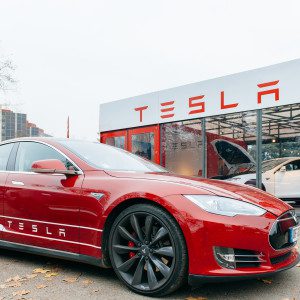
Tesla Model S

Andrew Paterson, a principal with the Verdigris Capital Group, told a conference in Washington on June 7, electric car sales will at least quadruple in the coming decade and then really begin to accelerate. This, he said, was part of a larger electric boom that would see the doubling of world electric demand, mostly in Asia, by the middle of the century.

Electric utilities in the United States stand to benefit from the switch from gasoline and diesel to electricity largely because they will be able to meet the new demand without adding new generation, according to the Electric Power Research Institute in Palo Alto, Calif. It believes most of the charging of electric vehicles will take place off-peak, at night and when there is less demand. At worst the new load will fall partly during the day, when there is a surplus of solar power.

Analysts say much depends on whether commercial and company parking facilities can be turned into charging stations as well. Maybe when the boom really picks up, even parking meters will become charging stations.

The change in transportation will have huge effects beyond the car infrastructure. Gradually, gas stations will become obsolete. Technicians who service cars with oil changes and tuning will be out of work.

Electric cars are fundamentally simpler than today’s vehicles — they will run for tens of thousands of miles without maintenance, and that will be confined to things like tires, brakes and lights. Cities will get cleaner and quieter.

The speed of technological evolution is the unknown, but it will control the accelerator in the race to electricity. Better batteries, faster charging and more public confidence in the duration of each charge will all control the rate of change.

Like all revolutions, there will be winners: those who find out how to make money out of battery charging and those who make electricity. And losers: oil companies, gas stations, service departments of dealerships and the long-dreamed-of hydrogen car.

Incontrovertibly, the air in cities will be a winner — a big, big winner.

Read more: Inside Sources

Norway is a leader in EV sales but has subsidised itself into a corner

When it comes to leaders in electric vehicles (EVs), Norway is top of the list. Around 35% of new cars sold in the country have some form of plug-in electrification, while the Government there has a target for all cars to be zero emission by 2025.

However, much of this adoption has been built around a program of subsidies, as current EVs are not able to compete with petrol vehicles in terms of price. While the country’s Government believes that price parity will come about by 2025, due to the falling cost of batteries and rising demand, many manufacturers believe it more likely to be 2030 before petrol and electric achieve price parity.

However, to ensure that the take up of EVs continues, there needs to be a point where public finances are not required for their purchase. If Norway wants to highlight to the rest of the world that the market for these vehicles can grow, it needs to do so organically. Penalties on fossil fuels and subsidies may drive many to plug-in power but it cannot then be claimed as free choice of the consumer.

EVs in Norway are free from any purchase tax and the country’s 25% VAT. However, a proposal to raise their road tax while cutting it for petrol cars caused a crisis within the government in 2016. This raises the challenge of how the country can raise taxes while still offering incentives. Otherwise if the proposal of an all zero-emission network is realised, it could cost the government dearly, losing out on taxes and VAT in vehicle sales, while investments in charging stations are also not being made back due to free charging.

Norway wants to be a leader in plug-in technology, however many will now be watching to see how it is able to ensure that zero-emission sales can grow when it starts to wean its drivers away from any subsidies.

Read more: Autovista Group

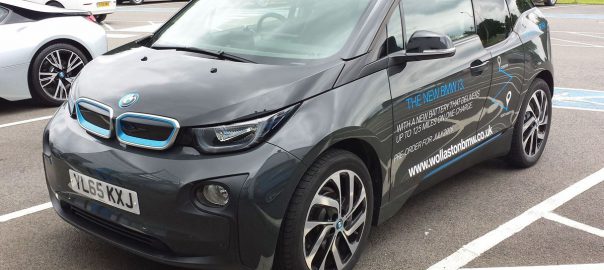
The i3 waiting for us (Image: T. Larkum)

Falling costs, new revenues fuel Britain’s big battery boom

Britain is emerging as a hotbed for utility-scale battery development, with two of Europe’s three biggest projects under way there and several companies joining a race that could shake up the energy market.

The i3 waiting for us (Image: T. Larkum)
The BMW i3 (Image: T. Larkum)

Rapid growth of solar and wind energy means power supplies depend increasingly on whether the wind is blowing or the sun shining. As a result, utilities are looking for new ways to store renewable energy for release into the grid when supplies are low.

In the UK the challenge is especially acute because the buffer between supply and demand is tighter than in other European countries as old fossil fuel plants close, while Britain lacks Germany’s supply lines to import power and maintain grid frequency – the change in direction of the electrical current – when local supplies drop.

“(Renewables) intermittency means the frequency on the grid changes more quickly than before so we need faster technology which can react to that,”

said Cathy McClay, commercial head at the British National Grid system operator.

Last year, National Grid held one of the world’s first tenders to supply rapid grid balancing services on four-year contracts.

“The National Grid tender required such a fast response it almost exclusively created a market for batteries, which isn’t something we have seen elsewhere in Europe,”

said Andy Houston, senior analyst at UK-based consultancy Poyry.

Swedish utility Vattenfall [VATN.UL] is developing battery projects in the Netherlands and Germany but chose Britain for its largest — 22 megawatts (MW) — at the Pen y Cymoedd wind farm in Wales after winning a National Grid contract.

“Britain’s National Grid tender is one of the best opportunities for batteries,”

said Sebastian Gerhard, Vattenfall’s head of battery projects.

Vattenfall is using lithium ion batteries purchased from German car manufacturer BMW (BMWG.DE), the same as those used in its i3 electric cars, stacked together in portacabin-sized units. Vattenfall estimates the drive to create commercially viable electric cars has sent battery costs tumbling by around 40 percent since 2010.

Energy trader Vitol [VITOLV.UL] is building two battery plants in Cumbria and Kent through subsidiary VPI Immingham after winning two National Grid contracts with joint venture partner Low Carbon, and aims to hook them up to the grid by the end of the year.

Read more: REUTERS

All-Electric Taxi To Be Rolled Out Across The Uk

The innovative all-electric Dynamo Taxi, which has been developed in Coventry, is to be rolled out across the UK following its official launch.

The taxi has been created by the Dynamo Motor Company – a division of ADV Manufacturing – in conjunction with Nissan – and was unveiled at the Private Hire & Taxi Exhibition at the MK Arena in Milton Keynes last week.

(l-r) Andy Wood, John Paterson, John Heath from Dynamo Motor Company with the new Dynamo Taxi.

The vehicle has been developed to be used in UK towns and cities. Within Dynamo’s vehicle line-up is a fully working demonstrator London Taxi that, pending approvals, will comply with Transport For London’s stringent Conditions of Fitness as well as exceeding new zero emission capability legislation coming into force in January.

The five-seat Dynamo electric taxi, with full side wheelchair access, will have a range of 100 miles between charging and can be re-charged in only 30 minutes when using a Rapid Charge Post which are growing in numbers around the UK.

Brendan O’Toole, chairman at Dynamo, said this was an exciting development in the move towards all-electric powertrains.

“We’re at the start of the biggest change in the motoring world since the era of Henry Ford because most of us will be driving electric vehicles in the future,”

he said.

“This is a pioneering new chapter in motoring and, if anything, driver selection of electric cars will continue to accelerate since they provide zero emissions for the environment which is important as we all continue to learn more about the damage to our health from pollution.

“We have spent several years developing the Dynamo Taxi and we are really proud of it. Our taxis are ideal for urban driving and we believe will play a leading role as regards electric vehicle adoption.

“By 2018, all new taxis bought in London must be zero emission capable and with more and more charging posts being installed throughout the country, I think within a short space of time drivers of electric vehicles will no longer need to make detailed plans for longer journeys because the UK’s major cities and towns will be connected by charging hubs.”

Read more: BQ

Swedish study calls for smaller EV batteries, finds Tesla more polluting than an 8-year-old car

Swedish study calls for smaller EV batteries, finds Tesla more polluting than an 8-year-old car

Swedish researchers have argued that electric vehicle (EV) batteries should not be as large as possible, but as large as necessary. This is the conclusion of their study which found that in terms of equivalent CO2 emissions, a car with an internal combustion engine (ICE) can drive for eight years before it reaches the same environmental load as a Tesla with a 100kWh battery.

Published in the journal Ingeniøren, the Swedish meta-study, which analyses and summarises studies completed so far in the field, found that around 150 to 200kg of CO2 equivalents (environmental impact equivalent to that of the release of CO2) are produced for every kilowatt hour (kWh) storage capacity of electric car batteries.

For example, taking two electric cars, the Tesla Model S and Nissan Leaf, which have 100kWh and 30kWh batteries respectively in Denmark, the study says these capacities are equivalent to 17.5 tonnes and 5.3 tonnes of CO2 being generated respectively.

To put this in perspective, a round-trip from Stockholm to New York, by International Civil Aviation Organisation figures, releases around 600kg (0.6 tonnes) of CO2 into the atmosphere. In Germany, annual emissions of CO2 are currently almost 10 tonnes per person.

Therefore, the study has calculated that a fossil fuel vehicle can currently drive for more than eight years before it reaches the same environmental impact of a Tesla. For the Nissan Leaf, with its smaller capacity battery, this figure comes in at three years.

Mia Romare, one of the two researchers of the study, hence concludes:

‘Unnecessarily large batteries weigh more on the environment. One should therefore consider whether one can manage with smaller batteries.’

According to the study, only 10-20% of the environmental impact is generated by the source extraction of raw materials such as lithium from the mines. The main environmental impact comes from the processing of these raw materials and the production of the lithium-ion batteries in factories, which accounts for around 80% of the environmental impact.

Read more: Autovista Group

This is how Big Oil will die

Big Oil is perhaps the most feared and respected industry in history.

Oil is warming the planet — cars and trucks contribute about 15% of global fossil fuels emissions — yet this fact barely dents its use. Oil fuels the most politically volatile regions in the world, yet we’ve decided to send military aid to unstable and untrustworthy dictators, because their oil is critical to our own security. For the last century, oil has dominated our economics and our politics. Oil is power.

Yet I argue here that technology is about to undo a century of political and economic dominance by oil. Big Oil will be cut down in the next decade by a combination of smartphone apps, long-life batteries, and simpler gearing. And as is always the case with new technology, the undoing will occur far faster than anyone thought possible.

To understand why Big Oil is in far weaker a position than anyone realizes, let’s take a closer look at the lynchpin of oil’s grip on our lives: the internal combustion engine, and the modern vehicle drivetrain.

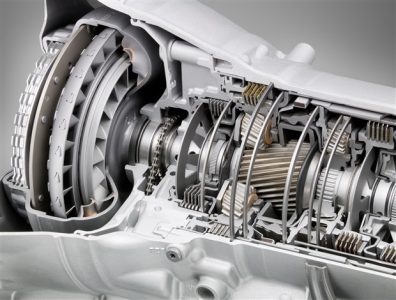
BMW 8 Speed Automatic Transmission

Cars are complicated.

Behind the hum of a running engine lies a carefully balanced dance between sheathed steel pistons, intermeshed gears, and spinning rods — a choreography that lasts for millions of revolutions. But millions is not enough, and as we all have experienced, these parts eventually wear, and fail. Oil caps leak. Belts fray. Transmissions seize.

None of these failures exist in an electric vehicle.

The point has been most often driven home by Tony Seba, a Stanford professor and guru of “disruption”, who revels in pointing out that an internal combustion engine drivetrain contains about 2,000 parts, while an electric vehicle drivetrain contains about 20. All other things being equal, a system with fewer moving parts will be more reliable than a system with more moving parts.

And that rule of thumb appears to hold for cars. In 2006, the National Highway Transportation Safety Administration estimated that the average vehicle, built solely on internal combustion engines, lasted 150,000 miles.

Current estimates for the lifetime today’s electric vehicles are over 500,000 miles.

Read more: NewCo Shift

UK in a chicken-and-egg situation regarding electric vehicles says InstaVolt CEO

Sales of electric cars will never reach their potential unless the UK commits to providing easy access charging for everyone says Hampshire firm InstaVolt.

Tim Payne, InstaVolt CEO

The company will be using National Clean Air Day tomorrow (Thursday June 15) to highlight the importance of an inclusive strategy for motorists rather than focussing on home charging points. The company installs and maintains electric vehicle charging points and believes that the UK is currently too focused on home charging, when the country should be making points accessible to all drivers.

“Around 30 per cent of UK households don’t have off-street parking so that means that more than eight million potential buyers are unlikely to buy an electric vehicle unless it’s easier to charge in public places”

said Tim Payne, CEO of InstaVolt.

“We’re caught in a chicken and egg situation where people simply won’t buy an electric vehicle until the infrastructure is there. At the same time, companies are hesitant to install charging units until they know there’s a buoyant market to use them. People don’t fill up their cars with petrol or diesel each night – they stop in to fill up as and when they need to. We need to make it just as easy to do so with electric vehicles.”

Tim believes that building a network of rapid chargers at the roadside is the key to boosting use of electric vehicles in the UK.

“Research consistently shows that a fear of not being able to charge up is one of the biggest factors stopping people from buying an EV” he added. “When you couple this with the number of people who don’t have access to home charging, it’s a recipe for failure. If we can install rapid chargers at service stations, petrol forecourts and shopping centres across the UK, people will be much more confident in buying and driving electric vehicles.”

InstaVolt is set to install 3000 rapid EV charging units across the UK by 2020. Last month it signed a deal with Silicon Valley giant ChargePoint to purchase more than 200 of its electric vehicle rapid charging solutions. The units, which can add hundreds of miles of range in just 20 minutes, will be installed later this year, marking the first time the rapid charging systems will be deployed in the UK.

They will be strategically placed close to popular routes across the country, enabling drivers to easily charge their vehicles during long journeys. It will offer a pay-as-you-go service with no subscription and will be installed at no cost to the landowner.

Tim says that ultimately, the private and public sector should be working together to make the UK’s roads an easier place to drive an electric vehicle.

Source: Renewable Energy Magazine

Nissan LEAF charges to 20,000 UK sales as all-electric favourite is named ‘Best Green Car’ in 2017 Driver Power New Car Survey

As Nissan LEAF charged past the milestone of 20,000 sales in the UK, owners of the best-selling electric vehicle have heaped praise on the model in the 2017 Driver Power survey.

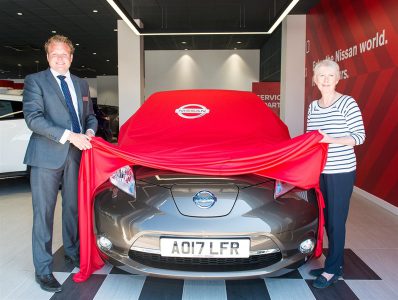
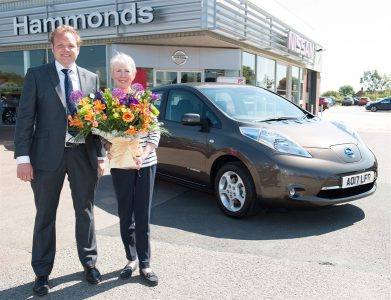
Diane Ray collects the 20,000th LEAF from Hammond Nissan

The Nissan LEAF was awarded Best Green Car overall and also came top in the Best Engine and Gearbox and Best MPG and Running Costs awards categories.

Driver Power is the UK’s biggest and most in-depth car satisfaction survey, with seven surveys covering the different phases of vehicle ownership. There also nine Judging Category awards split into satisfaction categories.

Editor of Auto Express, Graham Hope, commented;

“The Nissan LEAF’s results in the 2017 survey indicates that the hard work that the Nissan team has put in developing the vehicle and educating the market about the benefits of Electric Vehicles (EV) has paid off.”

“Leading the way in EVs is important. People are becoming more conscious of green vehicles (Hybrids and Electric Vehicles) and this year we have seen a 375% increase in the number of green vehicle owners.”

The Driver Power results came as Nissan GB confirmed it had sold its 20,000th Nissan LEAF in the UK.

The buyers of the milestone model were Diane and Chris Ray of Hollesley in Suffolk, who took home a range-topping 30kWh LEAF Tekna from local dealer Hammond Nissan.

It is the couple’s second Nissan LEAF – replacing a two year-old 24kWh model – and it was the only car on their shopping list when the time came for a replacement.

Diane Ray collects the 20,000th LEAF from Hammond Nissan

Diane, who runs a holiday let business, said:

“I love the LEAF. It does everything I want from a car and is beautiful to drive.

“When the time came to replace mine I didn’t look at anything else. I only wanted another LEAF but this time with the bigger battery.”

She added:

“It was a real surprise to find out I was the 20,000th LEAF customer but it’s so encouraging to see more and more people switching to all-electric cars and exciting to know I’m a part of that story.”

Read more: Nissan GB News

Milton Keynes EV Experience Centre

New Milton Keynes EV centre to feature multiple brands

The Electric Vehicle Experience Centre (EVEC) will open in Milton Keynes on Saturday 22nd July, featuring the UK’s first multi-brand electric vehicle showroom. Part of the city’s Go Ultra Low Cities bid, the EVEC will be located in the centre:mk shopping centre.

Milton Keynes EV Experience Centre
The EVEC will open with cars from a number of EV manufacturers

BMW i, Kia, Mitsubishi, Nissan, Renault, and VW have all signed up to be founding manufacturers for the EVEC, and will display a range of EVs spread across a range of costs and electric range.

Set to be run by Chargemaster, the EVEC will both showcase existing electric models and be an information point for EV ownership in general. Visitors will be able to talk with staff about all elements of owning and running an EV, with test drives available too.

Milton Keynes has a target for 23% of all new cars registered in the area to be electric by 2021. The centre is intended to help promote EV sales and use, and also to educate prospective buyers as to the benefits of going electric.

The EVEC is part of a suite of initiatives from Milton Keynes’ Go Ultra Low City bid, including investment in expanding the number of EV charge points available including creating a number of charging hubs, free parking for EVs, and additional grants for home and workplace charging.

Brian Matthews, Head of Transport Innovation at Milton Keynes Council, said:

“The EVEC is a centrepiece of our thrust to encourage the uptake of electric vehicles and is a good example of the innovation that Milton Keynes is using to lead the way in transport innovation. We are delighted to be working with Chargemaster and six founding car manufacturers to bring this about.”

David Martell, Chief Executive of Chargemaster, said:

“Opening the Electric Vehicle Experience Centre on 22 July will be a landmark day, not only for the electric vehicle sector, but also for Milton Keynes residents.

“Becoming the UK’s first multi-brand EV showroom, it will provide a destination for visitors to make an informed decision about owning an EV, without the pressure of having to make an immediate purchase decision. We are delighted to receive the support from six key electric vehicle manufacturers as founding partners of the EVEC.

“We hope that this platform will change the way that electric vehicles are sold in cities and we’re proud to be working with Milton Keynes and Go Ultra Low to deliver this to the public.”

Source: Next Green Car

f

Why Americans Should Care About The Renault Zoe

If you’re looking for a true game-changing company in the automotive arena, it’s the Renault-Nissan Alliance, not Tesla, that has a firm grasp on the future.

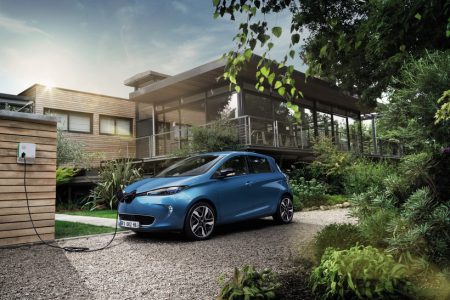
Renault ZOE

With all the talk of climate change and the Paris Agreement, ask yourself if you’ve ever heard of the Renault Zoe. Probably not. It’s an electric vehicle (EV) sold by French automaker Renault. It’s also the most popular EV in Europe and is mechanically similar to the Nissan Leaf we have here in the U.S. So why should you care about this French EV? One simple reason: Automakers are serving a global market whether they like it or not and Renault-Nissan will soon be setting the agenda for EVs around the world. Partly thanks to partnerships between Nissan, Renault and now Mitsubishi, the Zoe is the perfect barometer for global EV success or failure.

According to CleanTechnica, an EV website, of the top-selling EVs and plug-in hybrid electric vehicles (PHEV) in Europe, Renault, Nissan and Mitsubishi have the top three spots for in 2016 and that trend continues into 2017. In total, Renault, Nissan and Mitsubishi vehicles make up 6 of the top 30 spots, including some oddballs like the Outlander PHEV, Renault Kangoo ZE and Nissan e-NV200. Only VW Group has more total vehicles in the top 30.

EVs Replace Diesel?

Eventually, EVs will replace diesel as the budget and eco-friendly option. Last year, I spoke to a Renault-Nissan executive, and he said that affordable diesel-powered small cars are likely the first to gradually disappear given the stricter emissions regulations coming to the E.U. The main reason is that the cost of compliance is getting to be a serious obstacle. In short, as emissions requirements become increasingly stringent, the cost of building compliant cars will go up. The U.S. pulling out of the Paris Agreement won’t change automakers’ global strategy, but China deferring compliance until 2030 may remove some of the urgency of the agreement.

The first area to feel this will be small, typically inexpensive cars where the buyers are very price-conscious. Renault-Nissan Alliance Chairman and CEO Carlos Ghosn echoed those sentiments at a press conference at the Paris Auto Show in 2016. And judging by his comments and how he essentially spun every emissions question into a talking point about EVs and the Zoe/Leaf, the next version of that car will likely put the Renault-Nissan Alliance in the catbird seat when it comes to global EV sales.

Maybe they’re already there: If budget friendly, diesel-sipping small cars go away, the next best option for budget-strapped motorists is an EV like the Zoe. According to Forbes, Renault-Nissan is on track to sell nearly 10.5 million vehicles in 2017, second only to Toyota. Therefore, Alliance decisions and innovations are bound to have a ripple effect on the global automotive marketplace.

Read more: Huffington Post