Monthly Archives: October 2021

The UK Fuel Crisis Is Dumber, Pettier, and Worse Than You Could Imagine

As in, more than five times the usual number of people were putting gas in their diesel cars and vice versa. Here’s how we got to this point.

eing a truck driver in the United Kingdom is really not a great job right now. Classed as “low-skilled,” European Union workers were denied visas to be truck drivers after Brexit, and combined with horrific port backups and 10,000 drivers getting stranded in their trucks last Christmas, weirdly not a lot of people are that keen to take on bringing stuff to this ungrateful little island. And right now, that’s creating a major crisis for anyone who requires gasoline from time to time.

Petrol stations across the country are running low on fuel, causing long lines at the pump, rising prices and panicked drivers who fill up more than they should to stock up. It’s not unlike the gasoline crises of the 1970s in the U.S., but this time it’s happening for different reasons. In the U.K. this time, it’s about truck drivers. Specifically, the lack of them.

The U.K. is reliant on truck imports, a lot of which—99 percent, in 2019—come from EU countries. Which is complicated, if you haven’t brokered a particularly good trade deal. Of course, non-truck imports like sea freight also get distributed around the U.K. by truck, which is complicated, if 14,000 truckers who are EU citizens left the country last December. In fact, there’s now nearly 100,000 total fewer truck drivers in the U.K. (236,000 from 330,000) compared to 2016. As the New York Times noted this week, British truck drivers are getting older and retiring, and any younger ones lining up to replace them face delays in licensing due to the pandemic.

That’s not, necessarily, directly causing the U.K. fuel crisis that’s got cars queueing ’round pumps and people threatening to stab each other over 10 liters of unleaded. A lot of what’s happening is down to panic buying that’s causing localized shortages but haulers say there is an issue with not enough freight and although the government says there absolutely isn’t, they have made the army available to drive trucks. Just in case.

Because there’s nothing we can’t work really hard to make that little bit more farcical, after a few days of unreliable supply people just started putting whatever fuel they fancied in their car. As in, more than five times the usual number of people were putting petrol in their diesel cars or vice versa. This means a recovery vehicle has to be called out, the fuel pumped and wasted and your car might not really run the same afterward.

You’d think, as a smug electric vehicle enthusiast, I’d be chuckling to myself about how this would make everyone with a 2013 Nissan Leaf suddenly the absolute baller of range. Nope, because now we have problems involving electricity. Because not only are we out of petrol, we’re out of gas. Which we use to make electricity. Oh, man.

There are people making the argument that energy crises are going to hit all European nations this winter because of massively increasing gas prices. That’s gas in the EU sense, as in natural gas and not gasoline, which there’s a pretty major over-reliance on to generate electricity. EU countries are in a strong position to negotiate, as a large trade bloc and also to share electricity between their grids—something we have been heavily reliant on France for, the share imported actually increasing after the Brexit vote in 2016.

All that’s amounting to a situation where, say, overnight electricity prices are suddenly more than tripling and it’s possible that peak home charging might get banned. This isn’t a directly reactive concept to the current situation but does show the weirdly unnecessary problems we’ve heaped all over ourselves by failing to address them. And by “we” in this context I mean the people actually in charge who can do anything about it, whose leadership has been as consistently inspiring as it’s ever been.

Read more: THE DRIVE

It’s Time to Go Green!

If you would like to know more about Solar Panels and the PowerBanx range of home battery systems, and get a free instant quote, please complete our online form:

Nissan Leaf (Image: Qurren/Wikipedia)

Electric cars now CHEAPER to insure than petrol or diesel

Electric cars now cost less to insure, on average, than petrol and diesel cars – and the cost to insure an EV is continuing to fall.

New analysis from car insurance comparison site GoCompare reveals the average cost to insure an electric car in July 2021 was £484. The average cost for a petrol car was £489, while for a diesel it was £534.

It is the continuation of a trend that started in 2019, says GoCompare.

During the first half of 2020, an electric car typically cost £515 to insure. A year later, the cost over the first six months had fallen to £450 – a £65 decline.

Ryan Fulthorpe of GoCompare said: “As the popularity of the EV increases, it’s great to see the insurance costs coming down alongside this.

“Insurance companies are now getting used to evaluating the risks associated with these cars and so we have seen a slow but steady decline in premiums for EVs over the past two and a half years.”

Most popular EVs to insure
GoCompare is also keeping a track of the most popular electric cars insured by its customers – and it’s another win for the Teslerati:

1: Tesla Model 3

2: Nissan Leaf

3: Volkswagen e-Golf

4: MG ZS EV

5: BMW i3

Read more: msn

It’s Time to Go Green!

If you would like to know more about Solar Panels and the PowerBanx range of home battery systems, and get a free instant quote, please complete our online form:

Milton Keynes 'Mushrooms' Charging Hub (Image: T. Larkum)

MFG opens flagship 150kW EV charging station

Motor Fuel Group (MFG) has constructed a new dual-fuel station with eight dedicated 150kW electric vehicle (EV) charging bays.

This is alongside eight traditional petrol pumps, with the former petrol station on the site located on the A3 in Putney, south west London, having been demolished.

MFG has also developed 1,500 sq ft of retail space, with the site containing Costa Coffee, Budgens and an Amazon drop box and home delivery location.

Milton Keynes 'Mushrooms' Charging Hub (Image: T. Larkum)
Milton Keynes ‘Mushrooms’ Charging Hub (Image: T. Larkum)

“This is an important site for us as we see Putney as the industry-leading blueprint for the future of UK forecourts to achieve a practical transition from fossil fuels to electrically powered vehicles,” said William Bannister, CEO, MFG.

The development is part of MFG’s £400 million EV investment plans, with around £40 million committed for EV charging hubs in 2021.

Read more: CURRENT

It’s Time to Go Green!

If you would like to know more about Solar Panels and the PowerBanx range of home battery systems, and get a free instant quote, please complete our online form:

BMW i3 120Ah (Image: BMW)

Which EV to buy? Every electric car on sale

From 2030, sales of new petrol and diesel cars in the UK will be banned. It’s a huge, game-changing moment that’s less than a decade away, so it’s no surprise that manufacturers are already turning to EVs in earnest.

From being a relative novelty to present nearly everywhere, electric cars are fast creating a revolution. So to make sure you don’t get left behind, we’ve compiled a list of all the EVs that are currently on sale in the UK.

We’ve not included the button number, flight-of-fancy hypercars but instead concentrated on the machines that we’ve driven at Autocar and that you could walk into a dealership today and test drive before putting down your cash (or in Volvo’s case clicking on ‘pay now’ in its virtual online store) before driving away.

Audi
E-tron
It’s probably no surprise that Audi’s first foray into the world of EVs had a very SUV flavour. Available in standard or rakish Sportback guise, the E-tron was deliberately designed to look as ‘normal’ as possible, so as not to put off buyers nervous about its high-tech underpinnings – although its door ‘mirrors’ that beam pictures to screens in the cabin are fairly futuristic. Comfort is the order of the day, with soft suspension and excellent refinement. All variants feature twin motors and four-wheel drive, while the larger-battery 55 claims up to 261 miles of range. The tri-motor S packs 496bhp, a 0-62mph time of 4.5sec and greater agility.

E-tron GT

Sharing its underpinnings with the Porsche Taycan, the E-tron GT is in many respects a better all-round bet than its cousin. Sleek four-door coupé styling helps it stand out, while on the move it effortlessly blends blistering pace and back-road agility with long-distance quietness and comfort for impeccable grand touring credentials. The 637bhp RS version steals all the headlines for raw performance statistics, but with up to 523bhp available in brief spurts of overboost, the standard E-tron GT is no slouch, claiming a 4.1sec 0-62mph time and a longer (298-mile) range. Better still, 800V electrical architecture means a full charge can be achieved in as little as half an hour.

Q4 E-tron

Audi’s entry-level EV is arguably its least convincing battery-powered offering. Based on the same MEB platform as the Skoda Enyaq iV and Volkswagen ID 4, it delivers arguably the same driving experience and range (up to 316 miles) yet charges you more for the privilege. Only the second Audi (after the R8 RWS) to offer rear-wheel drive, the Q4 is also available in twin-motor Quattro guise. Both are capable and composed to drive, but neither are inspiring, while the spacious interior feels no more special than that in the Skoda or Volkswagen. Still, the eye-catching Sportback version adds visual appeal, plus any Q4 can rapid charge at either 100kW or 125kW.

BMW

i3

It’s hard to believe the innovative and quirky i3 has been around for the best part of a decade now. Designed from the ground up to be battery-powered, the tall and narrow compact hatchback still looks and feels like nothing else on the road. It features a light and strong carbon-reinforced plastic structure, suicide doors at the rear plus a minimalist interior packed with sustainable materials – although it seats only four and its boot is cramped. Despite skinny tyres, it’s good to drive, particularly the more powerful i3s, but its age is starting to show through its maximum range of 192 miles and 50kW rapid-charging limit.

BMW i3 120Ah (Image: BMW)

i4

On paper, the i4 is essentially an electric version of the new 4 Series Gran Coupé, but there’s more to it than that. It has been heavily re-engineered to take the 80.7kWh lithium ion battery and either one (rear-drive) or two (four-wheel drive) motors, while inside it gets bespoke digital instruments and infotainment set in a large curved screen set on top of the dashboard. Near 50:50 weight distribution front to rear means engaging and agile handling, while a slippery 0.24Cd drag figure helps the entry-level eDrive40 Sport deliver a 365-mile range. The 536bhp M50 will crack 62mph in just 3.3sec and is BMW’s first ever M-badged EV. Crucially, every i4 is capable of 200kW rapid-charging, which can add 100 miles of range in just 10 minutes.

iX3

Like the i4, the iX3 uses existing ICE architecture, in this case the X3. In fact, apart from a flush-fitting front grille and some natty blue trim inserts, it’s largely the same as its fossil fuel-fed cousin. Curiously, it’s rear-drive-only, the 282bhp motor driving the back axle via a single-speed transmission. Still, it’s as good to drive as the ICE X3s, while the typically low noise levels and adaptive dampers make it comfy. The EV drivetrain robs 40 litres of boot space, but at 510 litres, it’s still roomy enough and bigger than that of X3 PHEVs. There’s just the one battery available, but the 74kWh lithium ion pack can be rapid-charged to 80% in just half an hour.

iX
Few recent arrivals have stirred as much controversy as the iX, BMW’s flagship EV. Beauty has always been in the eye of the beholder, but surely even the most ardent BMW fan will struggle to put forward any praise for the slab-sided and awkwardly proportioned iX. Loosely based on the brand’s CLAR scalable architecture, it mixes the i3’s CFRP with aluminium, while the battery (a large 100kWh on the range-topping 500bhp xDrive50) is mounted low in the floor. Motors front and rear deliver four-wheel drive, while versions with that big pack claim an impressive 380 miles between charges. Air suspension means comfort is the order of the day, plus the interior is vast and lavishly finished – and at least you can’t see the exterior when you’re sitting in it.

Read more: AUTOCAR

It’s Time to Go Green!

If you would like to know more about Solar Panels and the PowerBanx range of home battery systems, and get a free instant quote, please complete our online form:

EV views and enquires surge as drivers rush to the pumps

It’s reported that the number of advert views for new and used electric models increased a record 28% and 61% respectively versus the previous weekend, but it saw an increase in the number of people sending enquiries to retailers, with one sent every two minutes.

This, it said, suggests that people have been encouraged to actively pursue a purchase. Accordingly, it expects retailers with electric stock to do particularly well this week.

Ian Plummer, commercial director, Auto Trader, said: “This weekend four out of five of the top performing new cars on Auto Trader were electric, with the Hyundai IONIQ 5 coming out top, followed by the Ford Mustang Mach-E. The launch of these ‘cool’ and aspirational models have been key to shifting the consumer perception of electric. This has been accelerated further by the significant increase in advertising among manufacturers, which is helping to drive awareness and dispel lingering myths.

Read more: MOTORTRADER

It’s Time to Go Green!

If you would like to know more about Solar Panels and the PowerBanx range of home battery systems, and get a free instant quote, please complete our online form:

Ubitricity Electric Avenue project lamppost charging (Image: Siemens)

UKPN records 42% increase in EV chargepoints

Nearly 2,700 Electric vehicle (EV) chargepoints have been added across London, the east and south east in the past twelve months, UK Power Networks (UKPN) has said.

As a result, there are now over 9,000 chargepoints in London, the east and south east, with a total of 40% of all chargepoints in Great Britain being connected to UKPN’s local grids. This is almost double the volume of any other network operator.

Additionally, UKPN is estimating there will be 4.5 million EVs in the areas it serves by 2030. As it stands, there are around 594,000 EVs in the UK, with an estimated 154,000 in the areas served by UK Power Networks.

Ubitricity Electric Avenue project lamppost charging (Image: Siemens)

However, Shira Lappin, innovation project lead at UK Power Networks, said there’s still “a lot of work to do ” to meet the growing demand for EVs and chargepoints, and that it is important UKPN works with local and central government, chargepoint operators, customers and other stakeholders to ensure a seamless transition.

The company pointed to how a single 50kW rapid charger uses the same amount of power as a block of 25 flats, meaning that the more EVs sold, and the more chargers installed, the greater the need to create smart solutions on the electricity network.

Read more: CURRENT

It’s Time to Go Green!

If you would like to know more about Solar Panels and the PowerBanx range of home battery systems, and get a free instant quote, please complete our online form:

Charging with an Ohme smart charging cable

Milton Keynes secures £1.1m grant for residential EV charging rollout

Milton Keynes Council has secured the largest grant offered to date from the Office for Zero Emissions (OZEV).

The council worked with Connected Kerb and Ringway on the proposal, with 250 chargepoints now to be installed on residential roads in older areas of Milton Keynes where there are fewer off-street parking options but where electric vehicle ownership is on the rise.

Currently, around 40% of homes in Milton Keynes don’t have access to off-street charging facilities.

Charging with an Ohme smart charging cable

“Encouraging drivers to make the switch to electric is a vital part of our carbon neutral future,” said cabinet member for Climate Action and Sustainability, Jenny Wilson-Marklew.

“It needs to be made as easy as possible and we look forward to working with all of our partners to begin this ground-breaking project.”

Read more: CURRENT

It’s Time to Go Green!

If you would like to know more about Solar Panels and the PowerBanx range of home battery systems, and get a free instant quote, please complete our online form:

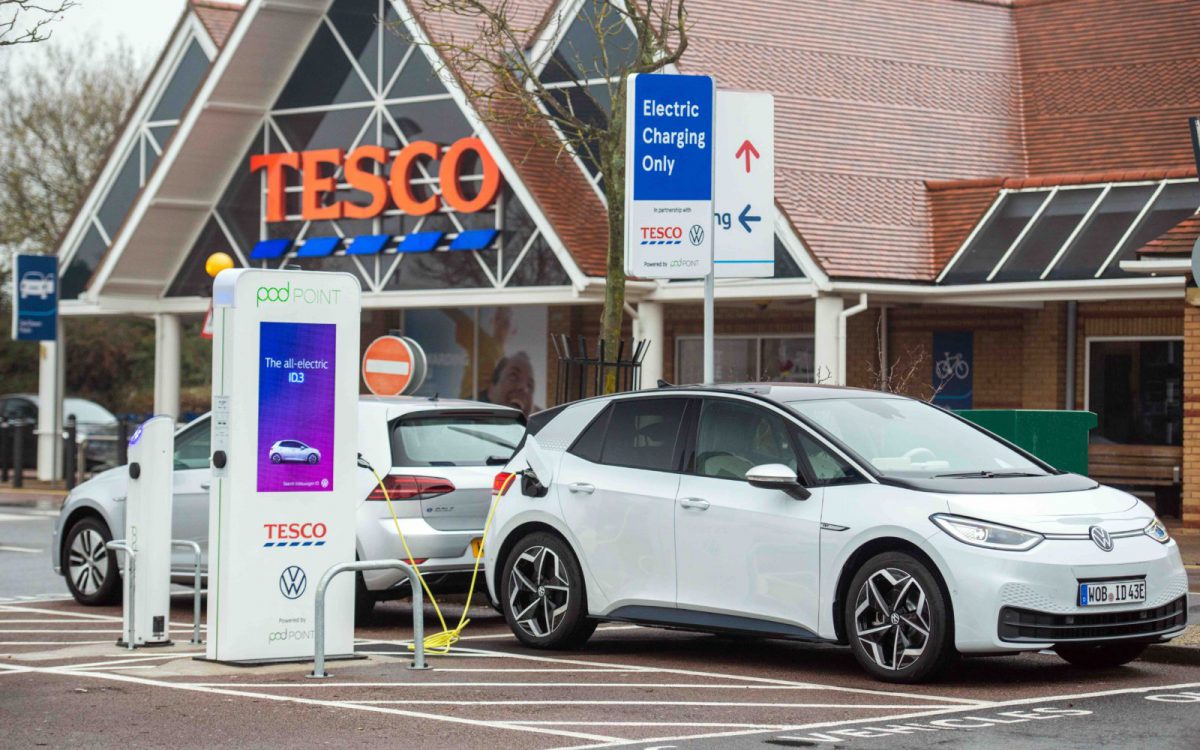
POD Point Rollout at Tesco Stores (Image: Tesco/POD Point)

UK electric car inquiries soar during fuel supply crisis

Sellers of plug-in vehicles say petrol shortages are driving people to adopt the new technology

As petrol stations in parts of the UK started running out of fuel on Friday, business at Martin Miller’s electric car dealership in Guildford, Surrey, started soaring.

After what ended up being his company EV Experts busiest day ever, interest does not appear to be dying down. This week the diary is booked up with test drives and the business is low on stock.

“People buy electric cars for environmental reasons, for cost-saving reasons and because the technology’s great,” he said. “But Friday was one of those moments where people said, ‘Do you know what, this is a sign that we need to go electric’.”

While scenes of chaos play out at petrol stations across the country amid shortages, for many electric vehicle (EV) dealers the fuel crisis has led to an unexpected surge in inquiries and sales.

EVA England, a non-profit representing new and prospective EV drivers, reports a rise in electric car inquiries and in interest at EV dealers, particularly in the last week.

POD Point Rollout at Tesco Stores (Image: Tesco/POD Point)

“Saturday was bonkers but Friday even surpassed that, it was very strange,” said Miller, who founded his company four years ago. “I’ve now got trade-in cars with no petrol to move them.”

Along with existing factors such as the expansion of London’s ultra-low emission zone, the fuel crisis has proved to be another trigger point, he said. “People were using it as ‘this is the moment where I’m not going to put this off any longer’.”

The EV market is no longer the preserve of innovators and early adopters, he said, with the most popular models the Nissan Leaf, Volkswagen ID 3 and Jaguar I-Pace.

Ben Strzalko, the owner of Electric Cars UK in Leyland, Lancashire, said that as a small business it would take a few months to feel the knock-on effect of the fuel crisis on sales.

But every time there are problems with petrol or diesel, he said they acted as “one more tick for people making that transition to electric cars”.

Read more: The Guardian

It’s Time to Go Green!

If you would like to know more about Solar Panels and the PowerBanx range of home battery systems, and get a free instant quote, please complete our online form:
MG 5 EV (Image: mg.co.uk)

New long-range MG 5 EV on sale now from £26,495

The MG 5 EV can now be specified with a larger 61.1kWh battery pack, which boosts the estate’s maximum range to 250 miles

MG has launched a new, long-range version of the MG 5 EV. It’s available to order now, with prices starting from £26,495 including the government’s £2,500 plug-in car grant.

It’s powered by a 61.1kWh battery pack (up from the 52.5kWh cell in the standard car), which increases the estate’s range from 214 to 250 miles. However, MG says that range figure will increase to 334 miles if the car is only driven around town.

The new battery pack also offers support for 100kW DC rapid charging, which can top the cells up to 80 percent capacity in 40 minutes. When connected to a home wallbox charger, the battery can be fully recharged in around eight and a half hours.

The larger battery feeds an electric motor mounted on the front axle, which develops 154bhp and 260Nm of torque. The company says that’s enough grunt for a 0–60mph time of 7.3 seconds and a top speed of 115mph.

Like the standard MG 5 EV, this long-range model focuses on practicality. The boot can swallow up to 578 litres of luggage with the rear seats in place – and this figure expands to 1,456 litres with the bench seat folded flat.

Buyers have their choice of two specifications, called Excite and Exclusive. The base-model comes as standard with 16-inch alloy wheels, rear parking sensors, electrically adjustable door mirrors and safety kit such as lane assist and autonomous emergency braking.

The MG 5 EV’s safety equipment is bundled into the standard-fit MG Pilot package, which also includes items like adaptive cruise control and traffic jam assist, meaning the electric estate can automatically keep pace with stop-start traffic.

Read more: AutoEXPRESS

It’s Time to Go Green!

If you would like to know more about Solar Panels and the PowerBanx range of home battery systems, and get a free instant quote, please complete our online form:

Citroen Ami (Source: uk-mediacitroen.com)

OPINION: Is the Citroen Ami a step backwards for electric cars?

Citroen has announced the ultra-compact Ami will be making its way to British shores, and despite its clown-car proportions, we should take its arrival seriously

It’s very easy to think of the Citroen Ami as yet another comedy electric car – on the same plane as the infamous G-Wiz or the (doorless as standard) Renault Twizy. Hell, with a range of 46 miles and 8bhp on tap, combined with plastic bodywork and a squared-off designed that makes the Ami resemble a heavily compacted Portaloo, you’d be forgiven for questioning why 12,000 people in the UK – actively, in sound mind and body – registered their interest for what looks like an electrified pet carrier. I’m fairly sure if I parked one outside my house on bin day, it would be mistakenly recycled by the council.

Electric cars in 2021 are capable of some stupendous feats, from the Lucid Air’s 500 miles on a charge to the Hyundai Ioniq 5 – an ordinary electric family car – recharging at the same speed as the circa-£100,000 Porsche Taycan. We’ve come a very long way since the G-Wiz arrived in 2001, so is the Citroen Ami actually a huge step backwards? Another round of ammunition for sceptics looking to hold back the serious and rapid adoption of electric cars ahead of the 2030 ban on the sale of new petrol and diesel models?

Perhaps not: in fact, there’s a very strong case to be made for this bizarre micro-EV. Not in terms of driving pleasure, comfort, practicality or even usability – as our full review of the Ami establishes.

Citroen Ami (Source: uk-mediacitroen.com)

But instead, as Eurig Druce, Citroen UK’s managing director and one of the people who pushed for the electric quadricycle to be sold in the UK, has said: “I would love to see collections of Amis on street corners, where it could become the norm not to get an Uber, but to get an Ami.”

It’s when you consider the Ami like this – as an alternative to the ranks of bikes and e-scooters you can now rent for a short time in cities like London, rather than as rival to ‘proper’ cars – that you begin to understand why people are so enthralled by the French brand’s little bundle of joy. And this isn’t just a theoretical notion: you can currently rent an Ami from as little as 26 cents (22 pence) per minute on Citroen’s ‘Free2Move’ initiative, which is up and running in France.

I’d certainly rather arrive at the office or to meet up with friends relatively fresh after a drive in an Ami, rather than sweating and panting like a St Bernard after a stressful stint on a Boris Bike. And for all my criticism of its proportions and design, I can’t argue that climbing out of an Ami makes you look as suave as 007 in comparison to making an entrance on an e-scooter.

Read more: <

It’s Time to Go Green!

If you would like to know more about Solar Panels and the PowerBanx range of home battery systems, and get a free instant quote, please complete our online form:
a href=”http://drivingelectric.com/electric/40866/opinion-is-the-citroen-ami-a-step-backwards-for-electric-cars” target=”_blank”>driving electric