Monthly Archives: September 2020

UK plans to bring forward ban on fossil fuel vehicles to 2030

Announcement expected in autumn to help trigger green economic recovery from Covid-19

The UK is poised to bring forward its ban on new fossil fuel vehicles from 2040 to 2030 to help speed up the rollout of electric vehicles across British roads.

Boris Johnson is expected to accelerate the shift to electric vehicles this autumn with the announcement, one of a string of new clean energy policies to help trigger a green economic recovery from the coronavirus pandemic.

The government had hoped to set out the plans as early as this week, according to sources in the energy and transport industries, but the announcement will be delayed until later this year as it focuses on tackling the rising number of coronavirus cases.

The government has previously consulted on plans to bring forward the deadline on sales of new polluting vehicles from 2040 to 2035. It is now expected to take a more ambitious stance following assurances that the UK’s infrastructure will be ready to cope with the shift to electric cars.

The decision to end the sales of new petrol and diesel vehicles by 2030 would put the UK ahead of France, which has a 2040 ban in the pipeline, and in line with Germany, Ireland and the Netherlands. Norway will bring in a ban in 2025.

The plan, which is backed by the government’s official advisers at the Committee on Climate Change, is likely to emerge alongside the national plans to become a carbon-neutral economy by the middle of the century.

Kwasi Kwarteng MP, the minister for clean energy, confirmed last week that the long-awaited energy white paper, which will underpin the government’s legally binding target to create a net-zero carbon economy by 2050, would be published this autumn after several delays.

It is tentatively scheduled for November and is expected to follow the advice set out by the Committee on Climate Change, including support for the UK’s nascent clean hydrogen industry to help cut carbon emissions from homes and heavy industry.

It may also include support for small, modular nuclear reactors, which have found favour with the prime minister’s chief aide, Dominic Cummings, according to industry sources.

Matthew Pennycook, the shadow climate change minister, repeated Labour’s pre-election call for a 2030 ban on petrol car sales last week, saying it was “an ambitious but achievable date” which would “give a new lease of life to the UK car industry, whilst combating climate breakdown and cleaning up the air that dangerously pollutes so many of our towns and cities”.

Read more: The Guardian

It’s Time to Go Green!

If you would like to know more about Solar Panels and the PowerBanx range of home battery systems, and get a free instant quote, please complete our online form:

Tesla Model 3 (Image: Tesla.com)

Electric vehicle acronym guide: Know your BEVs from FCEVs from PHEVs from ULEVs

When it comes to more sustainable driving, there is a whole host of options now and it can be confusing knowing what’s what. In the olden days you pretty much had the choice of diesel or petrol, but with the ever-evolving market of low-emission vehicles, there’s more choice than ever.

When it comes to “EVs,” you can choose from BEVs, PHEVs, HEVs, or FCEVS, all of which are classed as ULEVs. But what do all these acronyms actually mean?

If you need some quick pointers on what all these acronyms stand for and what they refer to specifically, look no further.

BEV
Let’s start with the most common type of EV, and the type of vehicle we usually refer to when we’re talking about EVs: the battery electric vehicle, or BEV.

As the name suggests, a BEV is an electric vehicle that uses batteries to store and deploy power which powers electric motors to drive the wheels. It’s also common to see words like “pure electric,” or “all-electric” when you read about battery electric vehicles.

Popular BEVs include cars like the Nissan Leaf, the whole range of Teslas, the Polestar 2, the BMW i3, Hyundai Kona Electric, Kia Soul EV, VW’s ID.3 and e-Golf, the Jaguar i-Pace — you get the idea.

Tesla Model 3 (Image: Tesla.com)

PHEV and HEV
Plug-in hybrid (PHEV) and hybrid electric vehicles (HEV) are perhaps the most confusing of the partially-electric vehicle world. There’s one key difference, though: plug-in hybrids can be charged up like a battery electric vehicle by plugging-in to an EV charge point, regular hybrids cannot.

It gives you the flexibility to drive and use your PHEV like it was a BEV and not rely on the combustion engine, for very short journeys at least. They typically have very small batteries and are only capable of driving between 30 and 50 miles on all-electric mode.

Popular PHEVs include the Mitsubishi Outlander, Hyundai Ioniq, MINI Countryman PHEV, and the Volvo XC60 T8.

Regular hybrid vehicles (HEVs), like the original Toyota Prius, can’t be plugged in and the only way to charge their batteries is from regenerative braking or by using the engine like a generator.

Some companies have even referred to these vehicles as “self-charging hybrids,” as if not having to plug them in is a benefit. That phrase has been branded as misleading, and Toyota and Lexus ads in EV loving Norway using the tag line have been banned for being misleading. In reality, to charge them, you need to fuel them with gasoline.

FCEV
FCEV stands for, Fuel Cell Electric Vehicle. These are a small offshoot of EVs that use hydrogen fuel cells to create an electrical charge that’s used to power motors that drive the wheels.

Most FCEVs use a small battery or super capacitor to act as a buffer between the fuel cell and the motors to ensure power delivery is consistent and reliable.

Some tout fuel cell vehicles as a better option than batteries for the future of sustainable transport. They can be filled up in the same way as a combustion engine vehicle, hydrogen is the most abundant element in the world, and their only waste product is water vapor.

Read more: TheNextWeb

It’s Time to Go Green!

If you would like to know more about Solar Panels and the PowerBanx range of home battery systems, and get a free instant quote, please complete our online form:

Vauxhall Grandland X Hybrid4 (Image: Vauxhall.co.uk)

Switching to an EV is the environmentally positive change you can make today

The Sustainable Now: Making the switch to an electric vehicle (EV) is the environmentally positive change you can make today, writes Poppy Welch, head of Go Ultra Low.

As the UK emerges from lockdown, we have all had time to reflect on our lifestyle choices.

From shopping locally to being increasingly mindful of household waste or limiting household energy consumption, there is no question that many of us across the country have introduced behaviours into our routines that have had an environmental upside.

As the Government, businesses and people across the nation look to build on this foundation and put sustainability at the heart of the UK’s recovery from the pandemic, there’s no question that transport has been a prominent theme of this discussion.

It’s not surprising – given the striking scenes of empty airports and motorways over these past months. According to Cabinet Office data, the first weeks of lockdown saw road travel fall by some 73% to levels last seen in 1955. Cities and urban environments have particularly felt a benefit, recording noticeable improvements in air quality.

So, as the Government consults on bringing forward the end to the sale of new petrol and diesel cars to 2035 or earlier, the lockdown has only served to encourage acceleration to a more sustainable future.

But this isn’t a change that you need to wait fifteen years to consider. Whether you’re a one-car family or a business with a thousand-strong fleet, electric vehicles (EVs) offer an opportunity to deliver environmental benefits for our communities today, as well as a whole host of other advantages.

Vauxhall Grandland X Hybrid4 (Image: Vauxhall.co.uk)

Greener transport
As fully electric vehicles and plug-in hybrids when driven in electric mode all have zero tailpipe emissions, this makes them greener, cleaner and better for the environment than petrol or diesel cars – helping to deliver a significant air quality benefit across towns and cities.

In addition, with more and more of the UK’s electricity coming from renewable sources – lockdown saw the UK running coal-free for the longest period recorded, of 67 days – which makes EVs even more environmentally friendly.

To support the renewables transition, drivers smart charge their EVs at home using a time of use tariff. Smart charging can help reduce the impact of EVs on the electricity system, whilst simultaneously creating benefits for consumers and maximising the use of clean, renewable electricity.

On the money
But being environmentally minded isn’t the only factor when it comes to vehicle choice, with financials, of course, being a key consideration. Thankfully, from initial purchase to maintenance, there are numerous savings that you can make over the lifetime of EV ownership.

Fully electric vehicles can cost from as little as 1p per mile to run, compared to 8-17p per mile for petrol and diesel cars. This means you can travel 200 miles for just £2 in a fully electric vehicle.

EVs have lower maintenance and service costs which offer great day-to-day savings too. With fewer moving parts in the vehicle, there is less wear and tear, less stress on the motor and fewer parts susceptible to damage – resulting in fewer trips to the garage.

And you don’t have to wait until you’re on the road to start saving. The Government’s Plug-in Car Grant offers up to £3,000 off the price of an eligible zero-emission electric car, and there is up to £8,000 available off the price of a new electric van using the Plug-in Van Grant. If you’re not looking to buy brand new, EVs also are a growing second-hand market which makes electric cars an even more affordable option.

Read more: airqualitynews

It’s Time to Go Green!

If you would like to know more about Solar Panels and the PowerBanx range of home battery systems, and get a free instant quote, please complete our online form:

Hyundai Kona Electric (Image: Hyundai)

5 reasons why the Hyundai Kona Electric is a brilliant EV

With a growing number of EVs to choose from, picking the right one for you is becoming increasingly difficult.

However, there are certain models that stand out from the rest – not least Hyundai’s Kona Electric. It has scooped a number of awards to back it up – including Which?’s ‘Product of the Year’, along with Top Gear’s ‘Best Small Family Car’ at its Electric Awards, and with updated for 2020 to its interior and enhanced connectivity features, it continues to be one of the best electric cars on sale.

Here’s why we reckon it’s a brilliant EV…

Long electric range
Despite many drivers only doing 20 or so miles a day, the range of an EV remains the key talking point – the longer being the better.

And if you want an electric car at an affordable price with a long range, the Kona Electric should be right at the top of your shortlist. Being able to travel for up to 278 miles with the 64kWh battery-equipped version gives this Hyundai a big trump card over many of its rivals. It also means that if you do long journeys, whether frequently or occasionally, you can do them with only occasional stops to charge.

Hyundai Kona Electric (Image: Hyundai)

Long list of standard kit
If you like the idea of getting a lot for your money, you should without doubt consider the Kona Electric.

Even entry-level SE models come equipped with 17-inch alloy wheels, climate control, keyless entry and adaptive cruise control to name but a few features. Meanwhile top-spec versions get all manner of luxuries, such as heated seats throughout, a heated steering wheel and a head-up display.

It certainly means you won’t feel short-changed by this Hyundai.

Funky styling
Some manufacturers take a more reserved approach when it comes to their EV’s styling – the Nissan Leaf, for example, whereas others – like Hyundai – take a much bolder approach.

Based on the already funky-looking Kona, the Electric is available in a host of bright different colours, along with textured alloy wheels, stacked headlights and a smooth closed-off grille to make sure it stands out next to the regular petrol-powered versions.

Great performance
While the Kona Electric isn’t designed to be a sports car, you get some superb performance with it. Especially on top-spec versions with the larger electric motor producing 201bhp and 395Nm of torque, you can surge to 60mph in just 7.7 seconds.

However, because of the instantaneous nature of its performance – electric cars have no gearbox to contend with – and the fact all that torque is available immediately, it often feels much quicker than its figures suggest.

Read more: Car Keys

It’s Time to Go Green!

If you would like to know more about Solar Panels and the PowerBanx range of home battery systems, and get a free instant quote, please complete our online form:

BMW iX3

New BMW iX3: electric SUV priced from £61,900 in UK

Rear-driven, 282bhp electric SUV available to pre-order in Premier Edition form; cheaper variants could follow

BMW has priced up its second fully electric model, the iX3, which is available to pre-order today ahead of UK customer deliveries commencing in summer 2021.

Two exclusive variants will be offered at launch: the Premier Edition and Premier Edition Pro, which are priced from £61,900 and £64,900 respectively. Although not confirmed, cheaper variants could follow at a later date.

The Premier Edition comes as standard with kit including 20in alloy wheels with an aerodynamic design, an electric tailgate, adaptive suspension and a panoramic sunroof. Electrically adjustable heated front seats, wireless smartphone charging and a suite of driver assistance systems are also thrown in. Four exterior paint colours, two exterior trim colours and four Vernasca leather colours are offered.

BMW iX3
BMW iX3

The Premier Edition Pro brings more features, such as a head-up display, a Harman Kardon surround-sound system, gesture control, automatic high-beam, adjustable lumbar support and Parking Assistant Plus. It also features BMW’s new IconicSounds Electric augmented ‘engine’ sound generation, developed in conjunction with composer Hans Zimmer.

Based on the third-generation X3, the electric SUV is positioned above the i3 supermini and introduces what BMW describes as its fifth-generation eDrive system. This features a newly developed electric-motor-and-battery combination that provides it with 282bhp and an official WLTP range of 285 miles.

First previewed at the 2018 Beijing motor show, the iX3 breaks new ground by being the first BMW to be produced in China for export to key world markets.

Production of the iX3, the first of three new electric, i-branded BMW models due to go on sale within the next 18 months, will take place exclusively at a joint-venture factory operated by BMW and Chinese car maker Brilliance in Shenyang, Liaoning, with right-hand-drive UK deliveries planned to begin next March.

Holding true to the appearance of the concept, the production version of the iX3 is differentiated from the standard X3 by a blanked-off front grille with vertical air ducts at each corner, an altered breather element behind the front wheelhouses, revised sills and a lightly revised rear bumper. Blue elements within the grille, sills and rear bumper are used to signal its electric propulsion. Its drag coefficient is 0.29Cd.

Although its bodystyle might suggest that it offers four-wheel drive, the iX3 is planned to be exclusively rear-driven. Power comes from a rear-mounted electric motor producing 282bhp and 295lb ft of torque, being channelled through a single-speed gearbox.

Read more: Autocar

Charging Station in Sunderland (Image: Fastned)

UK’s first electric car charging forecourt to open

First of 100 planned electric forecourts will open in November, offering 30 electric car chargers, plus shops, cafes and relaxation areas…

A new electric forecourt in Braintree, Essex aims to bring added convenience to electric car owners and make electric vehicle (EV) charging as simple and stress-free as using petrol stations.

Instead of the rows of petrol and diesel pumps you get in a conventional service area, the electric forecourt has 30 EV chargers, including six Tesla Superchargers. Twelve of the other chargers are capable of operating at up to 350kW so they can add 200 miles of range to a car in as little as 20 minutes.

If drivers need assistance with charging or technical information about their vehicle, there is a phone next to every charger that can be used to call a dedicated helpline manned by EV experts from the AA.

Charging Station in Sunderland (Image: Fastned)

While drivers are waiting for their cars to charge, they can relax and shop in the two-storey building on site. On the ground floor there will be a number of shops and cafes, and on the first floor there’s an airport style lounge, business meeting room pods and a wellbeing area. The facility has free superfast wi-fi.

There is also an education centre attached to the main building where people can find out more about electric vehicles and buy or lease one.

Toddington Harper, Founder and CEO of Gridserve, which is behind the project, said: “Our UK-wide network of electric forecourts will eliminate range and charging anxiety, and represent so much more than the electric equivalent of modern petrol stations.

“We will deliver a fully loaded customer experience, offering the best of British retail and customer service to cater for a full range of consumer and driver needs.”

Read more: whatcar

It’s Time to Go Green!

If you would like to know more about Solar Panels and the PowerBanx range of home battery systems, and get a free instant quote, please complete our online form:

2020 Renault Zoe (Image: Renault)

Vauxhall Corsa-e vs Renault ZOE: verdict and specifications

The Renault ZOE outshines the Vauxhall Corsa-e in several key areas, but it’s a fairly close result

Both of these electric superminis make a lot of sense for a lot of people. They’re not meant for long trips, but if you can get over that and realise that most journeys are short, especially if you live in a city, then their ranges of up to 200 miles are plenty.

The ZOE makes just a bit more sense overall, though. It’s more comfortable than the Corsa-e while also being more practical, and the interior is a nicer place to spend time. Yet the Corsa-e’s faster rapid charging capability and punchy motor mean it still has lots of appeal.

2020 Renault Zoe (Image: Renault)

1st: Renault ZOE
The ZOE is punchy despite being less powerful than its rival, and it also has a longer range than the Corsa-e. The 50kW rapid charging compatibility is enough for most users, too. The Renault is also more spacious than the Vauxhall, with a better-quality interior, a longer warranty and slightly better infotainment – so it’s the winner here and one of the best EV superminis around.

2nd: Vauxhall Corsa-e
The Vauxhall’s lower-quality cabin, smaller boot and more cramped rear seats let it down somewhat, but in most other areas it’s good. The 100kW rapid charging is a big bonus as it’ll reduce time spent waiting around, and it has enough range for daily use. It’s agile, nippy and quite fun to drive as well, so it’s worth a look if you’re after a small EV.

Read more: driving electric

It’s Time to Go Green!

If you would like to know more about Solar Panels and the PowerBanx range of home battery systems, and get a free instant quote, please complete our online form:

Highways England invests £9m in ‘try before you buy’ EV scheme

Highways England is handing £9.3 million to local authorities to encourage businesses with diesel vans to switch to electric with a free two-month trial.

The investment, announced on World EV (electric vehicle) Day (September 9), follows a successful pilot with the Energy Saving Trust and a launch with Leeds City Council earlier in the year.

More than £3 million of funding has been agreed with Bristol City Council and councils in Coventry, Kent, Nottingham, and Sheffield are also working to set up their own schemes.

The ‘try before you buy’ scheme is among a host of measures Highways England is taking to improve air quality and tackle carbon emissions from road transport as the UK takes steps to become a zero-carbon economy by 2050.

The scheme has been made possible by Highways England’s Designated Funds programme designed to benefit people, the economy and the planet with an overall investment of £936m between 2020 and 2025.

Jim O’Sullivan, Highways England chief executive, said: “We are working with councils across the country to encourage businesses to make the switch to electric vehicles and we expect many more to start using electric vehicles when they experience the savings possible.

“This is a key example of how we are using designated funds to benefit the environment and communities around our roads as well as the people travelling and working on them.”

The company’s Designated Funds programme has already delivered more than 2,000 schemes between 2015 and 2020.

Transport Secretary Grant Shapps said: “Whether you’re taking a trip with the family or commuting to work, with the wide range of models at competitive prices, it is now more cost-effective and convenient than ever to drive and charge an electric vehicle.

“This together with our continued support for R&D, will see talented UK-based SMEs flourish, as well as more than 6,000 skilled jobs created up and down the country.

“This is why, on the world’s first ever day dedicated to celebrating electric vehicles, I’m delighted to announce our unwavering support for a cleaner, greener transport future.”

The electric vehicles will contribute to improving air quality in cities and towns, and help reduce carbon emissions. They have also been put to good use during the Covid-19 pandemic.

Over the past five months, electric vans used for the trial scheme in Leeds have been driven more than 10,000 miles as part of the city’s emergency coronavirus response. The vehicles have been used in a number of ways including delivering local food parcels to those self-isolating or shielding, transporting key council key workers and supporting the work of vital third sector organisations.

Councillor James Lewis, deputy leader of Leeds City Council said: “Since launching the EV Trials scheme with Highways England in January, we’ve had a great response. Hundreds of local businesses and charities have already signed up to the scheme and its fantastic to see so many organisations leading by example.

It’s still early days, but it’s really promising to see participants starting to invest in electric vehicles of their own. Every organisation choosing to switch to EVs is making a real difference—helping to clean the air we breathe and tackle the climate emergency.”

Read more: Smart Transport

It’s Time to Go Green!

If you would like to know more about Solar Panels and the PowerBanx range of home battery systems, and get a free instant quote, please complete our online form:

Electric Car Line-up (Image: Go Ultra Low)

Government considers measures to boost EV uptake

The Government has announced today (September 9) it is considering a series of measures to accelerate electric vehicle (EV) uptake.

These include charge points installed at popular destinations such as supermarkets and tourist sites, consistent and clear public signage for drivers on UK roads, and guidance to local authorities on painting EV parking spaces green.

The recommendations were made in a report by the Office for Low Emission Vehicles, which the Government commissioned.

The proposals come alongside £12 million funding for EV research projects and a £9.3m ‘try before you buy’ scheme, also announced today, coinciding with World EV Day.

Electric Car Line-up (Image: Go Ultra Low)

Transport Secretary Grant Shapps said: “Whether you’re taking a trip with the family or commuting to work, with the wide range of models at competitive prices, it is now more cost-effective and convenient than ever to drive and charge an electric vehicle.

“This, together with our continued support for R&D, will see talented UK-based SMEs flourish, as well as more than 6,000 skilled jobs created up and down the country.

“This is why, on the world’s first-ever day dedicated to celebrating electric vehicles, I’m delighted to announce our unwavering support for a cleaner, greener transport future.”

There have been mixed reactions to the green parking spaces proposal, however.

Vix Leyton, consumer expert at Carwow, commented: “Special parking spaces could work as a nice fringe benefit of being a greener driver, but gimmicks like painting spaces green, or the recently released ‘green plates’ won’t do enough of the heavy lifting to persuade British drivers to move to an electric car.

“For many, particularly in the current climate, it remains financially out of reach to commit to the switch to electric vehicles. Introducing financial incentives and tackling range anxiety through investment in the charging infrastructure will have a much more powerful effect on shifting the dial to make electric driving the norm. So, while all steps like this are positive, more has to be done.”

Read more: Smart Transport

It’s Time to Go Green!

If you would like to know more about Solar Panels and the PowerBanx range of home battery systems, and get a free instant quote, please complete our online form:

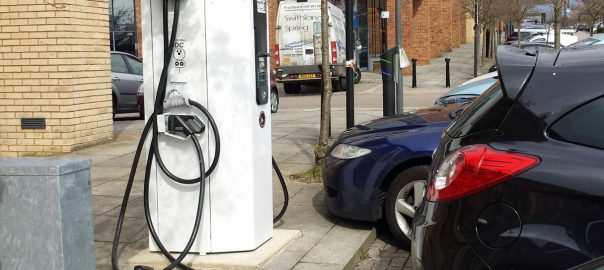
One of the many Polar rapid charge points around Milton Keynes, this one is in Central MK (Image: T. Larkum)

Zap-Map launches EV charging payment interoperability service Zap-Pay

A new electric vehicle (EV) charging payment interoperability service has been launched by Zap-Map.

Zap-Pay allows EV drivers to use a single app to pay for charging across different networks, with Engenie the first network signed up to the service.

Drivers using Zap-Pay will be able to pay for charging at any of the network partners as part of a pay-as-you-go tariff, with ESB EV Solutions, LiFe and Hubsta amongst others set to be introduced to the platform in the autumn.

Zap-Pay is to be rolled out across other UK networks in 2021 with the hope of providing “unrivaled coverage” across the country.

It bares resemblance to other new services launched by other players in the EV space, most notably the EV payment interoperability platform launched under Octopus’ Electric Juice umbrella, which also has Engenie signed on. Octopus’ also aggregates charges onto a single bill, targeting the fleet demographic.

One of the many Polar rapid charge points around Milton Keynes, this one is in Central MK (Image: T. Larkum)

Zap-Map is also developing new features to support the electrification of commercial fleets and other e-mobility services, it said, which are due to be rolled out over the next twelve months.

Zap-Pay was created due to the various different apps and cards required to charge on different networks across the UK, with a recent Zap-Map survey finding that charger anxiety – concern over being able to access the right chargepoint when needed – was an issue for 68% of EV drivers.

It is to also provide live status updates, charging history, PDF VAT receipts and 24/7 customer support.

At the time of its launch, it is live on ten Engenie chargepoints across four locations – Stratford, Gloucester, Chepstow and Bristol. By the end of this month, it will be rolled out across the whole Engenie network of rapid chargepoints.

Following Good Energy taking a 12.9% stake in the company in March 2019, Zap-Map told Current± it was working on the development of Zap-Pay before confirming in December 2019 it would be launched in early 2020.

Read more: Current

It’s Time to Go Green!

If you would like to know more about Solar Panels and the PowerBanx range of home battery systems, and get a free instant quote, please complete our online form: