Daily Archives: July 31, 2017

Refreshed Renault Kangoo ZE Now On Sale In Europe, With Improved Range

The newly refreshed Renault Kangoo ZE is now on sale in the European market, bringing with it an improved range and a number of other changes.
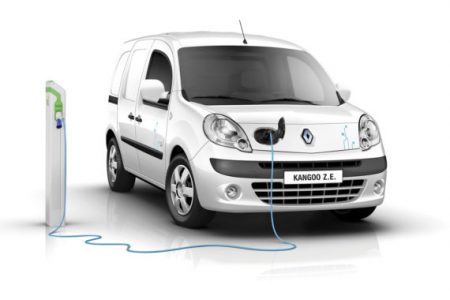
Reanault Kangoo ZE

The small electric van offering from Renault now features an official New European Driving Cycle (NEDC) range rating of 270 kilometers (167 miles). The company acknowledges that a real-world range of between 120 kilometers (74 miles) and 200 kilometers (124 miles) is probably more realistic, though.

That’s probably enough range to make the newly refreshed offering seem pretty attractive to many business operators, offering great potential to cut fuel and maintenance costs to a fair degree.

In addition to the improved range — courtesy of a new 33 kilowatt-hour (kWh) battery pack — the refreshed Renault Kangoo ZE also features an upgraded charging system and a heat pump that improves cold weather battery efficiency/range. The new battery pack was developed in partnership with LG Chem.

Green Car Reports provides more: “The new battery cells are denser but do not add additional weight to the Kangoo ZE, which means safety and payload are unchanged. Total power output from the electric battery and motor — shared with the Renault Zoe — is 45 kilowatts (60 horsepower).

“Additionally, Renault has added a dedicated heat pump to use less battery energy on climate control, which the brand says is a first for the light commercial vehicle segment. … In the coldest climates, the Kangoo ZE also benefits from an optional mini-heater for even more warmth.”

As far as the improved 7-kilowatt charging system, the Kangoo ZE can now be fully charged in 6 hours, rather than 7 hours, despite the much improved range.

Deliveries in Europe are expected to begin this summer.

Source: Clean Technica

Government puts up £20m for electric vehicle-to-grid tech development

Government has freed-up £20 million to help kickstart vehicle-to-grid (V2G) development. The aim is to work out how electric vehicles can help balance the electricity system.

Tesla Model 3

The Department for Business, Energy and Industrial Strategy (Beis) and the Office for Low Emission Vehicles (Olev) said money is available for three types of V2G projects:

  • feasibility studies – investigating the ways vehicle to grid technology can be used in the future
  • industrial research or experimental development – for example, to develop vehicle-to-grid charging equipment
  • demonstrator trials in the real-world environment – projects that trial vehicle to grid technology in different locations across the country.

There are currently around 100,000 EVs on UK roads. That number is expected to swell significantly over the coming years. Manufacturers such as Volvo have grabbed headlines in recent weeks with commitments to focus entirely on electric vehicles, Tesla is launching its first mass production model and even Rolls Royce, which produces some of the biggest and best combustion engines in the world, accepts that eventually, its future business will be electric. Meanwhile, France’s policymakers have outlined a goal to ban sales of petrol and diesel cars by 2040.

With battery costs continuing to fall, some analysts now believe the EV market is approaching a tipping point, and that battery powered cars will be “cheaper to buy than internal combustion engines in most countries by 2025-29”. That analysis does not take into account any fuel savings or subsidies that may be on offer.

In the UK, Beis is keen for carmakers and battery firms to collaborate on energy storage and services in order to help decarbonise both electricity and transport sectors. While the former sector has decarbonised significantly due to subsidy regimes, the latter appears to be in reverse gear.

“The ability to marry energy and automotive [goals] is a wonderful opportunity that would be crazy to separate and dilute,” secretary of state Greg Clark said recently.

“If you can create jobs in both sectors and simultaneously address problems that do not respect boundaries… that is a huge opportunity.”

Some carmakers are ahead of the curve. Nissan, second only to Jaguar Land Rover in the UK in terms of cars produced, told National Grid’s recent Power Responsive conference that it was becoming an energy services company.

Read more: The Energyst

Is a carmaker about to save the planet?

Volvo’s move to electric demonstrates the role ethical business can play in shaping our society for the better

think a lot about electric cars,” Tesla CEO Elon Musk famously said at a party at the very end of the 80s. “Do you think a lot about electric cars?” The problem with thinking a lot about electric cars is that certain things become impossible to unthink: powering a car with fossil fuels, meeting 21st-century challenges with 19th-century answers, become more than irresponsible. It becomes ridiculous.

You’ll never know when the tipping point is – it’s possibly as little as five minutes – but think enough about electric cars, especially if you’re a car manufacturer, and wham … you’re Volvo. They were rolling along perfectly happily until they thought too hard: about their business model and benefit to society; about climate change and their future customers; and so they made the decision that all their cars would be fully electric, or at least hybrid, by 2019. Not one car solely powered by internal combustion engine will come off a Volvo production line by 2020.

It is impossible to overstate the significance of this, and not because you are ever likely to buy a brand-new Volvo. If every branded car is a Veblen good – that is, something you want precisely because it is expensive, to flag to the world your ability to own it – then the Volvo is a peculiar inversion, the car you buy that looks less flash than it is, to show the world that you’re not the kind of person who shows off what they’ve bought. Nope, nobody here is buying a brand-new Volvo in 2019.

Yet this will instantly change the charging infrastructure for electric cars: there have already been pretty extraordinary advances in charge speed. You can fully charge an electric vehicle – one with a range of about 105 miles – in half an hour from a supercharger in a garage, which is the difference between being able to use an electric car in a normal way, and having to rebuild your life around it. However, there aren’t enough superchargers, in Europe or the US, and, maddeningly, a lot of the slower chargers – which take four to six hours – still call themselves “high speed” because that’s what they were when they were installed. Volvo will shunt progress forward worldwide on genuinely high-speed charging points, as well as battery production and research and development into battery storage.

Read more: The Guardian