Daily Archives: July 20, 2017

Tesla Model3 (Image: Wikimedia/Carlquinn)

Tesla’s First Mass-Market Car, the Model 3, Hits Production This Week

Tesla’s long-awaited mass-market electric car will begin rolling off the assembly line this week. But even as it moves ahead, the automaker is encountering challenges to its ambitious plans for growth.
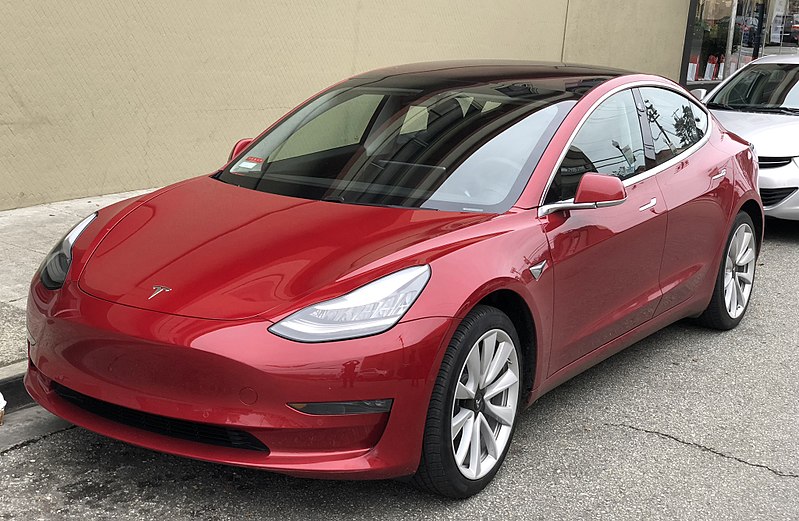
Tesla Model3 (Image: Wikimedia/Carlquinn)

On Monday, it acknowledged that it had experienced a “severe shortfall” in production of 100-kilowatt battery packs that use new technologies and are made on new assembly lines.
As a result, Tesla’s output of 25,708 cars in the second quarter barely exceeded its first-quarter production, though it was a 40 percent increase from a year ago.

Until June, the supply of battery packs was about 40 percent below demand, Tesla said, though supplies improved last month.

The hiccup in production appeared to have unsettled investors. Tesla stock fell $8.99, or 2.5 percent, to $352.62.

Tesla said production of its first midpriced car, the Model 3, would begin on Friday, two weeks earlier than planned, with the first deliveries on July 28.

Elon Musk, Tesla’s chief executive, said late Sunday on Twitter that production would increase quickly, with 100 Model 3s produced in August and 1,500 or more in September. He said that he expected the company to be able to produce 20,000 a month starting in December.

The Model 3 is a critical test for Mr. Musk and his ambitious plan to turn Tesla into a producer of mass-market electric cars.

Until now, the company has manufactured luxury cars in relatively small numbers, typically selling them for $90,000 or more. In 2016, it made about 85,000 vehicles. General Motors, by contrast, produced more than nine million cars and light trucks.

The Model 3 will be priced around $35,000. Mr. Musk envisions it reaching a much wider range of customers and has said he expects it to push Tesla’s output to 500,000 cars a year in 2018.

Read more: The New York Times

Lyft’s autonomous electric vehicles will run on 100% renewable energy

One of the leading on-demand ridesharing companies has committed to charging its forthcoming autonomous electric vehicle fleet with electricity from renewable sources.

Renault ZOE / nuTonomy

One of the promises of services such as Lyft and Uber (which are called ridesharing platforms but are more like dispatchers for freelance taxis) is that they will reduce the need for car ownership, and that they will bring down the total number of cars driving in cities, thereby also decreasing vehicular emissions.

The logical next step in that clean transport play is to move to greener cars, such as hybrids, plug-in hybrids, and full electric vehicles, and the one beyond that is using autonomous cars, while the third move looks to be a combination of electric mobility and self-driving cars. But although those steps, in conjunction with things like walkable neighborhoods and clean last-mile vehicles, can help move us forward in terms of a more sustainable transportation model, one of the many environmental elephants in the room is the origin of the energy powering this EV evolution, which in many places is still predominantly fossil fuels.

According to a blog post from Lyft co-founders, the company is committed to using 100% renewable electricity to charge its forthcoming fleet of autonomous electric vehicles, right from the get-go, beginning with the nuTonomy self-driving vehicle pilot program launching in Boston this year.

Read more: Tree Hugger

EVEC's BMW i8 plugin hybrid (Image: T. Larkum)

EV Experience Centre Nearly Ready

The Milton Keynes Electric Vehicle Experience Centre (EVEC) is due to open this Saturday, 22nd July. Being curious (ok, nosey) I scouted it out on Tuesday after my visit to the new Tesla showroom.

The new EV Experience Centre under wraps (Image: T. Larkum)

It has a fairly good location near the middle of the main shopping centre; it’s on Crown Walk, next to the big Boots store. It looks smaller than I expected, at least on the outside. Currently there isn’t much to see – the windows are blanked out and there was someone on the door in front of a sign saying ‘Invited Guests Only’.

EVEC's BMW i8 plugin hybrid (Image: T. Larkum)
EVEC’s BMW i8 plugin hybrid (Image: T. Larkum)`

Two plugin cars were on display at the intersection of Crown Walk and Silbury Arcade – a BMW i8 and a Kia Optima PHEV.

EVEC's Kia Optima plugin hybrid (Image: T. Larkum)
EVEC’s Kia Optima plugin hybrid (Image: T. Larkum)

We have been invited to the official EVEC launch so I’ll report back after that.


f

Carbon in Atmosphere Is Rising, Even as Emissions Stabilize

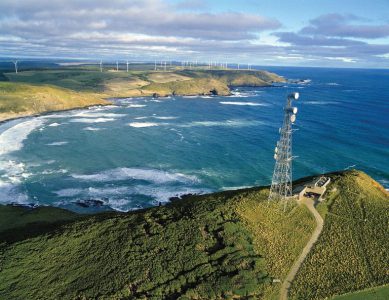
CAPE GRIM, Tasmania — On the best days, the wind howling across this rugged promontory has not touched land for thousands of miles, and the arriving air seems as if it should be the cleanest in the world.

The Cape Grim Baseline Air Pollution Station in Tasmania.
Credit Commonwealth Scientific and Industrial Research Organization

But on a cliff above the sea, inside a low-slung government building, a bank of sophisticated machines sniffs that air day and night, revealing telltale indicators of the way human activity is altering the planet on a major scale.

For more than two years, the monitoring station here, along with its counterparts across the world, has been flashing a warning: The excess carbon dioxide scorching the planet rose at the highest rate on record in 2015 and 2016. A slightly slower but still unusual rate of increase has continued into 2017.

Scientists are concerned about the cause of the rapid rises because, in one of the most hopeful signs since the global climate crisis became widely understood in the 1980s, the amount of carbon dioxide that people are pumping into the air seems to have stabilized in recent years, at least judging from the data that countries compile on their own emissions.

That raises a conundrum: If the amount of the gas that people are putting out has stopped rising, how can the amount that stays in the air be going up faster than ever? Does it mean the natural sponges that have been absorbing carbon dioxide.

“To me, it’s a warning,”

said Josep G. Canadell, an Australian climate scientist who runs the Global Carbon Project, a collaboration among several countries to monitor emissions trends.

Scientists have spent decades measuring what was happening to all of the carbon dioxide that was produced when people burned coal, oil and natural gas. They established that less than half of the gas was remaining in the atmosphere and warming the planet. The rest was being absorbed by the ocean and the land surface, in roughly equal amounts.

In essence, these natural sponges were doing humanity a huge service by disposing of much of its gaseous waste. But as emissions have risen higher and higher, it has been unclear how much longer the natural sponges will be able to keep up.

Read more: The New York Times