Daily Archives: July 4, 2017

Ecotricity rapid charger with LCD display (Image: T. Larkum)

Rapid Charging with an Ecotricity Charge Point – Part 2

Rapid Charging on the Motorway – Completing the Charge

Ecotricity rapid charger with LCD display (Image: T. Larkum)
Ecotricity rapid charger with LCD status display (Image: T. Larkum)

I previously described the process for initialising a charge at an Ecotricity rapid charger, as found at most motorway services. Here I’ll cover the process for monitoring and ending the charge session.


Step-by-Step Guide

12. While the car is charging you will want to monitor it regularly to confirm it is continuing successfully and to see when it has completed. The charge status, the time taken, the amount of electricity used and usually (depending on the car) also the charge level will be shown on the charge point screen.

Rapid charger status screen during charging (Image: T. Larkum)

13. There will also be visual indications on the car, for example the Nissan Leaf has blue lights on the dashboard, the Renault ZOE shows an icon on the driver’s screen, the BMW i3 has an indicator light around the charge socket, etc. However the most convenient monitoring method is via smarthphone, using an app provided by the car manufacturer. You can use this remotely, for example while eating in a services restaurant. Each app functions differently, but they all provide a display of the current charge level. The BMW one can generally be updated on demand (though sometimes requires the app to be killed to achieve this). The Renault one, rather inconveniently, will only update every 30 minutes.

BMW 'i Remote' app display during charging (Image: T. Larkum)
BMW ‘i Remote’ app display during charging (Image: T. Larkum)

14. When you wish to end the charge session you do so first in the Ecotricity app, then follow its instructions.

Ecotricity app display after ending session (Image: T. Larkum)

15. You remove the charge cable from the car and hang it back up on the charge point. Then you notify the Ecotricity app. The app will display the cost of the session (zero if you’re an Ecotricity customer) and the session identification number. You will also usually receive this information soon after by email to your registered address.

Ecotricity app display at end of session (Image: T. Larkum)

16. The session is ended and the rapid charger display will return to its welcome screen.

Ecotricity rapid charger welcome screen (Image: T. Larkum)

EV road trip marks 100,000 plug-in car sales

To celebrate more than 100,000 plug-in cars having been sold in the UK, 25 electric and plug-in hybrid cars drove from London to Milton Keynes [on] Sunday 18th June.

Organised by Chargemaster, the road trip covered around 100,000 meters in cars as diverse as the Nissan Leaf to the Tesla Model X, and BMW’s i3 to the Volvo XC90 T8.

The convoy all safely completed the journey of a little over 60 miles, showcasing the variety of plug-in cars on sale in the UK at the moment.

Coinciding with the sales milestone were two celebrations of Chargemaster’s own – 100,000 home charging sessions have been carried out on a single week, and Chargemaster’s Polar network has seen 100,000 public charging sessions so far in 2017.

David Martell, Chief Executive of Chargemaster, said:

“Today was a pivotal moment for the EV market, to mark a significant milestone in vehicle adoption and to celebrate two 100,000 milestones of our own. Thank you to the team, and everyone that made the day so special – here’s to the next 100,000 EVs.”

Source: ZapMap

f

Plug-In Vehicles Sales In UK Up 32% In May

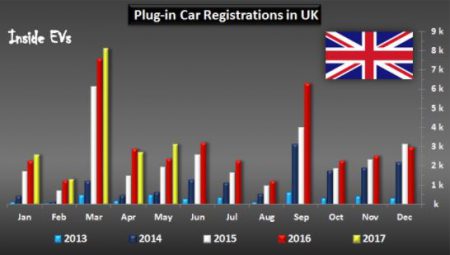
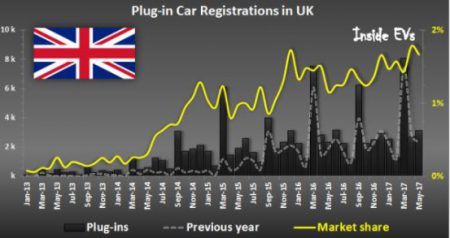
While the overall automotive market in UK shrank by 8.5% in May, ahead of June’s general election, the plug-in segment of the market continued to move forward, noting a strong 32% increase year-over-year.

Plug-in Electric Car Registrations in UK – May 2017

Total plug-in electrified sales in May amounted to 3,117 vehicles registered (17,904 YTD), which is one of the best ever results (that is, ex-annual March surges) in terms of market share at 1.67%.

All-electric offerings still only hold a third of the segment, but are now growing faster than their plug-in hybrid counterparts:

  • 926 BEVs (up 79 percent year-over-year)
  • 2,191 PHEVs (up 19 percent year-over-year)

The great result also helps the overall “alt-fuel” vehicle segment set a new record market share of 4.4% (previously 4.2% in January 2017).

We don’t yet know the individual model ranks; however, the new/longer ranged Renault ZOE ZE and reports of more RHD Tesla sales, likely accounted for the bulk of the all-electric sales.

Plug-in Electric Car Registrations in UK – May 2017

Source: Inside EVs

Whoosh! The Electric Car Is Rolling into American Life

U.S. transportation is about to get a mighty electric shock.

The days of the internal combustion engine are numbered. The electric car is about to do to the traditional gasoline and diesel car engine what the cell phone is doing to the copper-wire, landline telephone: shoulder it out of the way.

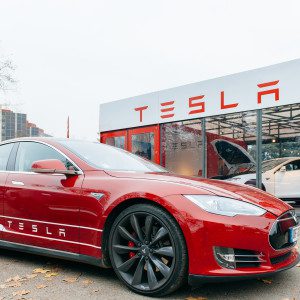
Tesla Model S

Andrew Paterson, a principal with the Verdigris Capital Group, told a conference in Washington on June 7, electric car sales will at least quadruple in the coming decade and then really begin to accelerate. This, he said, was part of a larger electric boom that would see the doubling of world electric demand, mostly in Asia, by the middle of the century.

Electric utilities in the United States stand to benefit from the switch from gasoline and diesel to electricity largely because they will be able to meet the new demand without adding new generation, according to the Electric Power Research Institute in Palo Alto, Calif. It believes most of the charging of electric vehicles will take place off-peak, at night and when there is less demand. At worst the new load will fall partly during the day, when there is a surplus of solar power.

Analysts say much depends on whether commercial and company parking facilities can be turned into charging stations as well. Maybe when the boom really picks up, even parking meters will become charging stations.

The change in transportation will have huge effects beyond the car infrastructure. Gradually, gas stations will become obsolete. Technicians who service cars with oil changes and tuning will be out of work.

Electric cars are fundamentally simpler than today’s vehicles — they will run for tens of thousands of miles without maintenance, and that will be confined to things like tires, brakes and lights. Cities will get cleaner and quieter.

The speed of technological evolution is the unknown, but it will control the accelerator in the race to electricity. Better batteries, faster charging and more public confidence in the duration of each charge will all control the rate of change.

Like all revolutions, there will be winners: those who find out how to make money out of battery charging and those who make electricity. And losers: oil companies, gas stations, service departments of dealerships and the long-dreamed-of hydrogen car.

Incontrovertibly, the air in cities will be a winner — a big, big winner.

Read more: Inside Sources