Monthly Archives: June 2017

Electric vehicles to cost the same as conventional cars by 2018

The cost of owning an electric car will fall to the same level as petrol-powered vehicles next year, according to bold new analysis from UBS which will send shockwaves through the automobile industry.

Chevy Bolt

Experts from the investment bank’s “evidence lab” made the prediction after tearing apart one of the current generation of electric cars to examine the economics of electric vehicles (EVs).

They found that costs of producing EVs were far lower than previously thought but there is still great potential to make further savings, driving down the price of electric cars.

As a result, UBS forecasts that the

“total cost of consumer ownership can reach parity with combustion engines from 2018”,

with this likely to happen in Europe first.

“This will create an inflexion point for demand,”

the analysts said.

“We raise our 2025 forecast for EV sales by ~50pc to 14.2m – 14pc of global car sales.”

If the prediction comes to pass, traditional car industry giants could face ruin. Germany’s Volkswagen Group – the world’s biggest car company – is racing to catch up with rivals’ investment levels in electric drivetrains, the components which deliver the power into the wheels, having largely ignored the technology in the past.

UBS’s research was to help understand what it called the

“most disruptive car category since the Model T Ford”.

The findings are based on its deconstruction of a Chevy Bolt, which it considered to be “the world’s first mass-market EV, with a range of more than 200 miles”.

UBS’s analysts deconstructed the Chevy Bolt (Image: UBS)

The 2017 car – which cost $37,000 – was taken apart piece by piece and the parts analysed. UBS said that the Bolt’s electric drive was $4,600 cheaper to produce than thought,

“with much cost reduction potential left”.

 “We estimate that GM (which produces the Bolt) loses $7,400 in earnings before interest, and tax on every Bolt sold today, mainly due to a lack of scale.”

Read more: The Telegraph

Charging ahead: Welsh battery scheme may aid growth of green energy

One of the UK’s largest battery storage schemes, built next to a windfarm, will offer vital services to the National Grid.

Nestling alongside rows of conifers and wind turbines in a Welsh valley, a pioneering project will materialise this summer that could prove a blueprint for unlocking Britain’s renewable energy potential.

The Upper Afan Valley near Swansea is already home to the biggest windfarm in England and Wales, but in July work will begin there on one of the UK’s largest battery storage schemes.

The Pen y Cymoedd wind energy project near Swansea. Photograph: Vattenfall

Built by Swedish energy company Vattenfall, the facility will involve six shipping containers stuffed with lithium-ion batteries made by BMW’s electric car division.

The project is seen as a crucial part of the jigsaw for helping wind, solar and other renewable sources go from the 25% of UK power they provide today, to the much greater share the government needs to hit its climate change targets.

The batteries will not store the electricity generated by the Pen y Cymoedd windfarm with which they share a site, but will offer vital services to the National Grid to cope with the fluctuations that come from renewable power.

Colocating the plant with the windfarm was key to making the economics of the scheme work. Vattenfall said that the site’s existing infrastructure, such as connections to the grid’s transmission network to take power around the UK, meant it was about £5m cheaper than building it on a standalone site.

“To connect a battery project to the transmission network would be prohibitively expensive, but because we have the windfarm already in place, we can share the assets. It’s a huge cost-saving,”

said Frank Elsworth, who is managing construction of the 22MW plant, the battery equivalent of 450 BMW i3 electric cars.

Read more: The Guardian

How Much Does Solar Panel Battery Storage Cost?

Your solar panels are converting light into electricity. This means that they are generating electricity during the day, when the house is often empty. Most commonly, this electricity is fed back to the grid.

Light, efficient, eco-friendly battery technology is advancing very fast in response to market demand. It is not by any means cheap yet, but prices are falling as the technology improves and battery storage is beginning to offer a genuine option for increasing savings, reducing your dependence on the grid and further reducing your carbon footprint.

Once you are sure that you are a good candidate to benefit from adding battery storage to your solar panels, the key factor in calculating the cost and potential return lies in the size of battery you will need and the amount of surplus electricity you generate.

What is your load profile?

Homes with 2.5kW to 4kW solar panel systems are generating somewhere between 1,700kwh and 3,400kWh per year. Suitability to benefit from adding or including battery storage will depend on what is called your Load Profile. Put simply this is the way in which you consume your electricity. If you are already using all or most of the electricity you generate then battery storage will bring you little value. If, however, you are generating a significant amount of your electricity when you are not in your house to use it then battery storage becomes a better option.

A qualified solar engineer will help you [choose] the size of battery you require to store your excess solar electricity. Installation costs tend to remain similar no matter the size of the battery. The size of the battery will, of course, affect the cost.

Tesla Powerwall 14kW

The new Tesla 14kW Powerwall battery will cost you approximately £6,500 including installation.

Sonnen

The German company Sonnen, offer a modular system starting at 2kW with additional 2kW batteries available up to a total of 16kW. Approximately £3,200 will install the basic 2kW system including inverter and controls which can take you up to the full 16kW. Each 2kW add-on will then cost a further £850.

LG Chem

The LG Chem range includes 3.3kW, 4.2kW and 9.8kW options for which you can expect to pay £2,200, £3,300 and £5,500 respectively. You should add approximately £1,000 to these prices for installation.

Calculating the savings you can expect from adding battery storage is complicated and requires both the expertise of a qualified installer and knowledge of your own particular system and load profile. If you think that battery storage would be a viable option then your next step should be to book a visit from a solar specialist who will be happy to do the calculations with you and advise you on your best options.

Read more: Green Business Watch

Watch Renault Zoe E-Sport Concept, Formula E Racer Cruise Paris

The Renault eDams team currently leads the Formula E standings and its racers Sebastien Buemi and Nicolas Prost currently sit in first and third in the Driver’s Championship, respectively.

Since the next race of the season is in Paris on May 20, the crew is celebrating the strong performance in its home country by holding a parade of electric vehicles through the City of Light. The Renault eDams R.S. 16 race car and Zoe e-Sport Concept lead the procession in this video.

Read more: Motor 1

Volvo says no more diesel engines, the future is electric

Stricter nitrogen oxide emissions regulations mean an end to diesel-engine development.

Volvo Cars has come down with a case of electric fever, and the cure is “no more diesel engines.”

The company’s CEO, Håkan Samuelsson, recently told German publication Frankfurter Allgemeine Zeitung that Volvo’s current diesel engines may well be the last of their kind.

Volvo S90

Samuelsson said that the technology is necessary to meet upcoming European carbon emission standards, which require OEMs to drop from 130g/km to just 95g/km in 2021.
But the outlook farther ahead involves regulations that will also severely limit nitrogen oxides (NOx). As a result, the company will devote its energy to electrification instead.

As we reported earlier this week, NOx are noxious and linked to 38,000 premature deaths in 2015 alone. Contributing to that body count is evidently beyond the pale for an automaker which has built an impressive reputation for safety.

The news is all the more remarkable given that the bulk of its sales in Europe are diesel-engined vehicles. Right now, Volvo uses a 2.0L diesel engine that shares much with the 2.0L gasoline engine that we get here in the US in the S90, V90, and XC90 models.

Samuelsson said that Volvo’s first purely electric vehicle will arrive in 2019. He also paid a mighty compliment to Elon Musk’s EV outfit.

“It must be acknowledged that Tesla has managed to offer such a car for which the people are queuing. In the area, we should also have space, with high quality and attractive design,”

he told Frankfurter Allgemeine Zeitung.

Source: Cars Technica

Cash-strapped councils breaking the law on air pollution, documents reveal

Exclusive poll for The Independent shows public – and most Conservative voters – back banning the most-polluting cars from city centres as pressure builds on the Government

It has been described as a “public health emergency” responsible for tens of thousands of deaths every year, but dozens of local councils have been failing to report on air pollution as required by law for years.

The revelation, based on documents obtained under Freedom of Information rules, casts doubt on local authorities’ ability to play their part in the Government’s new draft Air Quality Plan – its third attempt to meet minimum safety standards after repeatedly being taken to court by campaigners.

Ministers had sought to delay publication of the plan until after the general election, with a Government lawyer arguing it would drop a “controversial bomb” on the campaign.

But a judge ordered ministers to comply with a court-ordered deadline and the resultant plan was duly derided as “feeble” and “much weaker” than expected.

Public concern about air pollution has been growing. A new survey for The Independent found the majority of the public is now in favour of banning the most-polluting vehicles from city centres.

Some 51 per cent of respondents agreed with this suggestion, with only 15 per cent against and the remainder not expressing a view, pollsters ORB said.

The Government’s latest Air Quality Plan sought to pass the buck to a large degree to councils, saying they were “best placed to take the lead”.

However, the council documents, obtained by the DeSmog UK environmental news website, show that local authorities have already been failing to carry out the current requirements, suggesting they would struggle to cope with further responsibilities without extra funding.

Of the 77 councils contacted, 59 had not made air pollution reports, which must be produced under the 1995 Environment Act, available to the public.

After the website got in touch with the councils, 34 authorities were found to have gaps in their reporting between 2011 and 2016, although some said they were still in the process of producing reports covering last year. If this is a representative sample, it would mean 44 per cent of councils in the country are failing to properly monitor and assess the extent of air pollution.

Mat Hope, deputy editor of DeSmog UK, said:

“I think it shows local councils need resources to be able to deal with this problem properly.

“I think the councils themselves are doing what they can, but with the current budget constraints it’s clear they are likely to struggle with the extra obligations under the new Air Quality Plan.

“The Government needs to think very hard about the resources they are putting behind this.”

Read more: The Independent

Solar panels, EV chargers required in new homes in Fremont, CA

Half a century ago, the General Motors assembly plant was the largest employer in Fremont, California, and the town was known for its dragstrip.

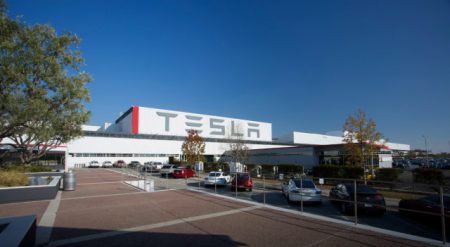
Today, that plant makes Tesla electric cars and Fremont is a part of the San Francisco Bay Area’s Silicon Valley, creating advanced technology for the world.

Tesla Factory, Fremont, California

The city has now taken another step into the future, requiring that all new houses be delivered ready for the installation of electric-car charging stations.

According to the East Bay Times, the city of Fremont has announced that any new housing project must include both solar panels and the electrical wiring required for the installation of a charging station.

The town, across the bay from Palo Alto—where a similar regulation was adopted in 2013—prides itself on being the ZIP Code with the highest concentration of electric-car owners in the state.

That makes it likely to have the highest such concentration in the U.S.

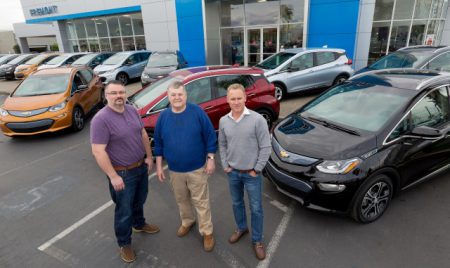
First 2017 Chevrolet Bolt EV Buyers, Fremont, California: Bobby Edmonds, Bill Mattos and Steve Henry

When the first 2017 Chevrolet Bolt EV electric cars were sold in December, Fremont Chevrolet was the site—because it sells more Chevy Volt plug-in hybrids than any other dealer in the country.

It’s exactly 3 miles from the dealer to the Tesla factory, formerly the GM-Toyota joint venture known as New United Motor Manufacturing Inc. or NUMMI.

The required coverage of the solar panels will be determined by the size of the new project.

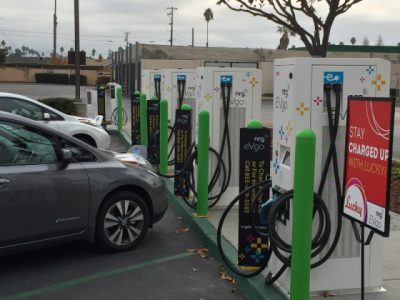
EVgo DC Fast-Charging Site in Fremont, California.

As for the charging stations, the wall hardware itself will not be mandatory.

New buildings will, however, have to be equipped with the electrical setup needed for later installation.

For commercial or multifamily projects, the ruling goes even further, requiring that at least 10 percent of the parking spaces have charging stations installed

Read more: Green Car Reports

Runaway Adoption of Pure Electric Vehicles: Multiple Triggers

It has long been speculated that electric vehicle adoption may have a sudden tipping point of adoption. IDTechEx pointed out that incentives help as does reaching lower cost of ownership but lower up-front price is the killer blow.

We noted how that has happened with small vehicles such as gasoline-assisted bicycles and golf cars becoming more expensive than pure electric alternatives, this resulting in runaway adoption of electric. Ten years ago, IDTechEx correctly predicted that this will progress to ever larger vehicles with on-road small cars in line for being cheaper as pure electric from 2020 onwards.

On cue, several car makers have now said they will be offering pure electric versions at no price penalty in that timeframe. That is more dramatic than it sounds, because maintenance of the much simpler pure electric powertrain and the cost of the electric “fuel” are tiny compared to conventional and vehicle life is often to be longer too.

Domino effects

There will be a domino effect. Take diesel. Many cities have set dates when they will ban diesel vehicles and some countries are contemplating such legislation. Globally sales of diesel vehicles are dropping due to the Volkswagen scandal, purchasers fearing that resale prices may collapse. In European countries sales of diesel are essential to gasoline stations: for example, in the UK, they represent 65% of fuel sales. There, the number of such “forecourts” is one sixth of what it was and the few remaining ones will be very tempted to grab the hefty increased property value and let someone turn them into apartments or, since they are shopping locations already, as supermarkets.

Ironically, shutting down gasoline stations is encouraged by the fact that you cannot make significant money out of EV chargers on your forecourt. Legislation is going through in the UK that gives the government the right to force the larger forecourt owners to provide EV charging.

Other unintended consequences

The unintended consequence will be extra journey time and hassle for drivers seeking petrol, not just diesel. Suddenly it is the internal combustion engines that become a pain to refuel whereas EVs are charged at home and at destination, a convenience not possible with the conventional vehicle.

This will make petrol vehicles undesirable even before cities and countries ban them and they become overpriced as they become more complex to meet 2025 and 2030 carbon dioxide laws intended to reduce global warming and a raft of acid gas restrictions, diesel being hit by particulate restrictions too.

Multiple hits

We face multiple hits on conventional vehicles all the time now, another example being linkage between diesel and breast cancer, depression and more, not just lung and heart disease.

As causality is proven and the true scale of injuries is revealed, people will be more and more cautious of putting money that way and that includes investors, so modernisation of facilities, reduced emissions and competitive pricing of conventional vehicles becomes more and more difficult.

Fuel cell tipping point

With runaway adoption of battery electric vehicles, even the grants for these non-green fuel cell vehicles are under threat, creating a self-fulfilling prophesy and boosting pure electric.

IDTechEx correctly forecasted the realisation that fuel cell vehicles will never be mainstream but, like all forecasters, we are struggling to predict accurately when the tipping point of pure electric cars will come.

Read more: IDTechEX

Fleet News Awards 2017: Best Plug-in Car (1-50g/km) – BMW i3 Range Extender

BMW has got all the ingredients right for it i3 electric car, despite its quirky looks.

Transport minister John Hayes CBE hands the award to BMW Group general manager, corporate sales Steve Oliver.

Although the fully electric version lost out to the more affordable Hyundai Ioniq in the zero tailpipe emissions category of our awards, members of our judging panel had plenty of praise for the Range Extender (REX) version of the i3, which has a small motorcycle engine to charge the battery when the plug-in range has depleted.

Made available with revised battery chemistry last year to boost its range, the i3 can now reach up to 195 miles on the official test cycle, or up to 243 miles with the Range Extender.

The i3 has played its part in the past three years to draw greater attention to EVs and make them desirable and aspirational. By far the most powerful compact EV on sale with 172PS, and using carbonfibre construction to minimise weight, the rear-wheel drive i3 has been very much the driving enthusiasts’ choice among plug-in cars.

Finalists

  • Audi A3 e-tron
  • BMW i3 Range Extender
  • BMW 330e
  • Mercedes-Benz C350e
  • Mercedes-Benz E350e
  • Volkswagen Golf GTE
  • Volvo XC90 T8

Judges’ comments

Practical and with a striking design, the i3 Range Extender offers a decent range with the added security of the range-extender petrol engine. It is great to drive and has competitive running costs thanks in part to the clever use of carbon fibre technology for low-cost repairs.

Award winner video

Source: FleetNews