Daily Archives: June 20, 2017

Renault Zoe leads 49% sales jump in EV sales in Europe during first quarter 2017

According to the European Automobile Manufacturers Association, alternative fuel vehicles (AFV’s) in the Europe Union are off to a very strong start in the first quarter of this year, increasing their numbers sold by 37.6% to 212,945 vehicles.
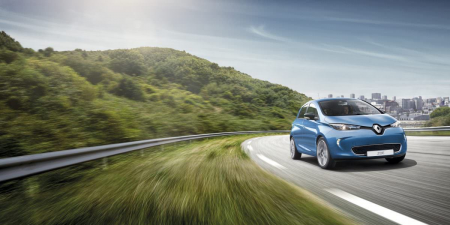
Renault ZOE ZE40

Hybrid vehicles (HEV) showed the biggest growth with 61.2% versus the same period last year, now counting 111,006 units. Electrically chargeable vehicles (ECV = BEV and plug-in hybrids) grew with 29.9% from 36,322 units sold in Q1, 2016 to 47,196 units in Q1, 2017. This includes 49% growth for “battery-only” (BEV’s) to 24,592 units sold and 13% growth for the plug-in hybrids (21,644 units). The U.S. market showed a similar growth of 49% for electric car sales to 40,700 units sold in the first quarter according to Bloomberg New Energy Finance. The American car market is about 16% larger.

All the major markets in the EU added many new AFV registrations over the first three months. Spain showed the largest increase (+87.4%) over the first quarter of 2017 followed by Germany (+67.5%), the UK (+29.9%), France (+24.8%) and Italy (17.2$). The growth in Italy is due in large part to the recovery in LPG-fuelled (natural gas) cars, but for the other markets, the growth is mostly the result of strong sales in electrically chargeable vehicles (ECV’s or BEV’s) and hybrid-electric (plug-in hybrids).
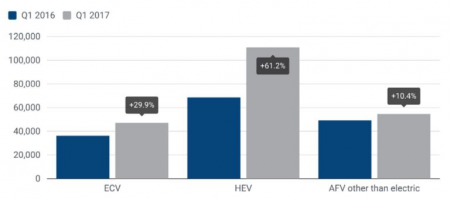
New passenger car registrations by alternative fuel type in the European Union during the first quarter of 2017.

Looking at electric- or battery-only car sales in Europe reported by the European Alternative Fuels Observatory, we see that the improved Renault Zoe is the number one seller by far, followed by the Nissan Leaf, BMW i3, Tesla Model S and X and the others.

Read more: Electrek

Scotland Yard To Green Its Fleet With Purchase Of Up To 700 Electric Cars

In a “green” effort, the Metropolitan Police Department will start by transitioning 250 of them to hydrogen and electric cars. The new vehicles will be put in place over the course of the next 12 months.

“The response from police drivers to the BMW i3 has been very positive. It’s actually a very quick car.”

Included in the initial plan is hydrogen fuel cell cars, specifically for emergency response vehicles, 30 plug-in hybrids for responding to “999” calls, additional larger vehicles (vans) for crime scenes, and 1o vehicles for Royalty protection officers.

The hope is that at least half of the police force is driving electric cars by next year. This is all part of a multi-million program which includes replacing about 700 vehicles. Monies are also allocated for infrastructure, and the capital area will get five hydrogen chargers.

The organization has looked into the BMW i3 and the Toyota Mirai as viable options. Hydrogen scooters are a possibility for specific patrol routes. At this point, officials aren’t ruling out any automakers or vehicles, as long as they are “clean.” Talks have included vehicles from Ford, Nissan, Mercedes, Renault, and Volkswagen, among others. All vehicle types are also being considered, from mopeds, to cars, and vans. The chief of police, Bernard Hogan-Howe, reportedly spoke personally with Elon Musk about the concept of using Tesla vehicles for “front line” operations.

Trials are already underway and more are planned. The BMW i3 REX has been successful in testing, specifically due to its acceleration. Hydrogen scooters manufactured by Suzuki are also being tested. Jiggs Bharij, the head of the Metropolitan Police fleet services, said:

“The response from police drivers to the BMW i3 has been very positive. It’s actually a very quick car.”

This is all comforting to residents due to the poor air quality in London. Many people have threatened to leave the area if changes aren’t initiated. Sian Berry, a member of the London Assembly Green Party concluded:

“A lot of new and positive ideas are being trailed and considered by the Met here … But what we need from them is a firm deadline for getting all diesel police vehicles off the road. Every organisation with a fleet in London needs to be making plans for this to happen as soon as possible, and this needs to start with the Mayor’s own bodies, including TfL and the Met.”

Source: Inside EVs

Blades Being Installed on Turbine 5, Yelvertoft Wind Farm (Image: T. Larkum)

Britain’s wind turbines catch breeze of a rising industry

The sound made by 100 tonnes of steel and carbon fibre rotating 400 feet overhead is surprisingly understated. Each whoosh of the 260 foot blades spans an area the size of the London Eye and generates enough electricity to power the average British home for 24 hours.

Blades Being Installed on Turbine 5, Yelvertoft Wind Farm (Image: T. Larkum)
Onshore Wind Farm (Image: T. Larkum)

There are 32 of these 8MW turbines in the second phase of Dong Energy’s Burbo Bank wind farm spinning off the Merseyside coast.

They are the most powerful ever, dotting an area the size of almost 6,000 football pitches within the Irish Sea, each one a beacon of Britain’s global dominance in the booming offshore wind industry.

Benj Sykes, the UK boss for Dong Energy’s wind power business, predicts he may be cutting the ribbon on turbines with double this power capacity by 2024.

“If you wind the clock back four or five years, this scale of technology was considered very ambitious. Now, you can see them in reality, commercially deployed. It’s very difficult to say where we will ultimately get to,”

he says.

Wind turbines have already more than doubled their power capacity since Dong Energy constructed the first phase of Burbo Bank in 2007 with 3.7MW structures. By the mid-2020s turbines may double again and a capacity of 15MW could be spinning in Europe’s waters.

As the efficiency and power potential of each turbine increases, costs keep falling.

Read more: The Telegraph