Daily Archives: June 17, 2017

Renault Kangoo Z.E. 2017 review

The Kangoo Z.E. is the all-electric, zero emissions version of Renault’s smallest van

The Renault Kangoo ZE is the electric version of the Kangoo, Renault’s smallest van. Like the diesel version, it’s available in standard, Maxi and Maxi Crew body styles. In reality the only difference between the diesel and ZE (Zero Emissions) version is the fact there’s an electric motor under the bonnet instead of an engine, and a battery pack under the load area where the fuel tank would normally be.

Renault Kangoo ZE

The Kangoo ZE has a payload of 650kg, which is the same for the Maxi ZE, while the two versions have a load volume of 3.4 and 4 cubic metres respectively. This pair are two-seaters, while the Maxi Crew ZE has five seats.

Prices start from around £16,500, thanks to a Government Plug-In Car Grant of up to £8,000, while Renault offers two purchase options; you can either buy the Kangoo ZE outright, or buy the van and hire the batteries to help keep costs in check and eliminate any concerns about the batteries losing their longevity.

Power for the Kangoo ZE comes from a 44kW electric motor, which is the equivalent of 60bhp from a conventional engine. While that means the ZE has less power than any of the conventional Kangoo range (and 0-62mph takes a laborious 20.3 seconds), it doesn’t feel slow, thanks to a healthy 226Nm of torque (only the more powerful dCi 110 does better), and this torque is available as soon as you put your foot on the accelerator, so it really does nip away from the traffic lights.

Renault claims a range of 106 miles for the Kangoo ZE – it’s the same for the Kangoo Maxi, and is the same quoted for the Kangoo’s main rival, the Nissan e-NV200 – but in the real-world you can expect a range of around 75 miles on a full charge.

Read more: Auto Express
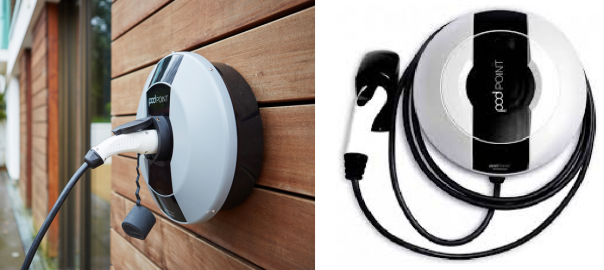
Untethered and Tethered Charge Points (Image: POD Point)

POD Point Installation Guide – Applying for the charge point

I Have my New Car Ordered – Now I Need a Charge Point

Untethered and Tethered Charge Points (Image: POD Point)

With my new Leaf, I get a new, FREE, POD Point charge point.
Thanks to a Nissan discount of £264 and the government OLEV scheme discount of £500, there is no charge for me at all for the entry level unit, although there are a couple of upgrade options you can choose.

Here is a quick guide to what to expect when you are ready to get your system installed. This blog covers the on-line application, with a separate blog that covers the installation.

Ordering my New Charge Point

The process starts with an email from POD Point to start the application. It was pretty straightforward and the pictures below step through the choices offered. The three choices I made of most significance to me were the following:
1) Upgrade to a 7kW charger. This cost £95. This seemed good value and future proofs me for longer range cars in the future.
2) Upgrade to a key so that I can lock the charger if necessary. This cost £30. I am not sure if electric thieving is likely.
3) I chose to have an un-tethered system with a type 2 socket so that it could work with any car. This was no charge. POD-Point tell me there is no difference in charge between a tethered and un-tethered system.

1 – The initial email from POD Point

2 – website starting point

3 – charge power choice

4 – tethered/untethered choice

5 – extras: key, cable, freestand

6 – Order summary showing total price less the nissan discount

7 – A statement that I have bought/leased a new car and have suitable off-street parking for a chargepoint to qualify for the OLEV grant

8 – 2nd Order summary including the OLEV grant

9 – payment for my extras

10 – payment summary

11 – address for installation

12 – installation specific questions

13 – statement of whether I do or don’t want the OLEV grant

14 – formal grant application. This needed a form downloaded, filled in and uploaded. Not particularly difficult and definitely worth it to save £500.

15 – MPAN number needed from my electricity bill.

16 – the thank you

Severe Flooding, Against a Background of Wind Turbines: November 2012, Tyringham, Bucks. (Image: T. Larkum)

Arctic stronghold of world’s seeds flooded after permafrost melts

No seeds were lost but the ability of the rock vault to provide failsafe protection against all disasters is now threatened by climate change

Severe Flooding, Against a Background of Wind Turbines: November 2012, Tyringham, Bucks. (Image: T. Larkum)

It was designed as an impregnable deep-freeze to protect the world’s most precious seeds from any global disaster and ensure humanity’s food supply forever. But the Global Seed Vault, buried in a mountain deep inside the Arctic circle, has been breached after global warming produced extraordinary temperatures over the winter, sending meltwater gushing into the entrance tunnel.

The vault is on the Norwegian island of Spitsbergen and contains almost a million packets of seeds, each a variety of an important food crop. When it was opened in 2008, the deep permafrost through which the vault was sunk was expected to provide

“failsafe” protection against “the challenge of natural or man-made disasters”.

But soaring temperatures in the Arctic at the end of the world’s hottest ever recorded year led to melting and heavy rain, when light snow should have been falling.

“It was not in our plans to think that the permafrost would not be there and that it would experience extreme weather like that,”

said Hege Njaa Aschim, from the Norwegian government, which owns the vault.

“A lot of water went into the start of the tunnel and then it froze to ice, so it was like a glacier when you went in,”

she told the Guardian. Fortunately, the meltwater did not reach the vault itself, the ice has been hacked out, and the precious seeds remain safe for now at the required storage temperature of -18C.

Read more: The Guardian