
The 2017 Volkswagen e-Golf, the only battery-electric car sold by VW in the U.S., got a large range boost for its third year on the market.
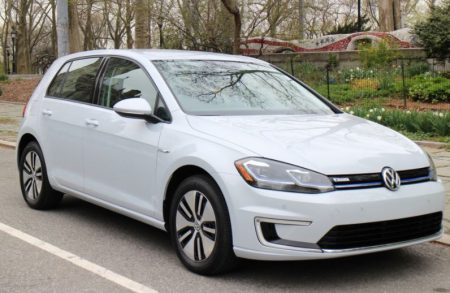
While the current model year is winding to a close, 2017 e-Golfs are just now reaching dealers in the handful of states where the compact electric car is offered for sale.
But with an EPA-rated range of 125 miles combined, the 2017 VW e-Golf now offers more range than any all-electric car that’s not a Tesla or a Chevy Bolt EV.
That’s a 50-percent increase over the previous model’s 83 miles, and significantly increases the practicality of the e-Golf for drivers with longer commutes—or those who live in areas with winter weather.
Two weeks ago, we spent a brief time behind the wheel of a 2017 e-Golf, though New York City traffic prevented any meaningful test of the car’s expanded range.
For that we’ll wait to get the electric Golf for a longer test.
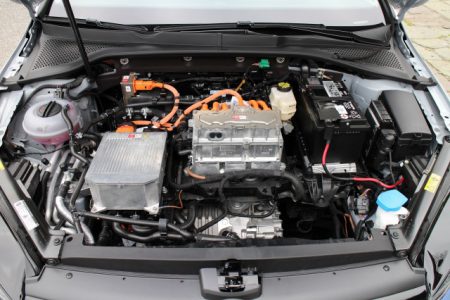
Meanwhile, what we can tell you is that the latest e-Golf is exactly what it was before: a Volkswagen Golf that happens to run on battery power.
What’s under the hood (and under the floor, rear seat, and cargo bay) may differ completely, but you’d never know it.
It’s so similar to conventional gasoline-powered Golfs that uninformed passengers might never catch on that it wasn’t simply the latest version of the 40-year-old hatchback classic.
As a result, our impressions of the longer-range VW e-Golf are essentially the same as those we had three years ago in testing its earlier iteration.
The 2017 e-Golf received a boost in its motor output, from 86 kilowatts (115 horsepower) to 100 kw (134 hp). Torque increased as well, from 199 to 214 lb-ft.
VW claims the acceleration from 0 to 60 mph is faster, at 9.6 seconds, which is a reduction of more than 1 second. To be honest, we couldn’t sense any difference, but it’s been three years.
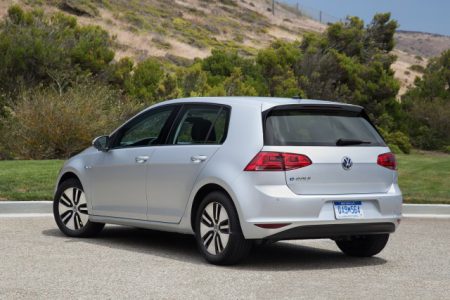
Reversing the car into parking spaces was as smooth as forward acceleration.
We noted no whine from either motor or power electronics under any circumstances, an impressive feat.
We smiled at the translation from German in the digital gauge clusters; in an e-Golf, it’s not “regeneration” but “recuperation.”
Otherwise, at the risk of disappointing those seeking decisive first-drive impressions … yep, it’s an electric Golf. Just as we expected, frankly.
Read more: Green Car Reports


