Monthly Archives: July 2016

EU dilutes proposal to halve air pollution deaths after UK lobbying

If implemented, weakened proposal means 14,000 people could die prematurely across Europe each year from 2030

EU states have agreed to water down a proposed law aimed at halving the number of deaths from air pollution within 15 years, after intense lobbying from the UK that cross-party MEPs have condemned as “appalling”.

Some 14,000 people will die prematurely every year across Europe from 2030 as a result, if the weakened proposal is implemented, according to figures cited by the environment commissioner, Karmenu Vella.

The revised proposal is likely to be rejected by the European parliament next week, setting the scene for a public row on 20 June, when Europe’s environment ministers meet to thrash out a compromise.

But EU diplomats said that the UK had been a key player in crafting a blocking minority to kill a more ambitious proposal to bring in measures that would result in a 52% improvement in pollution-related health impacts for citizens around Europe. This translates as a reduction in deaths from conditions such as stroke, heart disease and asthma.

One diplomat said:

“They [the UK] gathered some of the environmental attaches in Brussels who they thought would be most willing to follow their line and weaken the directive. They talked to big countries, such as France and Italy, and I think they also discussed with the strongest ones in eastern Europe, like Poland.”

Seb Dance, the Labour parliamentary group’s environmental lead, said the UK was

“a leading proponent of watering down the proposed target and [also] seems to be playing a leading role in the coalition of the unwilling”.

Read more: The Guardian
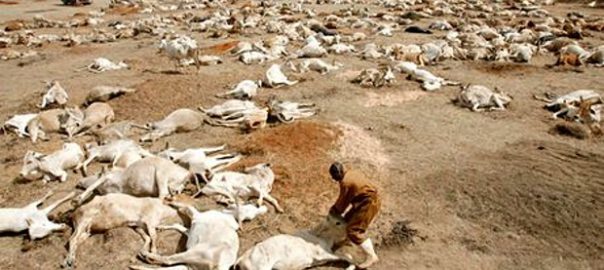
Climate Change Impact in Africa (Image: iPhoto)

Another Terrible Consequence Of Antibiotics In Farm Animals

In case you weren’t already convinced that overuse of antibiotics in livestock is a bad, bad, bad idea — a recent study offers a new reason to scale back on them: climate change.

Climate Change Impact in Africa (Image: iPhoto)

An international research team found that dung from cattle treated with a commonly used antibiotic gave off a little less than double the amount of methane of antibiotic-free dung. Their work was published Thursday in the science journal Proceedings Of the Royal Society B.

Scientists tested dung from 10 cows. Five of the cows received a three-day course of broad-spectrum antibiotic tetracycline, and five received none, Phys.org reports. Researchers then measured the dung’s outputs of carbon dioxide, methane and nitrous oxide, and found that the antibiotic course “consistently increased methane emissions.” Right now, the researchers aren’t sure exactly why the antibiotics have this effect.

Scientists also found that the antibiotics changed the types of microorganisms living within dung beetles that fed on the dung. That finding is important because it indicates that giving livestock antibiotics can affect other wildlife and not just the “target animal,” lead author Tobin Hammer told The Huffington Post in an email.

“In this case, dung beetle size and numbers were not affected — which is good, because these beetles are ecologically important,” Hammer said. However, it’s possible the drugs could influence the beetles in other ways that researchers didn’t examine, like behavior. He added that more work is needed to determine the various ways that different types of antibiotics could affect different animal species.

The new research comes after decades of experts warning that mass antibiotic use in livestock can and does lead to “superbugs” — bacteria that are totally resistant to antibiotics. As early as 1976, a Tufts University researcher found that when chickens received tetracycline, both the chickens and the farm workers handling them developed tetracycline-resistant bacteria within only a week.

Read more: Huffington Post

This Dutch town will grow its own food, live off-grid, and handle its own waste

It’s no secret that today’s aggressive agricultural techniques can take a heavy toll on the environment, both on the land used for crops and livestock, and in the surrounding atmosphere.

Architectural drawing of pilot project (Image: Effekt)

But a new vision of a more sustainable ‘integrated neighbourhood’ community is being implemented in the Netherlands, with the first of a series of high-tech farm villages set to be completed next year. The project, being built just outside of Amsterdam, is the brainchild of California-based developer ReGen Villages, and after its pilot community is finished in 2017, the company plans to bring the concept to Sweden, Norway, Denmark, and Germany.

Of course, communal farms aren’t exactly a new idea, with communities like the Amish people and more recent kinds of farming collectives having long lived off the grid. But we’re not talking about another attempt to recreate simple, pastoral living here.

ReGen Villages wants to harness the power of today’s technology to create “off-grid capable neighbourhoods” that provide the comforts of a regular modern lifestyle, but which are entirely self-reliant and sustainable: growing their own food, generating their own energy, managing waste locally, and recycling water.

“We’re really looking at starting off as the Tesla of eco-villages,” ReGen Villages CEO James Ehrlich told Adele Peters at Fast Company. “We are redefining residential real-estate development by creating these regenerative neighbourhoods, looking at first these greenfield pieces of farmland where we can produce more organic food, more clean water, more clean energy, and mitigate more waste than if we just left that land to grow organic food or do permaculture there.”

Read more: Science Alert

Nissan Leaf

New Nissan Leaf fuel included July 2016


Warning: preg_match(): Compilation failed: invalid range in character class at offset 4 in C:\inetpub\vhosts\fuelincluded.com\httpdocs\wp-content\plugins\maxbuttons\assets\libraries\simplehtmldom\simple_html_dom.php on line 1389

Warning: preg_match_all(): Compilation failed: invalid range in character class at offset 4 in C:\inetpub\vhosts\fuelincluded.com\httpdocs\wp-content\plugins\maxbuttons\assets\libraries\simplehtmldom\simple_html_dom.php on line 694

Warning: foreach() argument must be of type array|object, null given in C:\inetpub\vhosts\fuelincluded.com\httpdocs\wp-content\plugins\maxbuttons\assets\libraries\simplehtmldom\simple_html_dom.php on line 701

Warning: preg_match_all(): Compilation failed: invalid range in character class at offset 4 in C:\inetpub\vhosts\fuelincluded.com\httpdocs\wp-content\plugins\maxbuttons\assets\libraries\simplehtmldom\simple_html_dom.php on line 694

Warning: foreach() argument must be of type array|object, null given in C:\inetpub\vhosts\fuelincluded.com\httpdocs\wp-content\plugins\maxbuttons\assets\libraries\simplehtmldom\simple_html_dom.php on line 701

Fatal error: Uncaught Error: Attempt to assign property "href" on array in C:\inetpub\vhosts\fuelincluded.com\httpdocs\wp-content\plugins\maxbuttons\blocks\basic.php:171 Stack trace: #0 C:\inetpub\vhosts\fuelincluded.com\httpdocs\wp-content\plugins\maxbuttons\classes\button.php(382): MaxButtons\basicBlock->parse_button() #1 C:\inetpub\vhosts\fuelincluded.com\httpdocs\wp-content\plugins\maxbuttons\classes\button.php(476): MaxButtons\maxButton->parse_button() #2 C:\inetpub\vhosts\fuelincluded.com\httpdocs\wp-content\plugins\maxbuttons\classes\button.php(903): MaxButtons\maxButton->display() #3 C:\inetpub\vhosts\fuelincluded.com\httpdocs\wp-content\plugins\maxbuttons\classes\maxbuttons-class.php(525): MaxButtons\maxButton->shortcode() #4 C:\inetpub\vhosts\fuelincluded.com\httpdocs\wp-includes\shortcodes.php(434): MaxButtons\maxButtonsPlugin->shortcode() #5 [internal function]: do_shortcode_tag() #6 C:\inetpub\vhosts\fuelincluded.com\httpdocs\wp-includes\shortcodes.php(273): preg_replace_callback() #7 C:\inetpub\vhosts\fuelincluded.com\httpdocs\wp-includes\class-wp-hook.php(324): do_shortcode() #8 C:\inetpub\vhosts\fuelincluded.com\httpdocs\wp-includes\plugin.php(205): WP_Hook->apply_filters() #9 C:\inetpub\vhosts\fuelincluded.com\httpdocs\wp-includes\post-template.php(256): apply_filters() #10 C:\inetpub\vhosts\fuelincluded.com\httpdocs\wp-content\themes\twentythirteen\content.php(43): the_content() #11 C:\inetpub\vhosts\fuelincluded.com\httpdocs\wp-includes\template.php(812): require('...') #12 C:\inetpub\vhosts\fuelincluded.com\httpdocs\wp-includes\template.php(745): load_template() #13 C:\inetpub\vhosts\fuelincluded.com\httpdocs\wp-includes\general-template.php(206): locate_template() #14 C:\inetpub\vhosts\fuelincluded.com\httpdocs\wp-content\themes\twentythirteen\archive.php(42): get_template_part() #15 C:\inetpub\vhosts\fuelincluded.com\httpdocs\wp-includes\template-loader.php(106): include('...') #16 C:\inetpub\vhosts\fuelincluded.com\httpdocs\wp-blog-header.php(19): require_once('...') #17 C:\inetpub\vhosts\fuelincluded.com\httpdocs\index.php(17): require('...') #18 {main} thrown in C:\inetpub\vhosts\fuelincluded.com\httpdocs\wp-content\plugins\maxbuttons\blocks\basic.php on line 171