Your monthly energy bills can get quite expensive, especially during the summer. You need lots of energy to stay cool and power your electronics, but buying your energy from an outside company isn’t always the most efficient or cost-effective.
Start-up Orison is an at-home battery system that comes in form of a plug-in unit that looks like a lamp (Image: Orison)
That’s where at-home batteries come in.
Combined with advancements in solar technology, these large batteries have the potential to provide a whole new way to store and control the energy used in your home.
It’s for that reason that an increasing number of companies are working on at-home batteries to change the modern home into a sustainable vision for the future.
Here’s 9 at-home battery makers on the market today.
We would be remiss to make a list of at-home battery makers and not include Tesla toward the top. The $3,000 Powerwall can store solar energy and provide backup power for your home.
To help fight climate change, France’s Total commits to leaving some fossil fuels in the ground.
The sun sets on drilling (Image: Pexels)
One of the world’s biggest oil companies is factoring global goals for combating climate change into its multi-decade business plan.
French oil giant Total acknowledged in a report released Tuesday that “a part of the world’s fossil fuel resources cannot be developed” if nations are to fulfill the Paris climate accord agreement to hold global temperature increases to 3.6 degrees Fahrenheit.
The company stood by a 2015 decision to reduce investments in oil production from Canadian tar sands, adding that it confirmed at that time “that we do not conduct oil exploration or production operations in the Arctic ice pack.” Total first announced its position on Arctic drilling in 2012, according to Reuters.
Total’s leaders are “trying to link their strategies and investments to climate decisions,” said Alexander Shestakov, the director of the World Wildlife Fund’s global Arctic program.
“That’s a positive sign coming from one of the world’s oil majors.”
Plans to introduce subsidy this July for businesses installing charging points at work premises
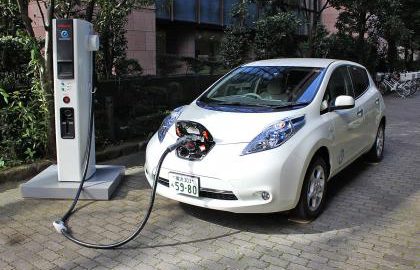
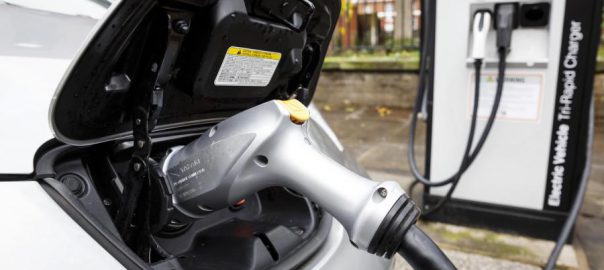
Nissan Leaf rapid charging
The Government is planning to boost electric vehicle uptake by introducing a grant for business charging points this summer.
Auto Express understands a workplace charging grant will be set up with a formal announcement likely in July. There’s no confirmation on how much the grant will be for but it’ll support companies wanting to set up charging points at offices and car parks.
David Martell, CEO of charging point specialist Chargemaster, revealed: “We have been informed that there is likely to be a workplace charging grant established this summer by the government. “It hasn’t been decided exactly how much the grant will be, but certainly there will be support by the government putting in charging points in work premises.”
And while a spokesman for the Department for Transport and the Office for Low Emission Vehicles did not confirm plans for the grant, he said:
“Watch this space. Fitting charge points in workplace car parks is a huge opportunity. We know there is an appetite out there from businesses.”
How much will electric vehicles slow carbon emissions?
(Image: Y. Yin/Greeenpeace)
Each passing month breaks modern temperature records, citizens perish in 51°C heat in India, unseasonal fires rage in the Canadian tar sands, methane escapes from arctic permafrost, Earth approaches the +1.5°C Paris Accord “goal,” and hoping to stop at +2°C appears increasingly naive.
As we observe these trends, we feel an urgent desire for solutions to global warming unleashed by human CO2 emissions. Automobile companies have finally adopted the electric vehicle (EV), led by Tesla Motors and founder Elon Musk, cult hero for technology-inspired optimism.
As serious ecologists, we may reasonably ask: Will EVs slow carbon emissions, and by how much? A genuine answer requires rigorous investigation, calculation and analysis. The general public may be forgiven for avoiding any such analysis, but as ecologists, we are obliged to know what we’re talking about. Good scientists observe the principle to “beware congenial conclusions.”
As we investigate this analysis, we will find that genuine solutions exist, although they may not be the easy solutions we hope for.
Even if you work the auto industry, you probably didn’t expect the current rush to develop, build, sell, and drive electric vehicles.
UK motorists now have more than 30 electric models to choose from
But there’s no denying it. A series of technology developments, market disruptions, and wake-up calls are hastening an inevitable shift from fossil fuel engines to electric power in cars and trucks, according to a post on TechCrunch.
Battery technology is the greatest enabler of the shift to fully electric-powered vehicles. Lower electricity cost means less expensive cars. With range anxiety now a “thing” and a common deterrent to full-electric car purchases, larger capacity batteries are needed for adequate driving range. The cost of lithium-ion battery power has dropped by about 80 percent in the last eight years. One kilowatt of power that cost roughly $1,000 in 2008 is now closer to $200. Continued battery technology advances plus the impending construction of huge new battery factories could bring prices down to $100 per kilowatt in the next few years.
Autonomous vehicle technology is developing hand in hand with the switch to electrification. Auto manufacturers are working fast to develop autonomous capabilities just to stay up with their competitors. Combining hybrid and all-electric power with autopilot and auto-assist features gives manufacturers showcase platforms.
The four main political parties in Norway are debating a ban on fuel-powered cars; we look at how other countries are tackling harmful car emissions
Charging at a rapid charger (Image: Go Ultra Low)
Norway is considering a ban on petrol and diesel cars by 2025 with the four primary political parties debating the action, according to Norwegian newspaper Dagens Næringsliv.
The new law has not officially been passed, but it has been put forward in a white paper, which calls for new private cars, buses and light commercial vehicles to be zero-emission after 2025.
Electric car sales account for around 24% of Norway’s new car market, making it one of the leading countries for electric car sales, but it’s also one of the world’s largest oil exporters.
The Dutch Labour party PvdA is also pressing for a ban on petrol and diesel cars in the Netherlands from 2025.
European leaders have been talking about such a ban for many years – insiders have suggested Paris will be the first city to implement a zero-emissions-vehicle-only zone within its boundaries – but if they were to be introduced, the Norwegian and Dutch policies would be the first complete ban on combustion-engined vehicles.
After five years, 30 million miles and £2.5 million pounds worth of free travel – Ecotricity will finally begin charging electric car drivers for using Britain’s most comprehensive car charging network – the Electric Highway.
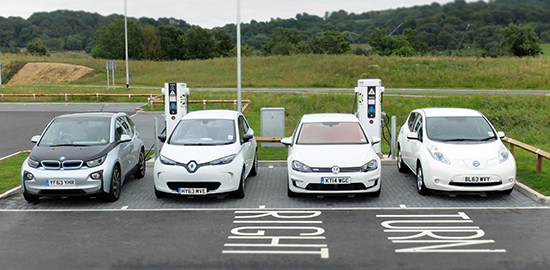
A row of electric cars at a rapid charger station (Image: Ecotricity)
The almost 40,000 members of the Electric Highway will need to download a new mobile phone app to make payments, which will have the added functions of a ‘live feed’ of the entire network, so users can see the location and availability of their nearest pump, making it easier for you to plan your journeys.
The Electric Highway is the most comprehensive car charging network in Europe, with nearly 300 ‘Ecotricity Pumps’ across Britain which enable electric car drivers to travel the length and breadth of the country using nothing but renewable energy. Up until now it’s been the only charging infrastructure in Britain that was available completely free of charge. It currently powers around two million miles a month and has powered more than 30 million miles since 2011.
The usage trebled in 2015 and it has been so successful in encouraging the uptake of electric cars that it is now necessary to start charging for the service in order to maintain and grow the network.
A new mobile phone app will replace the current card system, which will be available for Apple and Android devices and will enable users to manage their accounts, pay for charging and check the status of chargers all in one place.
The switch to charging will be manually implemented at all charging points, with work starting on 11 July and expected to be completed by Friday 5 August. This will mean that the changeover to the app payment system will be gradual, with some chargers continuing to work via the free card system later than others.
Ecotricity believes that by 2030 every new car should be electric (pure or hybrid), and that by 2040 they should be the only cars on the road.
Electric Highway facts and stats, as of 31st May 2016:
The first Electric Highway pump was installed on 27 July 2011
Ecotricity has since installed a total of 296 Electric Highway chargers, of which 276 are rapid chargers
There are Electric Highway chargers across 96% of the British motorway network
The network stretches from John O’Groats to Land’s End. Jonathan Porterfield and Chris Ramsey were the first drivers to travel the length of the country only using public charging points – a round trip that took 27 hours and 46 minutes in September 2015 and relied almost entirely on the Electric Highway
The Electric Highway has powered a total of 30 million miles totally free of charge
May 2016 was the busiest month of all time on the network. During the month, the Electric Highway powered 2,170,625 miles with 10,121 customers powering their cars with 347.3MWh of electricity through 43,211 separate charges. That’s the equivalent of having a car charging during every minute of every day throughout the month
38,537 customers currently hold Electric Highway cards
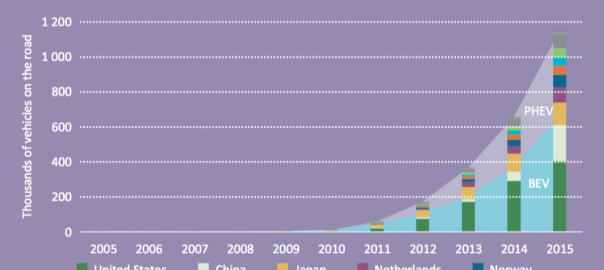
In 2015, the number of electric cars on the road globally passed the one million threshold for the first time.
Global Electric Car Stock: PHEV stands for plug-in hybrid vehicles, and BEV stands for battery electric vehicles (Image:: IEA)
The rapid growth of the industry means that it is now the only technology sector on track to meet the International Energy Agency’s (IEA) 2C scenario.
This is the conclusion of the IEA’s Energy Technology Perspectives 2016 report, which it released on Wednesday. This is the latest edition of their annual progress review of the technologies that will determine the rate of global emissions, including renewables, nuclear, CCS and coal.
Last year’s report, covered by Carbon Brief, painted a bleak picture. It deemed that none of the 19 technologies it tracks had made the necessary progress to limit global temperature rise to below 2C. It said that five technologies were off track, while the remaining 14 were failing to improve fast enough.
One year on, its assessment is equally bleak. The number of technologies off track has risen to six, while 11 are failing to improve fast enough. Only electric vehicles have made to jump towards actually being on track to meet the 2C goal modelled by the IEA.
Nissan has switched on a new solar farm at its plant in Sunderland, its biggest manufacturing site in Europe, and the latest landmark in the company’s journey towards Intelligent Mobility.
The installation comes as Nissan celebrates 30 years of manufacturing in the UK
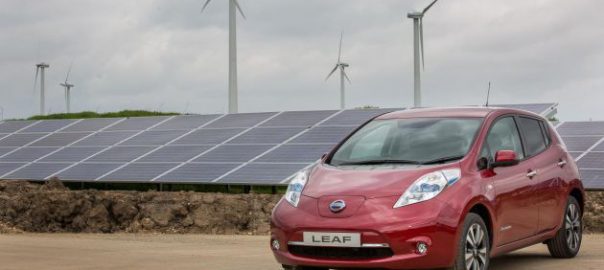
Made of up 19,000 photo-voltaic panels, the new 4.75 MW facility is now fully operational at the Sunderland Plant, as Nissan strives towards its twin goals of zero emissions and zero fatalities.
The solar farm has been installed alongside 10 wind turbines already generating clean power for the manufacturing facility in the North East, the European centre of production for the all-electric Nissan LEAF and its batteries.
Colin Lawther, Nissan’s Senior Vice President for Manufacturing, Purchasing and Supply Chain Management in Europe, said:
“Renewable energy is fundamental to Nissan’s vision for Intelligent Mobility.
“We have built over 50,000 Nissan LEAFs in Europe, and the industry-leading new 250 km-range LEAF is now available. With 10 wind turbines already generating energy for our Sunderland plant, this new solar farm will further reduce the environmental impact of Nissan vehicles during their entire lifecycle.”
Nissan began integrating renewable energy sources in Sunderland in 2005 when the company installed its first wind turbines on site. These 10 wind turbines contribute 6.6 MW power, with the 4.75 MW solar farm bringing the total output of renewables to 11.35 MW in Sunderland. This equates to 7% of the plant’s electricity requirements, enough to build the equivalent of 31,374 vehicles.
The solar farm has been developed and installed within the loop of Nissan’s vehicle test track in Sunderland by partner company European Energy Photovoltaics, with 100% of the electricity generated to be used by Nissan.
Its installation comes as Nissan celebrates its 30th anniversary of manufacturing in the UK, having become the biggest UK car plant of all time and now supporting nearly 40,000 jobs in Britain in vehicle design, engineering, production, parts distribution, sales and marketing, dealer network and supply chain.
Pursuing a goal of zero emission vehicles and zero fatalities on the road, Nissan’s Intelligent Mobility vision is designed to guide Nissan’s product and technology pipeline, anchoring critical company decisions around how cars are powered, how cars are driven, and how cars integrate into society.
Other Nissan initiatives recently announced concerning electric vehicles and next generation battery technology include: a future generation of electric vehicle batteries for the UK battery plant; a major vehicle-to-grid trial in the UK that will see Nissan EVs supplying the UK’s National Grid; and a revolutionary new residential energy storage system called xStorage.
As electric vehicles gain popularity, more homeowners and real-estate developers are adding this relatively low-cost amenity
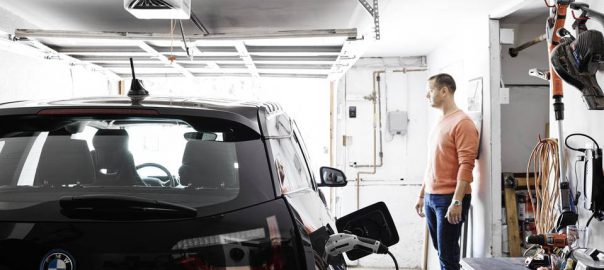
Eric Brassard charges his new BMW i3 electric car in his garage (Image:: J. Schmelzer/WSJ)
Self-described “car guy” Eric Brassard recently paid $846,000 for a two-bedroom, two-bathroom home in the Silver Lake area of Los Angeles. One big draw: It was wired to allow a charging station for vehicles.
The 29-year-old TV-development executive didn’t even own an electric car. But after his move in April, he leased a BMW i3—then bought a charging station for it on Amazon for less than $500.
“There’s something about it that has a total cool factor to me,” he said of his car.
Several of his neighbors have electric cars in their driveways, he added.
When Arjan Dijk built his home in 2014, he felt he should make it “as good as it gets for the environment.” Now under contract and last listed for $3.75 million, the San Francisco three-bedroom with a one-bedroom cottage has many green features: solar panels, low-energy appliances, a high-efficiency boiler. There is also a charging station in the garage where the 45-year-old technology executive can juice up a car.
The two homeowners are among a growing number of home buyers and developers installing charging equipment at home. It is a relatively low-cost amenity that appeals to tech lovers, committed greens and car aficionados. New condominium developments across the U.S. also are including them.
“I would not build a residential project today without providing for a charger for electric vehicles,”
said Aldo Pascarella, 48, a real-estate lawyer who developed a townhouse in Greenwich, Conn., with a charging station in 2012.