Monthly Archives: April 2015

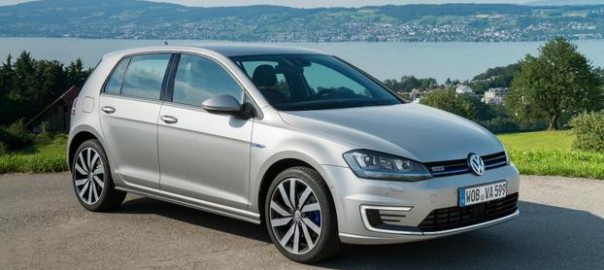
Volkswagen Golf GTE (Image: VW)

Volkswagen Leads Plug-In Electric Car Sales In Europe

Europe, with over 9,500 plug-in electric car sales in January 2015, far exceeded the US’ result of 5,924.

This year began especially strong for Volkswagen, which seems to now be most popular brand among plug-in electric car buyers.

We are not sure if VW will be able hold onto the #1 spot, but in January the automaker delivered over 2,300 cars (Golf GTE, e-Golf and e-up!) and some 2,800 if we include the whole VW Group (Audi and Porsche).

In second place is Nissan Tesla Renault Mitsubishi! Outlander PHEV had almost 2,000 sales, and with i-MiEV added in the result stood at nearly 2,100.

Nissan, combined with Renault (below 2,000), is at similar level, but only if we include Twizy.

Both BMW and Tesla are down in the hundreds range.

Well, Volkswagen might’ve come to the party late, but as a Group it’s moving forward to quickly become the sales leader in Europe.

Source: EV Sales Blog via Inside EVs

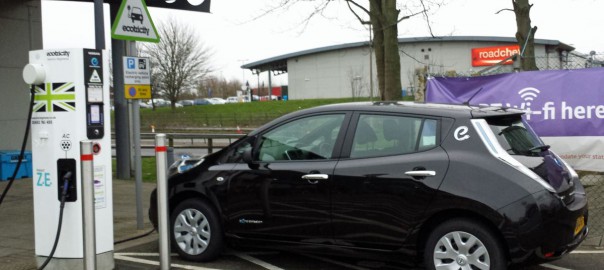
Charging the Nissan Leaf at an Ecotricity Rapid Charger (Image: T. Larkum)

Getting Familiar with the Nissan Leaf

The most popular car we supply is, naturally, the Nissan Leaf – the most popular electric car in the UK and, in fact, the world. However, being a Renault ZOE driver, it is relatively unfamiliar to me. I’ve only driven it twice, once way back in 2012 and the second time more recently during the test drive day last December.

For a while I felt I ought to become more familiar with the Leaf and, having joined the e-Car Club, it seemed like the Club gave the perfect opportunity. I therefore decided on a free afternoon to book a Leaf from the Club for a couple of hours (it costs £6 per hour) and to take it for a spin.

There are three Leafs permanently parked up in Northampton town centre, close to the Derngate Theatre. They are connected to charge points so they are always ready for use. Having booked one online I went to pick it up, and that’s when things went a bit wrong.

e-Car Club Nissan Leafs outside Northampton Derngate (Image: T. Larkum)

The website gave instructions for unlocking the car which worked fine – you just need to use your access card on the windscreen sensor. However, it didn’t give clear instructions on the process for releasing the immobiliser – in fact, I didn’t even know there was one. Being unfamiliar with the Leaf things seemed to be going fine: it appeared to power up and then reverse gently out of its parking space. What I didn’t realise was that there was actually no power to the drivetrain and it was just rolling backwards down the slope from the pavement.

After an embarrassing time getting pushed to the kerb by passers-by I investigated further and found a PIN-machine in the glove box. Once given the correct number the drivetrain came to life and we were ready to go. I later found out that there were detailed instructions in a log book folder in the passenger door pocket.

Charging the Nissan Leaf at an Ecotricity Rapid Charger (Image: T. Larkum)

First of all we just took a quick trip back home, and then headed out for a longer run. I took it up and down the motorway for a while to get its charge level below 80%. That gave me the chance to try out a fast charge at Rothersthorpe Services (at Junction 15A of the M1). I found the Chademo connector very fiddly and it took a couple of attempts before I was comfortable inserting it correctly and getting the charge to work. I was also caught out by the fact the dashboard screen needs to be powered down to accept a charge (and you can monitor it by blue LEDs on the top of the dash). This is in contrast to the ZOE where you monitor the charging through the dashboard screen.

Anyway, learning about these issues and the differences from the ZOE was precisely the point of the exercise so I deemed it a success. After this time spent with the Leaf I felt much more comfortable driving and charging it, and felt ready to undertake a long journey in one.

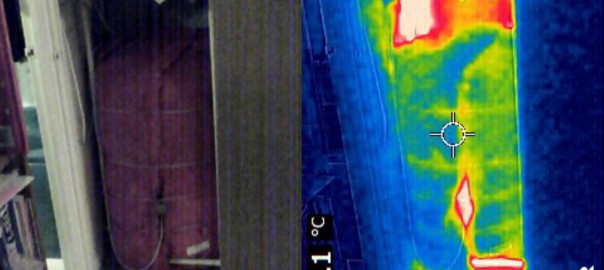
Figure 2: Composite image of hot water tank after insulating (Image: T. Larkum)

Using an Infrared Camera to Look for Wasted Energy – Part 2

Having used the FLIR camera to do an audit around the house I wanted to try a project where I could use it for a ‘before and after’ comparison. Since I only had a limited time before returning the camera, the project had to be fairly small. I decided on adding an insulating jacket to the hot water tank in our airing cupboard – something I had been meaning to do for some time.

Figure 1 is the ‘before’ image showing the tank with its integral white foam insulation layer. In the IR image we can see that the tank shows up very hot in bright yellow and orange. We can also see a large amount of hot air above it, plus the hot pipes going into it show up white.

Figure 1: Composite image of hot water tank before insulating (Image: T. Larkum)

Figure 2 is the ‘after’ image showing the red insulating jacket I had tied around the tank – a standard jacket bought at a local DIY superstore for about £15. In the IR image we can see that the tank now shows up much cooler, mostly blue and green with some yellow patches. There is less hot air above it, while the hot pipes going into it still show up white – I’m planning to insulate those next. An intentional gap in the jacket around the thermostat can also be seen showing up in white.

Figure 2: Composite image of hot water tank after insulating (Image: T. Larkum)

Use of the FLIR camera clearly indicates the significant benefit of even this simple insulation project, with much less heat being lost from the hot water tank. This is confirmed by our experience in the following days that the hot water became noticeably hotter than it used to be so I was able to turn down the temperature on the thermostat, and so save money as well as waste.

Source London repair deal reached

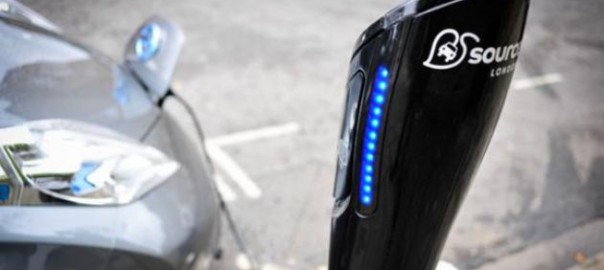
Bluepoint London, the operator of Source London since September 2014, has announced that it has finalised an agreement with Transport for London (“TfL”), the London Borough of Sutton and the London Borough of Southwark.

The agreement makes Bluepoint London responsible for the management of an initial 60 electric vehicle (EV) charge points, which represents 13% out of the 460 charge points in London boroughs as part of the scheme.

Next Green Car’s sister site, Zap-Map reported in September 2014 that almost a third of Source London points were offline. The new agreement will ensure these points are fully functional and compliant with EU standards as well as overseeing any necessary repairs for the benefit of the growing number of EV users across London.

Since taking over from TfL, Bluepoint London has undertaken an in-depth audit and will start implementing a live monitoring solution for all charge points which were part of the scheme. This agreement will start the deployment of a mobile maintenance team to assess the faults and start the necessary works. In the future, the points in the London Boroughs of Sutton and Southwark, as well as the TfL charge points, will now be serviced regularly to minimise faults and downtime.

In due course, other boroughs will be announced and, in consultation with local authorities, new charge points will supplement the network to ensure greater coverage and availability. By 2018, Bluepoint London’s target, via the Source London scheme, is to have 6,000 charge points under management across London to oversee the growth of electric cars in London.

Christophe Arnaud, Director of Bluepoint London, said:

“We are delighted to be responsible for these 60 EV charge points in London. This means we are finally in a position to offer electric vehicle users in the London Borough of Southwark and the London Borough of Sutton a better charging infrastructure and experience. This agreement is a key step in providing all Londoners with a sustainable alternative to traditional transport means.

“A better maintained and more extensive charging infrastructure will mean more drivers are able to use electric vehicles and join the early-adopters who are already helping London reach lower emissions level. We are very excited to be playing our part.”

Councillor Mark Williams, Cabinet member for regeneration, planning and transport, London Borough of Southwark, said:

“We fully support sustainable transport so welcome the opportunity to work with Bluepoint London to improve the management of electrical vehicle charge points locally. With better maintenance, we want more people to switch from petrol and diesel to electric cars.

“This will help reduce harmful emissions and improve air quality not just in Southwark but across the capital. Over 120 people die prematurely each year in our borough due to air pollution and we must do all we can to eliminate this silent killer.”

Source: Next Green Car

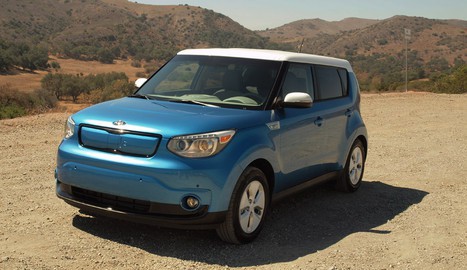
2015 Kia Soul EV Plus (Image: John Matras Media LLC)

Kia Soul EV wins Motoring TV 2015 ‘Best Electric Car’

  • Kia Soul EV claims Motoring TV 2013 ‘Best Electric Car’
  • Soul EV wins second Canadian award to date

MISSISSAUGA, ON, March 2, 2015 /CNW/ – Kia’s first all-electric vehicle launched in Canada has been awarded Motoring TV’s 2015 ‘Best Electric Car’. The 2015 Soul EV secured this win by finishing ahead of challengers like the Nissan Leaf and the Smart Fortwo Electric DriveElectric respectively.

“Receiving this prestigious award from such a distinguished group of automotive journalists at Motoring TV reaffirms how well this vehicle has been received by Canadians”

said Maria Soklis, Vice President and Chief Operating Officer (COO), Kia Canada Inc.

“Class leading range and complete utility without compromise similar to its gasoline sibling is an advantage that the Soul EV has to offer to Canadians in an urban environment.”

“The Kia Soul EV redefines what is to be expected of the next-gen electric car. It has more than acceptable range and does not sacrifice flexibility to be green” said Graeme Fletcher, “Unlike so many electric cars the Soul EV’s range is real and not something based on theory. I drove a Soul EV for 162 kilometres and it still had 25% left in the battery at the end of the drive.”

This is the second Canadian award that the Soul EV has won since its launch late last year. In December, Kia Canada was presented an Automobile Journalists Association of Canada (AJAC) Car of the Year category award winner of the “Best New City Car” award by AJAC. This award from Motoring TV marks the 9th award that Kia has received over the last five years to include back to back wins with Motoring Car of the Year in 2011 and 2012 with the Kia Sportage SUV and the Kia Optima mid-size sedan winning respectively.

SOURCE KIA Canada Inc.

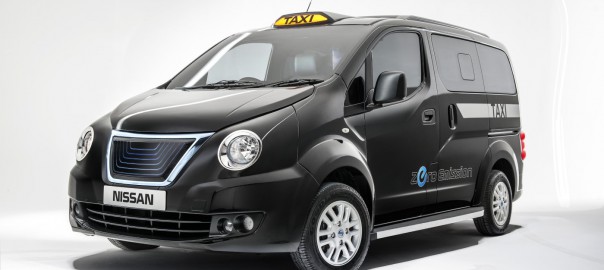
Nissan e-NV200 Black Taxi Cab for London (Image: Nissan)

Nissan e-NV200 Electric London Taxi Revealed

[From January 2014]

You might be unfamiliar with the name LTI TXII, but if you’ve ever visited London you’ve probably traveled in one at some point.

It’s best known as London’s black cab or ‘Hackney Carriage’, and it’s known the world over for its iconic shape. Nissan has incorporated the black cab’s famous face onto its new London taxi–with limited success. But the real story is the electric version, which makes its debut in 2015.

Current London cabs already have a strong connection to Nissan. Towards the end of its life, the old Austin FX4 cabs used 2.7-liter Nissan diesel engines to power them around the city, and until recently a Nissan unit also powered the existing TXII. But all have been diesel, and in its crackdown against inner-city emissions–London is one of the most polluted in Europe–diesel taxis are falling out of favor.

The NV200 van, also used in New York as the ‘Taxi of Tomorrow’, will debut in London with a 1.6-liter gasoline engine and automatic gearbox to reduce oxides of nitrogen and particulates. The cab also includes some of the features found in the New York version, such as a panoramic glass roof to let fares admire the scenery.

It should be more pleasant to drive, too–current London cabs aren’t designed for a comfortable driving environment. London versions are unique among NV200s, getting an extra-tight 25-foot turning circle. This is required for all Hackney Carriages and is based off the tight entrance roundabout at the Savoy Hotel.

In 2015, an electric version of the cab will appear, based on the e-NV200 Nissan has showcased over recent years. Using a Leaf-derived drivetrain, it’ll cut those local emissions down to zero, and reduce running costs. The electric taxi will hit the streets five years before the London Mayor’s target of 2020.

Nissan e-NV200 Black Taxi Cab for London (Image: Nissan)

Whether residents will get used to the new taxi’s face though is another matter. The NV200 is already an acquired taste–one New Yorkers will have to get used to replacing the iconic Crown Vic taxis. But equipped with a chrome grille and round headlights, designed to echo the existing cabs, we aren’t sure London’s streets will be easier on the eye…

Source: Green Car Reports

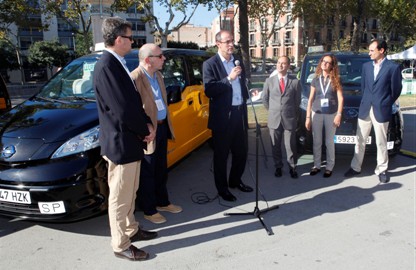
Nissan delivers first all-electric taxi to Barcelona (Image: Nissan)

Nissan delivers first all-electric taxis to Barcelona and Madrid

[From October 2014]

NISSAN DELIVERS FIRST ALL-ELECTRIC TAXIS TO BARCELONA AND MADRID

  • Delivery marks significant milestone in the expansion of zero-emission transportation to Europe’s city centres

Madrid and Barcelona (Tuesday 21st October) – The era of the 100% electric taxi has arrived to Spain’s two largest cities, as Nissan delivered its first 100% electric taxis to Madrid and Barcelona. The introduction the Nissan electric vehicles – the Nissan LEAF to Madrid’s taxi fleet, and the e-NV200 taxi for Barcelona – brings the option of quiet, zero-emission travel to these bustling city centres.

The Barcelona deliveries served as an important step in the execution of an agreement between Nissan, the City of Barcelona, and the Barcelona Metropolitan area which brings the Barcelona-built e-NV200 to the streets of the city where the revolutionary electric van is produced.

Jean-Pierre Diernaz, Director of Electric Vehicles for Nissan Europe, welcomed the news, commenting:

“Declining air quality levels are a top concern across Europe and it’s great to see Madrid and Barcelona taking such positive steps in improving air quality through the incorporate of Nissan’s all-electric cars into their taxi fleets. These taxi bring a huge benefit not only residents but also for the drivers – thanks to the ultra-low running costs only an electric car can offer. This scheme demonstrates that sustainable transportation is easy and affordable for everyone.”

These initiatives reinforce Nissan’s continued commitment to electric vehicles as the market continues to develop. September was also the month in which 2014 sales of the pioneering family hatchback passed the 2013 total, with three months still to go.

Madrid:

Madrid has now its first 100% electric Nissan LEAF taxi, the best-selling electric vehicle in the world with more than 142,000 units sold globally. The event was held at Puerta del Sol in Madrid, where the “Zero KM” the measuring starting point of all the Spanish roads is located.

Antonio Berzal Prieto, the first 100% electric taxi driver in Madrid to choose electric technology for his business, declared

“When I heard that the Nissan LEAF had been approved as a taxi for the city, I quickly looked into all the options it offered me. In addition to the environmental benefits, the costs of ownership are highly competitive and the car’s performance is excellent.”

Barcelona:

The delivery of the first three Nissan e-NV200 Taxis took placed during the Expo-electric Formula-e event, one of the most important meetings on sustainable mobility in Europe. Marco Toro, Nissan Iberia Managing Director and Antoni Vives, Deputy Mayor for Urban Habitat at Barcelona City Council, attended the event

The development and introduction of these first three e-NV200 Taxis units is part of the Memorandum of Understanding signed last year between Nissan, the Barcelona City Council and the Barcelona Metropolitan Area, which set out a number of different and significant measures to promote and to sustain the rollout of sustainable mobility in Catalonia Region. The e-NV200 began production in Barcelona in May, with the Catalan city building the electric commercial vehicle for the global market.

Source: Nissan Newsroom
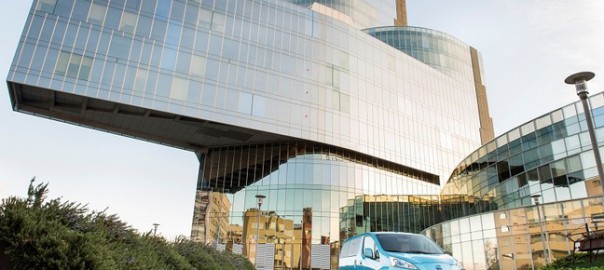
Nissan e-NV200 Electric Van (Image: Nissan)

Taxi Electric is first to use Nissan’s e-NV200 taxi in Amsterdam

[From May 2014]

  • This summer Taxi Electric becomes the first taxi company in Amsterdam to adopt the zero-emission Nissan e-NV200
  • Taxi Electric first 100% Nissan LEAF fleet since November 2011
  • Pioneering Amsterdam-based company have covered 1.5 million km demonstrating Nissan EVs’ quality and reliability

AMSTERDAM, Netherlands – Taxi Electric will be the first private taxi company to add the new 100-percent electric Nissan e-NV200 taxi to its green-energy zero-emission fleet.

The combination of Nissan’s innovative zero-emission technology, in the form of the 100-percent electric Nissan LEAF, and Taxi Electric’s ground-breaking city transportation model have been a recipe for success since the start of operation in 2011. Now the two companies have teamed up again to build on this success and take the next step forward by introducing the game-changing all-electric Nissan e-NV200 taxi this summer.

Nissan e-NV200 Electric Van (Image: Nissan)

Amsterdam-based Taxi Electric operates a fleet of 25 Nissan LEAF vehicles. It was the first private taxi service to switch to a fleet of 100% electric taxis in 2011. The Dutch company’s fleet of Nissan LEAFs has now amassed a trouble-free 1.5 million km in taxi operations – proof of the electric vehicle’s high quality and reliability.

Andy Palmer, EVP Nissan said:

“Taxi Electric was one of the first electric taxi companies in the world, and I’ve been impressed with their progress since their launch two years ago. They were the first to prove that zero-emission taxis – in the form of Nissan LEAFs – are a viable alternative. They have covered an astonishing distance in their fleet in such a short time and have shown just how reliable our electric technology is in a demanding environment. Their pioneering spirit closely matches ours, and we are certain they will continue their success with the ground-breaking Nissan e-NV200.”

Ruud Zandvliet, founder of Taxi Electric added:

“Two years ago we started with 10 Nissan LEAFs. Each of these travelled well over 100,000 km and proved to be extremely reliable. Since last summer demand for our taxis is growing rapidly, which allowed us to double our fleet. We are very excited about the e-NV200 as it is designed to be a taxi. This will improve our offering and open new business opportunities for us.”

Taxi Electric will not be alone in making the Nissan e-NV200 part of their taxi fleet, with the city of Barcelona having signed a memorandum of understanding with Nissan to promote it as a taxi for the Spanish region. Global production of the Nissan e-NV200 begins in May this year, with sales starting in the summer.

Source: Nissan News