Daily Archives: December 8, 2014

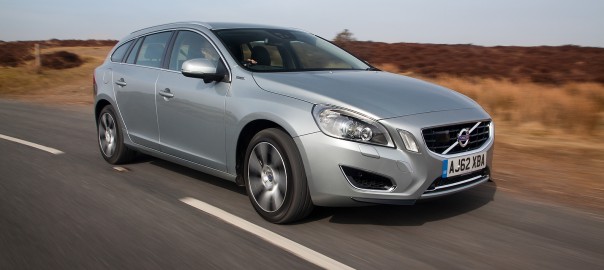
The V60 Plug-In Hybrid features a 2.4-litre diesel engine and an electric motor (Image: Autocar)

Volvo V60 Plug-In Hybrid first drive review

What is it?

The Volvo V60 Plug-in Hybrid sports a 212bhp 2.4-litre turbodiesel driving the front wheels and a 69bhp electric motor driving the rears. It can travel up to 31 miles in pure electric mode.

In Ehybrid mode, the diesel and electric motors combine to deliver the most efficient progress. Or if you’re feeling a bit frisky, select Epower mode and the diesel and electric motors deliver everything they’ve got in the name of performance.

In hybrid or even pure electric mode, if your right foot demands more power than the battery can deliver on its own, the diesel fires up. However, if you treat the throttle as though there’s a hand grenade trapped under it, you can actually top out at 78mph on electricity alone.

What is it like?

Volvo has done a great job of improving the V60’s refinement, which was reportedly a bit rough in earlier prototypes. Now, the transition between pure electric motoring and diesel fire-up is almost imperceptible.

The official fuel economy figure is 155.2mpg. Volvo isn’t for one moment suggesting that the average buyer will get that in the real world, although if you do an inner-city commute of less than 30 miles a day you might be able to get a pretty amazing return. I got 32.7mpg during my time with the V60, which included some very hard miles (not real-world, either), so that’s actually better than it looks. For the record, 0-60mph takes 5.8sec.

Less good is the V60’s ride quality. Very firmly suspended and riding on low-resistance tyres with stiff sidewalls, the V60’s ride around town is just too harsh over broken surfaces.

Power mode is good fun, but the V60 Hybrid’s extra 250kg compared with the non-hybrid equivalent makes itself felt during fast changes of direction; it’s like having two Johnny Vegases in the car with you. The handling balance does feel surprisingly neutral, though, and the hybrid V60’s weight distribution of 55 per cent front and 45 per cent rear is actually better than the regular car’s.

Should I buy one?

So does this rather special V60 make sense? Well, leaving apart the poor ride quality, even Volvo management admits that if you do a highish mileage this isn’t the car for you. On a long motorway run, you’re basically driving a diesel Volvo with a bit of a weight problem.

But if you have that short city commute, travel into central London (no congestion charge) and like the sound of low benefit-in-kind charges, it’s possible that the V60 could work for you.

However, for the vast majority of us that probably won’t be the case, and even after the £5000 Plug-in Car Grant this is still a £43,775 car – nearly £5000 more than the most expensive non-hybrid D5 V60. That’s reason enough to explain Volvo’s cautious forecast of just 150 sales this year.

Source: Autocar 2013
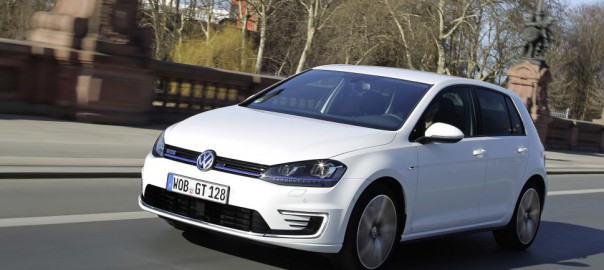
Volkswagen Golf GTE (Image: Evo)

Volkswagen Golf GTE review and pictures

What is it?

The Volkswagen Golf GTE is a plug-in hybrid version of the perenially popular family hatchback. As the badging suggests though, this is no hair-shirt rival to cars like the Toyota Prius Plug-In.

Volkswagen instead bills the GTE as the third member of its Golf GT family, joining the petrol Golf GTI and diesel Golf GTD. Knowing what we do about those models, that billing suggests this new car will be a keen performer and a fun, engaging hot hatch in a demonstrably grown-up sort of way.

Technical highlights?

The internal combustion engine is a 1.4-litre, four-cylinder turbo petrol unit, good for 148bhp, and the gearbox is a six-speed DSG. The 75kW (101bhp) electric motor sits between the two and drives through the gearbox. The hybrid drivetrain, which sends power to the front wheels only, delivers a peak output of 201bhp rather than the theoretical combined maximum of 249bhp because the power curves don’t quite converge at their peaks.

What’s it like to drive?

According to Volkswagen’s own figures, the Golf GTE is 173kg heavier than the GTI. It’ll sprint to 62mph in 7.6 seconds and top out at 138mph; those performance figures are more closely aligned to that of the 1.4 TSI model than the GTI. In its electric-only mode, it’ll cover 31 miles on a full charge.

It must be said that the hybrid drivetrain does work very well. Urban driving and electric motors, with their near-silent operation and instant torque hit, are so well matched that it’s easy to buy into the Golf GTE as a town car.

The powertrain also offers a switchable mode that ramps the energy harvesting up by such a degree that the driver needn’t bother with the brake pedal in town, although that mode is more off-putting than it is useful out on the open road. There’s a sharp edge to the way the GTE rides on city streets, which is just enough to hint at some degree of athleticism without ruining the ride comfort.

The true depth of the Golf GTE’s sporting merit depends entirely on perspective. If the point of reference is a conventional plug-in hybrid or full electric car there’ll be much to commend about the way the GTE grips securely with solid body control and good agility.

Judged as a traditional hot hatch, however, the GTE is unexciting, unrewarding and possessed of a benign chassis that collapses into understeer rather early – almost every component in the drivetrain is located ahead of the front axle line, after all.

How does it compare?

On paper it’s a deeply compelling package, but the reality is that the parsimonious fuel economy figures can only be repeated in quite particular circumstances, and in dynamic and performance terms it’s simply not in the same league as its stablemates, the Golf GTI and GTD.

It is, however, the only plug-in hybrid at this price point that holds driving enjoyment in any regard, which puts the GTE at the very top of a class of one. A Prius Plug-In is nothing like as entertaining, and Volvo’s V60 Plug-In Hybrid is more expensive and less dynamic.

Perhaps closest in spirit is the BMW i3 with the optional range-extender engine. It’s similarly priced – £33,830 before the government’s £5,000 plug-in car grant – and has similar performance with a 7.9sec sprint to the legal limit. It’s more technologically (and stylistically) interesting than the Golf, but the tall body and skinny tyres result in very different dynamics to the more conventional Volkswagen.

Anything else I need to know?

The headline 188mpg figure was achieved on the official New European Driving Cycle (NEDC) test for plug-in hybrid cars. The test is structured so that for two-thirds of its duration the subject is run in electric mode, then in hybrid mode for the remaining third of the test.

That means, then, that the Golf GTE’s petrol engine was only running for one third of the test. By extension, the owner will only replicate that 188mpg figure by running in electric mode for two-thirds of his or her overall mileage. In short, the Golf GTE will only deliver on its grand promises if the owner can plug in regularly and tends only to cover relatively short distances.

Source: Evo

The New Kia Soul EV in ‘The Electric Takeover’

From Kia Motors: When it comes to paying for fuel, we know it can be pricey. So imagine our driver’s reactions when we covertly took over a petrol station and only charged them £2.80 – the amount for a full charge of a Kia Soul EV.

Watch what happened when we charged ordinary drivers extraordinary prices for their fuel.

https://www.youtube.com/watch?v=qayjUsksu6w