Category Archives: Opinion

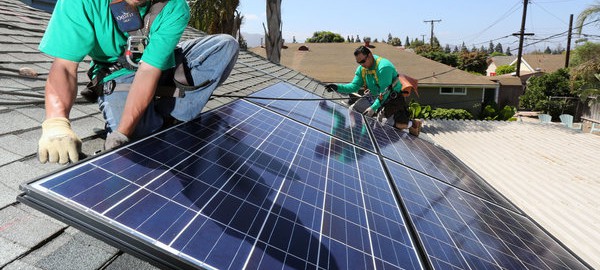
Workers for SolarCity installing solar panels (Image: JE Flores/NYTimes)

Why More Solar Panels Should Be Facing West, Not South

For years, homeowners who bought solar panels were advised to mount them on the roof facing south. That captures the most solar energy over the course of the day, which benefits the homeowner, but does so at hours that are not so helpful for the utility and the grid as a whole.

Mount them to catch the sunlight from the west in the afternoon, and the panels’ production over all would fall, but it would come at hours when the electricity was more valuable.

But that idea is slow to take hold. A new study of 110,000 California houses with rooftop solar systems confirmed that a vast majority of the panels were pointed south because most of the panel owners were paid by the number of kilowatt-hours the panels produced. Pointing them southward maximizes production over all, but peak production comes at midday, not in late afternoon, when it would be more helpful.

In late afternoon, homeowners are more likely to watch TV, turn on the lights or run the dishwasher. Electricity prices are higher at that period of peak demand.

“The predominance of south-facing panels may reflect a severe misalignment in energy supply and demand,”

said the authors of the study, Barry Fischer and Ben Harack. They work for Opower, a company that provides software that electric companies can use to manage their relationships with their customers.

Houses with solar systems consume less than half as much utility-delivered electricity as ordinary houses, the study found. But from about 4 p.m. through the night, they consume more, and they add to the system’s peak demand, which comes around 5 p.m.

Pointing panels to the west means that in the hour beginning at 5 p.m., they produce 55 percent of their peak output. So a 10-kilowatt system would make 5.5 kilowatts. But point them to the south to maximize total output, and when the electric grid needs it most, they are producing only 15 percent of peak, or 1.5 kilowatts.

Why wouldn’t everyone point the panels west? Some homeowners have their panels face south because that is the direction of the roof. While some solar panel owners are paid time-of-use rates and are compensated by the utility in proportion to prices on the wholesale electric grid, many panel owners cannot take advantage of the higher value of electricity at peak hours because they are paid a flat rate, the energy analysts said. So the payment system creates an incentive for the homeowner to do the wrong thing. The California Energy Commission recently announced a bonus of up to $500 for new installations that point west. A new solar installation is completed every 3.2 minutes, according to the authors of the analysis.

Solar panels do not have to be pointed in just one direction; a homeowner can buy a device called a tracker that will pivot them, over the course of the day, like a sunflower, so they always face the sun. A tracker can raise the output of a panel by 45 percent. But adding trackers can cost hundreds or thousands of dollars, and a cheaper way to get the same number of kilowatt-hours may be simply to buy a few extra panels.

Houses with solar panels are not necessarily efficient; during the hours when the sun is not shining, they use more electricity than houses without solar panels. It may be because the bigger users tend to install the panels in the first place. There may be another reason: People who own electric cars tend to also install solar panels, and their overall electricity consumption is higher. But from an environmental standpoint, it is still better to consume the energy as electricity rather than as gasoline.

Source: New York Times

Inconveniences of Gasoline 1: Gas Station (Image: Clean Technica)

The Inconveniences of Buying Gasoline

Thanksgiving weekend has historically been the biggest driving weekend of the year. What better time to discuss buying gasoline?

This article is intended to be a little bit of a light article, but with some food for thought included for consumption. It is not intended to be a full review of the pros and cons of buying an electric vehicle (EV) article. In short, some insights are being put forth here to contribute to the conversation about EVs. This article is a result of my own inner dialogue that has moved me in the direction of buying an EV. An EV will be my next car, but I’m still currently driving an anachronistic internal combustion engine (ICE).

Finding a Gas Station

How far out of our route do we have to drive to get to the gas station? For me, this varies from trip to trip. As an environmentalist, I do my best to get gas right on the road on which I’m already traveling, but that isn’t always possible. How many stop lights do we go through to get to a gas station while paying good money to burn gasoline, and polluting with CO2s, at those stoplights? How much gasoline do we pay for to get us to and from those gas stations? With EVs that charge at home and/or work, this issue is eliminated.

The Cost

The cost savings of using electricity instead of buying gasoline is commonly quoted as between $1,000 and $1,500 per year. This will vary based on one’s electricity rates, the cost of gasoline, and the number of kilometers (miles) someone drives per year.

Premium Gasoline

When we hear the price of gasoline on the news or radio, they are always quoting the price of regular gas as though that’s the only price of gasoline. Many cars such as all ICE Mercedes vehicles require premium petrol. The cost of premium gas varies, but is roughly 8% more costly currently and has cost as much as 20% more than regular in the past (in 1998). With EVs, this issue is eliminated.

Read more: Clean Technica

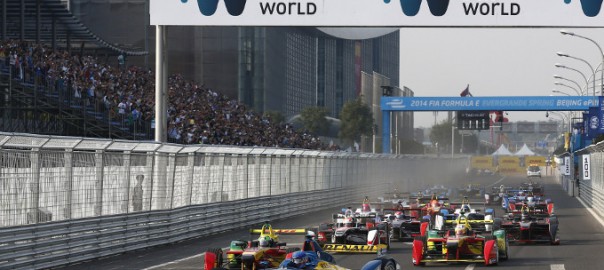
Formula E Racing in Beijing (Image: FIA Formula E)

FIA: What is Formula-e and why should we care?

With only three days until Round-2 of the inaugural FIA Formula-E Championship is upon us, I thought it was time to take a deeper look into this interesting racing series.

The debut of Formula-e racing was held in the streets of Beijing on 13th September 2014. You can read my review of that here. There was great racing from quality drivers with interesting incidents. That’s what you would expect from any racing series so what makes Forumla-e different?

Firstly, the obvious part is the “e” – this is the first fully electric single-seater racing series. The car is the Spark-Renault SRT_01E which uses a Dallara chassis, a McLaren engineered electric motor, a Rechargeable Energy Storage System (RESS) part of which has been engineered by Williams and it rides on Michelin tyres. This being a racing series that champions sustainability and cost saving, the tyre is essentially a road tyre, capable of running in both wet and dry conditions. One set of tyres should last a whole race weekend.

The “electric” part presents a number of issues for ensuring entertaining racing. The sound is an immediate problem, especially in the aftermath of the controversy over Formula 1 went through when the engines were downgraded for eight to six cylinders. The new sound of F1 is more tame than it ever has been and this has led to criticism from pundits and the race going public. So much so that some different artificial sound enhancing tricks have been tried to no avail. This however has meant that the problem of very little sound coming from an electrical power unit being much less of an issue. In practice, the Formula-e car sounds just as aggressive as the current Formula 1 engine, just a little less loud.

Another big problem with an electric car is refuelling. Currently there is very little in the way of technology that allows a car to be recharged in the time it takes for a pit stop to happen. How do Formula-e get around this? Simple, have two cars. Instead of pulling in to change tyres or recharge the battery, the driver simple hops out of one car and into another. Now this works at the moment but it isn’t exactly the most economical way of running proceedings. It means that each team, of which there are ten, has to have four cars as a minimum, two for each driver. Not ideal, however this can only be positive for the future of electric cars. With Formula-e investing time and money improving the image of the sport and electric cars in general, they will surely have to look at a way of improving this set up. Maybe a 3.5-second way of changing the batteries or a 10-second way of charging. All potential exciting developments for the future of road cars.

So, there are some issues but all of them so far, have been easy to account for. Here comes one part of Formula-e that I just can’t get past, “Fan Boost”. Three drivers out of the twenty in the field, are given a 5-second “Fan Boost”. This is measured purely on popularity via social media. This will force drivers to work harder in the media, gain more “Followers” and ask them to vote for them. I am not sure that measuring how popular you are to the public, should have any bearing on anything in your life, let alone the outcome of an otherwise very equal race. This boost, though it seems relatively ineffective, with a 5-second boost equivalent to 40 BHP for the drivers to use twice in the race (once in each car) feels like a poor gimmick taken from 1980’s Saturday morning kids television that Formula-e would do well to be rid of.

Another problem for me is the length of time between races. I understand that the logistics of getting a city ready to host a race are extremely complicated. Unfortunately, Formula-e whet the appetite for this series with an incident packed race-one in mid-September but race-two will not take place until the end of November, easily enough time for the public to forget it. Thankfully the rest of the races will be closer together but still 3 weeks to a month apart, the schedule is below.

Problems aside, the first race was gripping and I am genuinely excited about the close fought racing that is likely to await us in this year’s Formula E championship. I am also eager to see how this innovative series can improve both itself and race cars of the future. It also forces the likes of Formula 1 to ensure they are genuinely at the forefront of fuel-efficient racing and encourages new efficiencies through both series’, into our road cars.

The next race will be broadcast live on ITV4 at 6am on Saturday 22nd November.

Race Schedule

Round 1 – 13 Sept 2014 – Beijing, China

Round 2 – 22 Nov 2014 – Putrajaya, Malaysia

Round 3 – 13 Dec 2014 – Punta del Este, Uruguay

Round 4 – 10 Jan 2015 – Buenos Aires, Argentina

Round 5 – 14 Feb 2015 – TBA*

Round 6 – 14 Mar 2015 – Miami, USA

Round 7 – 4 Apr 2015 – Long Beach, USA

Round 8 – 9 May 2015 – Monte Carlo, Monaco

Round 9 – 30 May 2015 – Berlin, Germany

Round 10 – 27 Jun 2015 – London, United Kingdom

* Rio de Janeiro was originally scheduled to host a race in November but the calendar has since changed and though the date has been selected for Round 5, no venue has been announced.

Tar Sands in Alberta (Image: Wikimedia/Howl Arts Collective)

IEA Says Oil Supplies May Not Keep Up With Demand

Despite what appears to be a saturated oil market in 2014, oil producers around the world will struggle to meet rising demand over the next few decades.

In its latest annual World Energy Outlook, the International Energy Agency (IEA) warned that the current period of oil abundance may be fleeting, and in fact, without heroic levels of production increases, oil markets will grow dangerously tight in the coming years.

Global oil demand is expected to increase by 37 percent by 2040, with a dominant proportion of that coming from developing countries – i.e. China and India. In fact, the IEA says that for every barrel of oil the industrialized world expects to eliminate from demand through efficiency or other ways of reducing demand, developing countries will burn through two additional barrels.

The IEA predicts that the world will need to extract an additional 14 million barrels of oil per day (bpd) by 2040, which comes on top of today’s production levels of about 90 million bpd. While there is a lot of triumphalism in the United States about shale oil production and how places like the Bakken and the Eagle Ford have ushered in an era of abundance, the IEA says that tight oil production in the U.S. – along with Canadian oil sands – will only last until the mid-2020’s.

After that point, when the shale revolution peters out, oil markets revert to their old ways – that is, looking to the Middle East once again to meet global demand. And that should raise some alarm. Saudi Arabia will remain one of the largest and most important oil producers in the world, but it probably won’t be able to ramp up production much beyond its current levels. There is some slack production in Iran, due to western sanctions, but even when it returns to the fold it likely will only make a small contribution to oil production growth in the long-term.

Instead, much of the world’s hopes are pinned disproportionately on Iraq. A year ago, after the IEA released its 2013 WEO, I wrote about how the IEA was placing a surprising amount of faith in the ability of Iraq to scale up its oil production. For several years, the IEA predicted that Iraq would be able to triple its output from 3 million bpd to around 8.3 million bpd by 2035. Under that assumption, oil prices would rise only a modest amount over that timeframe.

That would have been a monumental task even before the country began unraveling in June 2014. Since then, Iraq has been plunged back into a state of war. The prospect that it can be put back together, and the requisite levels of capital investment can be put into its oil sector in order to add 5-6 million bpd over the next 20-30 years, appears fanciful to say the least.

An estimated $900 billion will need to be deployed each year beginning in the 2030s to bring enough oil online to meet global demand. But the IEA also cautions that replicating the tight oil boom in the United States will be very difficult. Different geological conditions could pose some problems, but the long lead times and opposition to drilling will also slow development in much of the world.

Unlike last year, this time around the IEA appears to be more concerned. The IEA Chief Economist Fatih Birol, said in a press release:

“A well-supplied oil market in the short-term should not disguise the challenges that lie ahead, as the world is set to rely more heavily on a relatively small number of producing countries.”

And in its WEO Fact sheet, the IEA declares:

“the task of bringing production above 100 mb/d rests on a fairly limited number of shoulders.”

Source: Oil Price

Electric Cars Fast Charging (Image: BusinessCarManager.co.uk)

Five reasons why electric vehicles will go mass-market

Over the last 100 years there have been a number of attempts from electric vehicle enthusiasts to push them into the mass market. Unfortunately the vast majority of these attempts have failed for a variety of reasons, often out of the control of the market itself, but today we stand in a very different place and electric vehicles will eventually go mass-market. We hereby list five reasons why electric vehicles are here to stay in the longer term: –

1. Technology

There have been enormous leaps in electric vehicle technology over the last 10 years which not only offer greater efficiency but also give the driving public greater confidence. This technology continues to advance at breathtaking speed not only in the area of electric vehicles themselves but also battery technology. In many ways the development of new technologies is putting gasoline vehicles in the shadows and grabbing the headlines.

2. Industry and government expenditure

While the electric vehicle market has made numerous attempts to crack the mass market, the majority of which failed, today is very different. The industry itself and governments around the world have literally invested billions upon billions of dollars and gone beyond the point of no return. In previous attempts there was a definite lack of incentives from governments around the world and indeed many governments paid lip service to the industry without cold hard cash. The simple fact is that too much money has been spent for the EV industry to fail this time round!

Quote from ElectricForum.com: “While the electric vehicle market seems to be dominated by the likes of Tesla, General Motors, Nissan, etc, there is a rather unknown entity sneaking up on the sidelines in the shape of Chinese electric car manufacturer BYD.”

3. Battery technology

One of the major problems of the last decade has been the relatively slow development of battery technology in relation to electric vehicles. This was in many ways overlooked by the industry as more focus and more investment was placed upon actual car technology as opposed to battery technology. It was only when the general public began to have major concerns about battery power and efficiency that both governments and the industry switched part of their investment towards battery technology.

4. Journey capacity

In tandem with new electric vehicle technology and battery technology we now have a greater emphasis upon extended journey capacity. The introduction of various electric vehicle recharging networks across the world has also added to this more positive picture with journey capacity in excess of 100 miles now commonplace among some of the more popular vehicles. There is still some way to go, more investment is required but there is no doubt that journey capacity concerns are certainly reducing.

5. Electric vehicles have lost that stigma!

In the early years the electric vehicles we saw on the roads were, how can we put it, very different in look and style and often embarrassing. This created something of a stigma which hovered over the electric vehicle industry for many years although thankfully this stigma has now gone. In many cases it is difficult to tell at a distance whether a vehicle is powered by traditional gasoline/diesel or whether indeed it is powered by electric. This in itself is probably the most compelling reason why electric vehicles will eventually crack the mass market, the fact they fit the hopes and aspirations of the motoring public and there is no embarrassment in driving one today!

Source: Electric Forum

Tar Sands in Alberta (Image: Wikimedia/Howl Arts Collective)

The scale of electricity use by fossil fuel refining

This is a fascinating episode of Robert Llewellyn’s (highly recommended) Fully Charged show. Ostensibly it’s a review of the rather dull Lexus is300h (just another hybrid) but actually the second half is an analysis of how much electricity is used in refining petrol and diesel fuels. He comes up with a figure of 4.5kWh of electricity wasted to refine one gallon.

This video is set to start at that point:

It gives a UK perspective on the well-known quote from Revenge of the Electric Car, usually attributed to Elon Musk (CEO of Tesla Motors) but really from the film’s director Chris Paine:

“you have enough electricity to power all the cars in the country if you stop refining gasoline. You take an average of 5 kilowatt hours to refine gasoline, something like the Model S can go 20 miles on 5 kilowatt hours. You basically have the energy needed to power electric vehicles if you stop refining.”

G20 nations had been spending almost $90bn a year on finding more oil, gas and coal

The Battle Between Oil and Electricity

Energy is not only a battleground between different sources such as nuclear, renewables or fossil fuels. There is also a battle between different means of delivering energy to consumers to provide light, comfort and mobility. Over the last century or more, two energy carriers have effected radical changes on human society and paved the way for a truly global economy. Oil has transformed our ability to move goods and people huge distances over land, sea and air. Electricity has transformed our homes and enabled the transfer of vast quantities of information and virtually instantaneous communication between any two points on the globe.

From a consumer’s perspective, these appear to be two different industries. Oil and gas producers exploit resources upstream and maintain distribution networks that end at the petrol pump. A different set of companies transforms primary energy into electricity and brings it into people’s homes. Two different energy sectors effectively co-exist because their products are so different in character. Liquid fuels have a high energy density and can be stored on-board a vehicle giving it a range of 1,000 kilometres or more. Electricity is difficult and expensive to store, and supply and demand must balance instantaneously. However, electricity is a very high quality form of energy that can be turned to almost any purpose: lighting, heating, motive power and the carriage of information.

Can we take the boundary between these two energy carriers for granted? Although the division appears clear and logical at the moment, history shows that nothing can be taken for granted. When oil was first produced, it was not to fuel the internal combustion engine. It was to provide a fuel for lighting to replace ever scarcer whale oil. Oil fractions that could have been used for transport were discarded as waste. However, through the innovative efforts of Edison and Westinghouse and by virtue of its greater power, flexibility and safety, electricity drove oil and gas from lighting markets. Oil has retreated from other markets too. Against a background of abundance and low cost supplies, Winston Churchill felt able to switch the Royal Navy from coal to oil prior to the First World War. But the high prices and scarcity associated with the 1970s oil crises drove oil from its markets in power stations and industry as companies responded to price signals and governments responded strategically to a deteriorating energy security situation. Lower oil prices in the 1980s and 1990s have not reversed these trends. There is now a prospect that global demand for oil will peak in the next 10-15 years – it may even have peaked already. Meanwhile, global demand for electricity increases at a rate that will lead to a doubling every twenty years.

There are reasons to suppose that the battle of the energy carriers is not over. The International Energy Agency’s latest Energy Technology Perspectives report focuses specifically on harnessing electricity’s potential. The next battleground involving oil and electricity could be in the transport sector. Several factors are involved. Two are environmental. In emerging economies, where car ownership is growing rapidly, transport-related air pollution is a major cause for concern and the attractions of electric vehicles are considerable. Electric vehicles can also help in the fight against climate change by making use, indirectly, of low-carbon energy sources such as renewables or nuclear to fuel the transport sector. Technological change is also playing a role. Energy storage technologies are developing rapidly and the cost and performance of battery technology in particular are improving. This will extend the range of electric vehicles and partly (though certainly not completely) erode the advantage of oil in this respect. Finally, in an uncertain world, it will allow more countries to reduce their reliance on imported transport fuels.

The new battle will not necessarily be clear cut. Improvements in extractive technology and access to new unconventional sources mean that oil will not be physically scarce. As with any major technological transition, it may take decades to work through. And “compromise” technologies such as hybrid and plug-in hybrid vehicles may help to make the best of both worlds, though at a cost.

The “eco-machine” of the future is now up for grabs. It may take a long time before we see an all-electric future for vehicles. But it is certain that the future will be both more electrified and more electrifying.

Source: Huffington Post

Car exhaust pollution (Image: Wikipedia)

Do Auto Emissions Kill As Many People As Car Crashes?

Carbon-dioxide emissions have documented negative effects at a planetary level–but could the other gases coming out of vehicle tailpipes be as hazardous to overall public health in total as car accidents are?

In the public discourse to date, the answer has previously seemed to be “no.” Emissions generally aren’t discussed in terms of individual deaths, but rather in the context of climate change or as a contributing factor to specific illnesses.

Now, researcher David Levinson suggests the answer is not that simple. In a post on his blog Transportationist, he argues that the impact of crash-related and emissions-related deaths could be roughly comparable, depending on how you crunch the numbers.

More deaths from air pollution

Levinson cited data from the 2010 Global Burden of Disease Study, which found that 36 deaths per 100,000 were attributable to air pollution, compared to 15 for road and transportation-related injuries–the vast majority of which involve cars.

In this case, air pollution is defined as fine particulate matter and ozone only, but the study does not differentiate between transportation-related emissions and other sources.

However, as Levinson’s colleague Julian Marshall noted in the same post, it’s hard to attribute a death to air pollution.

Pollution doesn’t appear as a cause on death certificates–it’s inferred by looking at higher instances of events like heart attacks in areas with high levels of pollution–and tracking an air pollution-related death to a specific source is even more difficult.

In addition, the 2010 study found that transportation-related injuries were responsible for more years of life lost than air pollution–653 per 100,000 people, compared to 565.

That’s because fatal car crashes tend to involve younger people, so they shorten lives more dramatically.

A matter of perspective

Eric Jaffe at CityLab came to largely the same conclusions–finding a larger apparent number of air-pollution-related deaths under a somewhat non-specific definition, but with car crashes cutting lives shorter.

He said the two problems could be “more on par than we typically treat them.”

Following that argument, automotive emissions should be viewed in the same category as traffic deaths–but the link between cause and effect isn’t as apparent.

Air pollution caused by emissions is already linked to respiratory illnesses.

Recently, a new study from the Columbia Center for Children’s Environmental Health (via Gothamist) found that it may also be linked to ADHD in children.

The study found a higher instance of ADHD-like symptoms in children exposed to polycyclic aromatic hydrocarbons (PAH), a byproduct of burning fossil fuels.

It shows the need to curtail emissions from burning hydrocarbon fuels overall, but it also demonstrates how varied their effects on health and lifespan can be.

That sharply contrasts with the immediate and grimly apparent toll of car crashes.

Car exhaust pollution (Image: Wikipedia)

Should electric vehicles be compulsory in city centres?

The subject of making electric vehicles compulsory in city centres in the UK, and indeed many other areas of the world, is one which keeps popping up time and time again. The Liberal Democrat party in the UK has been pushing for greater adoption of electric vehicles within city centres and, don’t shout this, a ban on diesel and petrol vehicles. This is now something of a hot topic and one which will continue to appear in the political domain as we approach general and local elections.

How would you feel about making city centres a no-go area for petrol and diesel vehicles? Is electric vehicle technology of sufficient reliability to support such a dramatic and controversial move?

Air pollution

If we look back 40 or 50 years ago the argument was whether vehicles powered by diesel and electric were making any contribution to air pollution whatsoever. The situation today is very different and all parties agree that non-electric vehicles are pumping out a number of pollutants which are causing major problems within city centres with regards to air pollution. The quality of air in and around city centres is impacted more than any other areas simply because there is limited space, limited airflow and the pollutants tend to hover over the city like a bad smell.

Air pollution within city centres has been linked to an array of health conditions such as asthma and other breathing issues. When you bear in mind the cost and the impact of such health conditions on the individual and health services, perhaps we should now be looking towards diesel and petrol free city centres?

Quote from ElectricForum.com:

“The reputation of BMW is based upon luxury therefore many people are now asking the question, would you buy an electric powered BMW? Is BMW Daimlers joint-venture just a way to placate the green movement? Would an electric BMW be a mass-market seller?”

Infrastructure investment

What came first, the chicken or the egg? There is no doubt that local government and federal government investment in charging networks across the UK and other countries has increased dramatically of late. However, there is a feeling among some experts that the actual investment required to create a suitable and reliable infrastructure has not yet been reached. The argument being, do local authorities invest now and push motorists towards electric vehicles within city centres or do they wait for a gradual transfer and then invest?

If you take a step back and look at the overall cost of air pollution not only in terms of cold hard cash but also health issues, perhaps these do far outweigh the potential investment required to create a reliable recharging network infrastructure?

How will motorists react?

When it boils down to the nitty-gritty politicians will only push through potentially controversial issues which will have the support of the masses. It is an interesting debate as to whether motorists are now moving towards electric vehicles en-masse and would support such a ban in city centres. Let’s not forget, motorists have been a cash cow for many governments around the world in relation to road taxes and the heavy levies cast upon petrol and diesel.

Would any political party be brave enough to take the risk of losing votes by banning petrol/diesel vehicles in city centres in favour of electric vehicles? Politicians can shout and scream about the environment, pollution, etc but the bottom line is they will not push through any controversial changes until they are sure they will not impact their core voting public. When that will be remains to be seen.

Source: Electric Forum