Category Archives: Opinion

Audi A3 e-tron, Mitsubishi Outlander and BMW i3 plug-ins

Electric vehicles sneaking up in the race for global car dominance

The age of electric vehicles, those quirky cars that have been perennially stigmatized as lacking range, reliability and affordability, is finally here. If you don’t believe that statement, you probably haven’t driven one recently. Or attended a Formula E auto race. Or taken a look at some of the sales numbers.

Or all of the above.

For the first time in a century, the electric vehicle (EV) is on the road to becoming a serious competitive challenge to its petroleum nemesis. That’s not to say that the world’s billion-plus “conventional” cars are ready to be dragged en masse to scrap yards with big cranes and magnets. Nor do a smattering of all-electric Teslas and BMWs suggest that the petroleum industry will easily surrender its headlock on the global transportation market. But at a minimum, today’s EV renaissance does strengthen the case that long-term forecasts for world oil consumption are overstated. And depending on the speed of technological advances in batteries and electric power trains, there are scenarios where EV adoption rates could surprise.

The most exciting place to witness EV advances is at an FIA Formula E racing event. All-electric Formula E (fiaformulae.com) is a newbie on the world racing circuit, but has attracted some of the same legendary names that have made its raucous Formula 1 cousin famous. For example, Williams Advanced Engineering is championing batteries; McLaren is involved with the motors; and founding partner Renault is integrating all the systems into sleek vehicles that look like mechanical doppelgangers for F1 race cars.

A couple of weekends ago, I attended the first North American Formula E race, the Miami ePrix, held just north of Biscayne Bay. Lineups and shoulder-to-shoulder crowds amplified the sense that this fresh event was more than just about seeing who would spray champagne at the finish line. Teal-coloured banners everywhere reminded the crowds that they were there to “Drive the Future.”

Race time arrived. Four o’clock. The announcer called the drivers to their starting positions. No one else seemed to notice, but I smiled at the absence of the obviously antiquated, “Start your engines!” command. Suddenly, off the mark, 10 cars lurched down the caged, 2.2-kilometre circuit with tires squealing. And for the rest of the one-hour race, that was it for loud noise. At every lap, the Formula E cars swished by with a satisfying, almost calming, smooth whine. Unlike a deafening Formula 1 race, a large part of the thrill was not having to silicone my ears shut.

Technological advances from the extreme engineering of the Formula E sphere will trickle down to mainstream cars, just as petroleum-powered cars have benefited from seven decades of F1 racing. To be sure, electric powertrains still need more work before mainstream EVs can be a compelling substitute for gas, gears and grease. But the race is on. EV sales figures from early laps of commercialization show that market penetration is worth a glance over the shoulder – especially if you’re driving for the oil team.

Our feature chart (Figure 1) this week gives an updated monthly sales snapshot of pure battery electric vehicles (BEVs) and plug-in hybrids (PHEVs). The latter still use a small gasoline-powered engine as a blanky for range, but primarily rely on a battery. Gasoline prices are overlain on the chart as a reference for the incumbent competition.

Adoption of EVs in the U.S. market began a steady rise in 2011. Conditions were favourable when average gasoline prices were in the range of $3.75 to $4.00 a gallon. Sales numbers of almost 10,000 a month still pale compared to overall U.S. auto sales of over a million a month; however it’s the uptrend of early adoption that’s noteworthy. Over the past six months, U.S. sales momentum appears to have fallen in tandem with gasoline prices; this is not surprising as there is less incentive for consumers to plug in when the price spread between the pump and the wall socket narrows. But like a race, it’s too early to call a downtrend.

For one thing, don’t confuse adoption with seasonality: EV sales have traditionally had a dip during the winter months; 2014 and 2015 were especially harsh in the eastern US. Globally, sales of EVs – four-wheeled and two-wheeled varieties – are on an upswing in Europe and Asia. The International Energy Agency reports that there are now 230 million electric bikes in China. Global car sales (battery electric vehicles and plug-in hybrid electric vehicles) are tracking 25,000 a month, and growing 50 per cent per year if the trend line is extrapolated.

Diesel- and gasoline-powered cars will still have the pole position for many years to come. Nevertheless, the EVs are off to the races, quietly sneaking up on their competition.

Source: Globe and Mail

Big Oil’s business model is broken

Many reasons have been provided for the dramatic plunge in the price of oil to about $60 per barrel (nearly half of what it was a year ago): slowing demand due to global economic stagnation; overproduction at shale fields in the United States; the decision of the Saudis and other Middle Eastern OPEC producers to maintain output at current levels (presumably to punish higher-cost producers in the U.S. and elsewhere); and the increased value of the dollar relative to other currencies. There is, however, one reason that’s not being discussed, and yet it could be the most important of all: the complete collapse of Big Oil’s production-maximizing business model.

Until last fall, when the price decline gathered momentum, the oil giants were operating at full throttle, pumping out more petroleum every day. They did so, of course, in part to profit from the high prices. For most of the previous six years, Brent crude, the international benchmark for crude oil, had been selling at $100 or higher. But Big Oil was also operating according to a business model that assumed an ever-increasing demand for its products, however costly they might be to produce and refine. This meant that no fossil fuel reserves, no potential source of supply — no matter how remote or hard to reach, how far offshore or deeply buried, how encased in rock — was deemed untouchable in the mad scramble to increase output and profits.

In recent years, this output-maximizing strategy had, in turn, generated historic wealth for the giant oil companies. Exxon, the largest U.S.-based oil firm, earned an eye-popping $32.6 billion in 2013 alone, more than any other American company except for Apple. Chevron, the second biggest oil firm, posted earnings of $21.4 billion that same year. State-owned companies like Saudi Aramco and Russia’s Rosneft also reaped mammoth profits.

How things have changed in a matter of mere months. With demand stagnant and excess production the story of the moment, the very strategy that had generated record-breaking profits has suddenly become hopelessly dysfunctional.

To fully appreciate the nature of the energy industry’s predicament, it’s necessary to go back a decade, to 2005, when the production-maximizing strategy was first adopted. At that time, Big Oil faced a critical juncture. On the one hand, many existing oil fields were being depleted at a torrid pace, leading experts to predict an imminent “peak” in global oil production, followed by an irreversible decline. On the other, rapid economic growth in China, India, and other developing nations was pushing demand for fossil fuels into the stratosphere. In those same years, concern over climate change was also beginning to gather momentum, threatening the future of Big Oil and generating pressures to invest in alternative forms of energy.

A “Brave New World” of tough oil

No one better captured that moment than David O’Reilly, the chair and CEO of Chevron. “Our industry is at a strategic inflection point, a unique place in our history,” he told a gathering of oil executives that February. “The most visible element of this new equation,” he explained in what some observers dubbed his “Brave New World” address, “is that relative to demand, oil is no longer in plentiful supply.” Even though China was sucking up oil, coal, and natural gas supplies at a staggering rate, he had a message for that country and the world: “The era of easy access to energy is over.”

To prosper in such an environment, O’Reilly explained, the oil industry would have to adopt a new strategy. It would have to look beyond the easy-to-reach sources that had powered it in the past and make massive investments in the extraction of what the industry calls “unconventional oil” and what I labeled at the time “tough oil”: resources located far offshore, in the threatening environments of the far north, in politically dangerous places like Iraq, or in unyielding rock formations like shale. “Increasingly,” O’Reilly insisted, “future supplies will have to be found in ultradeep water and other remote areas, development projects that will ultimately require new technology and trillions of dollars of investment in new infrastructure.”

For top industry officials like O’Reilly, it seemed evident that Big Oil had no choice in the matter. It would have to invest those needed trillions in tough-oil projects or lose ground to other sources of energy, drying up its stream of profits. True, the cost of extracting unconventional oil would be much greater than from easier-to-reach conventional reserves (not to mention more environmentally hazardous), but that would be the world’s problem, not theirs. “Collectively, we are stepping up to this challenge,” O’Reilly declared. “The industry is making significant investments to build additional capacity for future production.”

On this basis, Chevron, Exxon, Royal Dutch Shell, and other major firms indeed invested enormous amounts of money and resources in a growing unconventional oil and gas race, an extraordinary saga I described in my book The Race for What’s Left. Some, including Chevron and Shell, started drilling in the deep waters of the Gulf of Mexico; others, including Exxon, commenced operations in the Arctic and eastern Siberia. Virtually every one of them began exploiting U.S. shale reserves via hydro-fracking.

Only one top executive questioned this drill-baby-drill approach: John Browne, then the chief executive of BP. Claiming that the science of climate change had become too convincing to deny, Browne argued that Big Energy would have to look “beyond petroleum” and put major resources into alternative sources of supply. “Climate change is an issue which raises fundamental questions about the relationship between companies and society as a whole, and between one generation and the next,” he had declared as early as 2002. For BP, he indicated, that meant developing wind power, solar power, and biofuels.

Browne, however, was eased out of BP in 2007 just as Big Oil’s output-maximizing business model was taking off, and his successor, Tony Hayward, quickly abandoned the “beyond petroleum” approach. “Some may question whether so much of the [world’s energy] growth needs to come from fossil fuels,” he said in 2009. “But here it is vital that we face up to the harsh reality [of energy availability].” Despite the growing emphasis on renewables, “we still foresee 80 percent of energy coming from fossil fuels in 2030.”

Under Hayward’s leadership, BP largely discontinued its research into alternative forms of energy and reaffirmed its commitment to the production of oil and gas, the tougher the better. Following in the footsteps of other giant firms, BP hustled into the Arctic, the deep water of the Gulf of Mexico, and Canadian tar sands, a particularly carbon-dirty and messy-to-produce form of energy. In its drive to become the leading producer in the Gulf, BP rushed the exploration of a deep offshore field it called Macondo, triggering the Deepwater Horizon blow-out of April 2010 and the devastating oil spill of monumental proportions that followed.

Over the cliff

By the end of the first decade of this century, Big Oil was united in its embrace of its new production-maximizing, drill-baby-drill approach. It made the necessary investments, perfected new technology for extracting tough oil, and did indeed triumph over the decline of existing, “easy oil” deposits. In those years, it managed to ramp up production in remarkable ways, bringing ever more hard-to-reach oil reservoirs online.

According to the Energy Information Administration (EIA) of the U.S. Department of Energy, world oil production rose from 85.1 million barrels per day in 2005 to 92.9 million in 2014, despite the continuing decline of many legacy fields in North America and the Middle East. Claiming that industry investments in new drilling technologies had vanquished the specter of oil scarcity, BP’s latest CEO, Bob Dudley, assured the world only a year ago that Big Oil was going places and the only thing that had “peaked” was “the theory of peak oil.”

That, of course, was just before oil prices took their leap off the cliff, bringing instantly into question the wisdom of continuing to pump out record levels of petroleum. The production-maximizing strategy crafted by O’Reilly and his fellow CEOs rested on three fundamental assumptions that, year after year, demand would keep climbing; that such rising demand would ensure prices high enough to justify costly investments in unconventional oil; and that concern over climate change would in no significant way alter the equation. Today, none of these assumptions holds true.

Demand will continue to rise — that’s undeniable, given expected growth in world income and population — but not at the pace to which Big Oil has become accustomed. Consider this: In 2005, when many of the major investments in unconventional oil were getting under way, the EIA projected that global oil demand would reach 103.2 million barrels per day in 2015; now, it’s lowered that figure for this year to only 93.1 million barrels. Those 10 million “lost” barrels per day in expected consumption may not seem like a lot, given the total figure, but keep in mind that Big Oil’s multibillion-dollar investments in tough energy were predicated on all that added demand materializing, thereby generating the kind of high prices needed to offset the increasing costs of extraction. With so much anticipated demand vanishing, however, prices were bound to collapse.

Current indications suggest that consumption will continue to fall short of expectations in the years to come. In an assessment of future trends released last month, the EIA reported that, thanks to deteriorating global economic conditions, many countries will experience either a slower rate of growth or an actual reduction in consumption. While still inching up, Chinese consumption, for instance, is expected to grow by only 0.3 million barrels per day this year and next — a far cry from the 0.5 million barrel increase it posted in 2011 and 2012 and its 1 million barrel increase in 2010. In Europe and Japan, meanwhile, consumption is actually expected to fall over the next two years.

And this slowdown in demand is likely to persist well beyond 2016, suggests the International Energy Agency (IEA), an arm of the Organization for Economic Cooperation and Development (the club of rich industrialized nations). While lower gasoline prices may spur increased consumption in the United States and a few other nations, it predicted, most countries will experience no such lift and so “the recent price decline is expected to have only a marginal impact on global demand growth for the remainder of the decade.”

This being the case, the IEA believes that oil prices will only average about $55 per barrel in 2015 and not reach $73 again until 2020. Such figures fall far below what would be needed to justify continued investment in and exploitation of tough-oil options like Canadian tar sands, Arctic oil, and many shale projects. Indeed, the financial press is now full of reports on stalled or cancelled mega-energy projects. Shell, for example, announced in January that it had abandoned plans for a $6.5 billion petrochemical plant in Qatar, citing “the current economic climate prevailing in the energy industry.” At the same time, Chevron shelved its plan to drill in the Arctic waters of the Beaufort Sea, while Norway’s Statoil turned its back on drilling in Greenland.

There is, as well, another factor that threatens the well-being of Big Oil: Climate change can no longer be discounted in any future energy business model. The pressures to deal with a phenomenon that could quite literally destroy human civilization are growing. Although Big Oil has spent massive amounts of money over the years in a campaign to raise doubts about the science of climate change, more and more people globally are starting to worry about its effects — extreme weather patterns, extreme storms, extreme drought, rising sea levels, and the like — and demanding that governments take action to reduce the magnitude of the threat.

Europe has already adopted plans to lower carbon emissions by 20 percent from 1990 levels by 2020 and to achieve even greater reductions in the following decades. China, while still increasing its reliance on fossil fuels, has at least finally pledged to cap the growth of its carbon emissions by 2030 and to increase renewable energy sources to 20 percent of total energy use by then. In the United States, increasingly stringent automobile fuel-efficiency standards will require that cars sold in 2025 achieve an average of 54.5 miles per gallon, reducing U.S. oil demand by 2.2 million barrels per day. (Of course, the Republican-controlled Congress — heavily subsidized by Big Oil — will do everything it can to eradicate curbs on fossil fuel consumption.)

Still, however inadequate the response to the dangers of climate change thus far, the issue is on the energy map and its influence on policy globally can only increase. Whether Big Oil is ready to admit it or not, alternative energy is now on the planetary agenda and there’s no turning back from that. “It is a different world than it was the last time we saw an oil-price plunge,” said IEA Executive Director Maria van der Hoeven in February, referring to the 2008 economic meltdown. “Emerging economies, notably China, have entered less oil-intensive stages of development … On top of this, concerns about climate change are influencing energy policies [and so] renewables are increasingly pervasive.”

The oil industry is, of course, hoping that the current price plunge will soon reverse itself and that its now-crumbling maximizing-output model will make a comeback along with $100-per-barrel price levels. But these hopes for the return of “normality” are likely energy pipe dreams. As van der Hoeven suggests, the world has changed in significant ways, in the process obliterating the very foundations on which Big Oil’s production-maximizing strategy rested. The oil giants will either have to adapt to new circumstances, while scaling back their operations, or face takeover challenges from more nimble and aggressive firms.

Source: Tom’s Dispatch via Grist

Energy storage paves way for electricity independence

Renewables have the power to transform not just the world’s energy markets, but global economics and geopolitics.

But wind and solar alone cannot deliver a world of clean and free fuel. Both are, by their very nature, variable, so to realise their true potential other technologies need to be harnessed.

Improving connectivity to other countries is one relatively simple solution, but in a world where governments are becoming increasingly preoccupied with energy security, its attractions are somewhat limited.

Managing demand more effectively using smart grids and appliances is another.

But the technology with the most revolutionary potential is energy storage.

As Jimmy Aldridge at the UK’s Institute of Public Policy Research think tank says:

“This is the most exciting area within the energy sphere and it’s totally transforming the way we interact with the grid.”

‘Huge disruption’

There are some very obvious ways in which storage can help communities and companies across the world.

Blackouts in developing economies can cause havoc.

In South Africa in 2008, for example, power cuts caused some of the country’s biggest gold and platinum mines to close, leading to a rise in global commodity prices, not to mention huge disruption to the lives of millions. Such unreliable power grids also hamper foreign investment.

Energy storage can not only provide back-up power in case of power cuts, but also help electricity grids run at average rather than peak load, therefore reducing the chances of cuts in the first place.

To this end, Puerto Rico, for example, has set a 30% storage requirement for any new renewable capacity.

But it’s not just developing countries that can benefit. The US government estimates that hundreds of power cuts between 2003 and 2012 cost the country up to $70bn (£45bn) a year. Tens of storage systems are already operating in many states, while California has set a target of 1.3GW to help meet its renewable objectives.

The UK has already built its first grid-level storage battery while Italy, Hungary and Saudi Arabia among others are likely to follow suit.

Storage is also proving invaluable for isolated communities that have no access to the national grid, with islanders in particular enjoying continuous power without the need for additional diesel generation.

Read more: BBC

Go Long – $200 oil is coming sooner than you think

In isolation, it could have seemed innocuous.

Sonangal, the Angolan National Oil company announced cuts in capital expenditure. The industry paid little attention. Since the current crisis began, cuts in cap-ex have been all around us. But this move, from a National Oil Company, marks a significant shift that we should all recognize.

Early in the current cycle, the international operators were first to take decisive action. This is business as usual as the price of oil goes down. The Operators pull back on planned expenditure, put a few projects on hold and trim some fat in their workforce. It’s rough if you find yourself out of a job, and I sympathize with anyone in that position, but it’s not a long term problem.

Global exploration has slowed and this is markedly evident in the drilling market: Some offshore rigs which once were operating at full capacity are now standing idle as prices have fallen from $650k per day to $350k per day.

The oil field services companies take a heavy hit early on, as do other businesses that swim in the slipstream of big oil. When the oil stops flowing, so does the money. But the results are mostly limited to a few poor quarters of financial performance before things return to normal.

But in Angola, we see the start of something altogether more sinister. This is a National Oil Company making decisions that will drastically affect their ability to meet demand in the future.

The issue is not restricted to Angola. The industry is heavily populated with countries that are structurally dependent on robust oil prices. There is a long list, which includes Venezuela, Iraq, Nigeria and to a lesser degree Russia.

As oil prices have fallen and remained low these nation states are simply running out of cash reserves. In some cases the situation is already acute. Venezuela has reserves to cover a very limited period and Angola’s reserves will cover just six months on current spend. As an immediate consequence, these governments are being forced to make swinging cuts as they refocus increasingly scarce capital reserves on essentials such as food and medical supplies. One of the easiest ways to preserve capital is to stop investing in major capital projects. The biggest and most expensive of these capital projects are their investments in oil and gas exploration.

These countries have enough issues without cheap oil muddying the waters. This month saw Venezuela deploy a new exchange rate system that aligns official rates more closely with the real black market rate for dollars. It is an indication of willingness to address real problems but in itself it will solve very little. Their woes will continue for as long as oil remains at these levels. When it recovers, they will only be left to handle the legacy issues caused by decades of fiscal mismanagement.

In Mexico, oil prices have compounded the economic misery of recent years. Again, most of the cut backs resulting from the country’s recent $8.5bn budget slash will come at the expense of planned exploration projects. Geology works much the same way in Mexico as it does everywhere else: long term contracts for easy oil are fine, short term shale plays are out of the question.

Every time capital expenditure is reduced, the gap in future supply and demand deepens.

Back to Angola. Their national budget for 2015 was based on an oil price of $81; when that budget was resubmitted by the cabinet a few weeks ago, it lowered the benchmark to $40 and included a $14bn reduction in cap ex.

Without this investment, capacity for future investment will continue to drop. In 12-24 months, both their supply and their production capacity will have been depleted by underinvestment, just as the opportunity arises to capitalize on soaring prices. This predicament will be common to every oil dependent nation currently running out of dollars.

In the middle of all this carnage, Saudi Arabia is continuing to invest. The Middle East is the one area that remains buoyant even now. When prices rebound, and the remainder of the market finds itself hopelessly underinvested, the Saudis will be there with surplus capacity and the prices will be what you’d expect to see in a seller’s market.

At that point, Angola will be forced to regret the cuts in investment that left them floundering.

You and I will be the losers at the gas station back home, but bad news at the pump translates to good news for the wider economy and the oil and gas job market. When this dip ends, the rebound will be higher than the speculative prices of 2007.

I’m not a betting man, but my advice to anybody willing to take a gamble is go long on oil. You are going to see a major return.

Source: LinkedIn

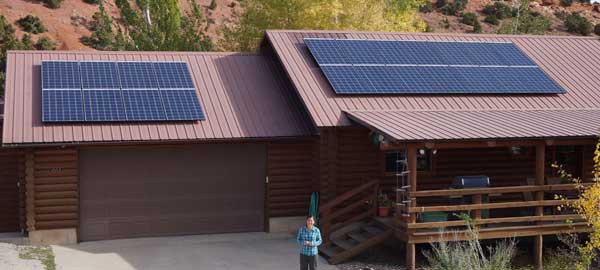
The Copelands’ home solar project (Photo: Creative Energies)

Going Solar: The 21st Century Family Home Project

300 pounds: That’s how much coal was not burned in a distant power plant in December as a result of the solar panels we installed on our house in Wyoming this fall.

Being December, it was our lowest monthly generation period, with low sun angles and periodic snow covering our panels.

An astonishing 1000 pounds of coal is burned to provide electricity for a typical US household per month.

Research shows that people most often take action on the environment based on a direct experience (Kollmuss and Agyeman 2002). In the case of climate change, ocean water isn’t lapping at our front door, nor did a hurricane recently flood our house.

Nor will we ever face these threats on the wind-swept plains of Wyoming.

But the health of the environment and our love of wildlife and open spaces is something that we care deeply about and also what drew us to settle here many years ago.

Home Solar Amidst an Energy Boom

Living in one of the epicenters fueling America’s energy boom has been a wake-up call. For the past 15 years, we’ve watched the slow unraveling of the sagebrush ecosystem: natural gas and oil extraction causing declines in species like sage-grouse and mule deer that depend on these systems (Naugle et al. 2011, Sawyer et al. 2013).

Even seemingly protected Yellowstone National Park, which sits nearly in our backyard, is warming at unprecedented rates. Recent temperatures have become as high as those experienced from 11,000 to 6,000 years ago (Shuman 2011) at a time when the concentration of carbon dioxide in Earth’s atmosphere has reached 400 parts per million (ppm), levels not seen since the Pleistocene (Pagani et al. 2010).

Wanting to join others as a part of the solution in reducing dependence on fossil fuels led us to consider installing solar panels on our home.

The Copelands’ home solar project (Photo: Creative Energies)

We studied the economics of the newest panels available and calculated that with the 30 percent federal tax incentive it would take 5 years to pay off the loan and 13 years to break even (Wyoming doesn’t have additional state tax incentives, but many states do). After that, all electricity we generated would be “free”.

Initially, I was pretty hesitant. Did it really make sense to take out a loan for solar panels or to take any “extra” money that we have for family vacations or college and put it into investing in solar?

The winning argument was to think of it like a bond fund, only we are the investors, and the project is solar on our house. When completed, our investment will result in nearly free electricity and the satisfaction of knowing that our electricity came from clean sources. Plus there’s the incalculable value of what it teaches our children. Even if we only break even financially, isn’t that still worth it?

Read more: Nature Blog

(Image: D. Bacon/Shutterstock/Economist)

How Much Crude Oil Do You Consume On A Daily Basis?

Oil. The commodity. We know what it’s worth – at least we thought we did – but what does a barrel of the black stuff get you in real life? Before we get theoretical, let’s first consider how much oil you use.

If you’re in the United States, that figure is approximately 2.5 gallons of crude oil per day; roughly one barrel every seventeen days; or nearly 22 barrels per year. That’s just your share of US total consumption of course; the true number is harder to discern – minus industrial and non-residential uses, daily consumption drops to about 1.5 gallons per person per day. Subtract the percentage of the population aged 14 and below and the daily consumption climbs back above 2 gallons. This is big picture, and it’s quite variable, so let’s go further.

Most of the nation’s daily crude consumption stems from transportation. If you’re an average driver in an average car, your crude consumption is in the order of 12 barrels per year. However, if your car is more than ten years old, chances are that figure is closer to 15 barrels annually. Does an electric car offer significant savings? Of course it does, but for an unconventional comparison let’s assume all of the electricity is sourced from oil – in truth, petroleum is not a very efficient fuel and accounts for just 1 percent of electricity generation in the US. Under this assumption, a Tesla Model S, with an 85 kilowatt-hour (kWh) battery and a range of 260 miles, will consume approximately 8 barrels of crude per year.

Frequent flyer? Say 2,000 miles per year on a US carrier? Add about two-thirds of a barrel of crude to your annual consumption.

A 3,000-mile cruise on the MS Oasis of the Seas may sound relaxing, but at roughly 4 barrels of crude per passenger, the carbon footprint alone is worth reviewing.

What about residential use? Using similar assumptions to the electric car example above, we can calculate our annual home electricity use in barrels of crude. In 2013, an average American home consumed 10,908 kWh of electricity, or approximately 20 barrels of crude. The real number – considering oil’s role in electricity generation – is far lower at around one-fifth of a barrel.

Petroleum products are active in nearly every facet of our daily lives; food and consumer chains are no exception. Take a look at bottled water for example. It’s an energy intensive business, one with an estimated energy expenditure of 32 million barrels of oil per year – for 33 billion liters of bottled water purchased in the US. The production of the single-use polyethylene terephthalate (PET) bottles alone requires the energy equivalent of almost 17 million barrels of oil.

Obtaining an accurate picture of your daily oil consumption is truthfully quite difficult. Your consumption is dependent on my consumption, which is dependent on someone’s consumption halfway around the globe to make a simple analogy. Moreover, consumption is largely bound by perception and the barrel is still a relatively abstract measure – few will ever lay hands on one. So for the sake of understanding, let’s look at what else a barrel gets you.

According to Chevron, one barrel of oil produces: 170 ounces of propane; 16 gallons of gasoline; one gallon of roofing tar; a quart of motor oil; 8 gallons of diesel fuel; 70 kWh of electricity; four pounds of charcoal briquettes; 27 wax crayons; and 39 polyester shirts.

For good measure, it can power a 42’’ plasma television for about a year and a half – again, it’s not very efficient. It can charge your laptop PC every day for over 7 years, or your iPhone for more than 240 years.

Finally, on the open market, a barrel of West Texas Intermediate will fetch around $50.

* 1 barrel = 42 U.S. gallons = 5,800,000 Btu
1 gallon gasoline = 124,262 Btu
1 gallon jet fuel = 128,100 Btu
1 barrel = 533 kWh (Power plant heat rate of 10,991 Btu/kWh)

Source: EIA and EIA and EIA

By Colin Chilcoat of Oilprice.com

New versus old (Image: P. Norby)

Top 10 Reasons Electric Cars Will Make ICE Obsolete

Breaking the Inertia of the Status Quo

“You never change things by fighting the existing reality.

To change something, build a new model that makes the existing model obsolete.”

― Buckminster Fuller

In 2007 I began to drive a Gem e4 Neighborhood electric vehicle (NEV) powered by roof top solar, It was a personal experiment connecting affordable solar PV “sunshine” to transportation.

In 2009 I began to drive the BMW Mini-E, a full electric car capable of around 90 miles of driving between charges.

At that time, in 2009, there were just the Mini-E and the Tesla Roadster drivers with no charging infrastructure, aiming at the goal of a better future for transportation.

That hopeful vision of the future was far from assured.

We had been down this road before, about a decade earlier with the GM EV1 and the Toyota Rav4EV and a few other smaller production run cars. That episode in the development of EV’s ended in disaster, and potentially our era would follow, arriving at the the same destiny.

The inertia of the status quo is a powerful foe of change. Its strength and certainty comes from the common knowledge of today and yesteryear.

By 2011 Chevy, Nissan, Tesla and others were in the EV game for good. No longer an R&D exercise, billions of dollars of plant development were green lighted for full production of the electric car. The future of the EV was almost certainly going to go forward with no chance of the stalled effort of the GM EV1 and Toyota Rav4EV.

Today, in 2015, we are looking at dozens of manufacturers and an ever growing number of plug in cars. From those first days of 2009 and less than 1000 cars on the road, to now, just five years later and 300,000 cars with plugs on the road. Amazing exponential growth.

New versus old (Image: P. Norby)
New (BMW i3) versus old (Image: P. Norby)

2017 looks to be the tipping point where the average electric car will improve to 150-200 miles per charge with both battery density and cycle duration increasing, with many manufacturers offering high volume electric cars. There ends the main obstacle of electric cars, range anxiety.

It’s possible, I would say predictable, that we will see a perfect storm in favor of EV’s in this 2017-2020 time frame. Extremely high gas prices and several models of 150-200 mile EV’s powered mostly by renewable energy.

It would not be surprising to see 30% of all cars sold being a hybrid or better with roughy 10% being pure electric by 2017. Exponential growth will continue. By 2020, a true revolution takes hold in transportation, the replacement of the gasoline vehicle feet will be underway en-masse.

Below is my view on why the electric vehicle will replace the gasoline powered car, and why it will do so very soon:

Top Ten reasons why the electric car will make the existing gasoline car obsolete.

1. They’re quicker.

2. They’re quieter.

3. They’re more fun to drive.

4. They’re connected to your home, instead of connected to oil.

5. You charge your car at home, not at the gas filling station. (just like your laundry is done at home and not at the Laundromat)

6. They’re up to 5 times more efficient and1/5th the cost to operate over the lifetime of the car. (energy conservation is wealth creation)

7. You can make your own fuel on the roof of your home.

8. They clean our air. Every EV that replaces a gasoline car makes every breath we take, cleaner and healthier.

9. They’re technologically superior, yet far simpler machines.

10. They will usher in a new transportation future including multiple mobility choices for our cities.

Bet on it!

Source: Peder Norby’s blog via Inside EVs

The sun sets on drilling (Image: Pexels)

The Oil Price Collapse Is Not Just Another Bust Cycle

This time, it could be long-lasting—with dramatic consequences for the climate, the economy and the global balance of power.

Oil is the most valuable commodity in world trade, so any significant change in its price—whether upward or downward—has far-reaching economic consequences. Because oil also plays a pivotal role in world politics, such shifts can have equally momentous implications for international relations. It is hardly surprising, then, that the recent plunge in prices has generated headlines around the world. Many giant energy firms have announced massive cutbacks in employment and investment, and major producing countries like Russia and Venezuela have been forced to scale back government expenditures. While some analysts speculate that prices have now reached bottom and will soon begin climbing again, there are good reasons to believe that this descent is not just another cyclical event but rather the product of something far more profound and durable.

Before examining these factors, let’s consider the sheer magnitude of the price collapse. Last June, Brent crude was selling at about $115 per barrel, ensuring substantial wealth for the major oil corporations and oil-producing countries. Most analysts assumed, moreover, that prices would remain at this elevated level. As recently as October, for example, the Energy Information Administration of the Energy Department predicted that the average price of crude in 2015 would be $102 per barrel, about the same that it’s been for the past five years. Just three months later, Brent had fallen to as low as $46 per barrel, with some experts predicting a further slide into the $30s.

Why this sudden plunge in oil prices? That old mantra, supply and demand, is mostly to blame. The high prices of recent years have been driven, in large part, by ever-increasing demand from China and other rapidly developing countries of the Global South. Chinese consumption jumped from 7 million barrels per day in 2005 to 11 million in 2014; comparable increases were posted by India, Indonesia, Brazil and Saudi Arabia. Production increased to satisfy all this added demand, but not always fast enough to keep up—thus explaining those high prices. Over the past six months, however, the fundamentals have shifted. The economic doldrums in Europe and tepid growth elsewhere have resulted in less than expected levels of demand, while the flow of crude from America’s shale formations has reached flood proportions, producing a glut of supply and driving prices downward.

The sun sets on drilling (Image: Pexels)

Historically, the major oil powers have responded to falling prices by reining in production, thereby constricting supply and reversing the slide—but not this time around. Saudi Arabia, which lost market share to its rivals after pursuing this strategy in previous price declines, has chosen to keep pumping at current rates. At the same time, several producers, including Iraq and Russia, have increased their output. But with the US market inundated with cheap domestic shale oil and demand shrinking elsewhere, the Saudis and their competitors have been forced to lower prices in order to attract customers in non-US markets. Some have speculated that the Saudis also hope that low prices will force the Russians into curtailing their support for the Assad regime in Syria; but retaining market share appears to be their principal objective.

Whatever the combination of factors at work, the plunge in prices is having far-reaching consequences. For countries that depend on oil revenue to finance government operations, the price collapse has already inflicted serious damage. Major producers like Mexico, Nigeria, Russia and Venezuela have announced budget cutbacks, significantly impairing the ability of these governments to implement favored domestic and international programs. Russia, for example, is under pressure to reduce its military expenditures, calling into question its ability to undertake major military operations in Ukraine or other peripheral regions. Mexico has announced a budget reduction of $8.3 billion, eliminating funding for prestige projects favored by President Enrique Peña Nieto, who is already facing strong popular opposition because of rampant corruption and lawlessness at the local level. The Venezuelan government, which has long relied on oil revenue to finance social programs aimed at lifting the status of the poor, is now scaling back its efforts—further eroding public support for the socialist government of Nicolás Maduro.

If prices remain at these depressed levels for any length of time, the consequences could prove even more severe. Although President Vladimir Putin continues to enjoy strong support from the Russian population for what is seen as his aggressive pursuit of Russian national interests in Crimea and Ukraine, this could change as the current economic downturn cuts deeply into people’s standard of living. The Iraqi government, which needs high oil prices to buy new weapons and bolster its army, is having to scale back its planned offensive against ISIS. The Nigerian government is also having trouble paying its soldiers and taking the offensive against rebel forces, in this case Boko Haram. While entrenched corruption (largely the product of misappropriated oil revenue) is a major part of Nigeria’s problem, the fall in prices is making things worse; some analysts now predict that a former military strongman, Muhammadu Buhari, will defeat incumbent Goodluck Jonathan in the forthcoming presidential election. Such upsets are likely in other countries that rely heavily on oil revenue, including Mexico and Venezuela.

The fall in prices has also affected the long-range plans of many major oil companies, especially those planning costly projects in “unconventional” producing areas, such as the Arctic, the deep oceans, Canada’s tar sands and US shale formations. These projects generally turn a profit only when oil sells for $70 to $90 or more per barrel—but prices that high are now considered unattainable for the foreseeable future. In January, for example, Royal Dutch Shell abandoned plans for one of the world’s largest petrochemical plants, the $6.5 billion Al-Karaana facility in Qatar, saying high construction costs and low oil prices had rendered it “commercially unfeasible.” Chevron has indefinitely shelved its plans to drill in the Beaufort Sea and withdrawn from its shale projects in Poland; BP is scaling back its operations in the North Sea, while Occidental Petroleum is curtailing its activities in Canada’s tar sands.

Much speculation has also arisen about the viability of drilling projects in US shale reserves. Most analysts believe that drilling in the most productive formations, notably Eagle Ford in Texas and Bakken in North Dakota, will continue as before, albeit at reduced levels; however, drilling in less productive “plays,” such as the Permian Basin in Texas and the Niobrara formation in Colorado, could slow down appreciably. A lot depends on the ultimate bottom level of oil: most independent drillers, it is said, can survive a price of $60 to $70 per barrel, but a sustained rate of $40 to $50 could kill off many of them. “For rivals on the periphery of Eagle Ford and Bakken, or with acreage in more frontier plays, [2015] will be a test of endurance,” observed John Kemp of Reuters. “Some will almost certainly fail or be taken over.”

Bust cycles like this have occurred before in the oil industry, most notably in the later 1980s and ’90s, when a glut of new production from Mexico, Saudi Arabia, the North Sea, West Africa and elsewhere depressed prices and discouraged investment in frontier regions. But eventually demand, much of it from China, overtook supply, again boosting prices. This, in turn, prompted investment in new technologies that permitted drilling in previously inaccessible or noncommercial areas. With demand continuing to grow, prices rose from as low as $10 per barrel in 1998 to the recent average of $100 (except for a sharp but temporary plunge after the financial crisis of 2008). It is reasonable to assume, therefore, that prices will again recover, as occurred in 2009.

Were prices to recover quickly, we would likely see a return to business as usual, with mammoth corporate investments in shale and other unconventional sources of crude. This, in turn, would result in rising carbon emissions and pervasive environmental destruction of the sort chronicled in Naomi Klein’s new book, This Changes Everything. It would also bolster the coffers of the giant oil companies and their government backers, enabling them to better resist efforts by environmentalists to curb the consumption of fossil fuels. But will this come to pass? Although some increase in prices is inevitable—given that the current cutbacks in investment will produce an eventual contraction in supply—a return to the $100-plus levels of recent years is by no means assured. This is so for several reasons:

First, the Chinese leadership is committed to slowing and eventually reducing the country’s emissions of carbon dioxide and other greenhouse gases. Although Beijing’s drive to reduce CO2 emissions will largely focus on coal, it is also seeking to retard the growth in China’s petroleum consumption. The leadership is also wary of becoming excessively dependent on imported oil, a trend that has led to increased—and often unwelcome—Chinese involvement in the politics of major supplying countries, such as Sudan and Ethiopia.

Second, automobiles in the United States are becoming increasingly fuel-efficient as a result of rules adopted by the Obama administration in 2012. If fully implemented, these rules will require that US-made cars achieve an average fuel consumption rate of 54.5 miles per gallon in 2025—nearly twice the current level. Although lower gas prices are likely to spur increased driving and rising sales of SUVs, the increase in fuel efficiency will result in diminished overall consumption.

Finally, we are likely to witness a worldwide shift from fossil fuels to green energy. As awareness of and concern over climate change grows, governments and individuals around the world will take steps to reduce their consumption of oil. This shift will take different forms—from government-imposed fuel efficiency standards and higher taxes to multiple individual decisions to replace conventional oil-driven cars with hybrids and all-electric vehicles—but will gain momentum as the climate changes. Oil will not disappear in this process, but the giant growth in demand needed to sustain $100-plus prices may never materialize.

Given all this, it seems rather unlikely that global oil demand will expand sufficiently in the months or years ahead to re-establish the high-price regime of recent years. Prices will rise, to be sure, but could stabilize at a level well below that needed to justify costly investments in unconventional sources of crude. We would, in essence, be entering a new epoch in which oil plays an ever-diminishing role in the global energy equation.

Should this prove to be the case, we can expect a welter of accompanying changes. Many oil companies will be forced to downsize, and to abandon plans for drilling in frontier areas. This in turn will bolster the argument posed by those favoring divestment from fossil fuels that these companies are sitting on large reserves of carbon that will never be exploited—“stranded assets,” as they’re called—making these companies a less attractive long-term investment. Reduced drilling in Alberta and the Arctic would also diminish the threat to the climate and the environment. Because natural gas prices are often pegged to the price of petroleum, moreover, lower oil prices will make gas cheaper—further clouding the future role of coal and nuclear power in generating electricity. Lower prices will also make biofuels and some other energy alternatives less competitive, but, by and large, the environment will be better off.

The global political scene will also be altered. In general, power will shift from oil-producing states like Iran, Russia, Saudi Arabia and Venezuela to consuming states like China, Japan and the United States. The producers, with their revenue sharply reduced, will be less capable of pursuing ambitious political endeavors, of whatever sort. The consuming states, on the other hand, will be spending less on imported petroleum and so should see an improvement in their domestic economies. This, in turn, could tempt them to adopt a more assertive stance in foreign affairs, with unforeseen consequences. The United States, for example, could be emboldened to increase its pressure on potential adversaries like Iran and Russia, knowing they are more vulnerable to economic sanctions—but risking a dangerous backlash in the process.

How all this will play out in the months ahead is impossible to foresee. But given oil’s importance to the world economy—and the prospect for a protracted period of low or moderate prices—we could see dramatic and lasting changes in the energy economy, the climate struggle and the global balance of power.

Source: The Nation

Car exhaust (Image: BBC)

Would Stressing Personal Risk Of Air Pollution Sell More Electric Cars?

When it comes to electric cars, buyers are often interested in two types of green.

The lower environmental impact of a zero-emission vehicle, and the potential to save cash by eliminating gasoline use are both typically factors that motivate the purchase of an electric car, to varying degrees in different individuals.

It’s also generally assumed that–for the mass market of car buyers — saving money is more important than saving the environment.

That has implications for the way electric cars are marketed, leaving carmakers to contemplate which benefits to emphasize.

Now, a new study suggests the environmental factor may be more important than many believe.

Participants who were reminded that conserving energy would cut air pollution used less electricity in their homes than those who were reminded only of the money they saved, according to the study results (via TakePart).

Titled “Altruism, Self-Interest, and Energy Consumption,” the study was conducted by researchers at the the University of California–Los Angeles (UCLA) and published in the journal PNAS.

At the outset, participants were asked what kinds of messages would get them to cut energy consumption.

The majority answered that it those would be messages on how much money they’d be saving. Reminders about air pollution would be less persuasive, they said.

Yet in practice, consumers who received messages about environmental benefits saved more electricity than those who received only messages about money.

Each household surveyed received updates comparing electricity use to that of their neighbors, to add a dash of competition.

One group was told how many pounds of pollution they were responsible for, while the other was shown the difference in electricity bills among neighbors.

The group that got the environmental messages saved more–cutting electricity use by an average 8 percent, or a remarkable 19 percent in households with children.

In a statement, lead researcher Magali Delmas attributed that result primarily to the “dual good” of reducing air pollution as a matter of public policy, and reducing health risks for individuals.

She said the environmental message was effective because it bundled public and private good, driving the point home for individuals.

Reminding consumers about personal health risks arguably taps into the same self-interest that motivate people to make a decision for financial reasons.

That duality between altruistic and personal motivation could make cutting air pollution a possible centerpiece for electric-car marketing.

Having two reasons to do something is better than one, after all.

Source: Inside EVs

Indonesians waiting to fill their scooters with subsidized fuel last November. The country has quit subsidizing gasoline (Image: Dedi Sahputra/European Pressphoto Agency)

Low Energy Prices Offer Opening for Subsidy Cuts

In Saudi Arabia, drivers pay roughly 45 cents a gallon to fill up their cars, and in Venezuela even less. Energy is so inexpensive in Kuwait and Qatar that residents chill their enormous swimming pools in the summer and typically leave their air-conditioners on at full blast while they are away on vacation.

Across the Middle East and much of the developing world, government subsidies make energy cheap and encourage consumption. But governments around the world are beginning to take advantage of plummeting oil and natural gas prices by slashing the subsidies. The cuts are just a small fraction of the global total of annual subsidies, but energy experts say they are beginning to add up.

Even with oil rebounding in recent days — including a 6 percent rise on Tuesday for the global Brent crude benchmark — the price is down nearly 50 percent from its peak last year of just over $110 a barrel.

On Jan. 1, the Indonesian government abandoned a four-decade-old policy of subsidizing gasoline, permitting prices at the pump to rise and fall with global oil prices. As long as oil is cheap, Indonesians will not see much of a difference. Since October, India has stopped subsidizing diesel and raised fuel taxes. Malaysia cut subsidies on gasoline and diesel late last year.

Indonesians waiting to fill their scooters with subsidized fuel last November. The country has quit subsidizing gasoline (Image: Dedi Sahputra/European Pressphoto Agency)
Indonesians waiting to fill their scooters with subsidized fuel last November. The country has quit subsidizing gasoline. (Image: Dedi Sahputra/European Pressphoto Agency)

Angola, a major African producer, raised gasoline and diesel prices 20 percent in December. Ghana has also acted to remove subsidies, and Nigeria is expected to follow suit after its national elections in February. Iran cut gasoline subsidies early last year.

“Many of the big producers have no choice but to raise domestic energy prices,” said Jim Krane, a Middle East energy expert at Rice University. “This includes prices on fuel, but also electricity and water, since most water in the region is desalinated by burning fossil fuels. Now, with less revenue coming in, the oil-exporting regimes have a stronger fiscal incentive to do this.”

Such subsidies amount to more than $540 billion a year worldwide, and for decades they have been used as a crutch by governments to buy political support and lend a crude, but flawed, safety net to the poor, energy experts say. But they are also a drag on economic development and cause environmental damage by encouraging the burning of fossil fuels and discouraging efficiency, the experts say.

Now, with political tensions high in North Africa and the Middle East, Kuwait, Oman and Abu Dhabi have all begun to reduce subsidies on power, diesel and natural gas in recent months. Kuwait has been notably aggressive because of a fiscal squeeze, and it has plans to triple the price of kerosene and diesel early this year. (Subsidies on gasoline and electricity, though, will remain untouched for now.)

At the same time, Egypt, which began cutting energy subsidies last spring even before oil prices began their 50 percent decline, is quickening the pace of its energy reform.

For countries like India, Egypt and Indonesia, which import sizable amounts of oil, governments hope not only to save money on subsidies but also to curb energy use to improve their balances of trade. For producing countries like Oman and Kuwait, lower subsidies save their governments money when they are earning much less from their exports. For both producer and consumer countries, government funds that finance subsidies could instead go to social programs and other investments.

“We know from studies in Mexico, Africa and Asia that these subsidies do not end up in the hands of the poorest people,” said Amy Myers Jaffe, an energy expert at the University of California, Davis. “They put a strain on federal budgets that are needed to help the poor, and they end up helping the wealthiest and middle class in these societies more.”

Sultan Ahmed al-Jaber, United Arab Emirates minister of state and chairman of Masdar, a company specializing in clean-energy technology, told officials at a regional energy conference in January that money saved from reduced subsidies is

“money that can otherwise be redirected to improve energy systems and transform economies by creating jobs, stimulating economic growth and educating future generations.”

The United States, like most developed countries, does not subsidize the consumption of energy or put price controls on fossil fuels, although environmentalists point out that oil companies receive tax breaks for exploration. A debate has begun about whether to raise gasoline taxes now to repair roads and bridges, as well as to damp demand for cheap fuel.

With oil prices halved, cutting subsidies is half as expensive for the governments at a time when they are under financial stress. Saudi Arabia, for example, now consumes about a quarter of its production of oil domestically compared with only 3 percent in the 1970s, because of a growing and more prosperous population and dependence on burning oil for electrical power. At the same time, subsidized consumption has meant lower revenues for national oil companies across the region, impeding exploration and technological advancement.

Rising consumption of oil in the Middle East and in the developing world has tightened global supplies by several million barrels a day, energy experts say, helping to raise crude prices over the last decade.

For years, the International Monetary Fund and the World Bank have been urging Middle East producers and developing countries alike to cut subsidies. In a report in October, the I.M.F. reported that subsidies distort prices and foster overconsumption.

“Overconsumption leads to adverse impacts on traffic congestion, health, and the environment,” the I.M.F. paper said. “Subsidies also discourage investment in the energy sector, and encourage smuggling and black market activity, which can lead to shortages of subsidized products.”

Since 2011, there has been slow reform in the Middle East and Africa, with Jordan, Egypt, Morocco, Sudan, Mauritania, Tunisia and Yemen raising some energy prices. But turbulence in the region has slowed change. Saudi Arabia, Russia and Venezuela — three of the most heavily subsidized countries — have done little or nothing to reform.

That is because cutting subsidies often leads to a political backlash, energy experts say, and they have already emboldened the opposition in Kuwait. Cuts in energy subsidies helped produce serious political turbulence in Venezuela in 1993 and Indonesia in 1998, and more recently in Nigeria, Jordan and Ecuador.

At an energy conference in Abu Dhabi in December, Maria van der Hoeven, executive director of the Paris-based International Energy Agency, urged regional oil ministers to seize the moment of low energy prices to reduce subsidies.

“There is no time for action like the present,” she was quoted as saying by the Middle East Petroleum and Economic Publications, which is based in Cyprus. “It’s an opportunity to put a price on carbon and slash fossil fuel subsidies.”

Source: NY Times