Category Archives: Opinion

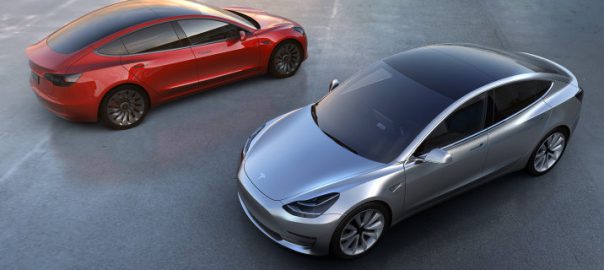
Tesla Model 3 Unveil (Image: Tesla)

Tesla Motors’ Elon Musk just killed the petrol car

“Adios gas-powered cars.”

[4 April 2016]  That was the reaction of Barclays analyst Brian Johnston over the weekend to news that Tesla Motors had received orders for nearly 200,000 of its Model 3 electric vehicle in less than two days.

Tesla Model 3 Unveil (Image: Tesla)

By nightfall on Saturday, that order tally had jumped to 276,000. That’s more than $US280 million in zero-cost capital to Tesla, from the $US1,000, $A1,500 and €1,000 deposits, and total orders for more than $A13 billion of electric vehicles.

It is – by a long shot – the fastest growing customer order book in the history of the automobile industry. And for a car that will not even enter production for 18 months, and has a price tag of $US35,000.

Barclay’s Johnston says the huge order numbers – more than the monthly sales of General Motors – suggests the tide is turning away from the internal combustion engine. Other analysts agreed.

“Tesla has changed the game again,”

said Andrea James, an analyst with Dougherty & Co. Alliance Bernstein’s Mark Jones also called it a “game changer”, and so too did Evercore ISI analyst George Galliers.

“To us the vehicle is ‘the game changer’ and will likely play a critical role in Elon Musk’s desire to expedite the auto industry’s transition from internal combustion engine to electric,”

Galliers wrote in a client’s note.

It’s hard not to agree with Johnston and the other analysts. There could have been no greater demonstration of the latent demand for electric vehicles than the response to the Model 3.

This is not just a Tesla thing, as alluring as the brand might be. It is a sign, noted Johnston and the other analysts, that the days of the internal combustion engine are numbered. Some say it may be over by 2025.

Musk has not played a lone hand in this. The German automaker VW managed to kill the future of the diesel car when it was forced to admit that its emissions claims were completely bogus – a development that forced it and other car makers to throw all their efforts into electric vehicles.

Read more: Renew Economy
The Disruption In Oil Markets Is Just Beginning

The near-term outlook for oil markets is a mess.

Forbes-blog_EV-chart_1200x698_Forbes

Price volatility recently reached its highest level since the global financial crisis as traders, investors and the industry as a whole try to sort through the significance of two big changes: the rapid rise of the upstart U.S. shale industry, which grew from essentially nothing in 2010 to being the world’s sixth largest source of oil supplies in 2015; and Saudi Arabia’s decision to abandon its role as market manager.

These are important issues for the near term, but they pale in comparison to a much bigger set of long-term issues. Two mega-trends are gaining steam that together have the potential to truly upend the energy industry.

First, signs of serious competition to oil in its most important market—transportation—are beginning to emerge. In the United States, more than 70% of the oil we consume is burned in our cars, trucks, ships and aircraft. The figure globally is only slightly less, at 64%. And for at least the past 100 years, oil has been the only game in town when it comes to mobility fuel.

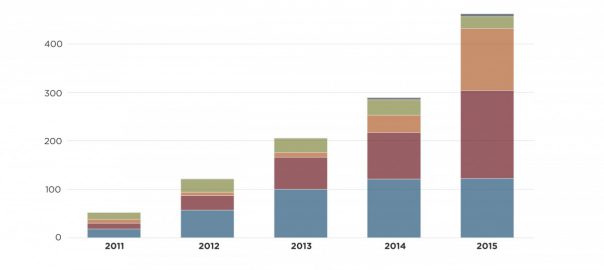
But based on a slew of data emerging over the past few weeks, that might be about to change. According to a new report from the Frankfurt School, global electric vehicle (EV) sales surged by nearly 60% last year, bringing the total number sold since 2011 to just over 1.1 million. That’s right—despite their higher purchase price, limited range and longer refueling times, electric vehicles took a massive step forward in 2015 even as oil prices collapsed. Incredibly, most of the growth came from China, where sales almost quadrupled compared to 2014.

Read more: Forbes

On Pretending That What’s Happening Isn’t Actually Happening

In December I found myself sliding into a state of extreme unwillingness to take on new projects, to continue work on those in hand, to write, or do much of anything else, really, at work or at home. I found myself prodded awake in the night by worries about global warming, the tides of war and migration, the ramifications of random, dismal environmental facts come upon during the course of a day’s work, or of social justice problems encountered in the news and on the streets of Chicago; about any of which I can do very little to help. There were too many meetings with environmental groups, and no time for walks. I could not look at a tree without wondering how its species would fare in coming, climate disrupted years. I had reached a state of incipient burnout.

144222931-638x425_global_warming_shutterstock
Thus, for a few weeks–a month and more, actually–after the solstice, I went into a state of semi-retreat. I did this by allowing myself to hope that COP21 would help bend the climate curve, and by pretending that our ongoing environmental catastrophe, of which climate change, is, after all, only a pernicious, deadly symptom, isn’t happening. I also attempted to pay less attention to the ever increasing spate of bad news, from war, to race relations, to migration, to the grim presidential race—and on and on and on, much of which is at least partly related to said catastrophe, with some industrial civilizational collapse, resource depletion and overpopulation thrown in.

Read more: Ecological Gardening

We Need to Keep 80 Percent of Fossil Fuels in the Ground (Image: Yes!/J. Eckwell)

Why We Need to Keep 80 Percent of Fossil Fuels in the Ground

Life depends on it. Bill McKibben on the big changes we’ve already made in remarkably short order.

We Need to Keep 80 Percent of Fossil Fuels in the Ground (Image: Yes!/J. Eckwell)

Physics can impose a bracing clarity on the normally murky world of politics. It can make things simple. Not easy, but simple.

Most of the time, public policy is a series of trade-offs: higher taxes or fewer services, more regulation or more freedom of action. We attempt to balance our preferences: for having a beer after work, and for sober drivers. We meet somewhere in the middle, compromise, trade off. We tend to think we’re doing it right when everyone’s a little unhappy.

But when it comes to climate change, the essential problem is not one group’s preferences against another’s. It’s not—at bottom—industry versus environmentalists or Republicans against Democrats. It’s people against physics, which means that compromise and trade-­off don’t work. Lobbying physics is useless; it just keeps on doing what it does.

So here are the numbers: We have to keep 80 percent of the fossil-fuel reserves that we know about underground. If we don’t—if we dig up the coal and oil and gas and burn them—we will overwhelm the planet’s physical systems, heating the Earth far past the red lines drawn by scientists and governments. It’s not “we should do this,” or “we’d be wise to do this.” Instead it’s simpler: “We have to do this.”

And we can do this. Five years ago, “keeping it in the ground” was a new idea. When environmentalists talked about climate policy, it was almost always in terms of reducing demand. On the individual level: Change your light bulb. On the government level: Put a price on carbon. These are excellent ideas, and they’re making slow but steady progress (more slowly in the United States than elsewhere, but that’s par for the course). Given enough time, they’d bring down carbon emissions gradually but powerfully.

Time, however, is precisely what we don’t have. We pushed through the 400 parts per million level of CO2 in the atmosphere last spring; 2015 was the hottest year in recorded history, smashing the record set in … 2014. So we have to attack this problem from both ends, going after supply as well as demand. We have to leave fossil fuel in the ground.

Read more: Yes Magazine

Severe Flooding, Against a Background of Wind Turbines: November 2012, Tyringham, Bucks. (Image: T. Larkum)

Do I need a bug out bag in the UK?

In case you were wondering. A bug out bag is typically a backpack containing enough items to sustain you for three days, or 72 hours. Thought by some, particularly Americans, as an essential item to have with you at all times. The reason for having a bug out bag is in case of natural or unnatural disasters. Or as some would call it. The zombie apocalypse.

Those that have bug out bags are often thought of as being ‘doomsday sayers’ or a bit strange. Particurly when you consider what Americans will include in their bug out bags. Which includes weapons for self defence.

Do I need a bug out bag in the UK?

But hang on a minute. Before we go down the ruling it out as a bit ott. Should we not consider our own situation in this country. The UK.

Severe Flooding, Against a Background of Wind Turbines: November 2012, Tyringham, Bucks. (Image: T. Larkum)
Severe Flooding (Image: T. Larkum)

Taking recent events and history in the UK as an example.

In the last couple of years we have been stuck in overnight traffic jams due to snow. Without electricity for three days. Stuck in a traffic jam for 7 hours because of a fatal accident. And more recently been flooded out of our homes. Admittedly, you don’t need to head for the hills and live like Grizzily Adams during these events, but just think how much easier our life’s would have been with a little preparation. The key is to think where you are most likely to be sent during an evacuation. The chances are that it will be a village hall or similar. It will also be more comfortable than trying to live in the woods. So it’s unlikely that you’ll need animal snares, knifes for skinning animals etc.

So do I need a bug out bag?

Perhaps not to the extent that the Americans go to. But I do think that a little common sense and a little forethought will help massively. Self reliance in such situations can make a very unpleasant situation tolerable. Think of a bug out bag not as a survival option for when the apocalypse comes, but more as a ‘comfort’ option, when you need to leave home quickly or get stuck in your car.

Read more: Midlife Crisis Man

BNEF report ‘EVs 35% of Global New Car Sales by 2040’ is ridiculously conservative

The Bloomberg New Energy Finance report that came out last week (press release at bottom) says that in 25 years, electric vehicles will make up just 35% of new car sales.

That means that in a generation from now, 65% of people will still be buying petroleum-based cars. It is hard to imagine a world where this few EVs makes any sense, even given BNEF’s own data.

The report and the numbers it presents are much too conservative for any reasonable circumstance. Take its own lede for instance:

“Continuing reductions in battery prices will bring the total cost of ownership of EVs below that for conventional-fuel vehicles by 2025, even with low oil prices.”.

Why would anyone buy a gasoline car when an electric or even a plug-in hybrid costs less than a gas car? Electric cars are cleaner, quieter, faster and safer than equivalent oil cars. Keep in mind that 2040 is 15 years after the cost of an electric car passes parity with oil in their scenario. Furthermore, by Bloomberg’s own estimates, batteries will reach less than one-third of today’s break-even prices.

Read more: Electrek

Automakers not currently promoting EVs are doomed

Why the company making your car in 2030 doesn’t exist yet

1_1_tesla_model-s_unk
Okay, let’s be honest. The sky isn’t falling – gas prices are. In fact, some experts say that prices at the pump will remain depressed for the next decade. Consumers have flocked to SUVs and CUVs, reversing the upward trend in US fuel economy seen over the last several years. A sudden push into electric vehicles seems ridiculous when gas guzzlers are selling so well. Make hay while the sun shines, right?

A quick glance at some facts and figures provides evidence that the automakers currently doubling down on internal combustion probably have some rocky years ahead of them. Fiat Chrysler Automobiles is a prime example of a volume manufacturer devoted to incremental gains for existing powertrains. Though FCA will kill off some of its more fuel-efficient models, part of its business plan involves replacing four- and five-speed transmissions with eight- and nine-speed units, yielding a fuel efficiency boost in the vicinity of ten percent over the next few years.

Recent developments by battery startups have led some to suggest that efficiency and capacity could increase by over 100 percent in the same time. Research and development budgets paint a grim picture for old guard companies like Fiat Chrysler: In 2014, FCA spent about $1,026 per car sold on R&D, compared with about $24,783 per car sold for Tesla. To be fair, FCA can’t be expected to match Tesla’s efforts when its entry-level cars list for little more than half that much.

But even more so than R&D, the area in which newcomers like Tesla have the industry licked is infrastructure. We often forget that our vehicles are mostly useless metal boxes without access to the network of fueling stations that keep them rolling. While EVs can always be plugged in at home, their proliferation depends on a similar network of charging stations that can allow for prolonged travel.

Tesla already has 597 of its 480-volt Superchargers installed worldwide, and that figure will continue to rise. Porsche has also proposed a new 800-volt “Turbo Charging Station” to support the production version of its Mission E concept, and perhaps other VW Auto Group vehicles. As EVs grow in popularity, investment in these proprietary networks will pay off — who would buy a Chevy if the gas stations served only Ford owners?

Read more: Autoblog

Peak Oil Returns: Why Demand Will Likely Peak By 2030

Will global oil demand peak by 2030? Is peak oil demand the new peak oil supply?

Many trends now point in the direction of this remarkable possibility:

  • In December the nations of the world agreed unanimously in Paris to leave most of the world fossil fuels in the ground.
  • Oil demand has been declining in developed countries for over a decade.
  • Electric vehicle sales are exploding around the world, especially China.
  • Battery prices are continuing their unexpectedly rapid price drop.
  • Tesla and Chevy now say their new 200-mile-range EV could cost Americans $30,000 — a game-changing price.

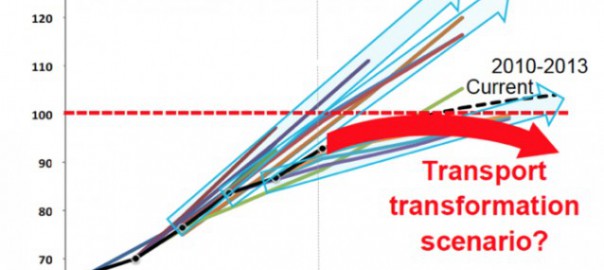
In November, a Bloomberg Business story, “The Oil Industry Has Been Put on Notice,” warned “the transformation of oil markets may be coming sooner than we think.” This recent Bloomberg New Energy Finance chart includes oil forecasts the International Energy Agency (IEA) has made since 1994:

16-638x497_BNEFoilpeak1_demand_IEA-BNEF_Bloomberg

Read more: Think Progress

Electric Vehicles Will Triumph Because They’re Better

Electric vehicle sales may be driven mostly by policy and preference right now, but they’ll soon be powered by dominant economics—including a profitable symbiosis between electrical drive and autonomous control, according to a former researcher for General Motors.

“What is going to happen here, I believe, is it’s just going to become easier to build an electric car,”

said Lawrence Burns, until recently the director of the Program for Sustainable Mobility at Columbia University and a professor of engineering practice at the University of Michigan. He served as General Motors’ corporate vice president of research & development and planning from 1998 to 2009. He now advises firms, including Google and Allstate, on mobility transformation.

Tesla Model S Drivetrain

“Beyond 2025, battery and fuel-cell vehicles could simply become the best way to design and engineer a light-duty vehicle,” Burns said tonight at the University of Chicago Booth School of Business. “Set aside all the motivations with climate change, oil dependence—it’s just a better way to do a car. It’s simple.”

Read more: Forbes

Kia Soul EV

KIA Soul EV Versus Nissan LEAF: An Owner’s Comparison

Hello, EV fans and interested parties! Trish, here. I know I’ve been pretty non-existent on this blog, but I’m finally chiming in to provide my thoughts on my new Soul EV. Further down, you’ll find Ty’s input as well, and a more technical analysis than I care to delve into.

Kia Soul EV
Kia Soul EV

I’m going to start this post off with a disclaimer: I’ve never been a fan of Kia. Moreover, I’ve always thought the Kia Soul was ugly as all get out and assumed that they were cheap and poorly made, and that I would never in a million years want one. So when Kia announced their new Soul EV, I was actually surprised to find myself liking what it had to offer; first, on a visual level, and then on a specs level.

And then I learned that they would only be offered in compliance states. In other words, not Washington. Sad trombone.

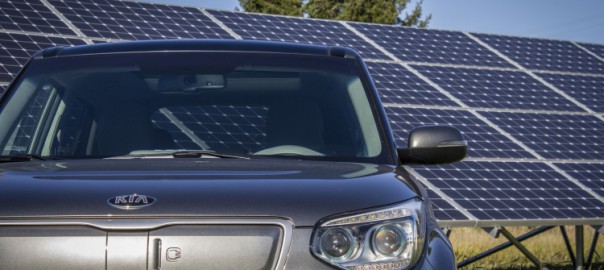
But then the 2016 Soul EV arrived, along with the announcement that it would be arriving at Washington Kia dealers this summer. And then they announced that the EV+ trim would be available with a “Sun & Fun Package,” which, most importantly, included a panoramic sunroof. And I was done for. Hook, line, and sinker: Kia reeled me in. On September 19th, we signed the lease papers at Smith Kia in Bellingham, and I drove my new titanium gray Soul EV+ with Sun & Fun Package home. Unfortunately, it was raining cats and dogs, so the sunroof needed to stay closed on her voyage home.

I’ve had many people in the EV community, most of whom have a Nissan LEAF, ask what I think about the car. After several months of driving it, I think I’m ready to share some of my feelings about it.

Read more: Inside EVs