Renault electric vehicles will continue to play a major role in the day-to-day running of the Eden Project and its drive to educate its millions of visitors on the environmental benefits of EVs after the world-famous attraction took delivery of a new fleet of 100 per cent electric ZOE and Kangoo Z.E models
Comprising of three Renault ZOE hatchbacks and 14 Renault Kangoo Z.E. in Van and Maxi Crew Van Cab specifications, the vehicles replace the Eden Project’s previous Renault EV fleet. The latest vehicles complement Eden’s existing Renault Twizys. The quadricycles’ compact dimensions make them ideal for use across the entire Eden site – even in the narrow pathways through the tranquil, climate-controlled Biomes.
Renault ZOE and Kangoo ZE (Image: Renault)
The usability and high visibility of its previous Renault EVs has allowed the Eden Project to lead by example when it comes to raising awareness of the benefits of electric vehicles in reducing carbon emissions. Compared to equivalent diesel and petrol vehicles, its original Renault EV fleet saved nearly 17 tonnes of CO2 since its inception in 2016, clocking up nearly 94,000 miles in and around its award-winning facility.
The mix of ZOE and Kangoo Z.E. will fulfil a variety of roles across the Eden Project, being used by its maintenance, horticulture, security, live programming and catering teams. A number of the vehicles will also be assigned to help with the provision of onsite medical support and transporting less able-bodied visitors around the site.
With zero tailpipe emissions and being near silent in use, the Renault EVs have little impact on the tranquillity and striking landscape of the Eden Project. Notably, during the last two years the lack of noise has allowed the busy Eden Live Team to work round the clock without affecting the visitor experience, while the fleet has also chauffeured presenters and celebrities to help facilitate the wide variety of filming that the renowned Cornish venue hosts every year.
Groupe Renault, Morbihan Energie, Les Cars Bleus and Enedis have joined forces to create FlexMob’île, an innovative programme aimed at accompanying the energy transition on the French island of Belle-Île-en-Mer.
This smart electric ecosystem is founded on three core activities, namely the sharing of electric vehicles, the stationary storage of solar energy and smart charging.
FlexMob’île sees Groupe Renault continue to develop the principle of smart islands, the first of which was Portugal’s Porto Santo.
Belle-Île-en-Mer (France), September 21, 2018 – In association with its partners the Belle-Île-en-Mer Community of Communes, Morbihan Energies, Les Cars Bleus and Enedis, Groupe Renault – a major player in the world of electric ecosystems – is delighted to unveil a brand new joint project known as FlexMob’île. The aim of this smart electric ecosystem is to facilitate the energy transition on the French island of Belle-Île-en-Mer which lies off the coast of southern Brittany. This initiative follows in the footsteps of the innovative Smart Fossil Free Island programme which has been operational since last February on the Portuguese island of Porto Santo in the Madeira archipelago.
Groupe Renault unveils France’s first Smart Island on Belle-Île-En-Mer (Image: Renault)
For the next 24 months, Groupe Renault and its public and private partners will be developing a smart electric ecosystem that has been conceived to reduce the island’s carbon footprint and increase its energy independence.
“We are thrilled to be collaborating with the Belle-Île-en-Mer Community of Communes, Morbihan Energie, Les Cars Bleus and Enedis on this project which is unprecedented in France. Our goal is the same as with Porto Santo. That is to say the implementation of global solutions that meet local needs using both tried-and-tested and more recent technologies. It will be possible to carry over the Belle-Île-en-Mer system not just to other islands but also to cities and suburban areas,” says Gilles Normand, SVP, Group Electric Vehicle Division.
The Felix Project takes delivery of seven all-electric Renault Kangoo Z.E. panel vans
Donation of vehicles strengthens the partnership between Renault UK and the London-based food charity
New Renaults will allow the Felix Project to grow its collection and distribution operation significantly
The Felix Project’s central London operation fleet will now be 100 per cent electric
Zero tailpipe emissions, ease-of-use and size make the Kangoo Z.E ideal for the charity’s London routes
Renault Kangoo Z.E. is priced from £14,799, excluding VAT, after the Plug-in Van Grant
Renault UK is growing its support of the London-based Felix Project with the donation of a further seven all-electric Renault Kangoo Z.E. panel vans. This will allow the charity to expand its operation to provide the capital’s most disadvantaged inhabitants with fresh food.
The development strengthens the partnership between the manufacturer and The Felix Project, which was established in November 2017 with the initial donation of a single Kangoo Z.E.
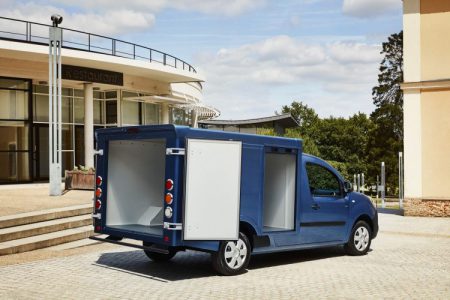
One of Felix Project’s Kangoo ZE electric vans (Imaged: Renault)
The additional vans will grow the charity’s fleet by more than 50%, enabling it to significantly increase the 20 tonnes of food they currently deliver each week. This is food which is fresh yet cannot be sold for a number of reasons, that they collect from supermarkets, wholesalers and other suppliers, and distribute free of charge to around 200 charities and schools throughout London. In turn, these organisations then provide meals, snacks or food parcels to those in need, including elderly or homeless people, struggling families, those with mental health issues, refugees and asylum seekers.
All of the vans will initially be based at the Felix Project’s central London operation. Vehicles that are already in-use in the depot will be allocated to the charity’s other sites with the result that the central operation’s distribution and collection service will be 100 per cent electric.
The constant stop/start for collections and drops, average journey lengths and the demanding nature of driving in the capital mean that the Kangoo Z.E. is the perfect vehicle for the Felix Project. Immensely easy to drive with users not having to worry about gear changes and enjoying instant response from the advanced drivetrain, the van is ideal for negotiating the city’s traffic, while also returning a significant saving on fuel costs and being exempt from the London Congestion Charge.
The ease-of-use is especially important to The Felix Project as the latest vans will not be assigned to one driver, but used by a variety of volunteers on evening runs into the capital. The Kangoo Z.E.’s payload of 640kg – near identical to that of its diesel counterpart – also makes it exceedingly versatile, the Felix Project’s existing Kangoo Z.E. is able to accommodate 32 crates of food, which is enough to deliver to four primary schools.
The Felix Project was established in early 2016 in memory of Felix Byam Shaw – the son of one of the charity’s founders – who died suddenly from meningitis in 2014. The idea for the charity was born out of Felix’s compassion for fellow youngsters who didn’t have his advantages and, in particular, after he played in a football match and discovered that some of the opposing team of 10-year-old boys from South London hadn’t had anything to eat that day.
Anne Elkins, Development Manager for The Felix Project’s school programme, said
“The new Kangoo Z.E.s will make a big difference to our operation, allowing us to plan more routes and also collect more donations that are made available on an ad hoc basis and which need to be collected in a short time frame. It’s great to have the extra capacity and the support from Renault.
“Our original Kangoo Z.E is a big hit with our drivers due to its manoeuvrability and being so easy to drive. The van really is a great fit for us as it does everything we need and adds another carbon efficient element to our operation’s ethos on protecting the environment by cutting down food waste and ensuring that good, nutritious food isn’t thrown away.”
Vincent Tourette, Managing Director, Groupe Renault UK, said:
“We’re exceptionally pleased to extend our support of The Felix Project. The charity is passionate in what it does and it’s a privilege for us to play a part in helping them to grow their operation and ultimately supply food to those in the capital who are in the most need. With its latest Kangoo Z.E. the Felix Project can extend their reach but also invest the majority of their current fuel and congestion charge costs back into other areas of the business.”
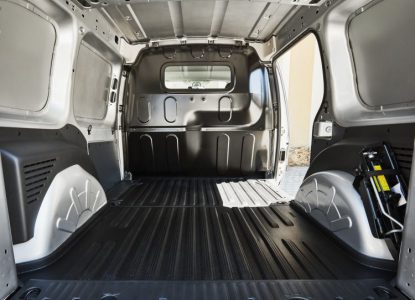
The Kangoo Z.E.33 has a real-world range of 124 miles and has a load capacity of up to 4.6m³, coupled with diesel-rivalling payload of up to 640kg. Together with the enhanced 33kWh battery, the Kangoo Van Z.E.33 benefits from an upgraded charger that reduces charging times and is twice as powerful as its previous one. The single-phase 7kW AC charger can take the new 33kWh battery to a full charge in just six hours, with the ability to ‘top-up’ the vehicle by up to 21 miles in just one hour. The Renault Kangoo Van Z.E.33 is available in a range of body styles, including Kangoo Van Z.E.33, Kangoo Maxi Z.E.33, Kangoo Maxi Crew Van Z.E.33 and Kangoo Maxi Crew Van Cab Z.E.33.
The automaker and city officials will also collaborate on future mobility services
Many European countries are considering ending sales of new gasoline and diesel cars, but the city of Paris isn’t waiting around. The French capital has already tested a “day without cars,” and has discussed banning internal-combustion cars by 2030. That makes Paris the perfect place to launch an electric car-sharing service.
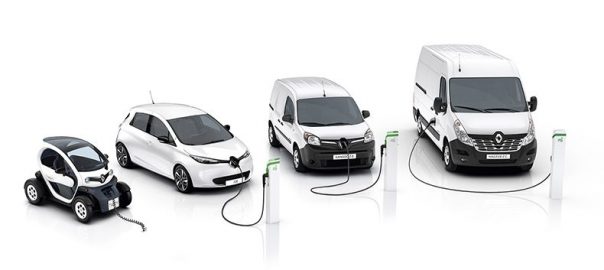
The Renault Electric Z.E. Range (Image: Renault)
Renault has teamed up with the city government to give Parisians access to electric cars. The automaker hopes the to continue working with Paris officials on future mobility services. For now, Renault is deploying a fleet of electric cars in Paris that residents will be able to access 24/7.
Cars set aside for longer journeys will be kept in designated parking lots and accessed via special stations. Other cars, designated for shorter journeys, will be accessible without the stations. Available cars will include the Renault Zoe hatchback, the Twizy neighborhood electric vehicle, and the Kangoo ZE and Master ZE vans. Renault hopes to have a fleet of 2,000 vehicles in operation by the end of 2019.
As a next step, Renault and city officials will initiate a “working group,” open to other cities and companies, “whose aim will be to think collectively about the integration of changes in mobility in the city,” a Renault press release said. The automaker hopes to involve the C40 network, a coalition of some 100 cities chaired by Paris Mayor Anne Hidalgo.
In June, Renault set a new all-time record for electric vehicles sales. The month saw sales of 4,498 EVs, which was 56% higher than a year ago, and 350+ units higher than the previous all-time record set in March.
For the Renault brand, EVs (not including the city Twizy) stand at 1.65% share of all sales in June, and 1.4% for the first half of 2017.
Renault electric vehicle sales in June:
Renault ZOE – 4,251 (up 73%)
Renault Kangoo Z.E. – 245 (down 42%)
In the first six months, Renault has sold total nearly 18,900 electric cars (up 34%), including nearly 17,300 ZOE.
Europe:
“Renault maintained its lead in the electric vehicle segment with a market share of 26.8%. Sales volumes increased 34%. Registrations of ZOE, Europe’s top-selling electric vehicle, rose 44%.”
France:
“ZOE remains the clear leader in the electric vehicle market, accounting for almost 70% of electric passenger car sales in France with over 9,200 registrations – a year-on-year increase of over 42%.”
The Kangoo Z.E. doesn’t account for many sales, but the new longer-range version maybe will enable higher sales.
The newly refreshed Renault Kangoo ZE is now on sale in the European market, bringing with it an improved range and a number of other changes.
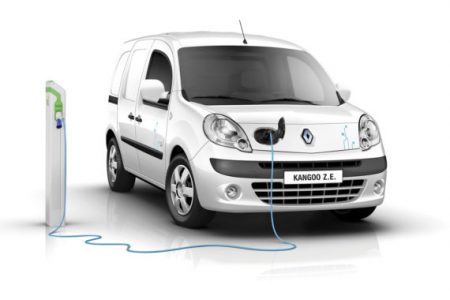
Reanault Kangoo ZE
The small electric van offering from Renault now features an official New European Driving Cycle (NEDC) range rating of 270 kilometers (167 miles). The company acknowledges that a real-world range of between 120 kilometers (74 miles) and 200 kilometers (124 miles) is probably more realistic, though.
That’s probably enough range to make the newly refreshed offering seem pretty attractive to many business operators, offering great potential to cut fuel and maintenance costs to a fair degree.
In addition to the improved range — courtesy of a new 33 kilowatt-hour (kWh) battery pack — the refreshed Renault Kangoo ZE also features an upgraded charging system and a heat pump that improves cold weather battery efficiency/range. The new battery pack was developed in partnership with LG Chem.
Green Car Reports provides more: “The new battery cells are denser but do not add additional weight to the Kangoo ZE, which means safety and payload are unchanged. Total power output from the electric battery and motor — shared with the Renault Zoe — is 45 kilowatts (60 horsepower).
“Additionally, Renault has added a dedicated heat pump to use less battery energy on climate control, which the brand says is a first for the light commercial vehicle segment. … In the coldest climates, the Kangoo ZE also benefits from an optional mini-heater for even more warmth.”
As far as the improved 7-kilowatt charging system, the Kangoo ZE can now be fully charged in 6 hours, rather than 7 hours, despite the much improved range.
Deliveries in Europe are expected to begin this summer.
French automaker Renault has given its small light commercial electric vehicle a handful of upgrades, including a significantly longer battery range.
Renault Kangoo ZE 2017
The Renault Kangoo ZE is now officially on sale with a longer rated range, a more powerful charging system, and a heat pump to keep the little van efficient in the coldest temperatures.
Renault revealed the Kangoo ZE back in 2010 as an electrified option for light commercial vehicle buyers, even before its 2012 Renault Zoe subcompact electric hatchback.
An electrified Master ZE joined the smaller van earlier this year. Just shy of six months later, the Kangoo ZE updates should receive a warm welcome from commercial-vehicle buyers with an eye for efficiency.
Rated range for the updated electric van jumps from 170 kilometers (105 miles) to 270 kilometers (167 miles) on the New European Driving Cycle.
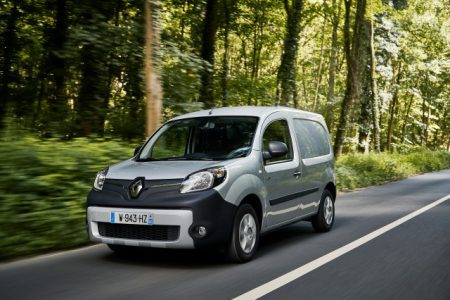
Renault Kangoo ZE 2017
However, Renault acknowledges the NEDC’s shortcomings, noting that a real-world range of 120 km (74 miles) to 200 km (124 miles) may be more likely.
That’s still a jump from its previous non-NEDC estimates of 80 to 125 km (50 to 77 miles).
The longer range is due to a new 33-kilowatt-hour battery, which was developed between Renault and LG Chem.
The head of Ford’s electric van programme has outlined the company’s strategy for promoting electric vehicles to commercial users, and said there is a ‘strong’ desire to reduce vehicle emissions within the business sector.
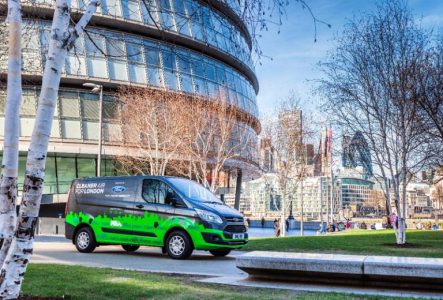
From autumn 2017 Ford will be trialling 20 hybrid electric Transit vans across London
Mark Harvey, director of Ford’s electrified van programme spoke to airqualitynews.com ahead of his presentation to the LowCVP conference in London this week, at which he revealed details of the company’s trial of 20 plug-in hybrid Transit vans for commercial users in the capital (see airqualitynews.com story).
The 12-month Transit plug-in hybrid trial will involve users including Transport for London, Metropolitan Police, British Gas and Addison Lee and will commence later this year.
Ford has revealed that the trial will use a telematics system to collect data on each vehicles’ financial, operational and environmental performance to understand ‘how the benefits of electrified vehicles could be maximised’.
Mark Harvey, director of Ford’s electrified van programme. Picture: Spencer Griffiths
Mr Harvey explained that the trial forms part of a wider commitment by the car maker to target the electrical vehicle market. He said: “Within Ford we have announced that we are investing $4.5 billion globally in electrified vehicle programmes between now and 2020 and that will deliver 13 new electrified vehicles in that time, of which the Transit Hybrid Custom vehicle that we are talking about is one.
“It’s a massive commitment from us and recent organisational changes in Ford also highlighted the importance of electric vehicles with Sherif Marakby [who has returned to the company from Uber] in a role in that space so it is absolutely exciting times.”
A leaked slide confirmed the plans to unveil two new U.S.-bound EVs under the Volkswagen brand.
Volkswagen Group is getting ready to hit the EV market hard. Between the recent news of a new Microbus successor and the continual improvement of Audi-brand EVs, Volkswagen is positioning itself in a very good way. But after a slide deck was reportedly leaked by Autoblog Netherlands, it seems that two new models are headed to the States.
The blog, which is written in Dutch, reveals the planned markets for several releases of electric vehicles under the Volkswagen brand between 2019 and 2022. These two models, the I.D. Lounge and I.D. AEROe are set to be released in the United States and China sometime between 2020 and 2021, assuming things go according to plan. To put this in perspective with Volkswagen’s other releases, the timeline also shows the following vehicles and the possible target dates for their corresponding markets:
Volkswagen I.D. – Released in the European market sometime around 2019
Volkswagen I.D. Cross – Released in the European and Chinese markets sometime between 2019 and 2020
Volkswagen I.D. Lounge – Released in the Chinese and United States markets sometime around 2020
Volkswagen I.D. AEROe- Released in the Chinese and United States markets sometime between 2020 and 2021
Volkswagen I.D. BUZZ – Release is still to be decided presumably between 2021 and 2022
Judging by the images, which are cars covered by sheets, the I.D. Lounge appears to be a full-size SUV, while the I.D. Aero seems to possibly fit a smaller hatchback profile, similar to the existing Audi A3 E-Tron. It is likely that these models will also be built in Volkswagen Group’s large electric assembly plant in Brussels, assuming it is up to the task of eight (five Volkswagen and three Audi) new EVs in the next five years.
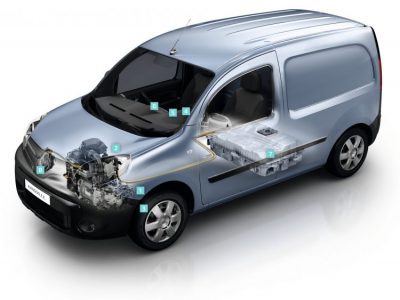
This summer Renault is introducing four major upgrades for the Kangoo Z.E. – a new battery, a new motor, a new charger and the incorporation of a heat pump for the climate control system.
Renault Kangoo Z.E. (Z.E. 33)
The battery option is the new Z.E. 33 (33 kWh), which extends range by around 50% compared to previous one:
270 km (168 miles) NEDC compared to 170 km
200 km (124 miles) real range in the summer (previously 125 km)
120 km / 135 km (84 miles) with heat pump in the winter
The new electric motor is still rated at 44 kW (225 Nm), but this time it’s all-Renault designed and produced, which should help with costs.
On-board charger power has (thankfully) doubled to 7 kW (now required 6-hours for a full recharge).
And finally, for the very first time in an electric LCV, there is a heat pump. Additionally, Renault has implemented a pre-heating feature. All welcome additions.