Category Archives: Volkswagen

News and reviews of Volkswagen electric cars (including plug-in hybrids).

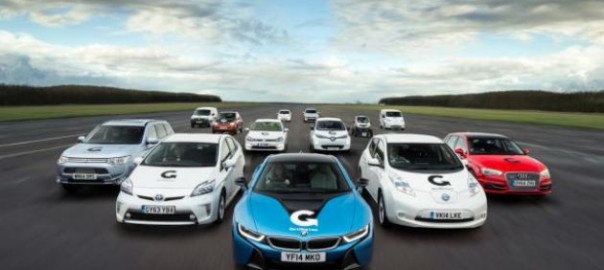
Go Ultra Low members boast 15 ULEVs across a range of segments (Image: OLEV)

Automakers race to double the driving range of affordable electric cars

Global automakers are readying a new generation of mass-market electric cars with more than double the driving range of today’s Nissan Leaf, betting that technical breakthroughs by big battery suppliers such as LG Chem Ltd will jump-start demand and pull them abreast of Tesla Motors Inc.

At least four major automakers — General Motors, Ford, Nissan and Volkswagen — plan to race Tesla to be first to field affordable electric vehicles that will travel up to 320 km (200 miles) between charges.

That is more than twice as far as current lower-priced models such as the Nissan Leaf, which starts at $29,010. The new generation of electric cars is expected to be on the market within two to three years.

To get a Tesla Model S that delivers 265 miles (427 km) on a charge requires buying a version that starts at $81,000 before tax incentives. Most electric cars offered at more affordable prices can travel only about 75 to 85 miles (121 to 137 km) on a charge – less in cold weather or when drivers have the air conditioning on.

Automakers need to pump up electric vehicle demand significantly by 2018. This is when California and eight other states will begin to require the companies to meet much higher sales targets for so-called zero emission vehicles — in other words, electric cars — and federal rules on reducing fuel consumption and greenhouse gases become much stricter.

BATTERY BREAKTHROUGHS

Tesla Chief Executive Officer Elon Musk said last week that

“200 miles is the minimum threshold” to alleviate consumer concerns over EV range. There is “a sweet spot around 250-350 miles that’s really ideal,” he said.

Musk has promised a more affordable Tesla, the Model 3, which will sell for around $35,000 and provide a driving range of 200 miles or more. That car is slated to begin production in mid-to-late 2017.

However, GM says it plans to field a 200-mile electric car, the Chevrolet Bolt, by late 2016.

The Bolt will use an advanced lithium-ion battery pack developed by Korea’s LG Chem, which also supplies batteries for the Chevrolet Volt hybrid. The newer batteries are said to have much higher energy density and provide much longer range between charges, thanks to breakthroughs in battery materials, design and chemistry, according to a source familiar with LG Chem’s technology.

“Several factors are at play that are landing at this 200-mile range” for a vehicle priced between $30,000 and $35,000, LG Chem Chief Executive Prabhakar Patil said in an interview. “We’ve been talking to several OEMs (automakers) regarding where our battery technology is and where it’s going.”

LG Chem also supplies standard lithium-ion batteries to the Ford Focus Electric and may supply the longer-range batteries to a new compact EV that Ford is tentatively planning to introduce in late 2018 or early 2019, according to three suppliers familiar with the program.

Compared with the 2015 Focus Electric, which has a range between charges of 76 miles, the new compact electric model would have a range of at least 200 miles, the suppliers said.

Nissan and VW both have battery supply deals with LG Chem, and both are working on longer-range EVs for 2018 and beyond.

Nissan is planning to introduce a successor to the Leaf in early 2018, according to a source familiar with the program, and that model is expected to offer significantly greater range than the current Leaf, the best-selling electric car in the United States, which can go 84 miles (135 km) between charges.

The 2015 Leaf uses batteries made by a joint venture between Nissan and supplier NEC. It is not clear if the future model will shift to LG Chem, although Nissan CEO Carlos Ghosn has identified LG Chem as a potential battery supplier.

VW plans to expand its current range of electrified vehicles, including a successor to the battery-powered e-Golf in 2018 with much longer range, according to two sources familiar with the program. The current e-Golf uses batteries made by Panasonic and has a range between charges of 83 miles.

Volkswagen plans to decide in the first half of this year whether new battery technology under development at U.S. startup QuantumScape Corp, which may expand an electric vehicle’s driving distance between recharges to as much as 700 kilometers (430 miles), is ready for use in its electric cars.

Source: Electric Vehicle News
Business Car Reviews Volkswagen e-Golf – Video

Here the Volkswagen e-Golf review is prepared by BusinessCar, who describes the German EV as being without unnecessary show.

According to the article, the electric version exudes all the usual Golf qualities in terms of cabin quality and classy understated looks.

85 kW of motor power is called reasonable, although the vehicle’s weight makes it less nimble than its petrol and diesel siblings.

Read more: Inside EVs

Volkswagen Releases Series Of e-Golf Videos

[January 2015]

https://www.youtube.com/watch?v=pbVgP8nwkLo

Would you like an overload of info on the new Volkswagen e-Golf? These multiple videos will provide you with more info on the e-Golf than you likely care to know.

The first video discusses different driving and regenerative braking modes.

Check out this e-Golf commercial. e-Golf is 2015 Motor Trend Car of the Year.

https://www.youtube.com/watch?v=LCCHcZabs_s

Like the other BEVs, you can control your e-Golf with a sophisticated smart phone app.

https://www.youtube.com/watch?v=kSZRsi5CG-g

Read more: Inside EVs

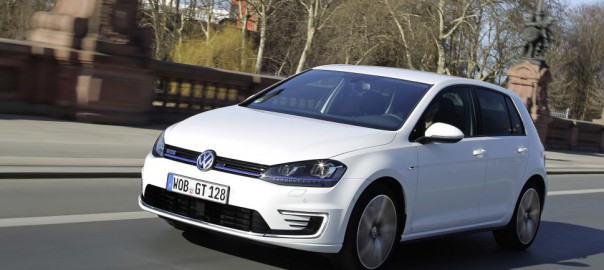
Volkswagen Golf GTE (Image: VW)

Volkswagen Leads Plug-In Electric Car Sales In Europe

Europe, with over 9,500 plug-in electric car sales in January 2015, far exceeded the US’ result of 5,924.

This year began especially strong for Volkswagen, which seems to now be most popular brand among plug-in electric car buyers.

We are not sure if VW will be able hold onto the #1 spot, but in January the automaker delivered over 2,300 cars (Golf GTE, e-Golf and e-up!) and some 2,800 if we include the whole VW Group (Audi and Porsche).

In second place is Nissan Tesla Renault Mitsubishi! Outlander PHEV had almost 2,000 sales, and with i-MiEV added in the result stood at nearly 2,100.

Nissan, combined with Renault (below 2,000), is at similar level, but only if we include Twizy.

Both BMW and Tesla are down in the hundreds range.

Well, Volkswagen might’ve come to the party late, but as a Group it’s moving forward to quickly become the sales leader in Europe.

Source: EV Sales Blog via Inside EVs

Go Ultra Low members boast 15 ULEVs across a range of segments (Image: OLEV)

New manufacturers join Go Ultra Low

Three new car manufacturers have joined Go Ultra Low, the campaign to increase awareness of ultra-low emission vehicles (ULEVs) among British car buyers.

Audi, Mitsubishi and Volkswagen have joined BMW, Nissan, Renault and Toyota to work with government to raise awareness of the benefits of ULEVs including low running costs and government incentives.

Between them, the seven Go Ultra Low members boast 15 ULEVs across a wide variety of model sizes and performance attributes, from family cars and vans, to SUVs and high performance sports cars. This broader scope of products has increased the appeal of ULEVs to more buyers, and increased uptake.

Go Ultra Low members boast 15 ULEVs across a range of segments (Image: OLEV)

With the recent announcement from OLEV that 23,083 claims have been made through the Plug-in Car Grant scheme, the number of electric cars and vans in the UK now exceeds 24,500 vehicles for the first time.

Hetal Shah, spokesperson for Go Ultra Low, said:

“More UK car-buyers are realising the advantages of owning an ultra-low emission vehicle, and the aim of the newly-expanded Go Ultra Low consortium is to share the multiple benefits with a wider audience.

“We’ve discovered that once people learn more about the benefits of these cars and vans, they’re keen to take action and once they’ve tried them, they’re hooked.”

With pure-electric vehicles able to travel around 100 miles on a single charge and other plug-in ULEVs boasting ranges of up to 700 miles, these efficient cars are a viable, low-cost option for millions of motorists across the country.

As well as tax benefits, government currently offers up to £5,000 of the price of ULEVs and the cost of driving them is as little as 2p per mile, compared to at least 10p per mile for a typical petrol or diesel car.

The Go Ultra Low campaign is the first of its kind, bringing together the Department for Transport, the Office for Low Emission Vehicles, SMMT and the consortium of seven car manufacturers.

Source: Newspress

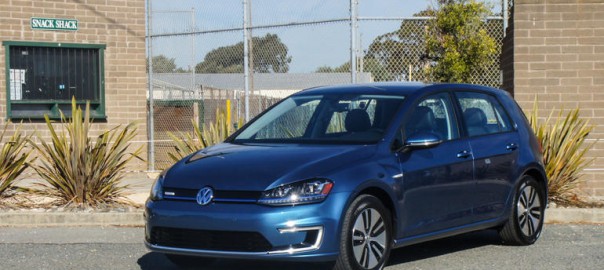
e-Golf is an attractive new electric from VW (Image: CNet)

e-Golf expands VW’s hatchback range into electrics

After a night charging up in the garage, the 2015 Volkswagen e-Golf’s display showed 108 miles of range when I pushed the start button. After slogging through San Francisco traffic then running down a rain-soaked freeway at 60 mph, covering 12 miles, the range figure was down to 82 miles, suggesting my real-world range from the garage had been 94 miles.

Still, it was considerably better than the EPA range of 83 miles for the e-Golf and illustrated the vagaries of electric car range estimates.

The e-Golf is Volkswagen’s entry into the electric car game, and incidentally broadens the Golf range beyond its gasoline and diesel offerings. As with other electric cars on the market, it could be considered a “compliance car,” necessary to meet zero emission vehicle (ZEV) sales requirements in seven US states that have adopted the ZEV mandate. Despite its limited range, however, I found nothing in the e-Golf to suggest it’s anything less than a fully realized car.

e-Golf is an attractive new electric from VW (Image: CNet)

Some of the e-Golf’s quality driving feel comes down to the base Golf model. Getting a major update for the 2015 model year, the new Golf is built on Volkswagen’s MQB platform, a modular chassis designed to handle a variety of drivetrains. The Golf GTI hot hatch and Golf TDI diesel share that platform and the basic Golf hatchback body with the e-Golf.

For the e-Golf, Volkswagen leaves out engine, transmission and fuel tank, replacing them with an 85-kilowatt motor driving the front wheels with a single reduction gear and a 24.2 kilowatt-hour lithium-ion battery pack. Impressively, this electric driveline gear does not impact the cabin space at all, nor does it unbalance the car. Instead, it gives the e-Golf 83 miles of zero emission driving, according to its EPA rating. The EPA rating of 116 mpg equivalent makes the e-Golf the most efficient compact electric car on the market.

As with electric cars from other manufacturers, Volkswagen offers just one well-stocked trim level. For the US, that means the navigation-equipped SEL Premium, at a price of $36,265 with destination fee. Volkswagen also offers the e-Golf in the UK, again with navigation, for a price of £30,845. UK buyers can shave off £5,000 with a government electric vehicle grant, and US buyers can figure in the government’s $7,500 tax credit.

Read more: CNet

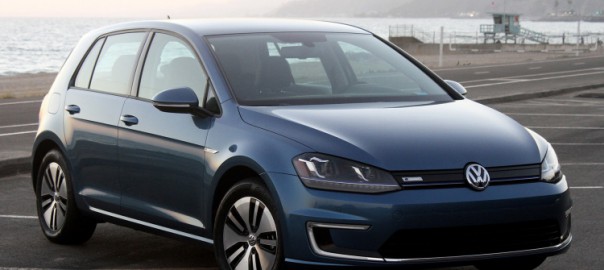
Volkswagen e-Golf (Image: J. Ramsey/Autoblog)

2015 Volkswagen e-Golf

Electrified Golf Is The EV We Could Live With

Until now, the only way you could get the words “electric” and “Golf” so close together was the put the word “cart” after them. Knowing that the e-Golf would be the next step in Volkswagen’s tilt at electrification, the automaker designed the MkVII platform to fit a myriad of drivetrains, none of which would require purchasers to sacrifice the Golf-ness that makes the best-selling car in Europe, not to mention a huge hit here in the States. In the e-Golf that means power electronics underhood and an amoeba-shaped battery that fits in the floorpan, between the axles, where it won’t ooze into the interior space.

We look at the e-Golf as another kind of crossover: traditional cars that just happen to be electric, offering a taste of the new EV religion in soothing, recognizable garb. We had one for a week in its natural habitat, Los Angeles and the surrounding area. We really like the fact that, powertrain aside, it maintains everything we dig about the Golf. The caveat is that this is an EV first and a Golf second – you must first address the EV challenges and live within EV constraints, then you can enjoy the Golf bits. Even so, it’s the electric car this writer would buy once we acquired the lifestyle to make proper use of it.

Volkswagen e-Golf (Image: J. Ramsey/Autoblog)

The most noticeable exterior change to the e-Golf are 16-inch Astana wheels wrapped in 205-series tires that reduce rolling resistance by ten percent. Once you’ve cottoned on to that, the other alterations become apparent: the blue trim strip underlining the radiator grille, the redesigned bumper with the C-shaped decoration LED lights and the full-LED headlamps above them, the little blue “e” in the model name on the rear hatch. You won’t notice the underbody paneling, that the frontal area of the e-Golf is ten percent smaller than that of a traditional Golf, that the radiator is closed off, or the reshaped rear spoiler and vanes on the C-pillars. Volkswagen says this results in a ten-percent drop in drag, getting the coefficient down to 0.281, but the standard Golf is also listed at 0.28. The TSI and TDI are 0.29. No matter those numbers, the point is the e-Golf looks just like… a Golf.

The 12,000-rpm, 85-kW electric motor equates to 115 horsepower and 199 pound-feet of torque, which compares to 146 hp and 236 lb-ft from the 2.0-liter diesel Golf. It takes 4.2 seconds to get to 37 miles per hour, 10.4 seconds to hit 62 mph, and the little guy tops out at 87 mph. That sounds like slacker acceleration, but it never feels that way – you can pull away from a light with the rest of traffic, and any time you need a squirt, 199 lb-ft of instant torque is there to woosh you forward.

Read more: Autoblog

2015 VW Golf 7 GTE (204hp)

Automann-TV

Fast Autobahn acceleration test of the 2014/2015 Volkswagen Golf 7 GTE with the twin engine concept delivering 204 hp and up to 350 Nm of torque. While the 1.4 TSI with 150 hp is already not really slow, they added the 102 hp electric motor out of the e-Golf to make this a proper GT(E). As you can see, this car really pulls once you put it in “B” (Boost?) and GTE-mode. I don’t really know why it is significantly faster than what VW claims but it also feels like more than 200 hp! Especially as I tested the Golf 7 GTD and GTI (220hp) I can tell that this hybrid is very close to the GTI! Besides that you get an “E-Mode” that let’s you accelerate pretty decent up to 130 km/h and drive totally quiet in cities….I personally like it! On top of that you get the quick shifting DSG (6-speed) that also shifts in E-Mode…very cool!

See also: Gas2.org: Is The Volkswagen Golf GTE As Fast As The GTI?

2015 Volkswagen e-Golf First Test: A Wintry Week Spent e-Golfing

Temperatures in the teens and 20s don’t make for ideal electric-vehicle driving conditions, but that was the weather presented during my week in Motor Trend’s electric Car of the Year. How’d it work? Way better than expected in every way except range, which plunged about as much as we were told to expect.

VW rates the e-Golf’s real-world range at 70-90 miles, the EPA says 83, and the range-remaining display generally started out saying 65 miles on these cold mornings, when started in the Normal driving mode. This mode automatically dials up a cozy 72 degrees on the climate control system, which is warmer than I would usually set it, but it refuses to remember my 69-degree setting upon restart. (Eco reduces the climate control power, and Eco+ switches it off, increasing the remaining range.) When I hit the buttons for electric windshield, rear-window, and side-view mirror defrosting, as well as both front-seat heaters, one morning, that range estimate dropped to as low as 48 miles briefly, but minutes later, as I toggled off the high-power glass heaters, the range rebounded to well into the 50s.

Read more: Motor Trend

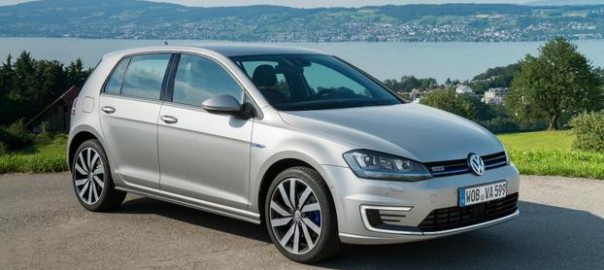
Volkswagen Golf GTE (Image: Evo)

Volkswagen Golf GTE Plug-in Hybrid

Volkswagen’s versatile 2015 Golf GTE plug-in hybrid has officially gone on sale in the UK.

Designed on the same Volkswagen MQB platform as the rest of the seventh-generation Volkswagen Golf family, the 2015 Golf GTE combines a 75 kilowatt electric motor mounted inside the gearbox and 8.8 kilowatt-hour lithium-ion battery pack with a 1.4-litre, TSI direct-injection gasoline engine capable of producing 148 horsepower.

Complete with a six-speed DSG gearbox designed specifically for use with hybrid drivetrains, Volkswagen says the Golf GTE is capable of producing a total power output of 201 horsepower (150 kilowatts) and a maximum available torque of 350 Nm (258 lbs ft) when both engine and motor work in concert.

In all-electric mode, Volkswagen claims a range of up to 31 miles per charge are possible, although based on previous brief drives with the Golf GTE we’d suggest a real-world range of between 20 and 25 miles per charge is more realistic.

Unlike some plug-in hybrids however, the Volkswagen Golf GTE operates in all-electric mode at speeds of up to 81 mph, with the gasoline engine only kicking in under extremly heavy acceleration. Due to its small size, the battery pack can be recharged from empty too full in just under four hours with a domestic power socket, or two and a quarter hours from an appropriate 16-amp charging station.

On power up, the Golf GTE’s default is to enter into all-electric mode, using up the energy in its battery pack first before switching on its gasoline engine. It can also be entered at any point during the trip after engaging anther mode by pressing the mode switch.

Like most other plug-in hybrids on the market today however, it’s possible to enter into ‘Battery Hold’ mode, which allows the driver to reserve their car’s battery charge for later use in the trip.

There’s also a ‘Battery Charge’ mode, which makes it possible for the Golf GTE to use excess energy from its internal combustion engine to recharge the battery pack as it is driving along. While this will result in temporarily dropping fuel efficiency, it does make it possible to drive in all-electric mode more than once in a trip although any driving made in electric mode using power generated by the engine has obvious emissions implications from an environmental standpoint.

Read more: Transport Evolved