Category Archives: Renault

News and reviews of Renault electric cars (including plug-in hybrids).

Zoe Battery Recovery (Image: Jo Pegram-Mills)

Driving style (example shown in Renault ZOE 22kWh)

One thing any existing or soon to be, Electric Vehicle driver should always bear in mind is ‘Driving Style’, this can sometimes, quite dramatically, impact your expected range.

Electric Vehicles are smart, they analyse your driving style and take this into account when estimating your expected range. If you are a rapid accelerator and tend to brake hard, you might find that your estimated range will drop quite low. I certainly have a tendency to forget this and simply enjoy the ride a bit too much when I’m doing short journeys, I find myself in this situation quite a lot.

But it can easily be rectified, you simply need to adjust your driving style, drive more economically and with a bit more consideration, soon you won’t realise you’re doing it and the car will give you better range expectations. The good news is that this is easy to do by just reacting to the feedback that the acceleration indicator on the dashboard gives you.

Your Visual Guide to Acceleration
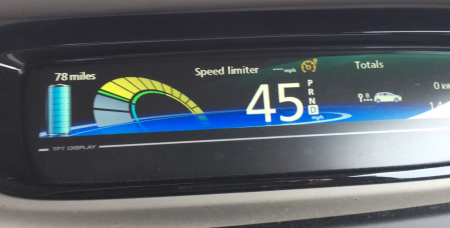
Zoe Accelerating (Image: Jo Pegram-Mills)

When you use rapid acceleration/peddle to the metal, it shows as many Yellow bars.

If you find you are constantly in yellow, be prepared to see your estimated range drop quite considerably.
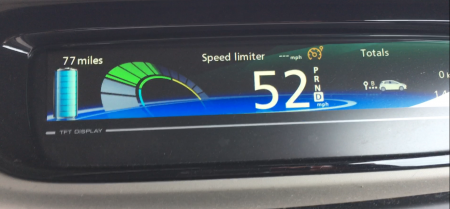
ZOE gradual acceleration (Image: Jo Pegram-Mills)

When you start driving more economically, with gradual acceleration, you can see this as fewer Green bars.

Get the most out of your range, try and stay within the green bars. If you switch to Eco mode the car will help you do this by restricting your maximum acceleration.

Success! Your range will become more predictable and consistent.

Your Visual Guide to Regenerative Braking

Regenerative Braking, also known as Battery Recovery is the clever trick where an Electric Vehicle reverses the behaviour of an electric motor. Instead of using electricity from the battery to create car motion, it uses the motion of the car to create electricity and recharge the battery. This results in the car slowing down.
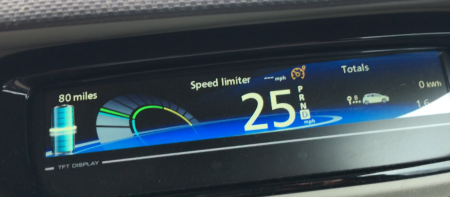
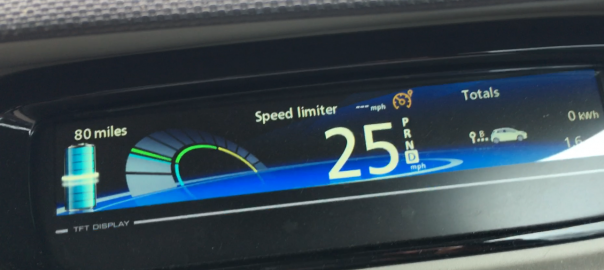
Zoe Battery Recovery (Image: Jo Pegram-Mills)

So, the battery recovery allows the car to slow itself when the road allows, and shows visually as Blue bars.

You will also notice the battery bar on the left gives a visual indication that a recharge is taking place. As a result, your range will sometimes increase the longer the car is moving without acceleration.
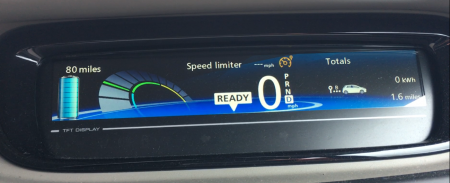
ZOE Display (Image: Jo Pegram-Mills)

An especially nice surprise is finishing your journey with more range than you started with. This can actually happen if you dramatically change your driving style during your journey, or if you do short trips. It’s a very satisfying moment and often results in excessive smugness.
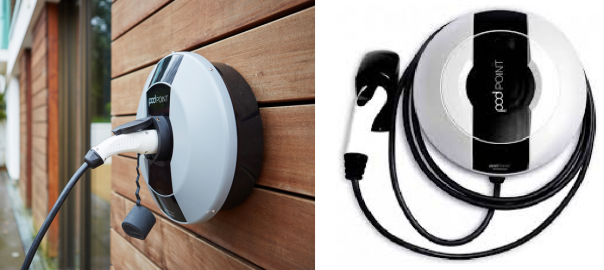
Untethered and Tethered Charge Points (Image: POD Point)

Choosing a Charge Point

When buying an electric car it is nearly always worthwhile to get a dedicated charge point installed at home.

It’s more convenient than an ‘occasional use’ or ‘granny’ (13 Amp) charge cable because you don’t need to reel it up and put it away each time.

Home Charging a Renault ZOE with a Dedicated Charge Point (Image: Charging Solutions)
Charging a Renault ZOE with a Home Charge Point (Image: Charging Solutions)

It will also be significantly faster because a dedicated charge point can provide more power without the risk of overheating. Also some electric cars, such as the Renault ZOE, don’t come with such a cable and buying one yourself can be very expensive (£500+).

The good news is that the installation of domestic charge points is subsidised by the UK government.

There are 3 decisions to be made when selecting the type of charge point for your car:

  • Tethered or Untethered
  • Connector Types
  • Power Level


Tethered or Untethered

There is usually the choice of a ‘tethered’ cable (it is fixed to the charge point) or an ‘untethered’ cable (it plugs into and can be removed from the charge point).

Untethered and tethered charge points (Image: Chargemaster)
Untethered and Tethered Charge Points (Image: Chargemaster)

Untethered has the advantage of allowing different cables to be connected (for example you can use the same charge point for a Nissan Leaf and a Renault ZOE). However, most people choose tethered because it avoids the inconvenience of connecting a cable whenever you need to charge (usually daily). It also reduces the risk of the cable being stolen.

A charge point with a tethered cable will usually cost more than an untethered one (typically about £50 more) because of the cost of its cable.

Untethered and Tethered Charge Points (Image: POD Point)
Untethered and Tethered Charge Points (Images: POD Point)

If you choose untethered you will need to use your own cable to connect to the car; it is the same cable that would be used to connect to a public charging point. It may come free with the car, for example the Renault ZOE or the Nissan Leaf with the 6.6kW charge option come with one. Otherwise you will need to buy one (we can advise you on suppliers).


Connector Types

All untethered domestic charge points supplied in the UK come with a Type 2 socket on the charge point, just as all public charge points now have (or at least officially should have) Type 2 sockets. Similarly all charge cables have a Type 2 plug at the charge point end.

Type 1 (5 pin) and Type 2 (7 pin) connectors

If the cable is tethered then you need to tell the installer the type of plug you want at the car end. This will depend on the car:

  • Type 1 socket: Nissan Leaf, Mitsubishi Outlander PHEV, Kia Soul EV
  • Type 2 socket: Renault ZOE, BMW i3, Tesla, VW e-Golf and Hyundai IONIQ

The Type 2 or ‘Mennekes’ connector is the official standard in Europe and should eventually replace the Type 1.


Power Level

A dedicated charge point can provide higher powers than a typical occasional use charging cable which will run at 10 Amps, equivalent at 230 Volts to 2.3 kilowatts. The charge will take place at the highest power that both the charge point can provide and the car can use.

There are two common power levels:

  • 16A = 3.5kW: This is the maximum charge level of the Nissan Leaf 3.3kW, the Mitsubishi Outlander and the VW e-Golf.
  • 30A/32A = 7kW: This is the maximum charge level of the Nissan Leaf 6.6kW, BMW i3, Kia Soul EV and Hyundai IONIQ. The standard Renault ZOE can use this level, in fact anything up to 22kW.

The higher power reduces the charge time so a typical EV battery will charge in about 8 hours at 16A but in about 4 hours at 32A.

It may be best to install the highest power charge point you can afford; even if your current car can’t use all the power, the next one almost certainly will be able to.

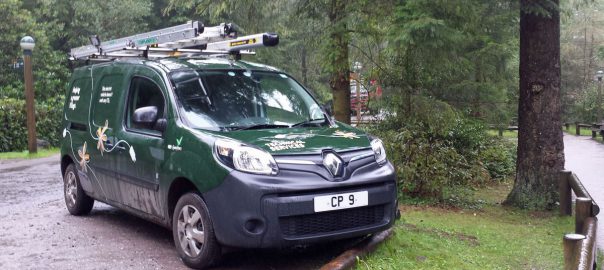
CenterParcs' All-Electric Renault Kangoo ZE Van (Image: T. Larkum)

Staying at Center Parks with a Renault ZOE EV

In the summer we spent the bank holiday weekend at Center Parks Longleat Forest with family. We travelled there and back in the ZOE.

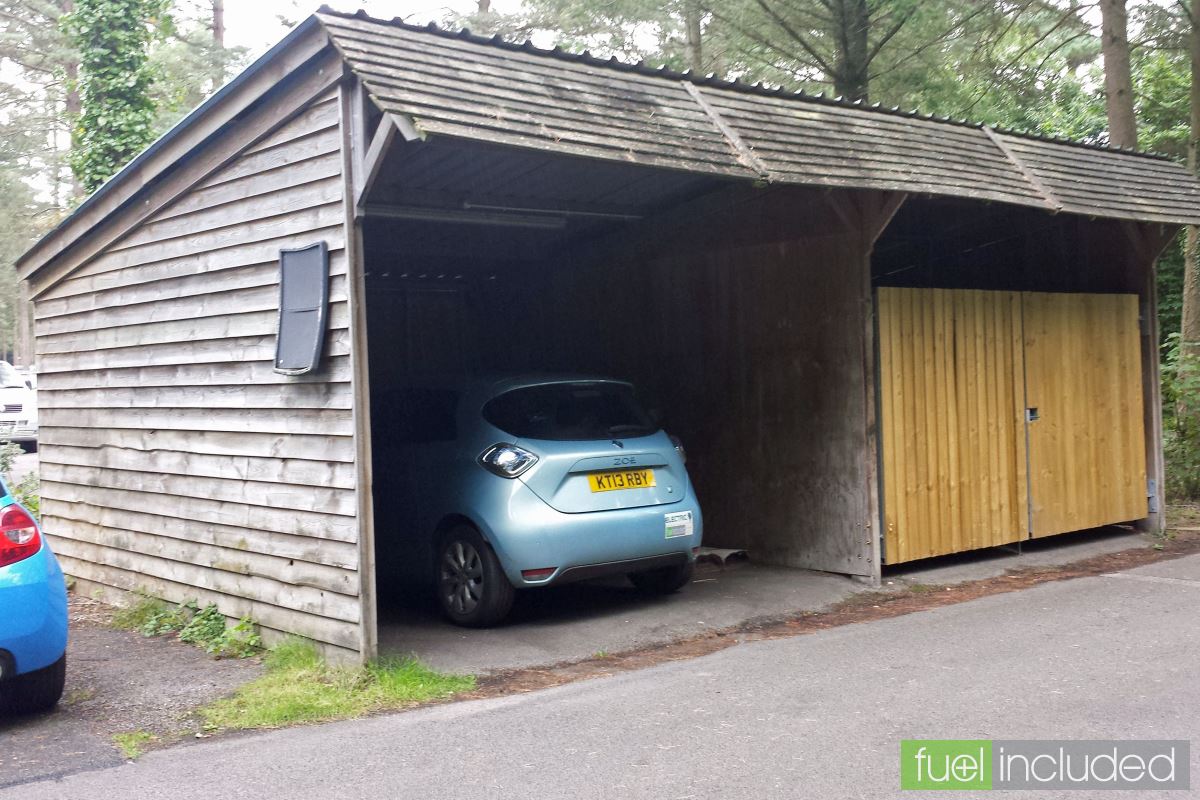
Naturally I hoped to charge while there but it turned out to be problematic. It seemed pretty clear that CenterParks was not setup for EV charging. Initially we were offered the use of a 13A socket in a shed in a far corner of one of the main car parks.

CenterParcs EV Charging Point in a Car Park Equipment Shed (Image: T. Larkum)

I plugged in and charging started fine. However, I was a bit sceptical and went back after a few hours to find that the charging had stopped, seemingly a circuit breaker had triggered. I restarted the charge, but disappointingly, I returned after a few hours to check on it to see that it had failed again.

CenterParcs EV Charging Point: the 13A socket above the bicycle (Image: T. Larkum)

I reported this and that night I was allowed to charge at the external sockets by the main entrance (next to the in and out barriers). However, the same thing happened and I gave up at that point. Instead we charged on our way home. So, overall, we were not too impressed with CenterParks’ provisions for EV charging (though apparently the provision of charge points has improved since).

CenterParcs' All-Electric Renault Kangoo ZE Van (Image: T. Larkum)
CenterParcs’ All-Electric Renault Kangoo ZE Van (Image: T. Larkum)

On the plus side, we did see that Center Parks were making use of all-electric Kangoo ZE vans for work around the park. And we did enjoy our time there, even if it was a bit pricey.

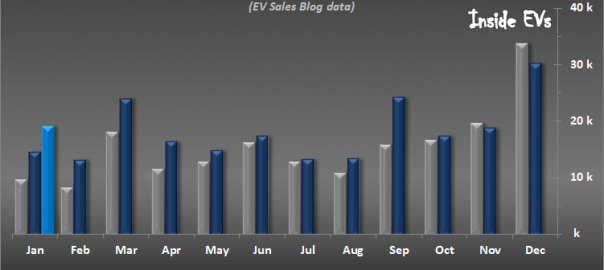
Plug-In Electric Car Sales In Europe – January 2017 (Image: InsideEVs)

Europe: 31% More Plug-Ins Sold In January 2017 – Renault ZOE In Charge

Europe began 2017 with solid growth of plug-in electric car sales, up 31% year-over-year according to the EV Sales Blog report. In total, roughly 19,000 units were sold, which is not only the best January ever, but also one of the better months ever.

Renault ZOE took an early lead with 2,602 sales (up 80 percent) after securing 1st place in 2016.

Plug-In Electric Car Sales In Europe – January 2017 (Image: InsideEVs)

In second place was the BMW i3 (1,818), which gives us one way to compare sales of different battery sizes. Renault is seeing better sales of the new 41-kWh ZOE, while i3 continues to sell the 33-kWh i3. Obviously, these cars are quite different, but with EVs, range does matter. And, if BEV sales are so tightly connected to battery pack capacity/range and price, we are eager to see the Opel Ampera-e later this year.

Nissan LEAF keeps seeing strong sales in Europe, taking 3rd place in January with 1,386 sales (up 29%). This EV’s battery increase – from 24 kWh to 30 kWh – wasn’t all that dramatic, and the Japanese manufacturer needs to do more soon. The top three BEVs sold in Europe totaled 5,806 units, which was 30.5 percent of all plug-in car sales. Tesla sold some 819 Model S (#7) and 586 Model X (#11) EVs.

Read more: Inside EVs

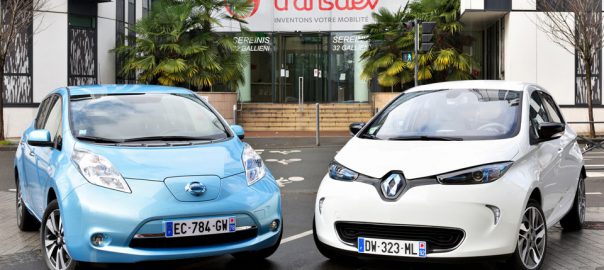
Renault-Nissan To Test Fleet Of Autonomous Zoes In Paris

The Renault-Nissan Alliance has announced a partnership with autonomous vehicle services company Transdev which will see a fleet of self-driving Renault Zoe models hit the streets.

In a statement, the two automakers said that they will collaborate with Transdev to develop a modular transportation system that enables clients to book vehicles and for mobility operators to monitor and operate self-driving car fleets.

The partnership will start with fields tests in the Paris-Saclay business area and involve Transdev’s on-demand dispatch, supervision and routing platform.

Speaking about the deal, Renault-Nissan Alliance senior vice president of connected vehicles and mobility services, Ogi Redzic, said

“As the mobility services landscape keeps evolving, we have a great opportunity to offer innovative, connected mobility solutions for the evolving needs of our customers, fully aligned with our vision of a zero-emission, zero-fatalities society.

“Partnering with Transdev allows us to share our knowledge as leaders in electric vehicles, autonomous drive and connected-car technologies with one of the largest multi-modal mobility operators worldwide. Together we will develop an advanced driverless mobility system that will enhance existing public and on-demand transport systems.”

Source: Car Scoops

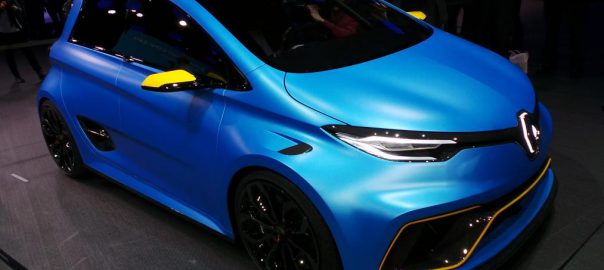
Renault ZOE e-Sport Concept (Image: AutoExpress)

Renault ZOE e-sport concept whizzes into Geneva 2017

Crazy electric Renault ZOE e-sport concept has 456bhp, four-wheel drive and extreme weight saving

Renault has a history of using its Renaultsport department to create crazy concept cars, and at this year’s Geneva Motor Show the company has followed up the mad Espace F1 and Twizy F1 with a new ZOE concept using the firm’s Formula E technology.

Renault ZOE e-Sport Concept (Image: Renault)

Called the ZOE e-sport, it’s a radical two-seat interpretation of Renault’s all-electric city car, boasting an aggressive, angular, wide bodykit, a colour scheme in homage to the Renualt e.dams Formula E team, and most importantly a four-wheel-drive powertrain borrowing Formula E technology.

Two electric motors are on hand to deliver 456bhp – almost 200bhp more than governed 270bhp limit of a Formula E single seater. There’s also up to 640Nm of torque available, and power is supplied by a 40kWh battery pack.

With this powertrain technology on-board, Renault claims the ZOE e-sport manages 0-62mph in 3.2 seconds, and it takes less than 10 seconds to reach its limited top speed of 130mph.

With that heavy electric powertrain and battery pack in place, Renault has gone to extreme measures to try and keep the ZOE e-sport’s weight down. The bodywork is made from carbon fibre, while the steel roll cage incorporates Kevlar panels. Despite the diet, the ZOE e-sport still comes in at 1,400kg.

A wider track is combined with a lower rider height and double-wishbone suspension front and rear, complete with four-way adjustable dampers.

Renault ZOE e-Sport Concept (Image: AutoExpress)

Plenty of aerodynamic trickery is woven into the all-carbon body. A large air dam and splitter set-up is found at the front of the car, while the ZOE e-sport also features a flat floor and large rear diffuser. Gaping tracts in the rear doors, a large rear spoiler and 20-inch centrally-locking diamond cut aluminium wheels complete the racecar inspired look.

In the cabin, two large Recaro bucket seats with race harnesses are found, alongside a rectangular steering wheel and a square dashboard display used to adjust powertrain settings. A new, de-cluttered concept interior design with lashings of Alcantara and angular switches and vents is employed.

According to Stéphane Janin, Renault’s Concept Car Director, the brief for the ZOE e-sport was to have fun, explaining: “we came up with something midway between a production model and a racing car”. Despite the production model influences, the ZOE e-sport will remain a one-off concept.

Source: AutoExpress

First drive: Renault Zoe ZE40 Signature Nav electric car review

Review

Six years after the mainstream launch of the Nissan Leaf, range anxiety is still a barrier for many when it comes to adopting electric vehicles. It’s a barrier Renault hopes to demolish with the updated ZE40 edition of the Zoe compact electric hatchback, which almost doubles the vehicle’s range on the NEDC cycle, from 130 miles per charge, to 250 miles.

In real life, the manufacturer says that means an expected range of 186 miles, which it believes will be enough for many drivers to attempt the switch to electric.

The new battery system occupies the same space as the old one, and is only marginally heavier, but offers substantially more capacity. But, aside from the fancy new battery technology, the car itself is largely unchanged.

Renault has introduced a new top-spec trim level, called Signature Nav, which includes a Bose sound system, rear parking camera, leather heated seats, and some different interior colours.

The top spec trim level seems unnecessary on this car, and the darker interior loses some of the character of lower trim levels. Dynamique Nav, the mid-range spec, remains the pick. The light and airy blue and white interior of Dynamique Nav better fits the character of the car – friendly, accessible and classless.

There is one other area that has been improved that is worth a mention – connectivity. From midway through this year, the car will be compatible with a system called Z.E. Trip, a phone and car app combination that links into real-time charging systems, and shows live charging point availability. When the driver reaches the charging point, the Z.E. Pass will allow them to pay through the infotainment system for their charge.

Renault says the vast majority of Zoes sold in the UK are still bought under the battery lease programme, which will continue to operate.

Battery lease pricing starts from £59 on the new ZE40 vehicle, £10 a month more than the old 22kw model.

After plug-in grant, a battery lease ZE40 model starts from £17,845, nearly £4,000 more than the new price of the old model, which remains on sale. Those opting for full battery-included ownership will stump up £23,445.

Despite the cost premium, the new Zoe ZE40 is a serious contender in the electric vehicle sector. It may be smaller than the Leaf, but it has more range and a more modern interior, and is still significantly cheaper – upfront, at least – than a BMW i3.

Read more: FleetNews

Renault ZOE Z.E. 40 (41 kWh) Battery Visualized

The new Renault ZOE Z.E. 40 proves that it’s possible to double battery capacity, without redesigning an entire car.

The key is to originally develop a battery pack that could handle future modules with more energy dense cells (see video below).

In the case of ZOE Z.E. 40, available energy went up from about 22 kWh to 41 kWh, while the dimensions of the battery remained unchanged, with the weight increasing by only 15 kg (33 lbs) – from 290 kg to 305 kg (5%).

Physically, Renault still uses a 192 cells (LG Chem) in 12 modules (16 cells per module) configuration.

With 41 kWh of energy in the sub-compact model, a real world range of 300 km (186 miles) is possible (officially in Europe the ZOE is rated at 400 km on the NEDC scale).

Source: Inside EVs

ZOE Winter Testing

ZOE it’s cold outside (or how I got my heating working)

♪ ♫ When the weather outside is frightful

the ZOE’s not so delightful

but now I know what to do

my fingers aren’t quite so blue! ♫♪

OK, I know we are past the month of December but with the current cold snap I am elated to finally have the answer to my winter woes. Don’t get me wrong I love my Renault ZOE 22kWh, but one thing I’ve always struggled with is heating her up. I’m not talking about the great pre-heat function; this is for those times when you either forget the pre-heat or you are out and about and want to get in your car knowing you can easily pop on some heat.

I have been driving my ZOE for two winters and have always been cold. I had just assumed it was a limit of the car, but having experimented, I realised there is just a bit of a knack to getting the heating to work right.  I now don’t have to wear full hat, gloves and scarf in the car!

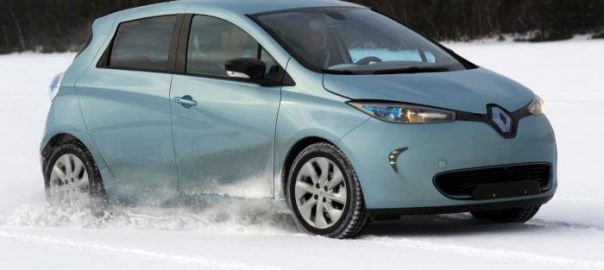
ZOE Winter Testing
ZOE Winter Testing

After reading a few posts and trying out a few carefully selected combinations it would seem I have my solution ,these are the steps I follow and try to stick to in this order.

  • Set your heat to 24 degrees, not full whack
  • Select fan speed 3
  • Make sure Air Con is Off
  • Turn on Air Circulation
  • Leave on windscreen fan for the first minute or so
  • Change the fan direction and speed to your preference after a few minutes

Just in time for err Spring [facepalm]

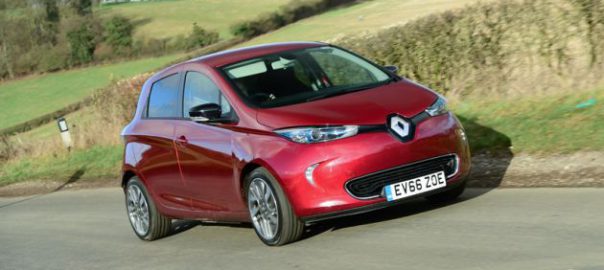
Renault ZOE Z.E. 40 in Mars Red (Image: NGC)

Renault Zoe Z.E. 40 first drive

Renault’s new Zoe Z.E. 40 promises the greatest range of any mainstream EV on the market today.

With an official range of up to 250 miles depending on model, only Tesla’s line-up can beat that range figure, but they cost far more than twice the amount of the little Renault. Next Green Car got behind the wheel of the new longer-range EV to see how it performs on a cold and misty winter’s morning in the UK.

Review by Chris Lilly

WHAT’S CHANGED?

Renault ZOE Z.E. 40 in Mars Red (Image: NGC)

We’ll start with the biggest and most significant change to the Zoe – the battery. Previous models were equipped with a 22 kWh battery which is good for an official range of 149 miles on a single charge. The new version now packs a 41 kWh battery with a quoted range of 250 miles. The previous 22 kWh model is still available in one specification, but it is the Zoe Z.E. 40 with almost double the battery capacity that is the big news and the model being pushed.

The extra range has been achieved by ‘chemical wizardry’ according to the presentation from Renault’s PR team, but essentially the engineers have made a battery with greater energy density through tweaking and improving the materials used. All of this means that the extra capacity battery is the same physical size, so it fits in the Zoe without the need for costly re-engineering.

Other changes include a new top-of-the-range trim level Signature Nav, which includes leather upholstery, bronze highlights inside, rear reversing camera, new alloy wheel design, and Bose stereo. All models get slight design tweaks inside and out, though you will be hard pushed to list them.

Charging has changed only in the sense that it now takes longer to top up the battery. Available in both rapid charge-capable 230 mile specification, and non-rapid 250 mile trim, the Zoe Z.E. 40 will take varying amounts of time to charge. The 250 mile model tested can connect to a 43kW rapid charger, but will only be charged from 0-80% in one hour and 40 minutes. A 7kW home charger – which comes free with a new Zoe Z.E. 40 – will complete a full charge in a little under seven and a half hours. The 230 mile model cuts rapid charging time to just over one hour, but increases the 7kW charge time by an hour. This is compared to the one hour rapid charge, and four hour 7kW charge offered by the 22kWh model.

Read more: Next Green Car