Pilot scheme beginning today aims to cut electric vehicles’ running costs and reduce energy usage from 2020
Renault has launched a revolutionary pilot scheme that aims to prove the feasibility of vehicle-to-grid charging systems by placing energy storage units aboard electric vehicles (EVs).
A fleet of Zoes have been adapted to enable reversible charging, which could help to bolster electricity supply at peak times. Renault anticipates that the technology will be ready for installation on customer vehicles as early as next year.
2018 – Renault ZOE
The system enables electric vehicles to stockpile energy supplies at times of low demand and then transfer electricity back to the grid when appropriate. By moderating power usage in this way, it could reduce strain on national electricity infrastructure, promote energy conservation and save its users money on running costs.
The first trials begin today in the Dutch city of Utrecht, in partnership with We Drive Solar, and on the Portuguese island of Porto Santo, where the scheme is backed by energy supplier Empresa de Electricidade da Madeira.
After taking a look at Motor1.com UK’s homepage this week, one could assume the death of the internal combustion engine is right around the corner. That’s not entirely true but it’s more than obvious that nearly every automaker is embracing electrification under full power these days. And the latest to show progress is Renault which is now testing the second-generation Zoe on public roads.
2018 – Renault ZOE
Seen here is a heavily masked prototype of the all-electric car undergoing cold winter evaluations in Northern Europe. Interestingly, the shape of the trial car is almost completely identical to the Zoe that’s still on sale today. The camouflage is not letting us see many details of the body, but it appears that the EV will be slightly larger than its predecessor.
The resemblance to the current Zoe is especially striking at the back where even the light clusters seem to have an identical shape. Up front, we notice a larger Renault logo flanked by sleeker headlights probably using LED technology. Of course, at this early stage of testing, some of our assumptions might not be completely correct.
Renault has sold 200,000 electric vehicles in Europe since its Z.E. range was launched in 2011
In France, the fourth biggest global market, Renault has registered 100,000 electric vehicles
Renault is number one in electric vehicle sales in Europe for the fourth consecutive year
ZOE and Kangoo Z.E. remain the flagship models in the group’s electric offensive
Renault has topped the 200,000 mark for sales of electric vehicles in Europe. At the same time, it has crossed a symbolic milestone in France with 100,000 vehicles registered. This double achievement underlines Renault’s position as leader in the European electric vehicle market, with steady growth in sales.
2018 – Renault ZOE
Almost one electric vehicle in every three sold in Europe is a Renault
A pioneer in electric vehicles with a range launched in 2011, Renault continues to lead the European electric vehicle market for the fourth consecutive year. Almost one electric vehicle in every three on European roads is a Renault. In 2018, Renault sales of electric vehicles in Europe surged by 36%, accelerating strongly in the second half-year to + 62%. In France, Renault holds a 56.8% share of the electric vehicle market, in both passenger cars and LCVs.
“Today, we are proud to say that over 200,000 customers in Europe have chosen Renault to make electric driving part of their everyday lives! And of course this is just a step on a far longer journey. Our clearly stated aim for the past ten years has been to make electric mobility available to everybody. Groupe Renault’s ambition is for electric vehicles to account for 10% of sales by 2022. To achieve this, it will build on the eight electric vehicles that will make up the range by this date,” says Gilles Normand, Senior Vice President, Electric Vehicles, Group Renault.
An electric vehicle with artificial intelligence (AI) sensors and computers is set to embark on a 1,200 kilometer (745 mile), three-month journey in Queensland, Australia.
The zero-emissions Renault ZOE will be used to map roads in the state, which is in the northeast of the country. Researchers from the Queensland University of Technology (QUT), which is based in Brisbane, will man the car.
“As researchers drive the car across Queensland, onboard sensors will build a virtual map to help refine AI-equipped vehicles to drive safely on our roads,” Mark Bailey, Queensland’s minister for Transport and Main Roads, said in a statement Wednesday.
2018 – Renault ZOE
Bailey added that while it was “early days”, AI technology and smart road infrastructure had the potential to transform the way people travelled in Queensland and “reduce road trauma.”
The project will look at how the vehicle and its AI system adapts to lane markings, traffic lights and street signage. Additionally, it will look to overcome GPS systems’ limitations “in built-up areas and tunnels for vehicle positioning.”
Michael Milford, from QUT’s Australian Centre for Robotic Vision, said that as the vehicle was driven, AI would “watch and determine if it could perform the same as a human driver in all conditions.”
With reduced taxes, well-proven technology and expanding infrastructure, it is now becoming more and more convenient to run electric vehicles when compared with running petrol or diesel vehicles
Electric vehicles are already looking cheaper to run for individual drivers compared with petrol or diesel but, when it comes to fuelling a fleet, businesses will still want to arrange preferential rates to make the numbers work at scale.
There are huge savings to be made by drivers who switch to electric vehicles (EVs) from petrol or diesel, according to Ben Fletcher, of Renault UK.
The Renault ZOE hatchback, for example, is 100pc electric, has a WLTP driving range of 186 miles and costs just “2p per mile whereas an equivalent petrol or diesel would typically be around 12p”, says Mr Fletcher, head of electric vehicles in the UK for the French manufacturer.
West Sussex Council Fleet Goes Electric With Renault ZOE (Image: Renault)
The amount of electricity it takes to charge an EV costs around a third as much as buying petrol for a normal car
Not only is the cost lower, drivers can also have peace of mind about where their electricity comes from, with far greater control “over who provides their energy, whether it comes from a renewable source and what tariff they are on, than they would do if they fill their cars with petrol or diesel on a forecourt”, he adds.
Both considerations are important for individuals, but when it comes to corporate approaches to transport they take on even greater significance.
Renault’s electric cars, for instance, are mirrored by a range of Renault Pro+ electric vans, demonstrating the opportunities for companies to switch to electric even on multi-tonne light commercial vehicles.
Fleet managers with multiple EVs will see considerable fuel savings and a large reduction of tailpipe emissions. Jon Lawes, managing director of Hitachi Capital UK’s vehicle solutions business, says: “If all of Britain’s vans and heavy good vehicles [HGVs] were to switch to electricity, businesses could save around £14bn a year in fuel costs alone.”
Renault has introduced a new flagship S Edition model to its all-electric ZOE line-up, with more equipment and added technology
Renault has updated its all-electric ZOE line-up, adding a new flagship model called the S Edition. Priced from £19,270 (including the government’s £3,500 plug-in car grant), the new trim level replaces the ZOE Signature Nav as the range-topper, adding more standard equipment for a lower price.
The new Renault ZOE S Edition gets a BOSE stereo with DAB radio, a choice of either 16-inch or 17-inch alloy wheels, a reversing camera and leather upholstery with lumbar adjustment on the driver’s seat.
Renault ZOE
Other features include parking sensors, automatic lights, rain-sensing wipers, climate control, a leather steering wheel, electric windows, electrically folding door mirrors and a seven-inch infotainment system with voice-controlled sat-nav.
A choice of two motors are available for the ZOE S Edition; a quick-charge Q90 unit with 86bhp or a more potent R110 model with 106bhp and 225Nm of torque. Both motors have a range of 186 miles under WLTP regulations, and the Q90 model can be charged to 80 percent capacity in 65 minutes using a 43kWh fast charger.
Europcar Mobility Group orders 85 all-electric Renault ZOEs for its UK car sharing and Deliver & Collect operations
A number of units to be used by E-Car Club to extend its cost-effective, low-emissions car share schemes
Majority of E-Car Club’s new Renault ZOEs to be made available at brand new Solihull locations
Order will also work to significantly lower the carbon footprint of Europcar’s city-based Deliver & Collect service
Ease-of-use, environmental compatibility and real-world range of 186 miles influence repeat order
Renault was the number one electric vehicle manufacturer in 2018, whilst the Renault ZOE is one of Europe’s best-selling electric cars
ZOE available from £18,420 on-the-road (after PiCG)
Over 5,000 Renault ZOEs are included in European car-sharing schemes
The UK’s leading low-emission car sharing club has reaffirmed the suitability of the all-electric Renault ZOE for its growing operation as its parent company, Europcar Mobility Group, orders a further 85 of the award-winning supermini.
E-Car Club – ecarclub.co.uk – has taken a number of units, supporting its expansion across the UK, from East London to St Andrews, Scotland. Through the innovative scheme, E-Car Club provides the public with a low-cost, hassle-free and environmentally friendly alternative to private car ownership and customers can hire a Renault ZOE from only £4.50 per hour, including power and insurance.
Europcar adds 85 ZOEs to its car-sharing service (Image: Renault)
The majority of E-Car Club’s newly acquired, 40 kWh Renault ZOEs, will be used for a brand new scheme in North Solihull, which sees the popular EV available to members at nine locations throughout the region’s residential areas.
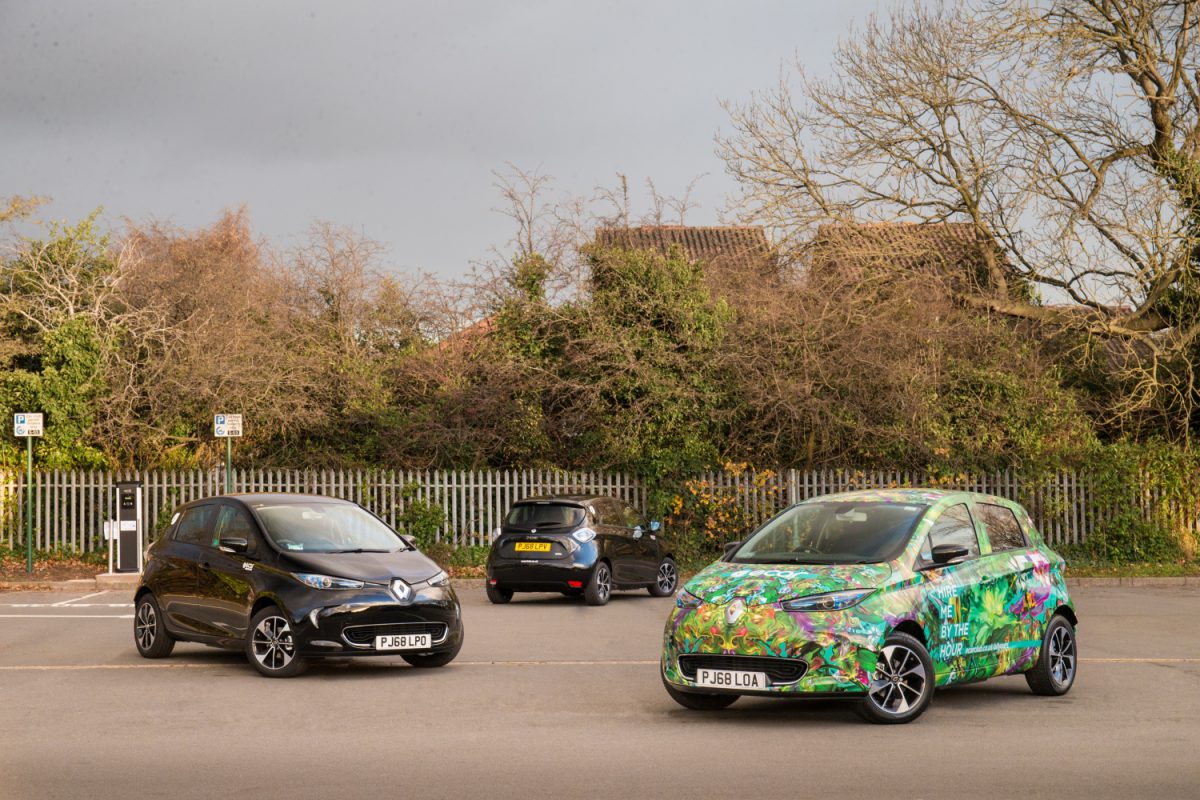
Local drivers can hire any of the new ZOEs, one of which has been wrapped in a distinctive ‘ECO Jungle’ livery, by simply signing up online. Completely self-service, bookings can be made via the E-Car Club website 24 hours a day, 365 days a year with customers gaining access to a ZOE simply by scanning their membership card against the windscreen. Drivers then unplug the ZOE from the onsite charger to experience all the benefits of all-electric motoring.
The rest of the Renault ZOEs will be used by Europcar to support its Deliver & Collect service in major UK cities. The use of the Renault ZOE works to significantly lower Europcar’s carbon footprint in these highly populated areas as well as reduce its operating costs.
The new order follows Europcar’s successful introduction of 55 Renault ZOEs for its Deliver & Collect logistics fleet in 2016, which at the time was the biggest ever UK order for the best-selling EV.
Europcar opted to extend its fleet of the 100 per cent electric, five-door supermini following feedback from both E-Car Club members and its own drivers. The ZOE has proved to be perfect for both its busy Deliver & Collect role and E-Car Club’s car sharing model, being immensely easy to drive and charge, spacious and boasting a very practical real-world range of up to 186 miles on a single charge. Notably, the reliability of the Renault ZOEs already on fleet also influenced Europcar’s purchasing decision.
Renault ZOE named ‘Best Used Electric Car’ in DieselCar and EcoCar’s Used Car Top 50 2019
All-electric ZOE takes the title for the second consecutive year
Five-door supermini also voted 21st overall out of over 750 cars that were evaluated
Renault is the number one EV manufacturer in Europe
LONDON – January 25, 2019: The 100 per cent electric Renault ZOE has successfully defended its title of ‘Best Used Electric Car’ in DieselCar and EcoCar’s Used Car Top 50 2019.
The ZOE clinched the title for the second consecutive year after impressing the magazine’s judging panel of second-hand car experts with its ease-of-ownership, clean looks and nippy yet relaxed driving experience. The award joins an ever-growing list of industry accolades bestowed on the stylish supermini. Additionally, the magazine placed the ZOE 21st overall out of over 750 cars evaluated.
Renault ZOE 22kWh (Image: T. Larkum)
Diesel Car and Eco Car reached its decision after assessing the Renault ZOE on a multitude of factors, including purchase price, residual value, general competency and fitness for purpose. Every car evaluated was given a score out of 10 that determined its final placing.
On awarding the Renault ZOE for the second year running, Ian Robertson, Editor and Publisher, DieselCar and EcoCar, said
“A supermini rather than a family car, the attractive ZOE is a stylish all-electric model that makes adopting electric motoring remarkably easy. Drive one around town in near-silence with zippy acceleration and zero tailpipe emissions and you’ll be convinced electric power is the future. That’s especially the case in cities like London, where it’s Congestion Charge exempt, saving owners a fortune. Be sure to check if the battery pack is included, as customers were given the choice of buying it outright or leasing the batteries separately.”
Renault ZOE wins ‘Best Electric Car for less than £30,000’ at the What Car? Awards 2019
All-electric Renault ZOE has taken the award every year since 2014
ZOE sales were up 1.25 per cent in 2018 to 1993 vehicles
Renault is the number one EV manufacturer in Europe
At this evening’s What Car? Awards the Renault ZOE won the ‘Best Electric Car for less than £30,000’ title for the sixth consecutive year. The What Car? Awards have been presented for the past 41 years and are recognised as being among the most prestigious in the industry. The award adds to the ZOE’s growing list of industry accolades.
2018 – Renault ZOE
Steve Huntingford, Editor of What Car? magazine, said:
“Our 2017 Electric Car of the Year remains a compelling proposition two years on, which is some achievement given the pace at which things are moving in this class. Unlike other sub-£30k pure electric options, you don’t have to put up with a feeble range. In fact, in our Real Range tests, the ZOE outperformed many much pricier options.”
Vincent Tourette, Managing Director of Renault UK, said:
“Electric cars are becoming more popular every month and the Renault ZOE has been at the forefront of the market since it was launched in the UK six years ago. ZOE is available with a choice of trims and motors, giving our customers the opportunity to choose the ZOE that best fits their lifestyle. That’s a key reason why the ZOE has been presented with a strong list of awards and it’s gratifying to see the model recognised by What Car? for a sixth successive year.”
Renault’s ZOE has proven popular with customers with 1993 sold in the UK last year, an increase of 1.25 per cent over 2017. The car continues to be available to purchase in two ways. First, under a battery hire scheme, where ZOE pricing starts at £18,420 (on the road) after the Government Plug-in Car Grant, with battery leasing from £59 per month. And second, under the ‘full purchase’ option, which allows the customer to buy the car and the battery from £25,020 (OTR). Whichever purchase option is chosen, the Renault ZOE is one of the most affordable electric cars on sale following Renault’s mantra of providing sustainable mobility for all.
In addition, Renault offers retail customers that purchase a ZOE a free 7kW wall box charger fully-installed in their home to ensure the best possible electric experience.
Two versions of the ZOE supermini are available and both have a real-world range of 186 miles (WLTP¹). With the R110 motor the ZOE has faster mid-range acceleration and 16hp more power than the R90 version it replaced. The second option is the Q90 motor, which allows faster charging. The ZOE Q90 Quick Charge can be charged from zero to 80 per cent in 65 minutes with a 43kW charger that can typically be found at most motorway service stations.
The customer can also choose between two trim levels: ZOE Dynamique Nav and ZOE Signature Nav. Included with the ZOE Dynamique Nav is 16-inch ‘black shadow’ alloy wheels, a hands-free keycard, automatic headlights and wipers, rear parking sensors and seven-inch colour touchscreen for the R-LINK 2 infotainment system with navigation.
Renault’s R-Link infotainment system utilises Android Auto™ to link the driver or passenger’s smartphone to the ZOE and mirrors the phone display onto the vehicle’s touchscreen to enable easy use of the smartphone’s functionality in the car.
ZOE Signature Nav adds a BOSE® 3D sound system, heated front seats, a rear reversing camera and bronze coloured interior detailing. It also features 16-inch ‘grey shadow’ alloy wheels and unique ‘Signature’ upholstery.
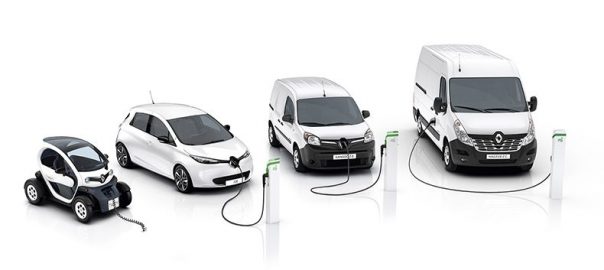
Renault has a strong line-up of 100 per cent electric vehicles that are in Renault dealerships nationwide. The ZOE is Renault’s popular electric supermini and is joined by the Twizy quadricycle, the Kangoo Z.E. 33 Van and the New Master Z.E. Van.
In connection with the announcement of their German sales figures for 2018, Renault has announced that a Cargo version of the Zoe will be added to their range of electric models this year.
To create more cargo space, Renault remodeled the rear seat area in the vehicle. More details on the cargo version are not yet available, as of yet though. Together with the Kangoo Z.E., Master Z.E. and a cargo version of the Twizy, the French will soon be offering a total of four purely electric delivery vehicles with the addition of the Zoe Cargo.
The Renault Electric Z.E. Range (Image: Renault)
As far as new registrations of electric vehicles by Renault in Germany in 2018 are concerned, there was an increase of 46.9% to a new record of 7,400 new vehicle registrations. According to the German federal motor transport authority KBA, the Renault Zoe recorded 6,360 new registrations in Germany alone. This is also due in no small part to the doubling of Zoe production to 440 units per day. The Kangoo Z.E. was responsible for 758 new registrations. And with the e-transporter, Renault is now even reaching its own limits. According to Renault’s German boss Uwe Hochgeschurtz, the car manufacturer is currently unable to meet the rapidly growing demand for electric delivery vans. This is also due to bottlenecks in battery production. The company hopes to get the problem under control in 2019.