Category Archives: Electric Cars

News and reviews of the latest electric cars (full electrics and plug-in hybrids).

Slow Charging near Peterborough Passport Office (Image: T. Larkum)

A Long Journey Easier with an Electric Car than a Conventional One

It doesn’t happen often, but we recently took a long trip in my ZOE that was easier than if we had taken a petrol or diesel car. We needed to travel to Peterborough Passport Office to renew my daughter’s passport at short notice.

Plan A was very straightforward – drive to Peterborough and slow charger there for the return journey. The beauty of this was that, with a bit of advance research, I found out that there was an electric car charging point and parking space on the same road as the Passport Office and very close to it.

Ecotricity Rapid Chargers at Haddon Services (Image: T. Larkum)

As ever, I had a Plan B, a contingency in case of problems. That was to charge at Haddon Services on the A1(M) just outside Peterborough. Therefore on the way to Peterborough we called in at Haddon. However, the AC rapid charge point wasn’t working so we just headed straight on to Peterborough.

In fact, we needn’t have worried. We found the parking space and charger by the Passport Office very easily and it was operating fine. It worked first time – we then headed into the Office to do the necessary paperwork. We then headed around Peterborough, visiting the various shops and restaurants to kill the requisite four hours until the passport was ready.

Slow Charging near Peterborough Passport Office (Image: T. Larkum)

Afterwards we unplugged and headed home. As the EV parking area was very close to the Passport Office and was neither occupied nor blocked (and, if memory serves me right we didn’t have to pay for parking), it turned out to be a long trip that was easier with an EV than if we had had a conventional car.

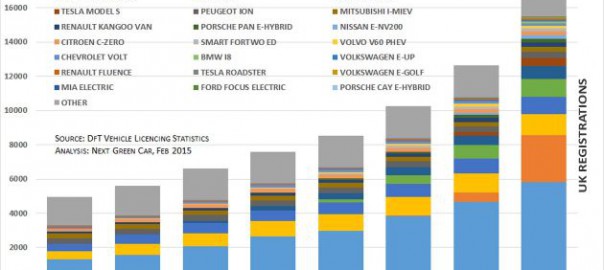
UK electric vehicle registrations UK (Image: Next Green Car)

Nissan LEAF most popular electric car in UK

Figures recently released show that the Nissan LEAF maintains its position as the most popular electric car or van in the UK, with at least 5,838 vehicles registered by the third quarter of 2014, representing over a third of all EV sales.

The registration data also shows the new Mitsubishi Outlander PHEV has made a dramatic entry to the UK market; the electric SUV is already in second position with over 2,706 sales less than a year after its UK release.

In third and fourth places are two more established plug-in hybrids, the Toyota Prius PHEV (with 1,226 registrations) and the Vauxhall Ampera (1,039 vehicles). The BMW i3 now ranks fifth with at least 1,029 UK registrations (454 all-electric and 575 range-extender variants).

The Renault ZOE and Tesla Model S are also selling well in the UK with over 775 and 474 sales respectively; the two models in fourth and fifth sales positions across Europe as a whole (YTD October 2014).

UK electric vehicle registrations UK (Image: Next Green Car)

With the recent announcement from OLEV that 23,083 claims have been made through the Plug-in Car Grant scheme, the number of electric cars and vans in the UK now exceeds 24,500 vehicles for the first time.

Another indicator that the EV market is gaining momentum is the number of fully electric and plug-in hybrid models available in the UK. While only 9 EVs were available for the major manufacturers in 2011 (excluding quadricycles), this increased to 18 models in 2013, and now stands at 24 high-quality cars and vans (in 2014) with more models due for launch in 2015.

Dr Ben Lane, Director of Next Green Car said:

“The strong growth of the EV market in the UK as elsewhere provides yet more evidence that the light-duty vehicle market is undergoing a radical change with consumer preferences changing from petrol and diesel models to electric power-trains. With sales growing exponentially, the EVs are set to become commonplace on UK roads within the next few years.”

Source: Next Green Car

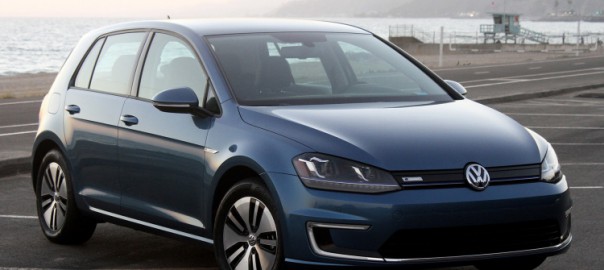
Volkswagen e-Golf (Image: J. Ramsey/Autoblog)

2015 Volkswagen e-Golf

Electrified Golf Is The EV We Could Live With

Until now, the only way you could get the words “electric” and “Golf” so close together was the put the word “cart” after them. Knowing that the e-Golf would be the next step in Volkswagen’s tilt at electrification, the automaker designed the MkVII platform to fit a myriad of drivetrains, none of which would require purchasers to sacrifice the Golf-ness that makes the best-selling car in Europe, not to mention a huge hit here in the States. In the e-Golf that means power electronics underhood and an amoeba-shaped battery that fits in the floorpan, between the axles, where it won’t ooze into the interior space.

We look at the e-Golf as another kind of crossover: traditional cars that just happen to be electric, offering a taste of the new EV religion in soothing, recognizable garb. We had one for a week in its natural habitat, Los Angeles and the surrounding area. We really like the fact that, powertrain aside, it maintains everything we dig about the Golf. The caveat is that this is an EV first and a Golf second – you must first address the EV challenges and live within EV constraints, then you can enjoy the Golf bits. Even so, it’s the electric car this writer would buy once we acquired the lifestyle to make proper use of it.

Volkswagen e-Golf (Image: J. Ramsey/Autoblog)

The most noticeable exterior change to the e-Golf are 16-inch Astana wheels wrapped in 205-series tires that reduce rolling resistance by ten percent. Once you’ve cottoned on to that, the other alterations become apparent: the blue trim strip underlining the radiator grille, the redesigned bumper with the C-shaped decoration LED lights and the full-LED headlamps above them, the little blue “e” in the model name on the rear hatch. You won’t notice the underbody paneling, that the frontal area of the e-Golf is ten percent smaller than that of a traditional Golf, that the radiator is closed off, or the reshaped rear spoiler and vanes on the C-pillars. Volkswagen says this results in a ten-percent drop in drag, getting the coefficient down to 0.281, but the standard Golf is also listed at 0.28. The TSI and TDI are 0.29. No matter those numbers, the point is the e-Golf looks just like… a Golf.

The 12,000-rpm, 85-kW electric motor equates to 115 horsepower and 199 pound-feet of torque, which compares to 146 hp and 236 lb-ft from the 2.0-liter diesel Golf. It takes 4.2 seconds to get to 37 miles per hour, 10.4 seconds to hit 62 mph, and the little guy tops out at 87 mph. That sounds like slacker acceleration, but it never feels that way – you can pull away from a light with the rest of traffic, and any time you need a squirt, 199 lb-ft of instant torque is there to woosh you forward.

Read more: Autoblog

The New York Times Test Drives Kia Soul EV – Video

Here is another short video review of the Kia Soul EV.

This time it comes from The New York Times and is a quite interesting presentation that maybe will be useful for those who are considering purchasing Kia’s electric car.

“Soul EV packs on an average of 500 pounds, making it one hefty hamster. In corners this mass is felt — generally in a good way — because of a lowered center of gravity. Acceleration is punchy and satisfying in city skirmishes, though over all, Soul EV is not particularly fast. Going from 0 to 60 hovers in the 11-second range. Don’t race a Prius. You will lose.”

Source: Inside EVs

Renault Electric Car Sales (Image: InsideEVs)

In 2014, Renault Sold Over 18,000 Electric Vehicles

After a few difficult years, Renault is finally moving upwards with electric car sales. Year 2014, with just over 18,000 EVs (almost 15,700 cars) sold, is still 3% down compared to 2013 (or 0% if we exclude Twizy), although the last couple of months of 2014 were really strong.

December ended with new record of over 3,300 sales (over 3,100 without Twizy) and it’s the very first time when Renault exceeded the mark of 3,000.

Growth year over year in November almost hit 50%, while in December it reached 57% for cars.

Renault Electric Car Sales (Image: InsideEVs)

All the good numbers comes from one car – the ZOE, because the three other models have seen sales going down. Fluence Z.E. almost doesn’t count (out of production), Kangoo Z.E. is struggling to sell at its pace from 2012 & 2013 (28% down year over year), while Twizy again weakened by 20% to 2,450.

ZOE shines at over 11,000 and this makes it the second best selling all-electric car in Europe, just behind the Nissan LEAF.

More than half (probably ~53%) of Renault ZOE sales occurred in France. Total number of ZOEs on the roads is now over 20,000.

We believe that Renault sold over 40,000 electric cars and additionally over 14,500 Twizys for a total ~ 55,000 EVs globally to date.

Source: Inside EVs

(Image: D. Bacon/Shutterstock/Economist)

Seven Reasons Cheap Oil Can’t Stop Renewables Now

Oil prices have fallen by more than half since July. Just five years ago, such a plunge in fossil fuels would have put the renewable-energy industry on bankruptcy watch. Today: Meh.

Here are seven reasons why humanity’s transition to cleaner energy won’t be sidetracked by cheap oil.

1. The Sun Doesn’t Compete With Oil

Oil is for cars; renewables are for electricity. The two don’t really compete. Oil is just too expensive to power the grid, even with prices well below $50 a barrel.

Instead, solar competes with coal, natural gas, hydro, and nuclear power. Solar, the newest to the mix, makes up less than 1 percent of the electricity market today but will be the world’s biggest single source by 2050, according to the International Energy Agency. Demand is so strong that the biggest limit to installations this year may be the availability of panels.

“You couldn’t kill solar now if you wanted to,” says Jenny Chase, the lead solar analyst with Bloomberg New Energy Finance in London.

2. Electricity Prices Are Still Going Up

The real threat to renewables isn’t cheap oil; it’s cheap electricity. In the U.S., abundant natural gas has made power production exceedingly inexpensive. So why are electricity bills still going up?

Fuel isn’t the only component of the electricity bill. Consumers also pay to get the electricity from power plant to home. In recent years, those costs have soared. Annual investments in the grid increased fourfold since 1980, to $27 billion in 2010, according to a report by Deutsche Bank analyst Vishal Shah. That’s driving bills higher and making rooftop solar attractive.

3. Solar Prices Are Still Going Down

You may have seen this chart before. It’s the most important chart. It shows the reason solar will soon dominate: It’s a technology, not a fuel. As time passes, the efficiency of solar power increases and prices fall. Michael Park, an analyst at Sanford C. Bernstein, has a term for the staggering price relationship between solar and fossil fuels: the Terrordome.

The chart above shows the price of energy from different sources since the late 1940s. The extreme outlier is solar, which only recently entered the marketplace, at a very high price. Prices are falling so fast that solar will soon undercut even the cheapest fossil fuels, coal and natural gas. In the few places oil and solar compete directly, oil doesn’t stand a chance.

Case in point: Oil-rich Dubai just tripled its solar target for the year 2030, to 15 percent of the country’s total power capacity. Dubai’s government-owned utility this week awarded a $330 million contract for a solar plant that will sell some of the cheapest electricity in the world.

Read more: Bloomberg

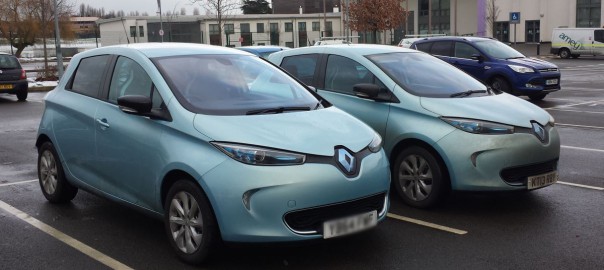
ZOE Twins (Image: T. Larkum)

EV Spotting

ZOE Twins (Image: T. Larkum)

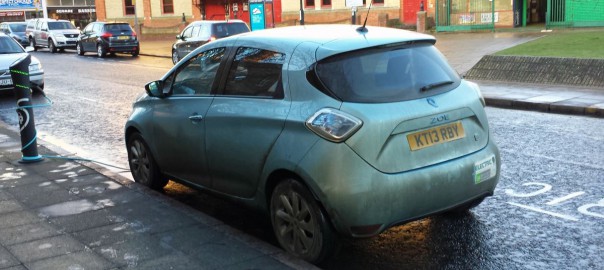
It turns out my Renault ZOE is no longer the only one in my local area, around Northampton. An almost identical but newer Dynamique Intens has turned up, and I’ve seen it in Northampton and nearby Wellingborough. It’s even the same Energy Blue colour. I’m embarrassed to say I can always tell which one is mine, it’s the dirtiest one!

Catching a quick charge at the local Renault dealer (Image: T. Larkum)

While catching a charge recently at the Renault dealership in Bletchley I spotted a ZOE with the rather neat registration number of “EV13 ZOE” (where, of course, EV is ‘Electric Vehicle’).

ZOE with custom number plate (Image: T. Larkum)

Meanwhile I saw the first BMW i3 in my home town of Northampton recently. It was just sitting outside the local shopping centre/health centre looking entirely at home. For sure it will be the first of many.

The first BMW i3 spotted in Northampton (Image: T. Larkum)

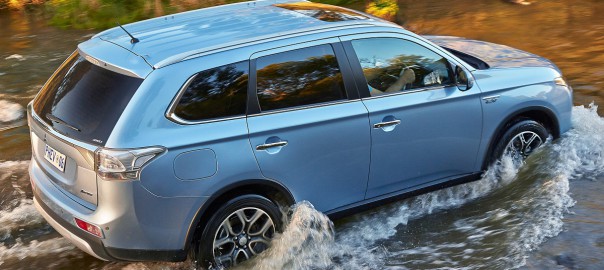
2015 Mitsubishi Outlander PHEV Review

The 2015 Mitsubishi Outlander PHEV is the first affordable full size SUV plug-in hybrid from Mitsubishi and is an ambitious car that moves the game forward in the electric power stakes.

In combination with a 2.0 litre four-cylinder petrol engine that acts primarily as a generator, two electric motors propel the Mitsubishi, mostly in silence and with reasonable urgency.

Electric only range is limited to around 50km, but with some planning, it is possible to carry out most of your day-to-day activities with out the need to engage the petrol motor.

Priced at $52,490 plus on road costs it’s not exactly cheap. It does however posses a full suite of bells and whistles in addition to the advanced hybrid drive train.

To put it to the test I loaded up the fully charged Outlander with kids, dogs and luggage and headed to the picturesque Mornington Peninsula for a few days.

It was a silent run out of the city but within 30km the battery level indicator began to flash low and it was time to hit the charge button located on the centre console.

The charge button does exactly that…it fires up the coarse four-cylinder petrol engine to charge the batteries. Mitsubishi claim a full charge can be achieved using 3.0 litres of standard unleaded.

By the time we reached our destination the trip computer was reading 11 litres per 100km – far from impressive. The petrol engine was at times called on to help power the front wheels. Under full throttle load, on high speed overtaking maneuvers for instance, the combustion engine assists the electric motors to send the full combined power of 87kw to the driving wheels. So with the extra power assistance and the charging of the batteries the petrol engine was a constant companion for about 100km of the 130km trip.

Once at our destination it was time to plug the Outlander in via an adapter to convert regular 10-amp household power into the 15-amp power the Mitsubishi likes. Done this way a full charge could take up to 20 hours, however 80% of the charge happens in under a couple of hours.

If you were to buy an Outlander PHEV I’d suggest factoring in the cost of installing a 15-amp power supply at home, which provides a full charge in less than 8 hours.

Once the battery levels were a bit over three quarters full, a trip to the beach and the pub, then home again saw the batteries as the only power source.

Back in the garage, the Outlander was plugged in again; a routine kept up over four days…when the Outlander wasn’t on the road it was hooked up to the power grid. With no trips over 40km, it was four days of completely silent motoring – the petrol engine wasn’t required and the performance of the electric only drivetrain was impressive with full torque available instantly.

A coasting mode helps convert the energy generated under braking or coasting down hills into power that is fed back into the batteries.

With the battery pack in the floor, the handling characteristics of the Outlander PHEV are far superior to that of the combustion only Mitsubishi SUV’s thanks to a low centre of gravity, although don’t expect sports car like dynamics, this is after all a high riding SUV.

The return trip back to the city saw identical performance as the trip to the beach, and once home the routine of keeping the Mitsubishi plugged in while not on the road produced exceptional results.

Over two weeks and 750km the total fuel consumption was 3.1 litres per 100km, and days would go by where the petrol engine was never heard.

If you lived within 20km of your daily work destination, it is entirely possible to expect to get away with electric only motoring…only the big trips highlight the weaknesses of the Mitsubishi Outlander PHEV limited range.

In every other way the Mitsubishi Outlander PHEV performs just like a regular SUV. Unlike the other Outlanders in Mitsubishi’s range no seven-seat option is available, that’s it though, everything else is just the same.

Blind spot monitoring, reverse camera, radar controlled cruise control, satellite navigation, a decent sound system and electric drivers seat, along with a full leather interior and plenty of space for passengers and cargo alike make the Mitsubishi Outlander PHEV a very useable family vehicle with virtually no option boxes left to tick.

Read more: BehindTheWheel.com.au
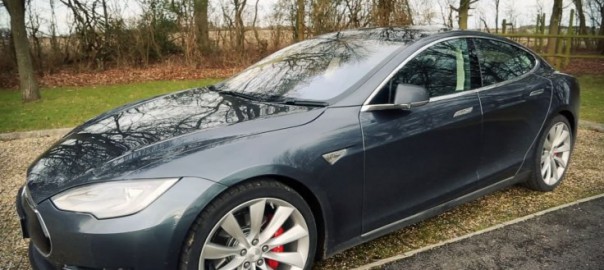
The Tesla Model S is a fully electric, four-door saloon car (Image: IB Times UK)

Tesla Model S P85+ review: The car of the future is already here

Tesla Model S Review

Log into an iPhone app, check how much charge is in the battery and set the heating while you eat breakfast. From your very first interactions with the Tesla Model S, you know it’s unlike any other car on the road.

The car continues to impress before you get inside. Walk up to it with the key in your pocket (I say key, it’s actually a small plastic model of the car itself) and the Model S senses your presence. The mirrors unfold and door handles glide outwards. Grab one, get in and prepare yourself for a journey unlike anything you’ve experienced before.

At this point I could talk about the huge touch screen, the electric, heated seats which remember exactly how you set them, the 3G connection, the two extra child’s seats in the boot, and everything else the Model S has to offer. But they can wait; let’s get straight to the party piece.

Tesla Model S: Performance

Foot on the brake to wake the car, engage drive with the Mercedes-sourced gear selector, breathe, hover your foot over the accelerator, then bury it. The car’s electric motor feeds 416 horsepower and 600 newton metres of torque (433ft lb in old money) to the rear wheels and launches you down the road with the unrelenting shove of a roller coaster.

Traction control filtering out a hint of slip from the 21-inch rear wheels, 60mph ticks by in 4.2 seconds – faster than a Porsche 911 Carrera S. It isn’t just the initial launch which impresses, but the way the Model S keeps you pinned to the seat with a ferocity which doesn’t fade until deep into license-losing territory. Because there’s only one gear the barrage of torque is relentless, and can be summoned instantly – this is where electric cars reign supreme over their internal combustion counterparts.

Flooring the accelerator never, ever gets boring, and feeling the immense surge forward is hugely addictive. The sci-fi whine from the motor and regenerative braking system only adds to the otherworldliness of it all.

The mind-bending turn of pace is even more impressive when you consider the size of the Model S. It’s just shy of five metres long, two metres wide, and weighs more than two tonnes.

But all that mass is more muscle than fat. Because it was designed to be a fully electric car from the very start – there is no petrol, diesel or hybrid alternative – the Model S is packaged cleverly. The immensely heavy battery pack is in the floor, keeping the centre of gravity low, which improves handling and stability.

Being much smaller than an equally powerful engine means the Tesla’s motor can be tucked away between the rear wheels, leading to masses of storage. The rear boot is about what you’d expect from a car of this size – plus my model had the optional (£2,100) children’s seats, good for kids aged five to 10. There’s also a front boot large enough for a weekly food shop or medium-sized suitcase.

Read more: IB Times