Category Archives: Electric Cars

News and reviews of the latest electric cars (full electrics and plug-in hybrids).

Translogic Tests Tesla Model S P85D – Video

Tesla Model S was already covered by Translogic long ago, but with a major new version available on the market, it’s time for Translogic to check what the P85D is capable of doing.

Jonathon Buckley found that acceleration is addictive, while insane mode is incredible… and the crew confirms that too.

A big part of the video is on driving assist features, although for true autonomous driving features like self-parking, P85D will need further software updates.

Source: Inside EVs

Tesla/Solar City Energy Storage Solution System Is In The “Pilot Program” Stage Today

Elon Musk Announces Major New Product Line

Tesla CEO Elon Musk took to his favorite source to disseminate breaking news (Twitter of course) on Monday to announce a “major new Tesla product line” will be debuting on April 30th at 8pm PT from the company’s Hawthorne, California Design Studio.

Mr. Musk stressed that it was “not a car” in the tweet.

No other hints were dropped at what this new product line could be by the CEO, but we are still free to speculate.

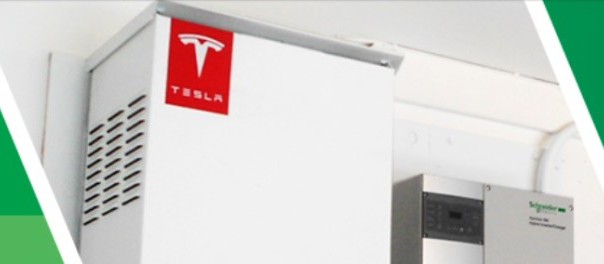
The most obvious choice would be standalone battery packs/”home energy storage” packages that are designed to independently power your home (or office) if need be.

Tesla/Solar City Energy Storage Solution System Is In The “Pilot Program” Stage Today

Of interest, Solar City (sister company to Tesla) already has a pilot “home energy storage solution” project running in conjunction with Tesla batteries and their own solar technology to over 300 clients today, and has promised to have that project be available to the masses by “late summer” with an announcement coming “mid-2015″ with all the finer details.

We think it is a good bet that Elon Musk’s announcement of an announcement in April will be related to this project.

In theory, this system could also allow for much higher speed residential/charging to the Model S (or future Model 3) with the aid of an external/auxiliary battery.

Then again, maybe it is just a line of Tesla-themed leisure wear, or personal use, James Bond inspired electric submarines.

Source: Inside EVs

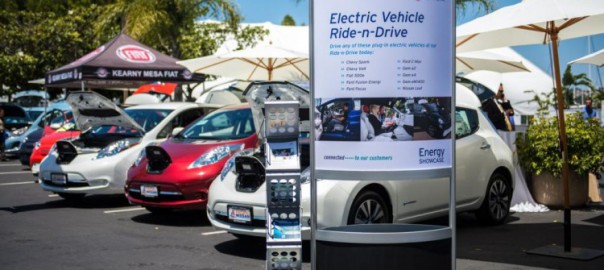
Electric cars on the SDG&E territory

San Diego Gas & Electric Integrates Electric Cars


San Diego Gas & Electric (SDG&E) announced a pilot project integrating electric cars and energy storage systems with California’s wholesale energy markets.

We don’t know the details, but there will be a group of energy storage systems and electric vehicle fleets at five separate locations, available for California Independent System Operator’s (CAISO). The first step for EVs is remote control of charging to avoid electricity peak demand.

Electric cars on the SDG&E territory

There are over 13,000 plug-in electric cars in SDG&E’s service territory and, since the number of EVs is growing, charging power will be an important factor one day.

“The project currently aggregates stationary storage systems together with the charging demand of EV fleets at five separate locations throughout San Diego County. The assets are remotely controlled using software that both balances the participant’s charging needs, and identifies opportunities to provide demand response services at the grid level. Demand response is when customers don’t charge EVs or consume energy at peak hours, which alleviates stress on the grid and helps make sure adequate resources are available for the entire region. The project achieves this by correlating charging activity with wholesale energy prices. By agreeing to not charge in certain high price hours, the aggregated resource is paid the marginal energy price in those hours, similar to a conventional generator. The pilot project will end in late 2015.

Besides being among the first to integrate electric vehicles into California’s energy markets, the project is identifying both barriers and best practices for future, large scale integration and interaction of dispatchable distributed energy resources with wholesale markets, and creating tools to evaluate growth opportunities for those resources.”

Read more: Inside EVs

Powervault Energy Storage System (Image: Powervault.co.uk)

Visiting Ecobuild by Nissan Leaf

Picking up the Leaf in Wolverton early in the morning (Image: T. Larkum)

Having had a try out with a Nissan Leaf, I was ready for a longer journey in one, and the Ecobuild Event in March gave me the perfect opportunity. It was located at the Excel Centre in London’s docklands so was a good distance from home in Northampton, but not far as to make me nervous in a new car.

I booked the car from the e-Car Club as before. However, there wasn’t one free in Northampton this time so I had to get one from Wolverton, near Milton Keynes. That wasn’t a problem, though, as it was on the way to London. An advantage was that this Leaf had a satnav, which was noticeably missing from the Northampton one.

The journey was relatively straightforward, though it turned out that I was overconfident in my knowledge of the Leaf. It appeared to indicate that it had enough range to get me from MK to Excel without charging. However, I hadn’t appreciated that the satnav was set to choose the shortest distance route. Instead I had planned to stay on the motorway as much as possible, around the M25 and down the M11. Therefore as I passed ‘shortcuts’ off the motorway at each junction the satnav kept recalculating the remaining distance, and of course it kept increasing. One to remember for next time!

Anyway, to cut a long story short I had to pull off just short of my destination to get a top-up in Ilford. As has happened before, I suffered from not knowing the foibles of the local charging infrastructure. There didn’t seem to be charge points where they were supposed to be according the Zap-Map, and one that did exist had tapes over it saying “QA Passed Awaiting Commission”!

So near yet so far – an Ilford charge point installed but not yet commissioned (Image: T. Larkum)

I finally got a charge in a local council office car park, courtesy of the staff, though I had to share the charge point with an employee’s Toyota Prius. However I was disappointed to hear that it wasn’t supposed to be on the public map and that they would now apply to have it removed!

The irony was that having arrived at the Excel car park, and hunting out the area marked out for public charge points, there were dozens to choose from. Since the Ilford charge point had only been a slow one, and so I had only got a partial charge, I was very grateful to plug in here.

Borrowing a slow charge in a council car park (Image: T. Larkum)

Ecobuild is marketed as ‘The sustainable design, construction and energy event for new build, refurb, commercial and domestic buildings’. My interest in it was primarily about looking for potential domestic energy solutions for Fuel Included customers. Essentially these were solar panel systems, and domestic energy storage systems (ESS), both of which fit well with an electric car household.

I began my visit by meeting up with a colleague and having lunch. Then we toured the hall just seeing what caught our eye. There were dozens of stands offering solar panel systems – it is clearly now a commodity product. Of more interest was the handful of stands offering home battery storage – a market that is obviously in its infancy, but which has great potential for the future.

Powervault Energy Storage System (Image: Powervault.co.uk)

Most of the storage systems were unpriced, or had guide price that were very high – of the order of £5000-£10000 for a typical domestic system. However, we spoke at some length with Joe Warren, MD of Powervault, about their system and found it very interesting. It uses lead-acid batteries currently (to be economic) and so systems with capacities in the 2 to 4kWh range could be had for £1800 to £2200 respectively which is very encouraging. Later versions will have the option of Lithium Ion batteries.

After a loop of the hall we used our remaining time to attend a seminar entitled ‘Ask the expert: Energy storage masterclass’. This had five presentations, including ‘Energy Storage Systems’ by SMA Solar, ‘Optimising PV storage with electric vehicles’ by British Gas, and ‘Utilities perspective on storage’ by SSE.

Maslow Energy Storage System (Image: MoixaTechnology.com)

However, the standout presentation for me was ‘Distributed battery storage with Maslow’ by Simon Daniel, Founder and Chief executive of Moixa Technology. He talked about work done by Moixa on developing and trialling domestic storage systems, combined with a vision for using distributed storage at scale for network control and balancing. I think this strategy fits very well with Fuel Included’s philosophy of providing domestic electric vehicles, solar power and energy storage so perhaps our paths will cross again at some point in the future.

After the event was over for the day I returned to the Leaf and found it fully charged. Notwithstanding that, I planned to stop off on the way home for a quick charge. I did this uneventfully at South Mimms, after fighting through dreadful traffic to get away from Docklands. I then dropped the car in Wolverton before heading back home in my ZOE.

Grabbing a quick charge at South Mimms late in the evening (Image: T. Larkum)

It had been a very useful day, not just in terms of learning about future energy systems, but also in getting some real-world usage of a Leaf.

North West Bicester is a government-designated eco-town being built in the UK

UK’s “first eco-town” built green from the ground up

An eco-town described as the UK’s “most sustainable development” is moving closer to being occupied. The first residents are expected to move into North West Bicester later this year. Planning permission has also just been granted for up to 2,600 homes in the next stage of the project.

North West Bicester (pronounced “Bister”) is one of four designated eco-towns in the UK announced by the government in 2007. The aim is to create a town that is good for the environment, good for the economy and a nice place to live.

It is also one of a handful of One Planet communities around the world. The One Planet scheme was set up by sustainability charity BioRegional. It aims to find ways for people and societies to reduce their level of consumption to an extent that is sustainable based on the amount of resources that the planet can provide.

In addition to homes that are highly sustainable, North West Bicester will offer a mix of affordable housing. Homes will be built to a minimum standard of code level 4 for Sustainable Homes and Sustainable Homes and BREEAM excellence. Residents will be able to access a community hub via mobile devices that will allows them to check car club availability, monitor energy usage and prices, check public transport information and communicate with other residents. Homes will also be future-proofed with climate change adaptation in mind.

Primary schools will be located within 800 m (2,625 ft) of all homes in the town, and jobs will be created within a sustainable travel distance. Non-car use will be encouraged, as will the use of electric vehicles where required. Town residents will benefit from specially-designed cycle and pedestrian routes, a bus service within 400 m (1,312 ft) of every home, charging points for electric vehicles and an electric car club.

A minimum level of 40 percent public and private green space is to be maintained throughout North West Bicester. There will be a focus on local food production and an aim of attaining a net gain in local bio-diversity.

The first phase of the town being constructed is called Exemplar. Once completed, it will have 393 zero carbon homes and, according to project lead A2Dominion, will be the UK’s first true zero carbon community. Among the amenities in Exemplar will be a primary school, community center, eco-pub and an eco-business and retail center.

Each home in Exemplar has been designed to remain warm in winter, but not to overheat in the summer. A combined heat and power plant will provide heat and hot water to the houses, whilst solar arrays averaging 34 sq m (366 sq ft) will be fitted to every property. This is said to be the UK’s largest residential solar array in total, capable of powering 550 homes with excess power fed back into the national grid.

The recent planning approval for new homes is for an area adjoining the Exemplar site, which will be the next major phase of the project. Of the homes built here, 30 percent will be affordable, including extra care apartments for the elderly. A new primary school with playing fields, a nursery and a sports pitch with a pavilion will also be built.

The plan also features space for a network of allotments, a country park, play areas, a community farm and a woodland burial ground. The area will have its own center with a convenience store, cafe, restaurant and shops, a public square and community hall. Other amenities will include an energy center, a GP practice, business and office provision and a place of worship.

Residents are expected to begin moving into Exemplar later this year, with the phase due for completion in 2018. A2Dominion plans to develop North West Bicester over the next 25-30 years. When complete, the town will have up to 6,000 highly energy efficient new homes.

The video below provides an introduction to North West Bicester.

Source: Giz Mag

Eight manufacturers to enter Formula E next season

Eight Manufacturers To Enter Formula E Next Season

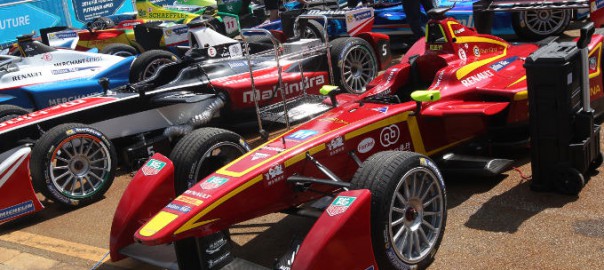
As was announced earlier, Formula E is looking to diversify the race cars in season 2. In the first season, the cars were all the same in an effort to make to the series very competitive and the cost of entry cheap.

The move from a common car to a whole set of different cars will be gradual to not exacerbate costs, especially for smaller teams, as the series is still in its infancy.

Eight manufacturers to enter Formula E next season

The official statement from the Federation Internationale de l’Automobil revealed that in the second season there will be eight manufacturers that will supply powertrains to any teams participating in 2015/2016 Formula E season:

  1. ABT Sportsline
  2. Andretti
  3. Mahindra
  4. Motomatica
  5. NEXTEV TCR
  6. Renault Sport
  7. Venturi Automobiles
  8. Virgin Racing Engineering

In the second season, teams will still get the same car chassis (the Spark-Renault SRT_01E) and the same battery packs, but the electric motor, inverter, gearbox and cooling system will be developed individually by each manufacturer and available for any team at fixed maximum cost.

Read more: Inside EVs

Mitsubishi Outlander PHEV Review, Small Business – Video

Here is a new Mitsubishi Outlander PHEV owner story video.

If you would like to know why people decide to buy a plug-in hybrid and what benefits they get from doing so, then please go ahead and check out this video.

Mark Bowler, using an Outlander PHEV for just about a month, still has more than half tank of gas left since buying it.

“Mark Bowler, Sales Director at The Window Exchange based in Northwich, explains how his customers have already noticed the Outlander PHEV and why they all want to know how it works.”

https://www.youtube.com/watch?v=oQgn28I-dQQ

Source: Inside EVs

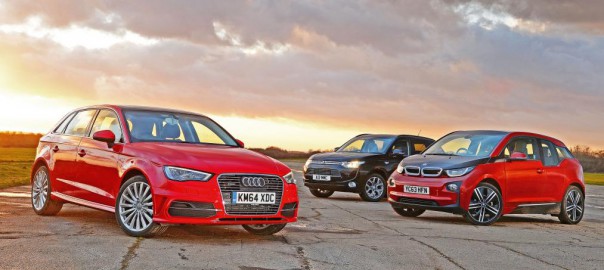
Audi A3 e-tron, Mitsubishi Outlander and BMW i3 plug-ins

Electric vehicles account for over 20% of Norway’s new-car sales

Plug-in electric car sales in Norway continue at just above 20% (21.03%) market share with 2,235 registrations in February 2015. Battery-only electric vehicles now account for 18% of all new-car sales.

The over-all #1 best selling car in Norway for the second month running is the VW e-Golf with 839 units. Sales of the Volkswagen e-Golf in Feb were almost double the top selling fossil fuelled car, the Toyota RAV4 with 450 sales.

The e-Golf accounts for almost 40% of all EV sales in Norway YTD (1,718) selling 3x more than second place Nissan Leaf (556) and 4x more than third placed Tesla Model S (392).

The ICE powered Volkswagen Golf has been one of the best selling cars in Norway for many years but the e-Golf and GTE Plug-in variants now account for 70% of all Volkswagen sales in Norway.

The Norwegian e-Golf sales success sends a clear signal to auto makers that non-quirky, conservative body styling can boost EV market share significantly.

Source: Electric Vehicle News

Plug-in Car Registrations in UK – February 2015 (Image: Inside EVs)

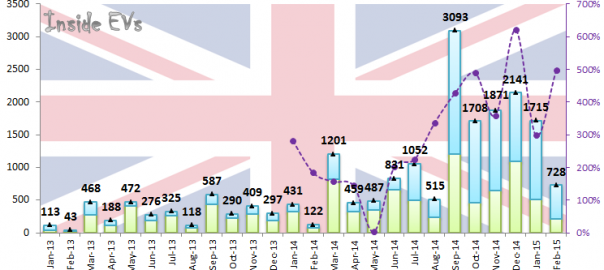
Electric Car Sales In UK Up Almost 500% In February

February was the 36th consecutive month of car sales growth in UK – registrations went up by 12% year-over-year to 76,958.

The numbers themselves are low as February is one of the slowest sales months of the year ahead of a number plate change in March.

Plug-in Car Registrations in UK – February 2015 (Image: Inside EVs)

Despite this, electric cars grew like crazy by 497% year-over-year to 728 new registrations. Market share was 0.95%.

There were 216 BEVs (up 167%) and 512 PHEVs (up 1,066.7%).

As previously mentioned, February is a slow month, so now we look forward to what we hope to be a record-setting March. 5,000? Maybe 7,000? We’ll find out soon enough.

Source: Inside EVs

Go Ultra Low members boast 15 ULEVs across a range of segments (Image: OLEV)

Automakers race to double the driving range of affordable electric cars

Global automakers are readying a new generation of mass-market electric cars with more than double the driving range of today’s Nissan Leaf, betting that technical breakthroughs by big battery suppliers such as LG Chem Ltd will jump-start demand and pull them abreast of Tesla Motors Inc.

At least four major automakers — General Motors, Ford, Nissan and Volkswagen — plan to race Tesla to be first to field affordable electric vehicles that will travel up to 320 km (200 miles) between charges.

That is more than twice as far as current lower-priced models such as the Nissan Leaf, which starts at $29,010. The new generation of electric cars is expected to be on the market within two to three years.

To get a Tesla Model S that delivers 265 miles (427 km) on a charge requires buying a version that starts at $81,000 before tax incentives. Most electric cars offered at more affordable prices can travel only about 75 to 85 miles (121 to 137 km) on a charge – less in cold weather or when drivers have the air conditioning on.

Automakers need to pump up electric vehicle demand significantly by 2018. This is when California and eight other states will begin to require the companies to meet much higher sales targets for so-called zero emission vehicles — in other words, electric cars — and federal rules on reducing fuel consumption and greenhouse gases become much stricter.

BATTERY BREAKTHROUGHS

Tesla Chief Executive Officer Elon Musk said last week that

“200 miles is the minimum threshold” to alleviate consumer concerns over EV range. There is “a sweet spot around 250-350 miles that’s really ideal,” he said.

Musk has promised a more affordable Tesla, the Model 3, which will sell for around $35,000 and provide a driving range of 200 miles or more. That car is slated to begin production in mid-to-late 2017.

However, GM says it plans to field a 200-mile electric car, the Chevrolet Bolt, by late 2016.

The Bolt will use an advanced lithium-ion battery pack developed by Korea’s LG Chem, which also supplies batteries for the Chevrolet Volt hybrid. The newer batteries are said to have much higher energy density and provide much longer range between charges, thanks to breakthroughs in battery materials, design and chemistry, according to a source familiar with LG Chem’s technology.

“Several factors are at play that are landing at this 200-mile range” for a vehicle priced between $30,000 and $35,000, LG Chem Chief Executive Prabhakar Patil said in an interview. “We’ve been talking to several OEMs (automakers) regarding where our battery technology is and where it’s going.”

LG Chem also supplies standard lithium-ion batteries to the Ford Focus Electric and may supply the longer-range batteries to a new compact EV that Ford is tentatively planning to introduce in late 2018 or early 2019, according to three suppliers familiar with the program.

Compared with the 2015 Focus Electric, which has a range between charges of 76 miles, the new compact electric model would have a range of at least 200 miles, the suppliers said.

Nissan and VW both have battery supply deals with LG Chem, and both are working on longer-range EVs for 2018 and beyond.

Nissan is planning to introduce a successor to the Leaf in early 2018, according to a source familiar with the program, and that model is expected to offer significantly greater range than the current Leaf, the best-selling electric car in the United States, which can go 84 miles (135 km) between charges.

The 2015 Leaf uses batteries made by a joint venture between Nissan and supplier NEC. It is not clear if the future model will shift to LG Chem, although Nissan CEO Carlos Ghosn has identified LG Chem as a potential battery supplier.

VW plans to expand its current range of electrified vehicles, including a successor to the battery-powered e-Golf in 2018 with much longer range, according to two sources familiar with the program. The current e-Golf uses batteries made by Panasonic and has a range between charges of 83 miles.

Volkswagen plans to decide in the first half of this year whether new battery technology under development at U.S. startup QuantumScape Corp, which may expand an electric vehicle’s driving distance between recharges to as much as 700 kilometers (430 miles), is ready for use in its electric cars.

Source: Electric Vehicle News