Category Archives: Electric Cars

News and reviews of the latest electric cars (full electrics and plug-in hybrids).

Untethered and Tethered Charge Points (Image: POD Point)

POD Point Installation Guide – Applying for the charge point

I Have my New Car Ordered – Now I Need a Charge Point

Untethered and Tethered Charge Points (Image: POD Point)

With my new Leaf, I get a new, FREE, POD Point charge point.
Thanks to a Nissan discount of £264 and the government OLEV scheme discount of £500, there is no charge for me at all for the entry level unit, although there are a couple of upgrade options you can choose.

Here is a quick guide to what to expect when you are ready to get your system installed. This blog covers the on-line application, with a separate blog that covers the installation.

Ordering my New Charge Point

The process starts with an email from POD Point to start the application. It was pretty straightforward and the pictures below step through the choices offered. The three choices I made of most significance to me were the following:
1) Upgrade to a 7kW charger. This cost £95. This seemed good value and future proofs me for longer range cars in the future.
2) Upgrade to a key so that I can lock the charger if necessary. This cost £30. I am not sure if electric thieving is likely.
3) I chose to have an un-tethered system with a type 2 socket so that it could work with any car. This was no charge. POD-Point tell me there is no difference in charge between a tethered and un-tethered system.

1 – The initial email from POD Point

2 – website starting point

3 – charge power choice

4 – tethered/untethered choice

5 – extras: key, cable, freestand

6 – Order summary showing total price less the nissan discount

7 – A statement that I have bought/leased a new car and have suitable off-street parking for a chargepoint to qualify for the OLEV grant

8 – 2nd Order summary including the OLEV grant

9 – payment for my extras

10 – payment summary

11 – address for installation

12 – installation specific questions

13 – statement of whether I do or don’t want the OLEV grant

14 – formal grant application. This needed a form downloaded, filled in and uploaded. Not particularly difficult and definitely worth it to save £500.

15 – MPAN number needed from my electricity bill.

16 – the thank you

Electric Cars Are the Story Now, but Battery Power Is the Future for Tesla Inc.

You know Tesla (NASDAQ: TSLA) as a builder of electric cars. But that’s not necessarily what the company is about in the long run.

The electric car thing has become a temporary stop on a longer and much more ambitious journey, as Tesla’s mission has since expanded beyond just sustainable transportation. Tesla CEO Elon Musk wants to change the world, and that includes getting people used to replacing gas-powered vehicles with electric cars.

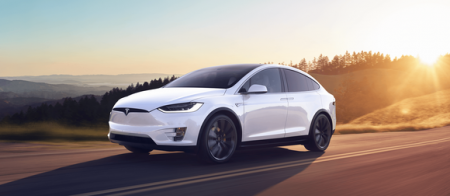
Tesla Model X

The Model X car is a good example of Tesla’s public image so far. .

Secrets and speculation?

This is not speculation on my part, or even a closely guarded secret. Musk laid out his master plan in some detail 11 years ago, and doubled down on the same theme last year.

In short, Tesla was always meant to develop and promote sustainable energy sources for everyone and everything. The expensive Tesla Roadster sports car only aimed at raining the capital to develop more affordable electric cars for a larger mass-market demographic — and even the Tesla Model S and Model X are just cash-generating stepping stones on the road to a clean-energy revolution.

Along the way, Musk is using Tesla’s capital platform and wide-ranging media reach to introduce and popularize other technologies for the good of humanity. Self-driving cars will make the road a safer place, while saving even more energy. Taking emotions and human error out of the driving experience can do both of those things.

Tesla’s early forays into electric vehicles and self-driving cars got the ball rolling. Now, Detroit and Japan are falling all over themselves to beat Tesla at its own game.

Read more: Madison.com

Consumer Reports Runs The Numbers On Tesla’s Solar Roof

Consumer Reports, which six months ago was skeptical about the viability of Tesla’s Solar Roof product, has once again “done the math” using newly announced pricing estimations.

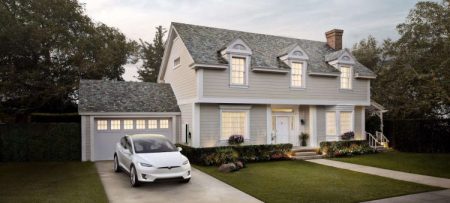
Tesla Solar Roof in Slate, Due for Release in 2018

According to CR, it’s not easy to weigh value of the offer, as company’s online calculator

“relies upon some important assumptions and predictions that delve deep into the economy of residential solar power in the U.S.”

In its first analysis, CR said that costs need to be below $24.50 per square foot to match costs of conventional roofs (including the cost of Powerwall batteries, but excluding solar incentives or rebates). A 3,000-square-foot Solar Roof would then cost $73,500.

Tesla announced an estimated cost at $21.85 per square foot, which would be $65,550 for the same example house.

After using Tesla calculator for example homes in New York, Texas and California and a 30 years period, CR found out that in some cases Tesla offers a good savings opportunity, although in other cases, it doesn’t look so good.

However, even if one’s first calculations seem tempting, CR advises to answer some questions before placing deposit.

Read more: Inside EV’s

Daimler unveils its own new battery Gigafactory for electric vehicles

Daimler is among one of the few major automakers with aggressive all-electric vehicle plans.

The German automaker recently announced acceleration of electric car plans by 3 years and that they will spend $11 billion on 10 models by 2022.

They are backing this up with a new battery factory, which they officially unveiled today.

The German automaker produces its own battery packs through its ACCUmotive subsidiary and last year, they announced an important €500 million investment in a new battery factory in Kamenz, Germany.

The inauguration was a big deal attended by Federal Chancellor Dr. Angela Merkel and Stanislaw Tillich (Minister President of Saxony), who, together with Dieter Zetsche (Chairman of the Board of Daimler AG and Head of Mercedes-Benz Cars), Markus Schäfer (Member of the Divisional Board of Mercedes-Benz Cars, Production and Supply Chain), Frank Deiss (Head of Powertrain Production and Site Manager Mercedes-Benz Plant Untertürkheim) and Frank Blome (Managing Director Deutsche Accumotive GmbH & Co. KG), laid the casing of a vehicle battery as the foundation stone.

They didn’t confirm the capacity of the plant, but it is expected to be in the gigawatt-hour range and it will employ over 1,000 workers.

Daimler CEO Dieter Zetsche said about the new factory:

“The automotive industry is facing a fundamental transformation and we see ourselves as the driving force behind this change. The battery factory in Kamenz is an important component in the implementation of our electric offensive. By 2022, we will have more than ten purely electric passenger cars in series. We also continue to drive forward the hybridization of our fleet. Under the EQ brand, we are creating a holistic ecosystem for e-mobility.”

Read more: electrek

Financial Times declares a winner in the war for energy’s future, and Big Oil won’t be happy

‘Fossil fuels have lost. The rest of the world just doesn’t know it yet.’

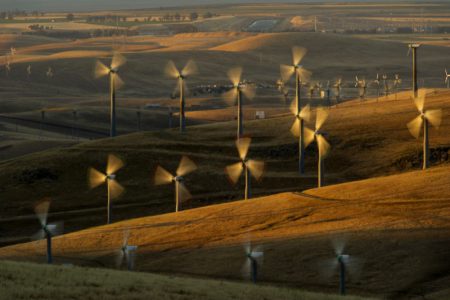
Wind turbines in California.

Traditional energy companies and mainstream financial publications are finally waking up to the new reality: The shift to renewable energy, electric cars, and a low-carbon economy is now unstoppable.
The details of this transition are spelled out in a new, must-read, 4000-word article in the Financial Times,

“The Big Green Bang: how renewable energy became unstoppable.”

What is most remarkable about the article is that it appears in the Financial Times. The free-market oriented paper is the “most important business read” for the world’s top financial decision makers and

“the most credible publication in reporting financial and economic issues”

for global professional investors, according to surveys.

We simply don’t see articles like this in Rupert Murdoch-run Wall Street Journal or even the New York Times, which continues to misreport the clean energy revolution and just hired a columnist who spreads misinformation on climate solutions.

The business community, though, is starting to see the writing on the wall, especially in Europe. The CEO of Royal Dutch Shell, Europe’s largest company, declared in a recent speech that the transition to a low-carbon economy is not just “unstoppable.” It is a necessity that “must be embraced” if an oil company like Shell is to survive and thrive. The low-carbon future, he explained, will be built around renewable electricity and electric cars.

The Financial Times article, in fact, begins with an anecdote of a company that developed a better turbocharger for gas-powered cars. After getting some interest from big car companies last year, in January,

“Suddenly, none wanted new products for cars running on fossil fuels.”

Instead, car companies were putting their limited R&D budgets into electric cars, a seismic shift at an unprecedented speed.

Read more: Think Progress

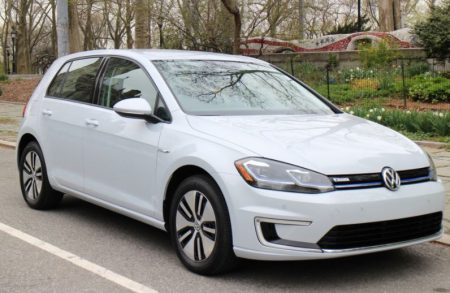
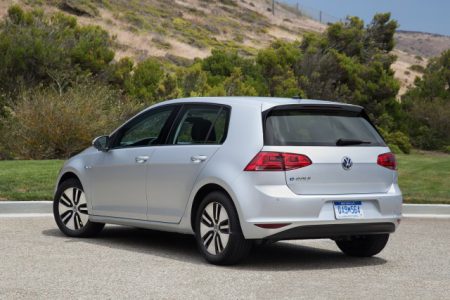
2017 Volkswagen e-Golf: first drive of updated 125-mile electric car

The 2017 Volkswagen e-Golf, the only battery-electric car sold by VW in the U.S., got a large range boost for its third year on the market.

2017 Volkswagen e-Golf

While the current model year is winding to a close, 2017 e-Golfs are just now reaching dealers in the handful of states where the compact electric car is offered for sale.

But with an EPA-rated range of 125 miles combined, the 2017 VW e-Golf now offers more range than any all-electric car that’s not a Tesla or a Chevy Bolt EV.

That’s a 50-percent increase over the previous model’s 83 miles, and significantly increases the practicality of the e-Golf for drivers with longer commutes—or those who live in areas with winter weather.

Two weeks ago, we spent a brief time behind the wheel of a 2017 e-Golf, though New York City traffic prevented any meaningful test of the car’s expanded range.

For that we’ll wait to get the electric Golf for a longer test.

2017 Volkswagen e-golf

Meanwhile, what we can tell you is that the latest e-Golf is exactly what it was before: a Volkswagen Golf that happens to run on battery power.

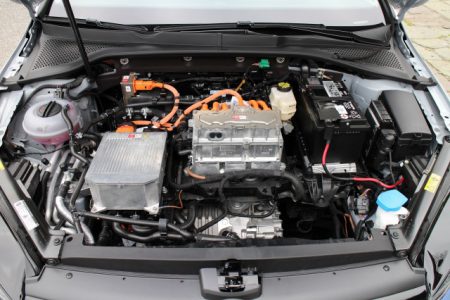
What’s under the hood (and under the floor, rear seat, and cargo bay) may differ completely, but you’d never know it.

It’s so similar to conventional gasoline-powered Golfs that uninformed passengers might never catch on that it wasn’t simply the latest version of the 40-year-old hatchback classic.

As a result, our impressions of the longer-range VW e-Golf are essentially the same as those we had three years ago in testing its earlier iteration.

The 2017 e-Golf received a boost in its motor output, from 86 kilowatts (115 horsepower) to 100 kw (134 hp). Torque increased as well, from 199 to 214 lb-ft.

VW claims the acceleration from 0 to 60 mph is faster, at 9.6 seconds, which is a reduction of more than 1 second. To be honest, we couldn’t sense any difference, but it’s been three years.

2017 Volkswagen e-Golf

Reversing the car into parking spaces was as smooth as forward acceleration.

We noted no whine from either motor or power electronics under any circumstances, an impressive feat.

We smiled at the translation from German in the digital gauge clusters; in an e-Golf, it’s not “regeneration” but “recuperation.”

Otherwise, at the risk of disappointing those seeking decisive first-drive impressions … yep, it’s an electric Golf. Just as we expected, frankly.

Read more: Green Car Reports

Electric vehicles to cost the same as conventional cars by 2018

The cost of owning an electric car will fall to the same level as petrol-powered vehicles next year, according to bold new analysis from UBS which will send shockwaves through the automobile industry.

Chevy Bolt

Experts from the investment bank’s “evidence lab” made the prediction after tearing apart one of the current generation of electric cars to examine the economics of electric vehicles (EVs).

They found that costs of producing EVs were far lower than previously thought but there is still great potential to make further savings, driving down the price of electric cars.

As a result, UBS forecasts that the

“total cost of consumer ownership can reach parity with combustion engines from 2018”,

with this likely to happen in Europe first.

“This will create an inflexion point for demand,”

the analysts said.

“We raise our 2025 forecast for EV sales by ~50pc to 14.2m – 14pc of global car sales.”

If the prediction comes to pass, traditional car industry giants could face ruin. Germany’s Volkswagen Group – the world’s biggest car company – is racing to catch up with rivals’ investment levels in electric drivetrains, the components which deliver the power into the wheels, having largely ignored the technology in the past.

UBS’s research was to help understand what it called the

“most disruptive car category since the Model T Ford”.

The findings are based on its deconstruction of a Chevy Bolt, which it considered to be “the world’s first mass-market EV, with a range of more than 200 miles”.

UBS’s analysts deconstructed the Chevy Bolt (Image: UBS)

The 2017 car – which cost $37,000 – was taken apart piece by piece and the parts analysed. UBS said that the Bolt’s electric drive was $4,600 cheaper to produce than thought,

“with much cost reduction potential left”.

 “We estimate that GM (which produces the Bolt) loses $7,400 in earnings before interest, and tax on every Bolt sold today, mainly due to a lack of scale.”

Read more: The Telegraph

Watch Renault Zoe E-Sport Concept, Formula E Racer Cruise Paris

The Renault eDams team currently leads the Formula E standings and its racers Sebastien Buemi and Nicolas Prost currently sit in first and third in the Driver’s Championship, respectively.

Since the next race of the season is in Paris on May 20, the crew is celebrating the strong performance in its home country by holding a parade of electric vehicles through the City of Light. The Renault eDams R.S. 16 race car and Zoe e-Sport Concept lead the procession in this video.

Read more: Motor 1

Volvo says no more diesel engines, the future is electric

Stricter nitrogen oxide emissions regulations mean an end to diesel-engine development.

Volvo Cars has come down with a case of electric fever, and the cure is “no more diesel engines.”

The company’s CEO, Håkan Samuelsson, recently told German publication Frankfurter Allgemeine Zeitung that Volvo’s current diesel engines may well be the last of their kind.

Volvo S90

Samuelsson said that the technology is necessary to meet upcoming European carbon emission standards, which require OEMs to drop from 130g/km to just 95g/km in 2021.
But the outlook farther ahead involves regulations that will also severely limit nitrogen oxides (NOx). As a result, the company will devote its energy to electrification instead.

As we reported earlier this week, NOx are noxious and linked to 38,000 premature deaths in 2015 alone. Contributing to that body count is evidently beyond the pale for an automaker which has built an impressive reputation for safety.

The news is all the more remarkable given that the bulk of its sales in Europe are diesel-engined vehicles. Right now, Volvo uses a 2.0L diesel engine that shares much with the 2.0L gasoline engine that we get here in the US in the S90, V90, and XC90 models.

Samuelsson said that Volvo’s first purely electric vehicle will arrive in 2019. He also paid a mighty compliment to Elon Musk’s EV outfit.

“It must be acknowledged that Tesla has managed to offer such a car for which the people are queuing. In the area, we should also have space, with high quality and attractive design,”

he told Frankfurter Allgemeine Zeitung.

Source: Cars Technica