I wrote last week of what is required to fill out the on-line application for the POD Point charge point. Once I had applied things moved pretty quickly.
Attaching the POD
The following day I got an email outlining the name and time of an installation appointment a week later. They also sent me a link to click should I need to reschedule. Two days before the install, I got a further email confirming I was still available and confirming that the engineer would arrive between 1pm and 3pm.
Come the day, a minor glitch. 3pm came and went and no engineer. I followed up with an email at 3.40pm, and 10 minutes later got a call from the engineer saying when he would arrive. So at 4.15, the installation began.
My installer turned out to be Mohamed Aly and was very knowledgeable and enthusiastic. He had the whole job done and dusted in an hour and a quarter.
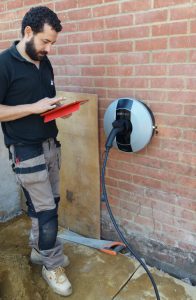
First he laid the cable and drilled through to the desired mounting point for the POD, and then attached the POD.
Lay the cable and drill through
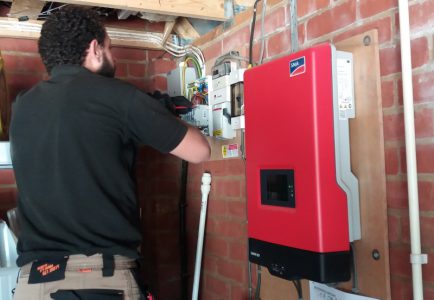
At the other end, he now connected to the mains. You can see my Photo-Voltaic Solar Array converter to the right. Mohammed commented that he used to install Photo-Voltaic systems, and that the SMA inverter I have was the most reliable he ever came across.
Connect to the mains
The final step was commissioning the system and connecting it to my WiFi router. A neat process in which he connected his tablet wifi to the POD, then selected the router from the list and ‘handed’ it over to the POD.
Connect to WiFi
The finished POD. We did test it, and it all worked as expected. Many thanks to POD Point and to Mohamed.
Renault has launched a smart energy system, which looks to make use of second-life EV batteries for domestic and commercial energy storage.
Partnering with Powervault, the system will undergo trials with customers who already have solar panels installed. A total of 50 units will be involved in the trial, which will involve eligible M&S Energy customers along with social housing tenants and schools in the South East.
The system stores energy generated by the solar panels for use when the demand is greatest. It also allows owners to charge from the grid at off-peak rates, for use during peak times.
Powervault will use batteries that have come to the end of their usable EV life from Renault, as the French manufacturer enters the home energy storage market like its group partner Nissan, and other plug-in manufacturers Tesla, BMW, and Mercedes Benz.
Nicolas Schottey, Program Director, EV batteries and infrastructures at Renault, said:
“Thanks to this home energy storage partnership with Powervault, Renault is adding a new element into its global strategy for second life batteries, which already covers a large number of usages from industrial to residential building and districts.
“The second life use not only gives additional life to electric vehicle batteries before they are recycled, but also allow consumers to save money. It’s a win-win-win: for EV owners, home-owners and the planet.”
Chief executive Elon Musk shows off image of new car and semi-truck, and gets ready for mass-market electric vehicles
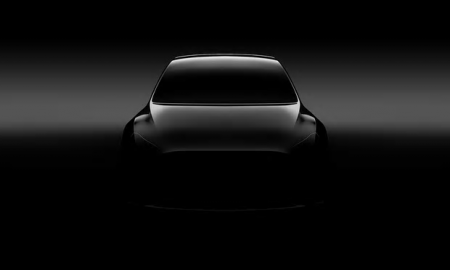
Tesla’s new Model Y electric SUV teaser image sparked controversy over its wing mirror-free appearance. Photograph: Tesla
Tesla’s chief executive Elon Musk has given preview of its upcoming Model Y small SUV and a so far nameless electric truck, as it prepares to deliver its first cheaper Model 3 electric saloons.
During the company’s annual shareholders’ meeting, Musk released a teaser image of the Model Y, which will be available in the 2019-2020 time frame and follow on from its larger SUV, the Model X. Musk said the Model Y would use a new platform building on the improvements made to existing models.
One of the new models to benefit from improvements since the original release of the Model S in 2012 is the more affordable Model 3, Tesla’s attempt at mass-market electric car. The Model 3 is expected to cost from $35,000 in the US, putting it in the same bracket as the BMW 3 series.
Musk said that Model 3 production is on track to start next month, and that vehicles should be delivered to those first in line for the pre-orders soon after. Tesla is aiming to make 5,000 Model 3s per week by the end of this year and 10,000 per week in 2018. The company hasn’t said how many people have put down $1,000 refundable deposits for the Model 3, but Musk said people who put down a deposit now won’t get a car until the end of 2018, indicating it could be close to 500,000.
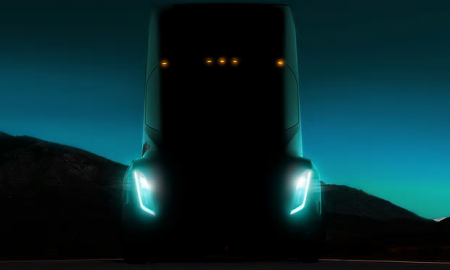
Tesla’s teaser image for its prototype all-electric semi-truck. Photograph: Tesla
The biggest challenge for Tesla will be around meeting mass-market production. It has faced manufacturing delays with previous models, including the latest Model X SUV which was nearly 18 months late. Musk said it was “crazy hard” to make cars and that Tesla had learned a lesson from the complexity of previous models. The Model 3 would be much simpler to make, not least because only the colour of the car and the size of the wheels would be customisable from the beginning rather than having a plethora of customisation options that would increase the time required to make the cars.
The 14-year-old Tesla has no experience producing and selling vehicles in high volumes, making just 84,000 cars last year compared with rivals such as GM, Volkswagen and Toyota, which routinely sell more than 10m per year.
Once the Model 3 is on the road in quantity, Tesla will also face servicing and charging troubles. The company said that it would increase the number of stores and service centres by 30% this year, but at the start of 2017 it had just 250 worldwide
Musk says a new fleet of mobile service trucks will be deployed and that Tesla plans to double its global high-speed “Supercharger” power points to 10,000 by the end of this year and increase them by another 50-100% in 2018.
Tesla is also seeking to break into freight transportation with a new all-electric semi truck, which is due to be unveiled at the end of September. Musk said that Tesla was currently shopping designs around to large freight firms with positive reactions and that the firm would have more than just truck news to share later this year.
Technology company Intel has released a study into the creation of a new ‘passenger economy’ when autonomous vehicles become commonplace on roads around the world.
The company believes that this new opportunity will be more than twice the size of the ‘sharing economy’, and will develop to support the idle time when drivers become passengers as they no longer have control of the vehicle themselves. Intel values this market at $7 trillion (€6.2 trillion) as autonomous technology grows by 2050.
Brian Krzanich, CEO of Intel, comments:
‘Companies should start thinking about their autonomous strategy now. Less than a decade ago, no one was talking about the potential of a soon-to-emerge app or sharing economy because no one saw it coming. This is why we started the conversation around the Passenger Economy early, to wake people up to the opportunity streams that will emerge when cars become the most powerful mobile data generating devices we use and people swap driving for riding.’
The report states that business use of Mobility-as-a-Service (MaaS) is expected to generate $3 trillion (€2.7 trillion) in revenues, or 43% of the total passenger economy, while consumer use of MaaS offerings is expected to account for $3.7 trillion (€3.3 trillion) in revenue, or nearly 55%.
Intel believes that this future mobility will see drivers moving away from traditional car ownership, with shared vehicles operating in towns and cities, a strategy that manufacturers in Europe also believe will aid infrastructure and improve both safety and pollution. In the report, the company states that self-driving vehicles are expected to free more than 250 million hours of consumers’ commuting time per year in the most congested cities in the world.
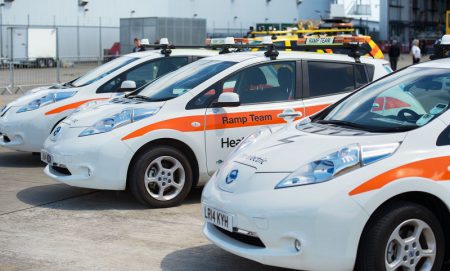
Heathrow airport has added 17 Nissan Leafs to its fleet to inspire a new culture of electric car usage.
The airport has allocated 12 vehicles to airside teams such as security and baggage while another five are to be used as pool cars.
Heathrow is committed to making the cars and small vans within its fleet electric or plug-in hybrids by the end of 2020.
Sales director at Nissan Motor (GB), Darren Payne, said:
“I’m sure this initiative will inspire other businesses to follow Heathrow’s lead by using Nissan’s electric vehicles to both reduce their emissions and cut their running costs.”
It is hoped that the visibility of the airside vehicles will encourage third parties operating at the airport to follow suit.
Head of operational strategy at Heathrow, Peter Leeming, said:
“We trialled the Nissan Leaf and found it was the perfect fit for many of our teams and the types of journeys they make. The trial went seamlessly, and within months we placed our order and put the Leaf into full time service.”
A video has been released detailing how the airport intends to implement the conversion and the trial process.
OAKLAND, CA (May 31, 2017)—Everywhere in the US, driving electric is cleaner than driving a typical gasoline-powered car. That’s truer now than ever before, and the advantage electric vehicles have over comparable gasoline cars is only continuing to increase.
New analysis by the Union of Concerned Scientists (UCS) shows that in 70 percent of the country, driving electric produces fewer emissions than driving a traditional gasoline car that gets 50 miles to the gallon. On average, today’s electric vehicles are as clean as gasoline cars that get 73 miles to the gallon. That’s thanks in large part to significant improvements in power generation, with more regions cutting their use of coal and increasing investment in renewable energy sources like wind and solar.
“Driving electric is one of the best choices a consumer can make to reduce emissions in their own lives,”
said David Reichmuth, senior vehicles engineer at UCS.
“As the electric vehicle market has emerged over the last five years, electric vehicles are better than a 50 mpg gasoline car for 70 percent of Americans, up from 50 percent. It’s been remarkable to see the improvements.”
Over their whole life cycle—from manufacturing to driving to disposal—electric vehicles produce half the emissions of a comparable gasoline vehicle. By far the largest share of emissions comes from driving, which is where electric vehicles have a big and growing advantage.
The new analysis is based on updated numbers on power generation from the U.S. Environmental Protection Agency, which show reduced greenhouse gas emissions from power generation in most of the country over the past five years.
“The future of driving is electric,” said Reichmuth. “We need to keep working to make sure these cars are accessible to more drivers, that we have the infrastructure to charge them, and that we continue to replace old dirty sources of power with new renewable technology.”
UCS has also updated an interactive online tool that drivers can use to learn how much cleaner different models of electric vehicles are where they live, as well as a map showing how electric vehicle emissions compare across the country.
The ride-sharing platform Lyft has been quite active through partnerships in the self-driving space. It took an important $500 million from GM to work with them on the deployment of autonomous cars in their fleet. They also announced a similar deal with Alphabet’s Waymo last month.
Now they announce another partnership with a self-driving car startup, nuTonomy, in order to use their vehicles for a fleet in the US – starting in Boston.
nuTonomy already operates similar test programs in Boston and Singapore, but through this partnership with Lyft, customers will be able to experience the vehicles through the ride-sharing app:
“The collaborative R&D effort will take place in Boston, MA, where nuTonomy has been testing its self-driving electric cars since the beginning of the year. The tests are being conducted in Boston’s Raymond L. Flynn Marine Park and the adjacent Seaport and Fort Point neighborhoods. An engineer from nuTonomy rides in each of its vehicles during testing to observe system performance and assume control if needed.”
What is also interesting here is that nuTonomy has been using electric vehicles as a platform for its self-driving technology, namely the Mitsubishi i-MiEV and the Renault Zoe.
“Thousands” of the vehicles should end up in the new program in Boston as the two companies develop the technology.
Karl lagnemma, CEO and Co-founder of nuTonomy, commented on the announcement:
“By combining forces with Lyft in the U.S., we’ll be positioned to build the best passenger experience for self-driving cars. Both companies care immensely about solving urban transportation issues and the future of our cities, and we look forward to working with Lyft as we continue to improve our autonomous vehicle software system.”
Here’s a demonstration of nuTonomy’s latest autonomous driving system:
Research from Frost & Sullivan finds that the global PHEV market is estimated to reach about 3.7 million units by 2025 with 4.8 million light vehicles in an optimistic scenario and 2.9 million light vehicles in a conservative scenario.
Mitsubishi Outlander PHEV Concept-s
The reasons behind such growth include the imminent launch of 100 new models, favourable incentives, emission target compliance, and long battery ranges.
However, factors that may impede PHEV adoption include the phasing out of electric vehicle incentives, long-range battery electric vehicles, emergence of 48V mild hybrids, and the complexity of having two powertrains in a single vehicle.
“The stringent emission norms of 95 g CO2/km can only be met by PHEV technology, while EV battery technology evolves to overcome limitations. PHEVs have a better market than BEVs due to uncertainty in charging infrastructure,”
said Frost & Sullivan Intelligent Mobility Research Analyst Pooja Bethi.
“Owing to their ability to provide internal combustion engines and EV advantages, the PHEV market is set for high demand and growth.”
Dedicated EV platforms like the Volkswagen (VW) MQB, Mercedes-Benz EVA, and BMW FSAR are major drivers, pushing PHEV growth.
Other key developments include high-performance models such as Maserati Levante, Bentley Bentayga, and BMW M3, which will have PHEV versions by 2025.
Global OEMs, led by Europe, have a strong PHEV strategy to meet regulatory changes and compliance mandates. VW Group is forecast to produce about 470,000 units by 2025.
China and Europe will likely lead the market, accounting for 39.8 per cent and 30.6 per cent of the total PHEV market, respectively.
By 2025, the C-Compact PHEV segment will be the largest, with over 35 new launches, followed by sports utility vehicles (SUV).
For what seems like a long time now, electric vehicles (EVs) have been on the cusp of going mainstream – in fact it was three decades ago that major automotive manufacturers first introduced working concepts of EVs.
Since then we’ve seen the hybrid vehicle make a significant impact on the car market, and now it looks like the fully-fledged EV is set to change motoring for good, making our cities less polluted and altering the very way we think of energy and how to use it.
The battery revolution
In the past, what’s held the EV back has been the high cost of batteries and their limited range. Consumers looking at the bottom line found they were paying more money for a car that travelled shorter distances. That has radically changed in recent years.
Battery costs have reduced enormously – 65% since 2010 – mainly for two reasons: firstly, as manufacturers figure out ways to make processes and materials more efficient, production becomes cheaper; secondly, economy of scale means that as EVs become more popular, the increasing demand pushes the cost of each individual battery down.
The other decisive factor with batteries is to do with improvements in their chemistry, which means they can now power a car over much longer distances.
Going station to station
Another criticism of EVs in the past has been the lack of charging points. This meant that – especially for long journeys – you had to plan meticulously and incorporate various diversions to ensure you didn’t wind up in the middle of nowhere with a dead battery.
But in the UK for example, the EV charging network is expanding rapidly. There are now 4,100 public charging locations, which is remarkable when you think there were only a few hundred as recently as 2011. Compare that to the 8,472 traditional fuel stations (a drop of 75% in the last 40 years) and it’s clear a major shift is underway. In fact, based on these trends, electrical charge points will outnumber traditional fuel stations by 2020.
Driving energy
One significant bonus for EV drivers relates to the energy convergence we’re beginning to see in urban areas, and how these vehicles interact with a ‘smart city’ dynamic.
Recharge stations could be used to feed energy back to the national grid, a process we already see in places like Japan, which has one of the largest EV populations in the world. It operates ‘Vehicle to Grid’ (V2G) systems, which essentially turn EVs into generators, enabling their users to sell energy from their parked cars to the national grid at times when it is most needed. Such technology combines easily with an app on your smartphone or alternative device that, in turn, ensures none of said energy is wasted.
For years we’ve been told the Electric Vehicle is the future, but as that future begins to unfold, and people begin to understand both the economic and environmental benefits, their popularity will begin to snowball. Within a generation, there is every chance EVs will be the only vehicles we’ll see on the road.