The Government has just announced that Britain is to ban sale of all diesel and petrol cars and vans from 2040. The writing is on the wall, with some sources saying that most cars sold will be electric as soon as 2025. If you want to learn about what’s coming, and how owning an electric car is going to affect you, then this guide is for you.
I have been driving an electric car for four years; first a Renault ZOE (48,000 miles) and now a BMW i3. Through my blog sites at Fuel Included and My Renault ZOE I have answered tons of questions about home charging. I decided it was about time to put all the answers together in one place, in a downloadable eBook.
Click on the image, enter your name and email, and download your free guide.
If it leaves any questions unanswered, just get in touch (contact details here and in the eBook).
Elon Musk’s company Tesla will partner with French utility Neoen to deliver the lithium ion battery designed to improve the security of electricity network.
Elon Musk, the billionaire founder of Tesla, will build the world’s largest lithium ion battery to store renewable energy in South Australia in partnership with French energy utility Neoen.
The 129MWh battery, which is paired with a wind farm, is designed to improve the security of electricity supplies across South Australia.
On Friday the state’s premier, Jay Weatherill, confirmed the deal, which forms a key part of the government’s $550m energy plan.
The state government said Musk had confirmed his pledge made on Twitter in March that he could deliver the battery within 100 days of signing the contract or it would be delivered free.
Romain Desrousseaux, the deputy chief executive of Neoen, said that at 129MWh the South Australian lithium ion battery would become the largest in the world. The battery will be built near Jamestown, in the state’s mid-north, and will be paired with Neoen’s Hornsdale windfarm to provide stability for renewable power being fed into the grid.
Musk told reporters in Adelaide on Friday the project was not without technical challenges, given it would be the largest battery installation in the world “by a significant margin”.
“When you make something three times as big, does it still work as well? We think it will, but there is some risk in that,” he said. “We’re confident in our techniques and the design of the system.”
He anticipated it would help stabilise the grid and help bring down prices for consumers.
Pollution free electric car is the answer to global warming and it is expected to become a reality by 2030.
Electric powered vehicles do not spew harmful gases and are free of pollution. Hence, one of the options to reduce #Global warming, which is at the root of many ills that plague the world, is to promote vehicles that do not use fossil fuels. The concept is gradually spreading and the world wants to see the popularity of #plug-in cars increase.
Electric car charging station in Buffalo New York (Image -wikimediacommons)
This strategy is necessary to combat climate change. As per estimates of the International Energy Agency, the population of electric vehicles must be at least 40 percent of passenger vehicle sales by 2040 to check global warming. This has to be achieved to meet the climate goals as envisaged in the Paris climate agreement.
However, transition would not be an easy affair because of several factors.
The bright side
According to New York Times, a new report by a research group has suggested that there is a downward trend in the price of plug-in cars because of the availability of cheaper batteries and aggressive policies that promote zero-emission vehicles in some countries. The vision of the future is that, within the next couple of decades, such vehicles would become cost competitive against traditional petroleum-powered cars. Obviously, people will be influenced to switch loyalties and embrace them to fight the menace of global warming.
It is true that plug-in vehicles are linked to climate change but they have yet to get a toehold in the market. At present, they comprise a miniscule percentage but the picture is slated to change.
Two majors like Tesla and Volkswagen have drawn up plans to roll out more than one million electric vehicles on an annual basis by 2025. Volvo is another major that plans to gradually phase out the combustion engine models and, from 2019 onwards, its new models would be either hybrids or entirely battery-powered.
One forecast is that by 2040, plug-in hybrids and all-electric vehicles will make up 54 percent of new light-duty sales and ease out combustion engine models.
Electric cars are expected to outsell gasoline-powered vehicles within twenty years, based on new projections by Bloomberg New Energy Finance.
The news and research organization expects electric cars and gasoline cars to be priced similarly by 2025, turning the automotive industry upside-down and having a severe impact on oil-exporting countries.
Electric cars in Milton Keynes (Image: T. Larkum)
What are the reasons? Dropping prices in batteries (a 73 percent drop in the past 7 years), increased manufacturing efficiencies, lower prices, and EV cars having simpler designs that require much less maintenance compared to cars with gasoline engines.
Bloomberg expects that plug-in vehicles will account for one-third of autos in use worldwide by 2040, eliminating 8 million gallons a day of oil production, equivalent to more than all the oil Saudi Arabia exports today. In Europe they expect two-thirds of all new cars to be electric in this same time period, compared to almost 60 percent in the U.S. and half in China.
Adoption of electric vehicles (EV) is already underway by Uber and Lyft, which are adding fleets of EV models. Lyft has a relationship with GM and is adding Bolts to their fleet, and in Europe and China, many of the transportation companies are using Teslas.
One of the surest signs of this transition is this week’s announcement from Volvo that beginning in 2019, every new model will use electronic propulsion, either hybrid or all electric. They’ve already abandoned diesel because of the stricter emission targets established by the EU and the growing concern over its health effects. The company said that between 2019 and 2021 they’ll launch five new electric vehicles.
Volvos are being built in Sweden, but the company is owned by Chinese automotive giant Geely, which likely influenced their decision. China’s Ministry of Industry and Information Technology has set a target that one-fifth of all new vehicles being sold in China in 2025 must be electric and hybrids.
Håkan Samuelsson, president and chief executive of Volvo Cars, said,
“This announcement marks the end of the solely combustion engine-powered car. Volvo Cars has stated that it plans to have sold a total of 1M electrified cars by 2025. When we said it we meant it. This is how we are going to do it.”
I saw my first autonomous electric pod in Milton Keynes today while taking a lunchtime walk.
Although I’ve followed the development of the Lutz Pathfinder for a few years, this was the first time I’ve seen one ‘in the flesh’. It appeared to be undergoing testing on undeveloped land on the eastern side of the city centre.
Unfortunately what’s not clear in the picture is that it’s stationary. Someone is hunched down on the far side with a laptop.
Nitin Gadkari said the government would “not allow any technology that takes away jobs”.
He said India needed to recruit about 22,000 more commercial drivers and would be opening 100 training facilities to address the need.
India’s road system and sometimes chaotic traffic makes it a difficult place to develop the technology.
The Hindustan Times reports Mr Gadkari as saying:
“We won’t allow driverless cars in India. I am very clear on this.
“In a country where you have unemployment, you can’t have a technology that ends up taking people’s jobs.”
However, he did not rule out the idea of a future change of policy.
“Maybe some years down the line we won’t be able to ignore it, but as of now, we shouldn’t allow it,”
he added.
Inderpreet Kaur, an analyst at research firm Ovum said:
“The ministry has cited job losses as a reason behind banning autonomous cars in India, a bigger challenge would be to have ready infrastructure for these self-driving cars.”
Google, BMW, Tesla, Audi and Uber are among businesses working hard to be the first to bring truly autonomous cars on to roads.
Self-drive technology trials, both for private cars and commercial vehicles, are being carried out around the world.
Google has been testing self-drive cars in California and other states since 2012.
Paris began a three-month test of self-driving buses at the beginning of the year, and in the UK a consortium of companies plans to test driverless cars on motorways in 2019, while others are testing cars in off-road sites, including in London.
Commenting on the decision on Twitter, Indian congressman Gaurav Pandhi tweeted:
“The BJP (Bharatiya Janata Party) said the same when Rajiv Gandhi talked about introducing computers to India. They haven’t really changed.”
A fully electric version of the Mini will be built at the Cowley plant in Oxford, BMW has said.
The carmaker said the model would go into production in 2019, with Oxford the main “production location” for the Mini three-door model.
However, the electric motor will be built in Germany before being shipped to Cowley for assembly.
BMW said it had “neither sought nor received” any reassurances from the UK on post-Brexit trading arrangements.
The electric vehicle will be based on the 3-door hatchback model
Last year, the government faced questions about the “support and assurances” given to Nissan before the company announced that new versions of its Qashqai and X-Trail would be made in the UK.
And there have been reports that Toyota agreed to invest in the UK after receiving a letter reassuring the Japanese carmaker over post-Brexit arrangements.
‘Vote of confidence’
About 360,000 Minis are made each year, with more than 60% of them built at Oxford. But BMW has built up an alternative manufacturing base in the Netherlands amid concerns about Britain’s suitability as an export hub after Brexit.
BMW has warned about the damage of Brexit uncertainty, and in May chief executive Harald Krueger said the company had to remain “flexible” about production facilities.
UK Business Secretary Greg Clark hailed BMW’s announcement as a “vote of confidence” in government plans to make Britain
“the go-to place in the world for the next generation of vehicles”.
On Monday, he set out plans to invest in development of battery technology in the UK.
Mr Clark met BMW’s head of sales and marketing, Ian Robertson, at the company’s headquarters in Munich in January and March this year. The two also held meetings at Westminster in March and June.
David Bailey, professor of industry at Aston University, said the true test of the global car industry’s desire to invest in the UK would come next year:
“I don’t think it [BMW’s decision] tells us much about Brexit and the form of trade barriers we may face in the future.
“The big decisions will be about future models [which would have redesigned bodies], both at Mini and at companies like Vauxhall when they announce their new models in the next couple of years.”
There weren’t cars only on display inside the Electric Vehicle Experience Centre (EVEC) at the launch. There were also a large number charging up outside, presumably getting ready for test drives for the public for the opening the next day.
Electric cars ready for free test drives in Milton Keynes (Image: T. Larkum)
The large numbers and broad range of EVs available was impressive.
How about a quick quiz: can you identify them all? The answers are given below.
Electric cars ready for free test drives in Milton Keynes (Image: T. Larkum)
Of course, whether you own an EV or are considering your first, you’re welcome to test drive any of the vehicles on show for free. Just get in touch and we’ll help arrange it.
Answers to the Quiz: these are the electric cars waiting to give test drives (from nearest the camera to furthest away):
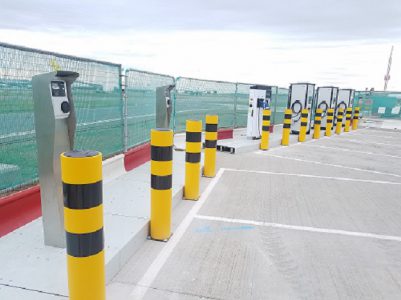
eVolt’s 200th electric vehicle (EV) Rapid Charging unit has been supplied to Heathrow Airport, after the charge point supplier was awarded the contract to provide the UK’s largest airport with 18 of its units in phase one.
The significant milestone has been achieved as a result of the hard work of Freemantle Electrical – the selected EV charger and infrastructure installer for the initial phase of works. The chargers were installed using a specific new designed EVCI-Go modular plinth system developed by Freemantle that allows wiring through the plinth system, which avoids any major civils works and speeds up the installation process. The Airport selected eVolt as its supplier of EV charge points following a competitive tender where multiple suppliers were reviewed.
The new Rapid charging units have been installed at eight of the airport’s airside locations including the Airside Operations Facility (AOF). They will be used by Heathrow Airport’s growing fleet of EVs run by Heathrow Airport Limited and its tenants assisting in everyday operations.
Richard Freemantle, Managing Director at Freemantle Electricals, says eVolt came highly recommended:
“The reliability of eVolt’s charging units is well known and that was key to Heathrow Airport Limited’s selection,” he says. “Its units are well maintained and have a high up-time, meaning the Airport’s EVs will be able to operate with maximum performance.”
Three Compact Rapid charging points, that can simultaneously charge two EVs to 80% battery capacity in 30 minutes at 50kW DC and 43kW AC, have been installed, taking the number of eVolt Rapid charging units installed in the UK to over 200. A Semi-Rapid Raption 22kW Triple charging unit that charges an EV to 80% in one hour has also been installed. This is ideal for fast top-up charges and utilises the latest modular power technology for enhanced reliability and performance.
The contract also includes the supply of eVolt 7kW and 22kW AC Wall mount charging units, which typically take up to four hours to charge an EV (battery size dependent). It is expected that these will be used to provide charging to ‘off-duty’ EVs, ensuring that when a shift starts the vehicles are able to make use of a full charge.
Justin Meyer, General Manager of eVolt UK, says:
“We are seeing increasing opportunities with major public transport hubs looking at ways to reduce emissions,” he says. “It’s a testament to our equipment’s reliability and performance that 200 Rapid charging units, the most technical and desired in terms of charging time, are operational.”
Last weekend saw the long awaited opening of the Electric Vehicle Experience Centre (EVEC) in Milton Keynes. It officially opened to the public on Saturday 22nd July. It is funded through a government scheme awarded to the local council and is managed by Chargemaster, the company that has installed the majority of charge points around Milton Keynes.
The Preview Event at the Electric Vehicle Experience Centre (Image: T. Larkum)
The EVEC is essentially a car showroom for electric cars but is located in a shop space on Crown Walk in the main centre:mk shopping centre (it’s close to the middle and next to Boots). It doesn’t resemble an out-of-town dealership so much as the boutique style shops developed by Tesla, Apple and most mobile ‘phone companies.
EVEC Purpose
The aim of the Centre is to both showcase existing electric models and be an information point for EV ownership in general. Visitors will be able to talk with staff about all elements of owning and running an EV, with test drives available too. It has been established to increase the number of EVs sold in the area. Milton Keynes’ target is for 23% of all new cars registered locally to be electric by 2021.
The Preview Event at the Electric Vehicle Experience Centre (Image: T. Larkum)
We are grateful to Chargemaster for inviting us to the Preview Event on Friday Night (Jo’s thoughts: A Little Bit of Zen). Most of the other guests appeared to be existing EV owners. The showroom housed examples of the Nissan Leaf, BMW i3, Volkswagen Golf GTE and Mitsubishi Outlander PHEV. There were drinks and snacks, and then introductory speeches by David Martell, Chief Executive of Chargemaster, and Ted Foster, the new EVEC Manager. After the talks we had an opportunity to talk to Ted and the other staff.
EVEC Test Drives
As well as providing help and guidance on electric cars and EV driving, the EVEC is also making cars available for test drives. These can be short accompanied drives, however there is also the option of week-long extended test drives. For these there will be a charge (we understand about £70) largely to cover the inevitable cost of insurance. That’s seems fair to us – £10 per day to drive a new car, particularly considering the fuel costs will be negligible.
The Preview Event at the Electric Vehicle Experience Centre (Image: J. Pegram-Mills)
The enthusiasm of the EVEC ‘gurus’ is clear and we certainly appreciate the enthusiasm and resources that have gone into building and staffing the first dedicated electric vehicle showroom in the UK (and probably in the world). We wish it every success and will be supporting it by passing local customers to it for test drives.
If you live near Milton Keynes and are interested in taking a test drive in any one of a large range of new electric cars (including the Renault ZOE, Nissan Leaf, BMW i3, Golf GTE, and others) just get in touch with us on 01908-904020, or by email at sales@ fuelincluded.com.