Category Archives: Electric Cars

News and reviews of the latest electric cars (full electrics and plug-in hybrids).

UK Study: Electric Cars Twice as Green Today as in 2012

Remember that BS news story from around 2005 about a Hummer being greener to own than a Toyota Prius over the life of the car? That story got debunked less than a year later, as- even by 2006 standards- the Prius is a pretty clean car.
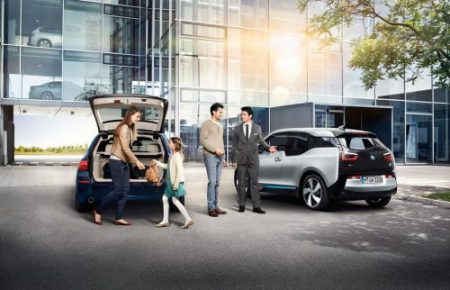
As we head into the 2018 model year, however, have things gotten any better for electric cars? According to a new study in the UK, things have gotten twice as good!

Thanks to the increase in solar energy and wind farm use, electric vehicles are putting out about half the carbon emissions that they put out just five years ago. The study revealed that charging a Tesla Model S created 124g of carbon dioxide per km driven in 2012- but that that is down to just 74g per km in winter and just 41g per km in summer in 2017, according to research by Imperial College London.

Interestingly, that same study found that a Toyota Prius hybrid was actually cleaner than Tesla’s Model S in the winter, producing just 70g of carbon dioxide per km compared to the Tesla’s 74, with the Tesla coming out ahead in the summer months. That seasonal differences found in the study were apparently caused by solar farms making up a higher proportion of UK electricity generation in the summer months, with the winter shortfall made up by gas power stations. Meanwhile, the same UK study found that the Nissan Leaf, BMW i3, and the highly anticipated Mitsubishi Outlander PHEV models are all cleaner than a Prius, regardless of the season.

Dr. Ian Stafell, lecturer in sustainable energy at Imperial College and author of the report, said that, “It is widely accepted that electric cars dramatically reduce air pollution in cities, but there is still some debate about how clean they actually are. It varies depending on where the electricity to charge them with comes from … now, thanks to the rapid decarbonisation of electricity generation in the UK, they are much better. Smaller electric cars like the Nissan Leaf and BMW i3 can be charged for less than half the CO2 of the cleanest non-electric car on the market.”

Source: GAS2

BMW and FCA alliance to develop autonomous cars

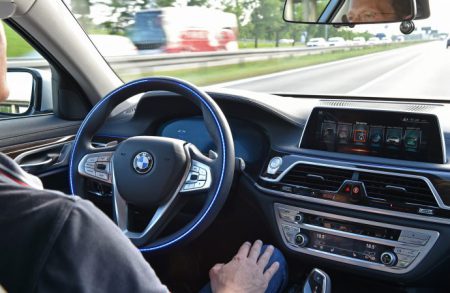
BMW GROUP and Fiat Chrysler Automobiles have formed an alliance, along with technology company Intel and advanced driver assistance systems company Mobileye, to develop self-driving vehicles.

The four companies signed a memorandum of understanding in order to allow them to work together on a new ‘world-leading, state-of-the-art autonomous driving platform’.

Under the arrangement, each organisation will be able to ‘leverage each other’s individual strengths, capabilities and resources’.

The aim is to start production of vehicles with Level 3 (highly automated driving) and Level 4/5 (fully automated driving) autonomous capabilities by 2021.

The companies are planning to have 40 autonomous test vehicles on the road by the end of 2017. They also expect to benefit from data received from Mobileye’s 100 Level 4 fully autonomous test vehicles.

Harald Krüger, chairman of the board of management of BMW AG, said: ‘The two factors that remain key to the success of the cooperation are uncompromising excellence in development, and the scalability of our autonomous driving platform.

‘With FCA as our new partner, we reinforce our path to successfully create the most relevant state-of-the-art, cross-OEM Level 3-5 solution on a global scale.’

Brian Krzanich, CEO of Intel, said:

‘The future of transportation relies on auto and tech industry leaders working together to develop a scalable architecture that automakers around the globe can adopt and customise.

‘We’re thrilled to welcome FCA’s contribution, bringing us a step closer to delivering the world’s safest autonomous vehicles.’

Professor Amnon Shashua, CEO and CTO of Mobileye, said:

‘We welcome FCA’s contributions and use of the cooperation’s platform, which has made substantial progress over the last year and is rapidly entering the testing and execution phase.

‘The combination of vision-intense perception and mapping, differentiated sensor fusion, and driving policy solutions offers the highest levels of safety and versatility, in a cost-efficient package that will scale across all geographies and road settings.’

Source: CarDealer

Living With The BMW 740e

Two Weeks With The Green Limo

It sits at the top of the BMW tree, sure there’s the i8 but when it comes to a pioneering marvel the BMW 7 series wins hands down. So many world firsts debuted on this car along with its rival the Mercedes-Benz S-Class. The generation one car featured BMW’s first on board computer and airbags, today gesture control is another precedent set. The flagship has always been powered by petrol and from the mid-nineties diesel. In more recent times electricity helps to propel the beast along. Chris Bowen spent two weeks in the plug-in hybrid variant, the 740e.

Very Potent

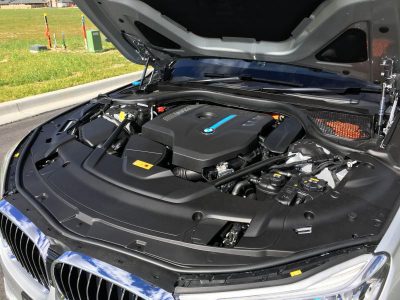
First up the usual 3.0-litre inline turbo-six-cylinder petrol unit has been ditched for a turbo 2.0-litre turbo-four-cylinder hooked up to an electric engine. Don’t underestimate what seems like lunacy, the combo pumps out 240kW and even more torque at 500Nm. If you’re interested in breaking down the figures the petrol engine contributes 190kW / 400Nm while the electric motor tips in the extra 83kW / 250Nm. This is a very quick 8-speed mothership that’s marginally quicker than its petrol donor car.

After jumping inside the 740i early last year I was expecting more of the same. That sameness means spades of opulence and an ability to stir the senses. In fact, having one for an entire two-week period really gave me a reality slap, it’s easy when doing this gig to lose perspective. The car simply makes you feel like a king, a king that likes to drive himself.

The Drive.

The cabin is so well insulated that if it wasn’t for the unique iPerformance instrument cluster and eDrive graphics you’d be flat out knowing when the battery is providing the momentum or the petrol engine has kicked in. It just floats along in a very pillowy way. The automatic self-levelling air suspension dispatches just about all surfaces with ridiculous ease. Even on dirt this thing just seems oblivious to the real world conditions. I’d say with my Rolls Royce experiences in mind the ride is basically the same, plus a bucket load cheaper.

The usual driving modes are there to suit your mood. There are two comfort modes, “Comfort” and “Comfort Plus” the latter dead set makes the car feel like it’s floating. In fact, the comfort modes are clearly more aimed at providing those in the back with the ultimate, hushed ride to and from the office. As a driver, they turn the limo into a slightly annoying woolly experience, especially around town. But flick into “Sports” mode and it’s goodbye flying magic carpet, hello excitement machine.

Read more: EFTM

Ford CEO cannot see robots taking over the world’s roads

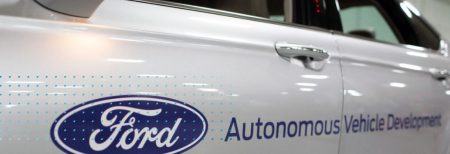
The new CEO of Ford Motor Company, Jim Hackett, has suggested that there will be no ‘robot takeover’ when it comes to the introduction of autonomous vehicles on roads around the globe. 

Speaking at the manufacturer’s City of Tomorrow event, Hackett, who headed up Ford’s Smart Mobility subsidiary before taking over as CEO, predicted that rather than a pod-based landscape, similar to robo-taxi services being tested in a number of cities, the technology will instead gradually augment current challenges such as limited parking and vehicle access.

‘When you paint the robots as perfect and humans as imperfect, we’ve made a big mistake,’ Hackett said. ‘We don’t need the robot to get around.’

Ford has been behind its rivals when it comes to developing autonomous technology, however Hackett has been tasked with turning this around. Since his appointment in May 2017, replacing former CEO Mark Fields, the company has invested in various transportation technologies, including lidar-maker Velodyne, mapping company Civil Maps, bike-share company Motivate, ride-sharing start-up Chariot and autonomous driving start-up Argo AI.

Hackett also said a combination of analogue and new technologies will be necessary to create a better transportation environment:

‘Networks only get stronger by inclusion, there’s no gain by carving someone out,’

he added.

The CEO also added his thoughts about vehicle ownership, particularly when it comes to less congested cities due to autonomous vehicles allowing for sharing and more efficient movements:

‘I don’t believe there’s going to be a big degradation of sales as the cities become less congested,’ Hackett said. ‘It’s probably going to give people more options to keep their cars, because they can choose to use them in ways that they couldn’t before.’

Read more: Autovista Group

The best new hybrid cars 2017

Conventional petrol and diesel cars will be banned from sale in the UK from 2040.

Therefore, electrified hybrid cars will be the only models available that still feature some sort of internal combustion engine. The choice of these electrified ‘mild hybrid’ and plug-in hybrid electric vehicles (PHEVs) is now wider than ever, as our selection here shows. All quoted ‘on the road’ prices include VAT, but do not include the government’s Plug-in Car Grant (PiCG) – where applicable.

Volkswagen Golf GTE: £30,635 – £32,135

The Golf GTE is Volkswagen’s idea of a fleet-friendly electrified performance Golf in the vein of the legendary GTI. With a combined output of 204hp from its 148bhp 1.4-litre petrol engine and 75kW electric motor, the plug-in hybrid Golf does the 0-62mph dash in 7.6 seconds, yet has CO2 emissions from just 38g/km. Electric-only range is 31 miles, while five electric and hybrid modes allow the plug-in Golf to be tailored to the prevailing driving conditions for the best performance or economy.

Hyundai Ioniq HEV: £20,585 – £24,185 / Hyundai Ioniq Plug-in Hybrid: £27,495 – £29,295

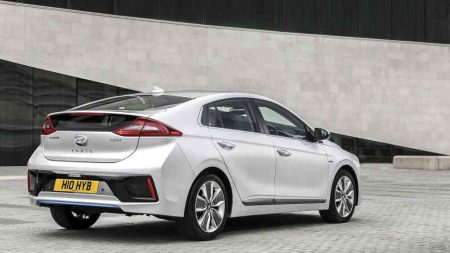
The Ioniq is Hyundai’s new flagship range of electrified cars. Available in all-electric, plug-in hybrid, and ‘mild’ non-plug-in hybrid versions, the latter car has an official total range of 700 miles. With a low drag coefficient figure of 0.24, the plug-in version of the hybrid Hyundai boasts a combined economy figure of 256.8mpg and CO2 emissions from 29g/km. The interior is a step up from Hyundais of old, while blue accents inside and out point to the hybrid version.

Mitsubishi Outlander PHEV: £34,305 – £46,055

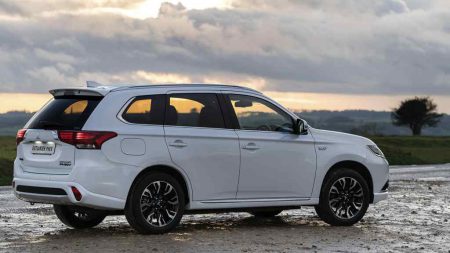
Want a hybrid more suited for the rough and tumble? The 41g/km Mitsubishi Outlander PHEV was the world’s first plug-in hybrid SUV and has proved very popular in the UK thanks to its low company car tax costs at launch. As well as more than enough space for families, the big SUV from Japan mates a 2.0-litre petrol engine to a pair of electric motors for up to 166mpg, and has the extra option of four-wheel-drive capability.

Read more: Motoring Research

Hyundai and PSA announce trade-in bonuses in Germany

Following in the footsteps of their German competitors and fellow importers, Hyundai and the PSA Group have now also introduced discounts on the purchase of new vehicles in Germany when an old Euro-1 to Euro-4 diesel car is traded in.

In the case of Hyundai, a bonus of between €2,500 and €10,000 is available until the end of 2017 when an older diesel car which conforms to the Euro-1 to Euro-4 emission standards is traded in. The only key condition of the ‘Green Deal’ scheme is that the car to be traded in must have been registered in its owner’s name for at least six months. All petrol and diesel Euro-6 compliant Hyundai cars are eligible for the bonus, including the hybrid version of the Ioniq. However, in an approach which mirrors that taken by other brands such as Ford and Opel, Hyundai’s electric vehicles (EV) – namely the plug-in hybrid and pure electric versions of the Ioniq – are not included in the offer. Nevertheless, these vehicles are of course still entitled to the German electric vehicle incentives, which amount to €3,285 for the Ioniq plug-in-hybrid and €4,380 for the fully electric variant.

The incentives on offer start at €2,500 for a Hyundai i10 and an ix20 and rise to €3,800 and €4,000 respectively for the i20 and Ioniq hybrid. For the Hyundai i30, Tucson and H-1, customers are entitled to a discount of €5,000 on the purchase price and the maximum €10,000 discount is available for buyers of the Hyundai i40 estate and Santa Fe or Grand Santa Fe SUVS. As with most other schemes, the bigger the car the greater the incentive. One additional noteworthy point, however, is that customers who trade in a Euro-4 compliant diesel are, according to the Hyundai press release, entitled to ‘a fair market value for the end-of-life vehicle from the participating Hyundai dealer beyond the promotional premium.’

Markus Schrick, managing director of Hyundai Motor Deutschland GmbH, said in Wednesday’s release that:

‘Environmentally-minded drivers are guaranteed to find the right vehicle at Hyundai. Whether you choose a petrol, diesel or hybrid powertrain. A modern powertrain is part of the DNA of every new Hyundai. And in comparison to many other manufacturers, our customers can top up the campaign bonus with the trade-in payment for their old Euro 4 diesel.’

Read more: Autovista Group

JPMorgan thinks the electric vehicle revolution will create a lot of losers

  • Adoption of electric vehicles will accelerate and that’s going to hurt some internal combustion legacy businesses, JPMorgan Cazenove said in a note on Monday
  • Losers were likely to include dealer networks, maintenance businesses, lenders and oil companies, the note said

Adoption of electric vehicles is set to accelerate, and that’s going to run over a lot of losers, including within the auto industry itself, JPMorgan Cazenove said in a note on Monday.

The shift toward electric vehicles is set to be a multi-year process, but once there’s a tipping point, likely on a shift in costs, the transition could take off, JPMorgan analysts said.

They noted the price difference between traditional internal combustion vehicles (ICVs) and electric vehicles (EVs) was already narrowing as battery prices fall, but prices might not need to fall much for consumers to make the leap.

“Concerns about scrap values of ICVs may drive consumers towards EVs even before the price differential between the two classes of vehicles closes,”
JPMorgan said.

It estimated electric cars would take 35 percent of the global market by 2025 and 48 percent by 2030.

That’s going to create some clear losers in an industry that’s been spreading its tendrils for more than a century.

For one, adoption of electric vehicles means much lower maintenance costs for consumers, the analysts said.

“EVs have 20 moving parts compared to as many as 2,000 in an ICV, dramatically reducing service costs and increasing the longevity of the vehicle,” the analysts said, adding that it estimated running costs for an electric vehicle can be around 10 percent of an internal combustion one.

“We see this as a meaningful risk for car dealers who rely on after-sales service for a large chunk of their profitability,” the note said. “This should over time reduce the number of vehicles sold as well, in addition to other potential trends, such as automated driving and greater car utilization rates.”

Read more: CNBC

Chery to launch its electric model offensive in Europe with compact SUV

Chinese giant Chery is to launch its next major attempt to break into the European market in September with the unveiling of a compact SUV at the IAA (International Motor Show) in Frankfurt in September.

It is to come with an ‘all-new nameplate’ that will spearhead the launch of a large upcoming model family across several segments on a new modular platform, all featuring some degree of electrification – from mild hybrid, plug-in hybrid to full electric powertrains, mirroring the much-lauded plans of rival Geely’s Volvo from 2019.

Chery is the largest all-Chinese car producer, selling more than 700,000 vehicles in 2016, including 100,000 in overseas markets, which made up 30% of China’s total car exports last year. Chery last attempted to break into the European market in 2007 via a 50-50 venture called Qoros with an Israeli company. Sales have greatly underperformed and the brand never made it to Europe.

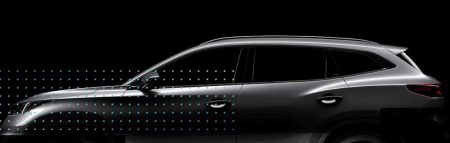
The compact SUV to be revealed in September, spearheading Chery’s new brand for Europe and America, uses typical SUV lines, as revealed from design previews, which also show an interior with a large high-mounted infotainment screen as well as climate control switchgear.

Although Chery has not revealed the model’s target market, it is likely to be competing against mass-market SUVs including the Ford Kuga and Vauxhall Grandland X, as well as being in direct competition with Geely’s upcoming Lynk & Co brand, acquired alongside Volvo from Ford in 2010, which is launching in Europe in 2019.

This will be a major international re-launch for Chery, with the company announcing it will be opening dedicated European design and engineering facilities specifically for the model. It has not yet revealed which countries will see the vehicle first, nor has it been named. It will not use the Chery badge.

Similar to Lynk, Chery will be targeting young, trend-oriented customers in growing urban centres, focussing on high quality low-emission drive technologies, and instilling its models with emotion to improve margins.

Chery has sufficient existing production capacity to build the European model at its current production sites, which include four plants in China and ten international production sites. It is looking for local distribution partners to facilitate its European and American expansion.

Read more: Autovista Group

U.K. Companies Pledge to Expand EV Fleets

The head of Go Ultra Low, a public-private EV advocacy group, says the corporate sector has a huge role to play in achieving the U.K. government’s goal of having every new car and van in the region be ultra-low-emissions by 2040.

Government offers grants, incentives to businesses wanting greener fleets.

The number of U.K. companies promising electric vehicles will make up at least 5% of their fleets by 2020 tops 100.

The companies signal their intention by signing up with Go Ultra Low, a consortium of automakers, government and the Society of Manufacturers and Motor Traders formed to promote the benefits, cost savings and capabilities of EVs.

Organizations signing on range from the London Fire Brigade to Microsoft U.K.

Many of the companies have ambitions to exceed the 5% target.

Santander U.K., a bank, operates 57 EVs and wants to increase this to represent 10% of its 1,400-strong fleet by 2020. The Oxford City Council says all-electric vehicles will account for 7% of its fleet by the end of the decade.

Minister of State for Climate Change and Industry Claire Perry says the government backs companies making the switch to low-emissions vehicles through grants and incentives.

Go Ultra Low Head Poppy Welch says the corporate sector has a huge role to play in achieving the U.K. government’s goal of having every new car and van in the region be ultra-low-emissions by 2040.

“Go Ultra Low companies are setting an example for others to follow, dispelling misconceptions around EVs at the same time as helping to improve U.K. air quality and reduce the country’s carbon footprint,”

Welch says in a statement.

A survey of U.K. company car drivers commissioned by Go Ultra Low last November found almost 700,000 U.K. motorists would join the EV revolution, if they were given the opportunity by their employers. It also found only 25% of businesses offered electric company cars to employees.

U.K. sales of EVs rose 14.3% in first-half 2017 to 22,480 units.

Source: Wards Auto