Category Archives: Electric Cars

News and reviews of the latest electric cars (full electrics and plug-in hybrids).

Tesla Model3 (Image: Wikimedia/Carlquinn)

Tesla shares jump as Musk delivers quarterly profit, cash

SAN FRANCISCO (Reuters) – Tesla Inc (TSLA.O) reported a net profit, positive cash flow and wider-than-expected margins for the latest quarter on Wednesday, delivering on Chief Executive Elon Musk’s promise to turn the electric carmaker profitable as higher production volumes of its new Model 3 began to pay off.

Tesla reiterated that it expected to repeat its net profit in the current quarter, helping drive the company’s shares up 14 percent in after hours trading.

The controversial Musk, who has often set goals and deadlines that Tesla has failed to reach, surprised investors by delivering on his pledge to make Tesla profitable for only the third quarter in its 15-year existence, providing a positive end to a difficult quarter for the CEO whose leadership was openly questioned only weeks ago.
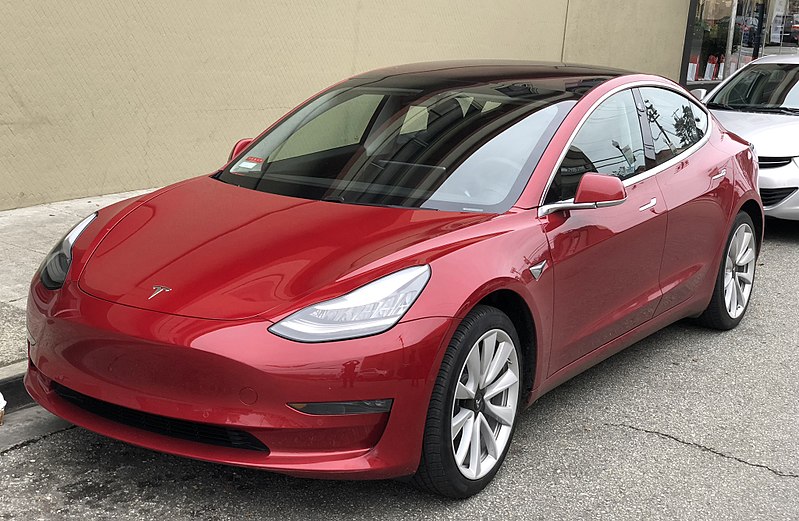
Tesla Model3 (Image: Wikimedia/Carlquinn)

“We can actually be cash flow positive and profitable in all quarters going forward,” Musk said, qualifying that he excluded those in which a big debt payment comes due, such as the first quarter of 2019.

Musk reiterated that Tesla currently does not plan to raise equity or debt.

Tesla said it would begin taking orders in Europe and China for the Model 3 before the end of 2018. Deliveries would begin to Europe in late February or March, and those to China in the second quarter, if not before, Musk said.

Musk said he planned to begin local production in China next year in a ‘capital efficient manner,’ suggesting the company might use a similar tent structure for car assembly that has already been used at its Fremont, California, plant. He gave no further details on plans in China.

Meanwhile, seeking to quell speculation that a large number of prospective buyers had canceled their reservations due to delays receiving their cars, Tesla said only 20 percent of North American reservation-holders had canceled their bookings.

Free cash flow at $881 million was positive for only the third time in Tesla’s history and was helped by a surge of new production of the Model 3, lower capital expenditures, and more efficient use of working capital.

While still below the production target it set for June of 5,000 Model 3s per week, the roughly 4,300 Model 3s the company is now averaging per week were enough to boost results.

Read more: Reuters

Groupe Renault unveils France's first Smart Island on Belle-Île-En-Mer (Image: Renault)

Renault EVs drive forward the Eden project’s commitment to reducing carbon emissions

Renault electric vehicles will continue to play a major role in the day-to-day running of the Eden Project and its drive to educate its millions of visitors on the environmental benefits of EVs after the world-famous attraction took delivery of a new fleet of 100 per cent electric ZOE and Kangoo Z.E models

Comprising of three Renault ZOE hatchbacks and 14 Renault Kangoo Z.E. in Van and Maxi Crew Van Cab specifications, the vehicles replace the Eden Project’s previous Renault EV fleet. The latest vehicles complement Eden’s existing Renault Twizys. The quadricycles’ compact dimensions make them ideal for use across the entire Eden site – even in the narrow pathways through the tranquil, climate-controlled Biomes.

Groupe Renault unveils France's first Smart Island on Belle-Île-En-Mer (Image: Renault)
Renault ZOE and Kangoo ZE (Image: Renault)

The usability and high visibility of its previous Renault EVs has allowed the Eden Project to lead by example when it comes to raising awareness of the benefits of electric vehicles in reducing carbon emissions. Compared to equivalent diesel and petrol vehicles, its original Renault EV fleet saved nearly 17 tonnes of CO2 since its inception in 2016, clocking up nearly 94,000 miles in and around its award-winning facility.

The mix of ZOE and Kangoo Z.E. will fulfil a variety of roles across the Eden Project, being used by its maintenance, horticulture, security, live programming and catering teams. A number of the vehicles will also be assigned to help with the provision of onsite medical support and transporting less able-bodied visitors around the site.

With zero tailpipe emissions and being near silent in use, the Renault EVs have little impact on the tranquillity and striking landscape of the Eden Project. Notably, during the last two years the lack of noise has allowed the busy Eden Live Team to work round the clock without affecting the visitor experience, while the fleet has also chauffeured presenters and celebrities to help facilitate the wide variety of filming that the renowned Cornish venue hosts every year.

Read more: Automotive World

Uber updates London electrification plans with new ‘clean air fee’ and charger partnerships

Uber has teamed up with seven electric vehicle charging suppliers to offer its drivers cheaper prices for home charge points, while adding 15p per mile to each London journey to fund the switch to EVs across its London fleet.

The company’s latest Clean Air Plan is aiming to get every car in London on the Uber app to be fully electric in 2025 – a significant change to its pledge made in September last year to transition its London fleet of uberX vehicles to hybrid or fully electric by 2019, followed by the rest of the UK in 2022.

From early 2019, a ‘clean air fee’ of 15p per mile will be included on every trip booked through the app in London – averaging at 45p a journey – to be put towards aiding drivers in upgrading to an EV.

The amount of support drivers could receive will be based on the number of miles they have driven, with those using the app for an average of 40 hours per week likely to expect around £3,000 within two years’ time and £4,500 in three years.

This is in place of a similar charge proposed by Uber in September last year of 35p per journey to be put into a ring-fenced Clean Air Fund offering up to £5,000 to drivers towards the cost of upgrading to a hybrid or fully electric vehicle.

The company expects to raise £200 million in the coming years, with a goal to have all Uber vehicles fully electric in London in 2025, with the first 20,000 drivers upgrading to electric vehicles by the end of 2021.

Read more: Current News

OVO Vehicle-to-Grid (V2G) charging (Image: T. Larkum/Fuel Included)

Nissan Leaf gets approval for vehicle-to-grid use in Germany

So-called vehicle-to-grid (V2G) technology is a connection between the EV and the grid through which power can flow from the grid to the vehicle and vice-versa. That potentially enables car owners to sell energy to the network, while utilities could use electric cars as a backstop if demand rises.

Nissan said it would initially target corporate clients with fleets of more than 60 electric vehicles, adding that services based on V2G technology would be offered in Germany from next year onwards.

OVO Vehicle-to-Grid (V2G) charging (Image: T. Larkum/Fuel Included)
Leaf Vehicle-to-Grid (V2G) charging (Image: T. Larkum/Fuel Included)

There will be 280 million electric vehicles by 2040, according to estimates by the International Energy Agency, compared with more than 3 million last year.

“We strongly believe in an emission-free future,” Guillaume Pelletreau, Vice President and Managing Director, Nissan Center Europe, said. “Leaf batteries could make an important contribution to energy transition in Germany and a sustainable future.”

Read more: Reuters

Electric vehicle chargers could offer £6 billion opportunity to 2040 across shops, workplaces and motorways

An investment opportunity of up to £6 billion is available to 2040 owing to the need for millions of electric vehicle chargers at workplaces, shops and motorway services, according to a report out this week.

Released by Aurora Energy Research and supported by Eaton, NatWest, Lombard and the Renewable Energy Association, the study states the number of chargers needed at commercial and industrial (C&I) units could hit 3 million.

This would occur under a high deployment scenario with 35 million EVs on the road in Great Britain, as demand for charging facilities away from the residential sector increase.

Demand for these would be spread across fleet vans, workplace commuters, pubic car parks, and motorway stops, requiring between £2 billion to £6 billion of investment to fund the total cost of equipment and installation.

Dr. Felix Chow-Kambitsch, head of flexible energy and battery storage at Aurora said:

“High electric vehicle deployment over the next twenty years will radically transform Great Britain’s energy system, stimulating innovation through a shift to ‘smart’, increasing flexibility and enhancing the role of renewables in the energy mix.

“Commercial and Industrial ‘smart’ charging has a key role to play in meeting high levels of consumer ‘away-from-home’ EV charging demand and represents an exciting development for the whole energy industry.”

Read more: Current News

Response to BEIS Committee report on electric vehicles

Following the release of the Commons’ Business, Energy and Industrial Strategy Committee (BEIS) report into the future of electric vehicles published today, a number of interested parties have responded.

On the whole, the response has been positive, with the main criticism being that the government needs to be doing a lot more now to boost the roll-out of charging points. One dissenting voice comes from SMMT.

Mike Hawes, SMMT Chief Executive:

“Government’s 2040 ambition was already extremely challenging, so to fast-track that by eight years would be nigh on impossible. We said we need world class infrastructure and world class incentives to have any chance of delivering so the recent cuts to the Plug-in Car Grant and lack of charging facilities – both of which are severely criticised by the Committee – show just how difficult it would be to accelerate this transition.

“Zero emission vehicles make up just 0.6% of the market meaning consumer appetite would have to grow by some 17,000% in just over a decade. This is unrealistic and rejects the evidence put forward by SMMT on behalf of the industry, which is investing billions into these technologies but which recognises consumers need greater confidence and support if they are to buy these vehicles in the numbers we all want.”

David Martell, Chief Executive of BP Chargemaster, said:

“We welcomed the invitation from the BEIS committee to present evidence to its enquiry and we are pleased to see many of our concerns are addressed in its findings.

“The largest factor limiting the growth of the UK EV market today is the number of electric cars physically available. There is probably sufficient demand for around 100,000 new EV registrations in 2018, but that number is likely to be around 60,000 due to supply constraints.

“In terms of charging infrastructure, while the committee endorses the provisions in the Automated and Electric Vehicle Act 2018 to ‘ensure interoperability’, it ignores the fact that this ease of access already exists thanks to the Alternative Fuels Infrastructure Regulations 2017, which mandate ‘ad hoc’, pay-as-you-go access to all public charging points – so the aim of interoperability has already been achieved with existing legislation.

“The committee’s finding that EV charging infrastructure is ‘not fit for purpose’ does not correlate with the overall customer experience and appears to be based on outdated information, and figures relating only to publicly-funded charging points, ignoring the fact that the majority of new infrastructure is being privately-funded. BP Chargemaster will continue to expand its affordable, reliable and convenient charging network over the coming years, to make driving an EV as easy as possible.”

BVRLA Chief Executive Gerry Keaney said:

“The Government’s electric vehicle strategy needs to move from one based on visions to one based on actions. If India, China and Scotland feel able to set a target of banning new petrol and diesel cars and vans by 2032, then the UK should be brave enough to meet that challenge as well…”

Read more: Fleet Point

Cheap Motoring

Electric cars are set for explosive growth, but it’s not all smooth runway ahead

The need for energy in transport is determined by the basic laws of physics. Improvements in efficiency will happen, but there are limits as to what can be achieved

The switch to electric cars is speeding up. There are two forces driving this. One is legal or regulatory controls, the other the falling cost of batteries. Some words about each, and then some conclusions.

The spate of legal moves against petrol and diesel vehicles has become an avalanche. Here are just a handful of them. There is a move in parliament to bring forward the date in the UK when all new vehicles will be zero emission from 2040 to 2032 – Norway has pledged to do so by 2025 and India by 2030. In Germany older diesel cars are to be banned from the centre of Hamburg and, more remarkably, from Stuttgart. Stuttgart is Germany’s motor town, home to Mercedes-Benz, Audi and Porsche. True, these are older cars, but the signal is clear: regulations will tighten up on polluting vehicles. In the UK the City of London plans a zero-emission zone as part of an effort to improve air quality. A vote will be taken on this at the end of this month.

Cheap Motoring

In the US, regulatory progress has been slow but earlier this year the governor of California, Jerry Brown, set a goal of having 5 million electric cars in the state by 2030. The US is, however, a pioneer in that most of its electric vehicle sales are pure plugins rather than hybrids – a tribute to Elon Musk and his Tesla brand.

But the largest and most important car market in the world is China. Here things are moving very fast indeed. All manufacturers will have to have at least one electric vehicle by 2020, and forecasters see this as a trigger for explosive growth.

If it were simply regulation that was pushing the shift it would happen quite slowly. But economics are now reinforcing it. In a nutshell, electric vehicle batteries are expensive but the drive trains are cheap. They simply have electric motors. Internal combustion engine vehicles, by contrast, don’t have the huge batteries but they have extremely complex (and expensive) drive trains – the engine, the clutch, the gearbox and so on. A Tesla has about 150 moving parts, whereas a typical internal combustion engine has several thousand. The batteries in a pure electric car are still the most expensive item. It is estimated that those in a Tesla Model 3 cost $13,000 (£9,950) to make.

Read more: Independent

West Sussex Council Fleet Goes Electric With Renault ZOE (Image: Renault)

Renault’s Electric ZOE Wins CarWow Eco Award

  • Renault ZOE wins carwow Eco Award at carwow’s annual award ceremony, held today in London
  • All-electric ZOE is the flagship of Renault’s diverse Z.E. electric vehicle range
  • ZOE is priced from £17,420 on the road, after Plug-in Car Grant and excluding battery hire

Renault’s all-electric ZOE has won the carwow Car of the Year Eco Award in a presentation that took place today at The Shard in Southwark, London.

West Sussex Council Fleet Goes Electric With Renault ZOE (Image: Renault)

Commenting on the Renault ZOE, carwow presenter Mat Watson said:

“The carwow Eco Award goes to a pure electric car – the Renault ZOE which is affordable, gives decent range and is now nippier thanks to a new uprated motor. And if you charge it from renewable sources it’s truly zero emission.”

Vincent Tourette, Managing Director of Renault UK, said:

“The ZOE is at the forefront of electric driving across the UK and the car showcases Renault’s leadership in electric technology. It’s highly equipped and the latest R110 motor makes the ZOE even more responsive to drive. We thank carwow for presenting us with the carwow Eco Award today.”

The ZOE is available with an easy choice of two motors and two trims. In March this year the new R110 motor went on sale, giving more power but with the same range as the electric motor it replaced. The R110 motor is two seconds faster when accelerating from 50mph to 75mph compared to the previous motor, with a real-world range of 186 miles.

ZOE is also available with the Q90 motor, which includes a rapid charge function. With a 43kW connection a ZOE equipped with the Q90 motor will charge from zero to 80 per cent in one hour. While the R110 motor is well suited to driving around town, the Q90, with its rapid charging functionality, is perhaps better suited to driving longer distances.

Both motors are available on the Dynamique Nav and the Signature Nav trims. ZOE Dynamique Nav has, in addition to its comprehensive list of standard equipment, rear parking sensors, cruise control and Renault’s 7-inch R-Link infotainment system.

Renault’s R-Link infotainment system utilises Android Auto to link the driver or passenger’s smartphone to the ZOE and mirrors the phone display onto the vehicle’s seven-inch colour touchscreen to enable easy use of the smartphone’s functionality in the car.

Signature Nav offers premium leather upholstery, a BOSE® audio system, heated front seats, electrically folding door mirrors and a rear parking camera.

ZOE continues to be available to purchase in two ways. First, under a battery hire scheme, where ZOE pricing starts at £17,420 (OTR) after the Government Plug-in Car Grant, with battery leasing from £59 per month. In addition, Renault offers retail customers who purchase a ZOE, a free 7kW wall box charger fully-installed at their home to ensure the best possible electric experience.

Source: Renault Press

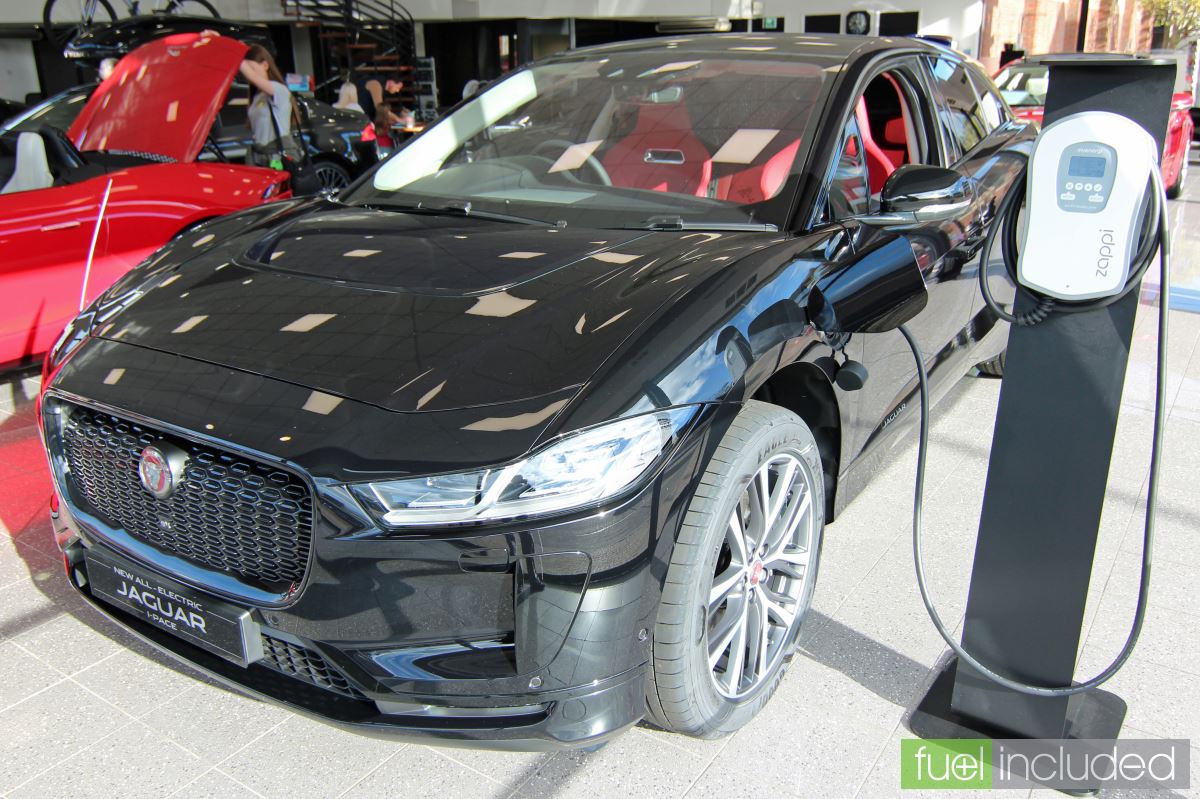
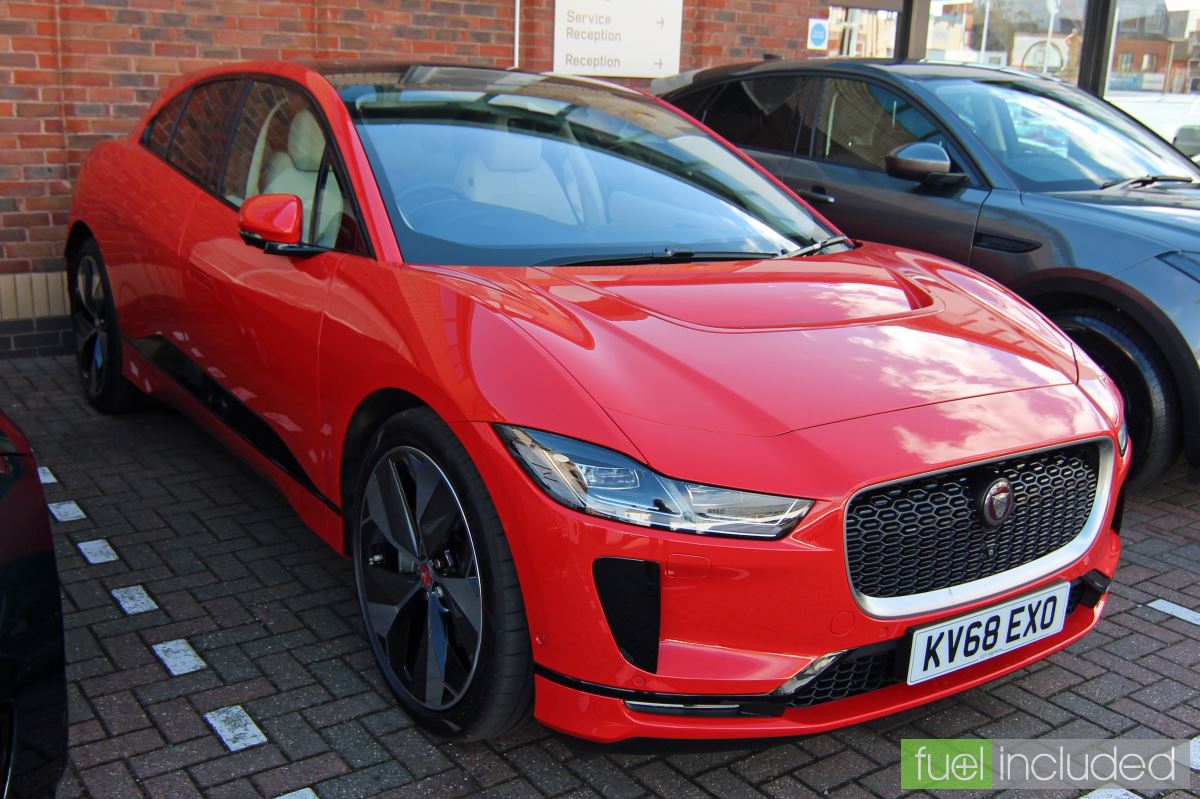
Jaguar I-PACE Electric Car (Image: T. Larkum)

My First Jaguar I-PACE Experience

On Friday I had my first taste of the new Jaguar I-PACE as I took my family for a test drive.

I was intrigued to see what it’s like as I think it would be fair to say that the motoring press have been raving about it, the first all-electric production car from the Jaguar Land Rover group.

Jaguar I-PACE Electric Car (Image: T. Larkum)

It turns out it is a nice car to sit in and drive; it’s very comfortable, has a decent (though not huge) boot and lots of features. My family particularly liked the rear seat heaters, air conditioning and USB ports.

It accelerates nicely and pretty quietly, and has a decent range – somewhere between 250 and 300 miles (with the usual caveats over driving style, ambient temperature, etc). Overall a pretty good car.

However, I couldn’t help but feel a bit disappointed as I was expecting something a little more special. I guess I’m a bit spoilt, driving a BMW i3 and having driven the Tesla Model S a number of times. But it pretty much seemed like just another Jaguar but this time with an electric powertrain.

Jaguar I-PACE Electric Car (Image: T. Larkum)

While almost any car can be improved by going electric, I had hoped for a more ‘clean sheet’ design. For example, it had a huge console between the driver and passenger as though it had a gearbox and transmission tunnel, where on the i3 there is space, and a flat floor.

Anyway, if you are in the market for a Jaguar then do consider the I-PACE as it’s certainly the best Jaguar available. It has good looks, electric performance and a decent range so it’s well worth a look.

My thanks to David at Guy Salmon Jaguar Northampton for giving us the test drive.

Diesel and petrol ban should come much faster, say MPs

A ban on sales of new petrol and diesel cars should be brought forward by eight years to 2032, MPs have said.

The government’s current plans to ensure all new cars are “effectively zero emission” by 2040 were “vague and unambitious”, a report by Parliament’s business select committee said.

It also criticised cuts to subsidies and the lack of charging points.

The government said it aimed to make the UK “the best place in the world” to own an electric vehicle.

However, the report from the Business, Energy and Industrial Strategy committee said the government’s deeds did not match the ambitions of its words.

The committee’s chairwoman, Rachel Reeves MP, said the government’s targets gave “little clarity or incentive to industry or the consumer to invest in electric cars.”

‘Zero means zero’

Earlier this year the prime minister said that all new cars and vans should be “effectively zero emission” by 2040.

The government’s Road to Zero Strategy said it wanted “almost every car and van” in the UK to be zero emission by 2050. However it was unclear which, if any, hybrid models were being included.

The committee said “zero should mean zero” and called for the government to bring forward “a clear, precise target for new sales of cars and vans to be truly zero emission by 2032”.

The UK was among the top 10 countries for electric vehicle sales in 2017, and has around 14,500 public charging points. However, in its report the committee said the country was far from electric vehicle ready.

Read more: BBC