Category Archives: Leaf 30kWh

The Leaf 30kWh has an official range of 155 miles - with 124 miles of real world range

Nissan Leaf 30kWh UK launch

Next Green Car was invited along to the UK launch of the Nissan Leaf 30kWh at Silverstone yesterday (Tuesday 26th January), giving us another chance at an early test for the new longer-range model.

The Leaf 30kWh has an official range of 155 miles - with 124 miles of real world range
The Leaf 30kWh has an official range of 155 miles – with 124 miles of real world range

With around 12,000 UK sales, the current Leaf is the best selling electric vehicle (EV) on the market and has played an important part in increasing the growth of plug-in vehicles in the country. Since its UK launch in 2011, the Leaf has been been joined by the likes of the Renault Zoe, BMW i3, and VW’s e-Golf and e-up! in terms of pure-electric models, and a number of plug-in hybrid vehicles also to increase ultra-low emission vehicle (ULEV) sales dramatically in the last five years.

As a market leader then, Nissan is keen to maintain its position as a familiar EV manufacturer to the general public, and this new version of the Leaf shows its commitment to improving the offering available to consumers.

The previous generation of Leaf – the 24kWh battery model – had a quoted range of 124 miles, and a real world ability to cover around 99 miles on a single charge. The 30kWh model extends that official range to 155 miles which, although it is highly unlikely that drivers will ever achieve this figure, the real world range only drops to 124 miles – or the official range of the previous model.

When we attended the European launch towards the end of last year, we had an extended and challenging test route set up which took us up into the Alpes Maritime, with some long climbing making the range plummet before a downward section that saw us recuperate a large amount of energy. This tested the Leaf’s range to extremes and it coped very well, averaging some impressive figures. However, it was worth seeing how well the new Leaf would do on a cold and wet January morning in Britain, with muddy surfaces, pot-holes and a wide range of different roads available to deal with.

In terms of testing the biggest change to the Leaf – the increased range – the Nissan again performed well. The route was less obviously demanding, there are no mountains to climb in Northamptonshire after all, but conditions and roads represented a far more typical journey.

The car we were allocated came with a full charge and an indicated 99 miles worth of range. This low figure was explained by both a cold night and, of greater impact, the fact that the car had been used for press images the previous day, with the Leaf having weighted its indicated range to some spirited driving.

Deciding to treat the Leaf without any deference normally due to an EV, we set off on the route and drove exactly as if we were in a petrol or diesel model. The only difference was the use of the Leaf’s Eco button once acceleration was completed and we were largely up to speed. This meant sitting at around 70 mph on dual carriageways and motorways for about a third of the 55 mile route.

Read more: Next Green Car
Nissan Leaf 30kWh Tekna (2016) review

The electric Nissan Leaf now has a greater range thanks to a boosted 30kWh battery pack. But is a bigger charge enough to tempt you away from cheaper, conventional petrol and diesel hatchbacks that don’t suffer from range anxiety in the first place?

0_nissan_leaf01_CM

Read our first drive review to find out whether – five years after becoming the first credibly mainstream EV – it can still make a viable argument for the silent but saintly genre.

What’s new on the 2016 Nissan Leaf?

The Leaf has evolved slowly since launch in 2010, gaining a tidier interior here, cleverer electronics there, and now a bigger charge capacity to stretch the (theoretical) range by as much as a quarter. Nissan claims the 30kWh battery pack means you can now drive up to 155 miles on a single charge.

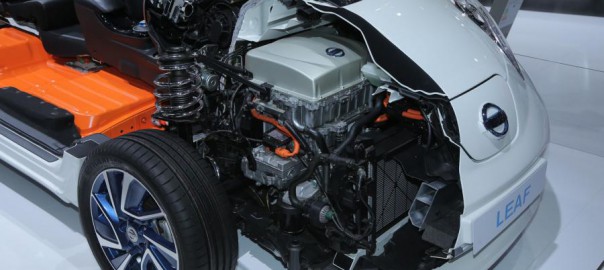
The battery is the same size as the old one, but weighs around 21kg more, thanks to a different cell architecture inside and uprated power management systems on top. Buyers can still choose the cheaper 24kWh Leaf if they prefer.

There’s a refreshed 7in touchscreen multimedia system, too, and Nissan has overhauled its smartphone app, rebranding it NissanConnect EV and adding new features such as guidance to the nearest unused charging stations. You can still remotely warm your Leaf up from the breakfast table – handy for those cold winter mornings. Relying on electricity for heat means it defrosts in a jiffy.

How does the new Leaf EV drive?

The Leaf hasn’t changed much since we first drove it earlier this decade; the car is still a paragon of saintly silence – wafting quietly around city streets, the soft, floaty ride smothering away the worst road acne rolling under those eco-tilted Dunlop Enasave 215/50 R17 tyres. There are few more relaxing cars to drive.

Read more: Car Magazine

Fully Charged Checks Out Longer Range 30 kWh Nissan LEAF – Video Review

Nissan recently demonstrated the new 30 kWh LEAF to journalists in France.

Among the various media outlets was Fully Charged with Robert Llewellyn impressed by the longer range LEAF.

According to latest episode, it’s worth buying the 30 kWh version, as you’ll definitely notice the difference in range compared to 24 kWh – reasonably about 110-120 miles (107 miles EPA).

“A wonderful drive up a mountain in the South of France in the newly released 30kWh Nissan Leaf. No question, it’s a big improvement in terms of range and driver interface.

A bigger battery that’s not physically bigger, just 25% more energy dense.”

Source: Inside EVs

Nissan Leaf with 30kWh battery

First drive of the new longer-range Nissan Leaf

What an opportune time for a new electric car…

Indeed. As owners collectively scratch their chins about just how clean their diesel cars really are, Nissan has given its Leaf an extra 26 per cent of range – hiking it to 155 miles – as well as a bit of a spruce-up.

Nissan Leaf with 30kWh battery

It’s fortuitous timing rather than a clever plan, but you could say the stars have aligned, the most convincing Leaf yet arriving just as internet searches for electric cars exponentially increase.

It looks no different. Why should I care?

It’s unlikely to grab headlines quite like the more obviously revolutionary Toyota Mirai, true. But the Leaf is the world’s best selling electric car, ever. Over 200,000 have been shifted, 11,500 of them in the UK. It currently accounts for more than half of all EVs sold here, and a fifth of plug-in vehicles if you include plug-in hybrids like the Prius and, erm, Porsche 918.

Owners love them, too; the Leaf has the highest satisfaction rate of any car Nissan sells. So you can understand why little has changed: the styling is identical, remaining divisive, and its 109bhp electric motor is untouched, with the only mechanical tweaks occurring to the batteries that lie in the floor.

What’s new?

Their size and packaging are actually identical, but the cathodes are upgraded, helping energy output climb from 24 to 30kWh. In simple terms, this means a claimed 155 miles from a full change, as opposed to 124 miles. Fast chargers will top most of the power back up in 30 minutes for longer journeys via appropriately equipped motorway services.

The 30kWh battery is an option – a £1,600 option, no less – with sales of the 24kWh Leaf continuing. But 80 per cent of buyers are expected to go for the more accommodating setup.

A Tesla Model S will go quite a bit further.

Yeah, but it will also cost quite a bit more than the 30kWh Leaf’s £24,490. And the numbers are spot-on for what people actually use cars in the Golf and Focus class for, according to Nissan. It reckons so-called C-segment buyers travel an average of 30 miles a day, with 98 per cent of them covering fewer than 100 miles daily.

If you’re thinking “the old one could do that,” you’re right. But it’s all about perception: an extension of the range makes people more secure, makes them worry less about driving their EV in a mollycoddling way. Likewise an eight-year warranty on battery degradation is probably overkill in an age of short-term lease deals, but it’s all added peace of mind.

Read more: Top Gear

New battery for Nissan Leaf to deliver 155-mile range

A new 30kWh battery in the Nissan Leaf will go on sale in December, delivering a claimed range of 155 miles.

iaa-2015-0493_Nissan_Leaf_Autocar

It will go on sale alongside the 24kWh unit but will only be available in Acenta and Tekna trim, priced from £24,490 to £27,940 including the UK government’s £5000 Plug-in grant, which was recently extended until February 2016.

Nissan is also increasing its warranty for the 30kWh unit to an eight-year, 100,000-mile warranty.

The new battery brings an increase in range of around 25% over the alternative 24kWh unit, according to Nissan. It has the same dimensions as the lesser-powered unit but is 21kg heavier. The manufacturer says this longer range is the result of the introduction of carbon, nitrogen and magnesium to the electrodes in the new unit.

Nissan expects the real-world range of the new battery to be around 12-15% less than the claimed 155 miles, representing a similar loss to the 24kWh unit. This would put the new battery’s real-world range at around the 135-mile mark.

In Acenta and Tekna trims, the 30kWh Leaf comes with a 7.0in touchscreen and the smartphone-compatible Nissan Connect EV infotainment system, which allows users to check the charge status of the car and remotely control features such as the air-con. The system the previous Car Wings set-up.

The new infotainment package includes a charging map that can show which charging points are available and which are being used. It also delivers maintainance alerts and a car-finder facility.

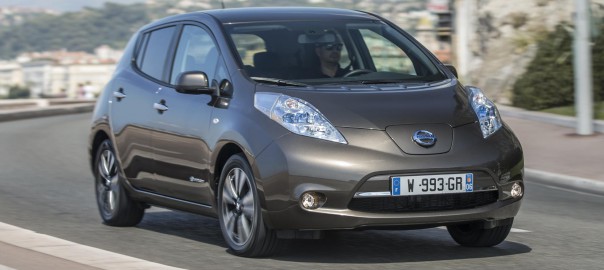
Exterior alterations are minimal and include a new roof-mounted aerial as well as the choice of a new bronze colour.

“It’s a game changer for Nissan,” said EV director for Europe Jean-Pierre Diernaz. “This increased range will have an impact on the perception of our electric vehicles and will open it up to a wider market.”

Diernaz also added that the Leaf range could expand in the future to new electric models.

“It’s possible,” he said. “We will take this technology, improve it, and we are looking at putting it wherever it is relevant for us as a line-up expansion, and where it is releveant for a consumer.

“This new battery is just the beginning of something bigger,” he added. “The next milestone is a range of over 180 miles.”

Earlier this year Nissan expanded the Leaf trim range with a new Acenta+ version, sitting between Acenta and range-topping Tekna priced at £24,740 including the plug-in grant.

Source: Autocar