Category Archives: MINI

News and reviews of MINI electric cars (including plug-in hybrids).

Fuel Included BMW i3 on static display (Image: T. Larkum)

Renault Zoe Climbs To #1 In Germany

The German plug-in electric car (PEV) market grew 23% in June, to 5,709 registrations, with plug-in hybrids (+25%) and fully electric cars (+21%) growing at a similar pace. In 2018, all-electrics are reaching 1% share, while plug-in hybrids have also grown their share to 1%, resulting in a total PEV share of 2%.

But the most interesting story on the fuels mix is the Titanic-like drop of diesel vehicles sales. In June, their sales sank 16%, to the benefit of all other kinds of fuels. Diesel now represents only 31% of the market. At this pace, diesel sales could be tot in this market by 2021. Inconceivable? Well, in 12 months, diesel lost 9% share, going from 40% to 31%.

Fuel Included BMW i3 on static display (Image: T. Larkum)

Looking at June best sellers, BMW had a 1–2 win, with the i3 scoring 509 units, a new year best, while the 225xe Active Tourer registered 500 units, a new record for the German MPV.

The Renault Zoe was 3rd, while the surprise of the month was the #5 Mini Countryman PHEV. With 300 deliveries, it had its best result ever in Germany.

Just outside the top 5, the VW e-Golf registered only 290 deliveries, its worst performance in 11 months. Is the German brand already starting the sunset mode of its BEV hatchback?

Read more: Clean Technica

BMW Plug-In Sales In June At Nearly 9,500. MINI Joins The Party

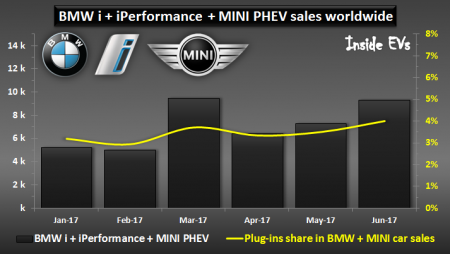
BMW scored one of its best ever results for plug-in electric car sales in June, delivering around 9,350 units (up 79.8% year-over-year) and a record 42,573 in the first half of the year.

BMW i + iPerformance + MINI PHEV sales worldwide – June 2017

In June, plug-ins accounted for 4% of total BMW & MINI sales, while for the first six months that market share number stood at 3.5% – although we have to stress that the full year number is not quite representational now, as it includes MINI, which just started sales of the new plug-in Countryman on June 24th.

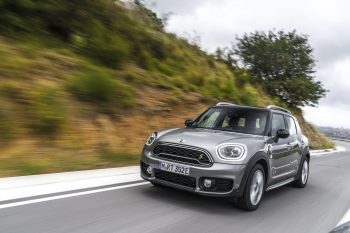
MINI Cooper S E Countryman ALL4

Production of BMW Group plug-ins this year was 51,725, and company says is on track for 100,000 sales in entire 2017. With 43k sales already bagged, and the 2nd half of the year always showing far greater plug-in sales across all regions and brands, the goal seems easily attainable at this point.

Because BMW’s cumulative plug-in sales topped 100,000 in late 2016, by the end of this year BMW will also reach 200,000.

Dr Ian Robertson, Member of the BMW AG Board of Management with responsibility for Sales and Brand BMW commented:

“June rounds off our best ever first half-year and the BMW Group remains the world’s leading premium car company. We’ve already sold more than a million BMW vehicles this year, which is a new first-half-year record. June also saw our successful electrification strategy expand still further to include the MINI brand, meaning customers can now choose from nine electrified BMW Group vehicles. With sales of these models up by eighty per cent compared with the first half of last year, we’re looking forward to celebrating delivery of the 200,000th electrified BMW Group vehicle later this year,”

Source: Inside EVs

Electric Mini to be built in Oxford

A fully electric version of the Mini will be built at the Cowley plant in Oxford, BMW has said.

The carmaker said the model would go into production in 2019, with Oxford the main “production location” for the Mini three-door model.

However, the electric motor will be built in Germany before being shipped to Cowley for assembly.

BMW said it had “neither sought nor received” any reassurances from the UK on post-Brexit trading arrangements.

The electric vehicle will be based on the 3-door hatchback model

Last year, the government faced questions about the “support and assurances” given to Nissan before the company announced that new versions of its Qashqai and X-Trail would be made in the UK.

And there have been reports that Toyota agreed to invest in the UK after receiving a letter reassuring the Japanese carmaker over post-Brexit arrangements.

‘Vote of confidence’

About 360,000 Minis are made each year, with more than 60% of them built at Oxford. But BMW has built up an alternative manufacturing base in the Netherlands amid concerns about Britain’s suitability as an export hub after Brexit.

BMW has warned about the damage of Brexit uncertainty, and in May chief executive Harald Krueger said the company had to remain “flexible” about production facilities.

UK Business Secretary Greg Clark hailed BMW’s announcement as a “vote of confidence” in government plans to make Britain

“the go-to place in the world for the next generation of vehicles”.

On Monday, he set out plans to invest in development of battery technology in the UK.

Mr Clark met BMW’s head of sales and marketing, Ian Robertson, at the company’s headquarters in Munich in January and March this year. The two also held meetings at Westminster in March and June.

David Bailey, professor of industry at Aston University, said the true test of the global car industry’s desire to invest in the UK would come next year:

“I don’t think it [BMW’s decision] tells us much about Brexit and the form of trade barriers we may face in the future.

“The big decisions will be about future models [which would have redesigned bodies], both at Mini and at companies like Vauxhall when they announce their new models in the next couple of years.”

Read more: BBC News

MINI Countryman Plug-In Hybrid gets the thumbs up

I was recently lucky enough to have an extended test drive of the MINI Countryman Plug-In Hybrid, a car I’ve been keen to experience since I got word that the electric MINI’s were coming.

With an electric range of 24.8 miles (NEDC) this car could be the answer to fairly short distance commuters who are not quite ready to go All-Electric but want something a bit more eco-friendly and a little more trendy than some of the other PHEVs on offer.

On first impressions of the exterior I really liked it, it was sleek and just a little aggressive, it’s reasonably sized yet still manages to keep some of the iconic MINI features.

MINI Countryman Plug-In Hybrid

Inside I found it roomy and comfortable, the 3 driving modes made it easy to switch from fully electric (Max eDrive), Petrol use only (Save Battery) and Auto eDrive – the option where the car decides what fuel source to use based on your driving style.

There are some useful features to help you ‘keep an eye’ on your consumption and your fuel usage. The first being the trim surrounding the display, when using electric it glows yellow and gives you an indication of your remaining electric range. You can also toggle through different options on the display to show you the percentage of battery remaining and remaining range. The E-Instruments gauge is to the left of your tachometer and this shows you the status of your fuel usage (i.e. when you are using petrol and when using electric).

On usage, it breezed through my short 12 mile commute to work on fully electric – I knew it would. I used the car around town on the Saturday taking it to the DIY store where the roomy boot space came in useful, again only using electric for my short journeys.  On the Sunday I travelled a bit further, taking the MINI to Woburn Centre Parks. With a car full of family I decided to try the ‘Auto eDrive’ driving mode. It changed effortlessly between petrol and electric fuel whilst maintaining a quiet ambience within the cab.

The Navigation software was a little complicated to read, but I think this is just the style of the software, much like the BMW Navigation system. I’m sure I would have got used to it after a bit more use.

My experience on charging will be a little different to others as I don’t have a charge point at home, it was doable but I did need to charge publicly quite often which wasn’t ideal. Not having a home charge point doesn’t cause me any issue with my fully electric car because I don’t need to charge up as often but this approach doesn’t lend itself well to a plug-in Hybrid, as you do need to charge it everyday to make real use of the electric motor.

Overall I really liked this car. It was good to drive, I love the look and I can certainly see this being a top player in the PHEV market.

If the spec, look and feel of the MINI Countryman PHEV is anything to go by then I eagerly await the all-electric MINI.

See our dedicated page for MINI Countryman Plug-In Hybrid prices.

MINI Countryman Plug-in Hybrid Electric Vehicle (PHEV) – Part 2: Driving and Charging

Part 1 is here: MINI Countryman Plug-in Hybrid Electric Vehicle (PHEV) – First Impressions

In terms of driving I was pleasantly surprised. Of course, I have been driving electric for 4 years so am rather spoiled and hate the thought of having to go back to a piston engine.

However, fair play to MINI, the transition from electric to combustion is barely noticeable when travelling at speed such as on the motorway. The noise and vibration are kept to a minimum.

The driver’s displays and controls are nicely done – similar to those in the i3, except that the satnav/media screen is a touchscreen. You can choose to operate it with the usual MINI/BMW joystick control or just by pressing on the screen. The state of charge is indicated by a big illuminated ring around the screen area.

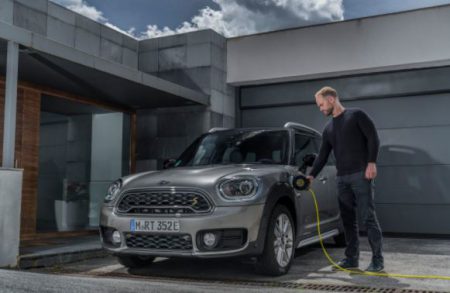
Charging was straightforward – it has a Type 2 socket (same as the ZOE and i3) so I was able to plug it in while parked on my drive. The charge socket is on the front nearside wing (the petrol cap is on the rear offside wing). As it starts to charge a ring around the socket flashes amber, once it’s fully charged this goes to a constant blue.

The MINI PHEV has a switch to set the drive mode – this allows you to keep it electric, keep it petrol (to save the battery for later) or let the car decide the most economic balance (much like a hybrid). I was keen to test the electric range so coming in to work this morning I put the MINI into the all electric mode.

I was pleasantly surprised to find, by keeping my speed to no more than about 60mph, that I was able to do the whole journey on electric. That’s a distance of about 23 miles so better than I had expected. Of course, you would likely not get so far if you have a heavy foot and drive fast, or in cold weather. A real-world range of 17-20 miles is probably a better expectation.

Nonetheless if you have a commute of up to about 20 miles I’m sure you could adjust your driving style appropriately so that you never need to use any petrol. Certainly I managed to drive from Northampton to Milton Keynes on 50p of electricity rather than £5 of petrol. And with charging at work your commute range could be doubled.

Naturally as a premier car the MINI Countryman PHEV has some nice features. I liked the independent climate controls for driver and passenger. My children liked the so-called ‘puddle light‘ that comes on at night by the driver’s door – and looks rather reminiscent of Batman’s famous Batsignal!


Overall I was impressed with the MINI Countryman PHEV. While it’s electric range may be poor compared to an all electric car it is still far ahead of a conventional combustion car or a hybrid. It could work really well for someone with a commute of up to 20 miles who could do most of their driving on electricity, but then revert to petrol for holidays and other long trips.

Prices are here, and a form to get a quote: Prices for the Mini Countryman Plug-In Electric Hybrid

If instead you’d like us to calculate the Total Cost of Ownership of a MINI PHEV compared to a fossil car or another electric car then go here: Total Cost of Ownership

For some quick videos see: MINI Countryman Plug-in Hybrid (PHEV) electric car videos

Our thanks go to Wollaston BMW for the loan of the car.

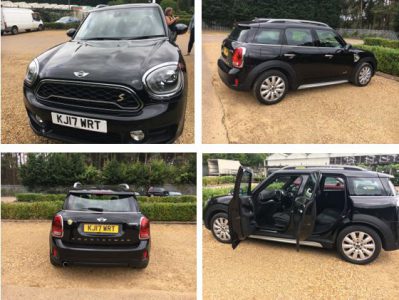
MINI Countryman PHEV (Image: T. Larkum)

MINI Countryman Plug-in Hybrid Electric Vehicle (PHEV) – First Impressions

We currently have a plugin MINI Countryman on loan (technically it’s an “F60 MINI Cooper S E ALL4 PHEV Countryman AUTO” but that’s too much of a mouthful) and I was lucky enough to get the first go with it last night. What’s special about this MINI is that it has a conventional petrol engine driving the front wheels and an electric motor and battery driving the rear wheels.

This means it can drive entirely on electricity for up to about 20 miles and then go over to petrol for longer journeys (300 miles or so). Also, it can act as a hybrid like a Prius to get good economy. Finally, the drive layout means it can be used in four wheel drive mode – very useful in rain and snow.

I drove it home, had use of it for the evening, and drove it back to the office today.

The first thing that struck me when I was it was the size – this is not a small car! Having grown up with the original Mini (my Dad had a series of them) I was surprised just how big the new MINI Countryman is.

It is intended, of course, for families with children so its size shouldn’t be a surprise. The upside is that it has a lot of interior space and feels very roomy.

In fact, I took a number of passengers in the back and they all remarked on how much space there was, and in particular its high ceiling.

It also has a pretty big boot.

Part 2 is here: MINI Countryman Plug-in Hybrid Electric Vehicle (PHEV) – Part 2: Driving and Charging


MINI Countryman Plug-in Hybrid (PHEV) electric car videos

We are lucky to have been lent one of the new MINI Countryman plug-in hybrids for a couple of days.

This morning I took the opportunity to do some quick videos around the car to give a taste of what it’s like.

Prices are here, and a form to get a quote: Prices for the Mini Countryman Plug-In Electric Hybrid

If instead you’d like us to calculate the Total Cost of Ownership of a MINI PHEV compared to a fossil car or another electric car then go here: Total Cost of Ownership

First try of an electric mini

We are lucky today to get the loan of the new plug-in electric hybrid Mini Countryman for the weekend from our friends at BMW. Jo, our sales and business administrator, drew the long straw and will  get to enjoy the new car until Monday.

It shows an electric range of up to 22 miles (25 if you drive really gently), so the average driver won’t need to switch on the 1.5l engine.

Looking forward to lots of fun with an iconic car.

MINI Cooper S E Countryman ALL4, Arrives In June

MINI has released full specs, further details, and an extensive photo gallery ahead of the launch of its first production plug-in hybrid –  the MINI Cooper S E Countryman ALL4 plug-in hybrid.

The MINI Countryman PHEV (which is the name we are going with from here on out), begins sales in Europe and the US and in June.

In UK prices (without plug-in car grant) start at £31,585 OTR (‘On-the-road’).

MINI Cooper S E Countryman ALL4

MINI Countryman PHEV quick specs:

  • all-wheel drive with 1.5L 3-cylinder TwinPower Turbo Technology petrol engine (100 kW/136 hp), 6-speed Steptronic automatic transmission and 65 kW (87 hp) electric motor. System output of 165 kW/224 hp and 385 Nm.
  • up to 42 km (26 miles) of all-electric range NEDC – one can mostly likely expect around 28 km/17 miles EPA
  • Combined power consumption: 2.3 – 2.1 l/100 km (average fuel consumption of 134.5 mpg); combined CO2 emissions: 52 – 49 g/km
  • 7.6 kWh battery
  • 0-60 mph in 6.8 seconds
  • top speed in all-electric mode of 78 mph (125 km/h)

Read more: InsideEV’s

2014 Minis - not plug-ins

AWD Mini Plug-In Hybrid Expected In 2015

An all-wheel-drive plug-in hybrid version of the Mini Clubman is on it’s way in the second-half of 2015.

2014 Minis - not plug-ins
2014 Minis – not plug-ins

The PHEV Mini Clubman is slated to get the same powertrain as the BMW 2 Series Active Tourer:

  • Plug in version will likely feature a a 1.5-liter three-cylinder turbocharged (borrowed from the BMW i8) engine with a “high-performance” electric motor (likely borrowed from the BMW i3) and a lithium-ion battery.
  • This setup will crank out somewhere in the neighborhood of 190 hp, which will propel the production vehicle from 0 to 60 mph in 7 seconds.
  • Top speed will be approximately 125 mph.

Read more: InsideEVs