Category Archives: Soul EV

2015 Kia Soul EV first drive

Kia is set to launch its first electric car in the UK. The Soul EV looks great, but high-tech typically brings high prices. Can this stylish EV really ever add up?

[From November 2014] According to figures compiled by Kia, the fastest growing segment in the car market is electric vehicles, so it’s not surprising that the Korean giant has chosen to make it’s popular mini SUV, the Soul, available as an electric-only version. The Soul EV goes on sale in the UK before Christmas.

Far from simply ditching the conventional engines in favour of an electric motor and a battery, the Soul has undergone a fairly radical rethink in order to go zero-emission. With Kia also working on hybrid, plug-in hybrid and hydrogen technologies, it is fair to say that the firm is hedging its bets a little, but the Soul is its first attempt in the UK, at least, to push something that doesn’t run on petrol or diesel.

Kia is going to appoint a selection of its dealers to sell and service the EV, but it has modest sales expectations, with around 170 units a year expected to find homes. As a result, only one trim level and two colour schemes are available.

What’s the 2015 Kia Soul EV like to drive?

The standard Soul drives pretty neatly anyway, but it would reasonable to expect the extra weight of the batteries and electric motor to dull things dynamically. Oddly, that is not really the case. From behind the wheel, the Soul feels more than eager enough, as many electric cars do, thanks to instant availability of torque from rest. It can sprint to 60mph in around 11.5 seconds which is around a second slower than 1.6 diesel models, but the EV does so in virtual silence. The claimed range for the EV is 124 miles on a single charge and the top speed is 90mph, which mirrors the official figures of the Soul EV’s natural predator, the Nissan Leaf.

In order to take the additional weight of the batteries, the floor of the Soul has been beefed up with extra steel crossmembers, which has the effect of making it more rigid than the standard car. There’s also some 277kg of batteries beneath the floor, although if you are going to add weight anywhere, between the wheels and low down is not a bad place to do it. Aerodynamic improvements have also been made to make the EV slip through the air as cleanly as possible and this has reduced the wind noise at speed.

The effect of all this is that the Soul EV drives really very well. For town driving, there is a mode with extra regenerative braking to keep the batteries topped up, which allows one-pedal operation, where backing off the accelerator pedal essentially applies enough braking force. For most conditions, the standard drive mode requires less thought.

Refinement is usually a strong point of any electric car and so it is here. The ride is a touch firm, but is never uncomfortable, even over poor road surfaces.

What’s the 2015 Kia Soul EV like inside?

At a glance, the interior of the EV looks much like the standard Soul’s, but there are a few key differences. First up, Kia is keen to ensure that buyers know the EV is as green as it can manage, which means a lot of the interior materials are greener versions than those seen on the standard car. Items such as the dashboard panel, headlining and various plastic panels are made using bio- rather than petroleum-based plastics with a view to the car being more recyclable at the end of its life. It is nice place to be, though, regardless of what it is made out of.

There is only one interior finish available, and no options, because it’s already very well equipped with a large colour touch-screen infotainment and nav system. The cabin is finished in light grey with light blue piping; despite the floor being 80mm higher than in the standard car, to accommodate the batteries, the EV has reprofiled seats which ensure headroom is just as good as in the very roomy normal Soul. Both front and rear seats are comfortable and there’s plenty of room for four adults.

Boot space is also slightly reduced by the need to house all the electric paraphernalia under the floor, reducing the regular capacity by 30 litres, at 324 litres with the seats in place. All told, though, the boot is big enough for a car in this class and easily eclipses the BMW i3’s.

One thing that Kia is very proud of in the Soul is the hyper-efficient heating system. Typically, running the heater or air-conditioning in an electric car has a devastating effect on the range. Kia has developed two key technologies to mitigate this as much as possible. First is a setting which heats or cools only the occupied part of the cabin when there is one person on board. This means considerably less energy is expended and there is no detriment to the comfort of occupants.

The other clever development is that, rather than having an electric heating element to put a bit of warmth in the car on a cold morning, the Soul harvests warm air from around the car’s complex electronic systems, and from the ‘back end’ of the air-conditioning system, to ensure that no warm air is wasted when it might be put to good use. Kia reckons this system gives the car a significant advantage over rival cars, which lose considerable range in order to keep the cabin comfortable in hot or cold conditions.

Should I buy one?

Maybe.

Kia suggests the price is likely to be around £30k, with the government grant for plug-in cars dropping that to around £25k. That puts it at a slight disadvantage to the Nissan Leaf, which costs £23,590 after the grant when comparably equipped, and assuming you want to own the batteries – which is your only option with the Soul.

Nissan also offers the option of leasing the batteries for a monthly cost with the Leaf, which means you won’t be responsible for any maintenance, and also brings much lower initial purchase costs, with the top-spec Leaf Flex costing £18,590. Renault offers the an even cheaper rival to the Soul – the Zoe, which is smaller and can only be had if you lease the batteries from £70 per month, but will still seat four comfortably and be practical to live with, and costs from just £13,995.

Viewed in isolation, the Soul EV is a very appealing, technically clever and nice to drive electric vehicle but even with the government discount for plug-in cars, it is still likely to be too pricey for the majority to consider as a stylish second car. If you like the Soul, a petrol version in a comfortable trim level will be £10,000 cheaper, and that buys you a lot of petrol.

That said, if an electric car fits into your lifestyle, the Soul EV is a very likable, practical addition to the market and should be considered a genuine rival to the Nissan Leaf, Renault Zoe and even the BMW i3.

Source: What Car

Living with the Kia Soul EV

ECO FACTS

Model/Engine size: Soul EV

Fuel: Electric

Fuel economy combined: N/A

Green-Car-Guide rating: 9/10

INTRODUCTION

We’ve already driven the Kia Soul EV at its UK launch, but what is it like to live with, and does it have a more practical range than rivals in real-life?

SUMMARY

• All the normal electric car qualities: very refined, quiet, strong acceleration

• Attractive benefit in kind company car tax and low running costs

• Reasonably spacious, practical shape for an EV

• Limited range may not suit everyone, and subjective styling

BACKGROUND

Having some degree of electrification on our cars is the only way to achieve our emission reduction targets. Plug-in hybrids provide a practical overall driving range, but a small electric range, but pure EVs mean zero-tailpipe emissions – if you can cope with the limited overall driving range. A number of manufacturers are bringing EVs to market, even with the prospect of small sales numbers; the Soul EV is Kia’s offering, and it promises a longer range than rivals, with an individual shape and styling.

DESIGN & ENGINEERING

Two distinct types of electric cars are now emerging – ones that are designed from the ground up as electric cars – such as the Nissan LEAF and BMW i3 – and ones that are standard models with the petrol engine replaced by an electric powertrain – such as the Volkswagen e-Golf, and now the Kia Soul EV, which is built on the same production line as the petrol and diesel Souls.

006-low-res_Kia_Soul-EV_GCG

So this is a regular Soul, but with a 275kg lithium-ion polymer battery bolted underneath the floor and the electric motor (producing the equivalent of 109bhp) under the bonnet.

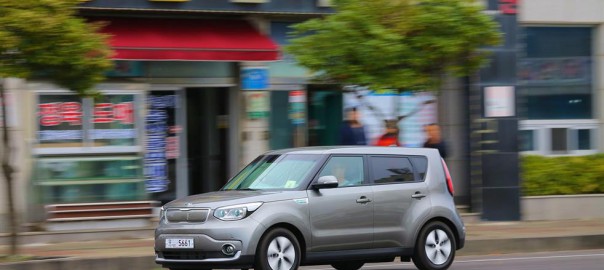
The rest of the interior and exterior is virtually the same as a petrol or diesel Soul, apart from aerodynamic features such as the blanked-off front grille and special lightweight alloy wheels (the basic Soul body is not the most aerodynamic of shapes). There are also super-low rolling resistance tyres, which can reduce energy consumption by as much as ten per cent compared with regular low rolling resistance tyres.

The electric powertrain has no impact on space inside the car apart from an 80mm higher floor for rear seat passengers, and luggage capacity is reduced by 31 litres to 281 litres to accommodate charging cables under the boot floor.

The Soul EV’s interior heating controls can just be used by the driver only, to save energy. It also has an intelligent heating, ventilation and air conditioning (HVAC) system which includes a heat pump to recycle air that has already been heated or cooled within the cabin. The interior can be heated or cooled while the car is plugged in, so saving battery power on the move.

Kia claims that its battery has a class-leading energy density of 200 Wh/kg and an energy storage capacity of 27 kilowatt-hours, and there’s a heating and cooling system to keep it at an ideal operating temperature.

The Soul EV can be recharged using a standard domestic socket, a wallbox supplied as standard with the Soul EV, a public fast charger, or a public rapid charger. Using a UK 230-volt domestic power supply, the Soul EV can be fully recharged in 10 to 13 hours. With the wallbox or a public fast charge point, the time can be reduced to around five hours. Using a public rapid charger the batteries can be topped up to 80 per cent of capacity in 33 minutes.

KIA SOUL EV DRIVING EXPERIENCE

We previously drove the Kia Soul EV on its launch on a fairly short route in London, and initial impressions were good, but what is it really like to live with over a longer period, as part of everyday life?

We drive a range of different cars every week, including petrol, diesel, hybrids and EVs, and it’s always the EVs that provide the best experience in urban driving. They’re virtually silent, very refined, have great response when accelerating, and with no gears or clutch, they’re easy to drive. However these are qualities that are common to all EVs, so how does the Soul differ?

The key difference is that the Soul does genuinely appear to have a longer driving range than most rivals. We’re not talking about a huge difference, but when you need to cover 80 miles in one day, in a car that has a range of around 80 miles in real-life driving, an extra 10 miles range makes a big difference.

You notice this most when keeping an eye on the remaining range during driving – the range displays of other EVs have a habit of plummeting under many driving conditions, whereas the indicated range left on the Soul EV remains much more constant.

The outcome of the range not plummeting is that you find yourself not having to recharge the car every night – you can go two to three days without charging.

Another practical benefit of the Soul EV is its spaciousness. Although based on a supermini footprint, because it is essentially a square box, it does have more room inside for people and luggage than most other EVs. Having a compartment under the boot floor for cables may reduce some of the official luggage space, but it’s a neater solution than having cables lying in the boot. It has a very clearly laid out dashboard which features an excellent reversing camera.

The Soul EV has a comfortable ride and decent handling, helped by the low centre of gravity due to the batteries, and the steering is well-weighted, but the brakes, due to focusing on regenerating energy, have a different feel to conventional petrol or diesel cars and take a bit of getting used to.

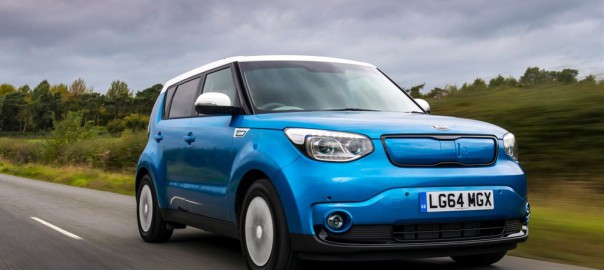
The main issue with the Kia Soul EV is its styling. The ‘normal’ Soul looks perfectly acceptable, however the EV version has features such as the blanked off grille, flat wheel covers, high profile, energy efficiency tyres, and in the case of our test car, blue bodywork and a white roof. Overall this gives the impression of a ‘cartoon car’. This contrasts to the likes of the BMW i3, which has super-cool styling. We would suggest that Kia needs to look at the styling of the Soul EV and make it less ‘eco’ and more desirable for both private and business buyers.

KIA SOUL EV ECONOMY AND EMISSIONS

The whole point of living with the Kia Soul EV for a week was to find out what its range was in real-life, and to see if that was sufficient to live with. The official range of the Soul EV is 132 miles on one charge. Just like the discrepancy between official and real-life mpg figures, the same discrepancy also exists between official electric range and real-life electric range. On average over a week we achieved a range of 82 miles between charges. This is obviously less than the official 132 miles, but is better than some other EVs that we’ve tested, which have only managed around 64 miles in real-life.

We would stress that this range was achieved after typical driving; we’ve achieved a 40% improvement on the official range of an electric car on the RAC Future Car Challenge event, so with very careful eco-driving, we’re fully confident that you could achieve a range of over 100 miles in the Soul EV (in an urban environment rather than in any higher speed driving). The trouble is, there’s usually not the time, the inclination or the traffic situation to drive in an eco-fashion consistently.

Of course the big idea behind pure electric cars is that they have zero tailpipe emissions. It’s impossible to have missed all the stories in the media over recent months about the air quality problems in our cities, with diesel engines being responsible (particularly old diesel buses, taxis and trucks rather than modern diesel cars). Pure electric cars such as the Kia Soul provide a solution to this problem.

However EVs can be accused of just moving the emissions problem from the tailpipe to the power station, so ideally electric car owners would charge their cars using a renewable energy source, which would mean both the car and its energy would be zero CO2.

PRICE, EQUIPMENT AND MODEL RANGE

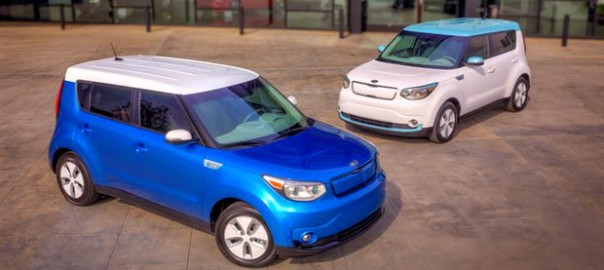
There’s only one Soul EV model and it costs £24,995 after the £5,000 government Plug-in Car Grant. You can choose between two colours, blue (with a white roof) or silver. Kia will also install a recharging point at your home if you buy a Soul EV – as long as you have suitable off-road parking. The Soul EV is no different from any other Kia in terms of the reassurance offered; it comes with a seven-year, 100,000-mile warranty.

CONCLUSION

So, after a week of living with the Kia Soul EV, would we buy one?

The first consideration has to be whether a pure EV is suitable for your driving needs. Pure EVs are ideal for use in urban areas, where they can help combat issues of air pollution. However off-street parking to allow charging is often a challenge in urban areas. Although an infrastructure of public charge points is being built up, all the statistics show that people mostly charge at home or work.

So although the ideal is that a pure EV such as a Kia Soul is a person’s only urban mode of transport, the reality is that many EVs are bought as a second car, when there is also typically a decent-sized, diesel-powered estate car in the household. In this scenario cars such as the Soul EV are ideal for shorter journeys. The issue is whether the whole life costs stack up, which may be an issue if only low mileages are covered.

From a business perspective, the Soul EV would be ideal for regular short journeys, and the company car BIK tax rate from April 2015 is just 5% (it was zero prior to this date). Although the purchase price is high compared to conventional cars in this class, running costs are very low – around one-fifth of a petrol car.

So, if you think a pure electric vehicle would be suitable for you, should you choose a Kia Soul EV? It has a better real-life driving range than some rivals, and it’s a practical shape. It drives equally as well as other EVs. On the downside, the styling may not be to everyone’s tastes.

So after a week living with the Soul EV, overall it remains a perfectly acceptable car to live with if it’s suitable for your driving requirements, and it offers another choice in the fairly limited pure EV market place; it maintains its original Green Car Guide rating of 9 out of 10.

Source: Green Car Guide

Kia Soul EV (Image: Kia America)

2015 Kia Soul EV + Long-Term Arrival

Mr. Toad’s Wild Ride

“So the question is — what next? I’ve driven the Tesla for so long that returning to a gas car feels like backward time-travel. Do I say giddyap to these things?”

That’s a line I wrote late in my 38,000-mile odyssey at the wheel of our long-term Model S P85+. Which, when it was recently returned — rolling silently (and cruelly) away without me in it — left me feeling as if my beloved starship from the future had abruptly dropped me back in the ordinary-old circa 2015. Plunk, there I am on the ground — amid a small puff of dust.

And there I bewilderedly sat, an alien from Elon Musk’s future returned to the primitive present.

No more giant multi-touch screen? No more magical over-the-air updates? No Superchargers? Back to driving mere ordinary cars? Never!

But even the irrepressible Mr. Toad in me had to face the fact that I needed a way to get around. So I started typing emails.

After coming up goose eggs in my attempts to coerce either Hyundai or Toyota into letting me sample their hydrogen fuel cell wares (the first, stymied by internal corporate barriers, the second, just premature timing), I made a list of available battery-electric cars. Based on what? One thing, baby. Range.

My round-trip commute is a minimum of 76 miles (a bit more when the 405 is closed for late-night construction, which it usually is). So, conservatively, let’s say its 80. Adding a 10 percent fear factor makes it 88. OK, now let’s run through the list of available non-Tesla BEVs out there:

  • Smart ForTwo: 68 miles — too short.
  • Ford Focus Electric: 76 miles — nope.
  • BMW i3 BEV: 81 miles — nope, but cool carbon-fiber tech.
  • Chevrolet Spark EV: 82 miles — nope.
  • Volkswagen e-Golf: 83 miles — nope, but certainly fun to drive.
  • Nissan Leaf: 84 miles — we’re inching closer.
  • Mercedes-Benz B-Class Electric Drive and Fiat 500e: 87 miles — ack, short by 1 crummy mile.
  • Kia Soul EV: 93 miles — eureka!

So the Kia is actually my one and only pure battery-electric choice since Toyota discontinued its slow-selling, 103-mile RAV4 EV ($49,800 — no wonder). The sole quasi-alternative was the BMW i3 with Extended Range, which would have amusingly punctuated my trips with brief firings of its two-cylinder engine-generator, needing refueling (with gas) every week and a half or so. Unfortunately, our slow-motion BMW-courting hasn’t resulted in a date; disappointing, but simplifying things.

Read more: Motortrend

Kia Soul EV Named “Best Value In America” In Electric/Plug-In Hybrid Category

According to Vincentric, a “leading source of cost-of-ownership data and analysis within the automotive industry,” the 2015 Kia Soul EV is the “Best Value in America” in the Electric/Plug-In Hybrid category.

David Wurster, President of Vincentric states:

“As a first time winner of the ‘Best Value in America’ awards, the Kia Soul EV rose above the competition with a total cost of ownership that was more than 9% below expected. Contributing to its performance were low operating costs, which were powered, in part, by a 5-year, 60,000-mile comprehensive warranty.”

Orth Hedrick, vice president, product planning, Kia Motors America, remarked:

“The Kia brand has always stood for value, and even as we’ve grown and matured, adding ever more refined and diverse models to our lineup, we’ve never strayed from that commitment to our customers. The Soul EV, our first all-electric zero-emissions vehicle for the U.S. market continues that commitment. It offers iconic design, the best range of any vehicle in its class and superbly practical packaging, all at an affordable price. Being honored as a ‘Best Value in America’ by Vincentric is validation of Kia’s winning formula.”

The Kia Soul EV starts at $33,700 in the U.S.

Here’s how Vincentric calculates “best value:”

“Vincentric measures cost of ownership using eight different cost factors: depreciation, fees & taxes, financing, fuel, insurance, maintenance, opportunity cost, and repairs. Utilizing this methodology, Vincentric identifies which vehicles have lower-than-expected ownership costs relative to other comparable offerings. The statistical process evaluates each vehicle across all 50 states and Washington, D.C.”

Source: Inside EVs

Kia Soul EV in puddle (Image: The Register)

Kia Soul EV: Nifty Korean ‘leccy hatchback has heart and Seoul

A cracking little wagon and a declaration of intent

Vulture at the Wheel I didn’t have high hopes for the Kia Soul EV. I assumed that it was a bit of a lash up; a regular Soul with the engine and gearbox ripped out and a battery pack and electric motor rudely bolted onto it. Wrong.

Kia Soul EV in puddle (Image: The Register)

In many ways it is quite the equal of the Renault Zoe and Nissan Leaf if not quite the ground-breaking BMW i3.

What you think of the Soul EV’s looks will depend on what you think about the aesthetics of the conventionally powered version. Personally, I’ve always quite liked it and I like the EV version even more. Granted, it is not as pretty as the Zoe but it’s a darned sight less frumpy than the Leaf and considerably less jarring than the BMW i3, which is a shape you either love or loathe.

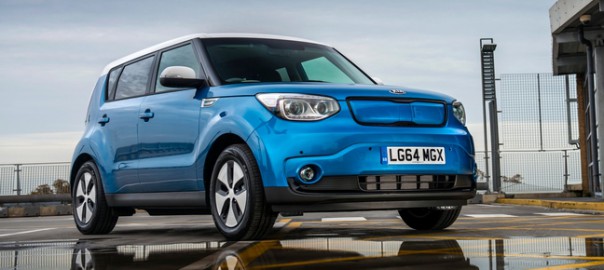
The very slightly restyled rear light clusters and blanked-off grille – which houses the recharge ports – give it, again, to my eyes, a modern and resolved appearance. The EV-specific detailing, like the wind-cheating alloys and LED-running lights, look right at home too. The funky styling really shouldn’t come as a surprise because the Soul was styled at Kia’s California studio.

In terms of battery capacity and motor power, the Soul has the Zoe and Leaf beaten. It boasts 27kWh and 81.4kW to the Zoe’s 22kWh/65kW and the Leaf’s 24kWh/80kW. Kia reckons that the Soul’s battery energy density of 200Wh/kg is a class best. I can neither confirm nor refute that for the simple reason that I’m not sure how Kia arrived at the figure.

What I can confirm is that the Soul can hit 60mph in 10.8 seconds and waft on to a top speed of 90mph. That acceleration figure means the Soul is noticeably faster than either the Renault Zoe or the Nissan Leaf. Granted, a BMW i3 will leave it for dead (the BMW can hit 60 in 7.5 seconds) but the Soul is still a rapid little pup, especially at lower speeds.

The Soul is quiet as well as quick. At all times the electric motor is as silent as the grave. In fact, I think it’s the quietest electric car I’ve driven. Kia has done a good job keeping wind and road noise at bay too, considering that the Soul EV has a semi-detached drag coefficient of 0.35. That is an improvement on the regular Soul’s 0.38.

Read more: The Register

EVTEC 180kW rapid charger and Kia Soul EV (Image: Automobile-Propre)

EVTEC has an 180kW AC / DC charger

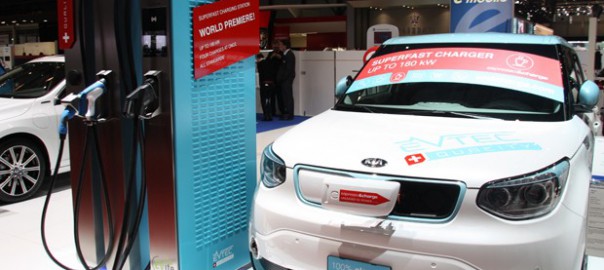
In Geneva, Switzerland, the EVTEC company has introduced a new generation of quick charger, AC / DC, capable of operating at a maximum power of 180 kW.

[Translation by Google] Welcoming 4 connectors load, three in rapid charge and a AC 22 kW the “Espresso & charge” terminal of EVTEC meets the standard Combo, CHAdeMO and AC with a maximum load of 180 kW. Depending on the number of supported vehicles, power is automatically regulated between takes with a maximum of 120 kilowatts and 43 kilowatts DC side AC side.

In Geneva, the terminal was presented alongside a Kia Soul EV. A choice that is not trivial since the electric crossover Korean manufacturer is the first model to bear charging CHAdeMO 100 kW.

EVTEC 180kW rapid charger and Kia Soul EV (Image: Automobile-Propre)

According to the information we have collected from the manufacturer’s stand, the first terminal is expected to be deployed this year in Switzerland as part of the project AVOIDED.

Towards a new generation of “superchargers”?

If EVTEC is perhaps now the only company to offer this type of charger, you imagine that other manufacturers quickly follow the trend since the load capability of 100 kW and over become widespread among manufacturers.

Especially, the transition to faster charging powers will better meet the needs of future generations of electric cars, expected for 2016-2017, the capacity of batteries should be around 40 to 50 kWh.

Source: Automobile Propre

Kia Soul EV Road Test Review – Video

“We road test the all-new 2015 Kia Soul EV electric car to see if how it drives, how it behaves, and if it pencils. And does it still have soul?”

Host of TestDrivenTV, Sam Haymart provides a thorough overview and review of the Kia Soul EV.

This is one of our favorite reviews of the Kia Soul EV we have seen so far.

The video covers most of the Soul EV’s features and even compares it to the ICE model.

Kaymart truly enjoyed the Soul EV. In fact, the electric Soul is the first vehicle for 2015 to make TestDrivenTV’s “I’d Buy It” list.

We recommend you check out the review video above. It’ss worth a watch for those who interested in the Kia Soul EV and/or other EVs in its class.

Source: Inside EVs

Kia Soul EV second only to Model S in driving autonomy

In my previous post about EVTEC’s four-port 100+ kiloWatt DC Fast Charging station, there’s a little footnote that deserves more attention — the Kia Soul EV supports 100 kiloWatt DC Fast Charging via CHAdeMO. The Kia Soul EV is getting strong reviews, with Kia making it available in several European countries, in Canada, and several U.S. States. The reviews indicate Kia carefully crafted an excellent electric car, and as a Soul EV owner I can attest to how good a car it is. That it also supports a 100 kiloWatt charging rate demonstrates the assertion that Kia paid attention to details with the Soul EV.

This, and the Soul EV’s driving range, make it second in driving autonomy to the Tesla Model S.

That’s a big claim to make about a car many people dismiss as a compliance car (it’s not), so let’s take a look at what it means.

Since September, the Soul EV has been shown twice alongside 100 kiloWatt CHAdeMO charging stations. Last September it was a Korean charging station maker demo’ing their station and the Soul EV in Europe. Then in late March, it was EVTEC (a Swiss company) showing off their four-port CHAdeMO/CCS station, alongside a Soul EV. Hence, while Kia hasn’t said much about it in public, this demonstrates the Soul EV’s capability of charging at 100 kiloWatts via CHAdeMO.

To my knowledge no other CHAdeMO or Combo Charging System (CCS) car can charge at this rate. Well…. that’s a hard assertion to test because the CHAdeMO and CCS public infrastructure doesn’t support 100 kiloWatts.

The Tesla Supercharger network, however, supports a 120 kiloWatt charging rate which is how the Model S is the first electric car that can implement proper road trips. That charging rate means a sub-1-hour recharge for a 260+ mile driving range.

Therefore, by supporting a 100 kiloWatt CHAdeMO charging rate, the Soul EV has the second fastest charging behind the Model S. BUT .. of course .. it’s difficult to be happy about that if you can’t find a 100 kiloWatt CHAdeMO station anywhere. We have to be satisfied with our 50 kiloWatt (or less) charging rate supported by the current infrastructure.

It does point to future standards compliant EV charging infrastructure, supporting electric cars from any manufacturer, with charging rates as fast as Tesla’s Supercharger system.

I said the Soul EV is “second in driving autonomy to the Tesla Model S”. We’ve just gone over the charging rate side of that, let’s now go over the driving range.

The Model S comes with two battery pack sizes – 60 kiloWatt-hours, 208 mile EPA range – 85 kiloWatt-hours, 265 mile EPA range.

The next longest electric car EPA range is the Kia Soul EV, coming in at 93 miles with many people reporting testing it at over 100 miles range. The Gen2 Toyota RAV4 EV has a longer EPA range, but is no longer on the market. The Mercedes-Benz B-Class Electric has a larger battery pack, but an 87 mile EPA range. Neither have fast charging.

The Kia Soul EV supports a 93 mile (or more) range, and 100 kiloWatt charging rate, with a 27 kiloWatt-hour battery pack. Some claim that a small pack like this cannot charge at such a rate without damaging the pack. Supposedly the rule of thumb is to not charge faster than 2x the pack capacity, so a Soul EV should max out at 54 kiloWatts charging rate.

That “rule of thumb” is a way of describing a 2C charging rate (1C means a 1 hour charging time, and 2C means a 1/2 hour charging time). The actual safe charging rate (“safe” meaning both actual safety from events like fire, and “safe” as in not damaging the pack) depends on the battery chemistry. Some chemistries can charge at a higher C rate than other chemistries. Did Kia choose battery technology that can charge at a 4-5C rate?

The phrase “driving autonomy” means a combination of charging speed and driving range. The gasoline cars are tops in both measures, with a 300+ mile driving range and a 5 minute recharge time. Our gasoline driving cousins prove every day what they can do with that sort of autonomy. It’ll be awhile before electric cars catch up (1 megaWatt charging rate?) but as the manufacturers push both driving range and charging rate forward we’ll get closer and closer to what the gasser drivers enjoy.

Going forward it’s best if electric vehicle drivers demand “autonomy” from automakers and charging network operators. That’s the only way to convince those stuck with range anxiety issues that electric cars are safe for adoption.

Source: The Long Tail Pipe

Kia Soul EV (Image: Kia America)

2015 Kia Soul EV Turns at Least One Cynic into a Hipster Hamster Lover

What blew me away most about my week-long test drive of the all-electric 2015 Kia Soul EV was despite the boxy exterior, booming sound system and man-size hamster ads that scream BOOMPF-BOOMPF-BOOMPF, DOOIT-DOOIT-DOOIT, what stood out most was the quiet, ultra-smooth ride.

Surely those young ‘uns stopped alongside me at red lights thinking to themselves “mid-life crisis … sad” had no idea that my blue-and-white charmer drove like grandma’s Buick LaCrosse.

Indeed, at around 35 grand with all the bells and whistles and mad beats on my test model, this Kia Soul EV had me re-thinking my looming personal strategy of going as cheaply as possible just to get into an electric, and then trade up as time (and main battery life) march on.

Besides the smooth ride, it delivers impressive power when you need it, like getting on the freeway or passing grandma in her Buick LaCrosse. Being winter in Southern California, there was no need to deploy the heat for the heated front seats, but with their leather trim they were quite comfortable. Rear-view mirror visibility, which has been an issue for me with other EVs and tiny cars, was no problem in this Korean version.

Then there were those aforementioned bells, whistles and yes, mad beats, yo. The electronically powered air conditioner had the cabin cool in a snap, something vital since it was winter in SoCal. (Pass the sunscreen.) What really had me styling was the smart key you keep in your pocket and the power-folding outside side mirrors. There’s a setting that allows the mirrors to fold inward when the car is off and then they electronically fold out when you unlock it. (The mirrors are also said to be heated and have turn-signal indicators, but I didn’t feel/see to confirm.)

The car makes a little blip sound as you (and only you) approach with the key in your pocket, purse or murse. You can take the key fob out and press unlock or simply push a little black button on the door handle to do the same. With the key still in pocket, you (and only you) can then press the car start button inside the cabin. The engine barely makes a noise; it’s better to check the gauge behind the steering wheel to see that it’s indeed running.

Kia Soul EV (Image: Kia America)

A large screen in the center console allows for viewing the navigation system, SIRIUSXM satellite radio settings or a split screen of both. Of course, when you shift your EV into reverse, the same screen is filled with the rear-camera image. This came in especially handy on a dark side street off PCH in Laguna Beach, where a mom and dad carrying little ones decided to walk right into my reverse path as I started to back up. I was able to watch them amble off to safety.

You’ll notice little holes around the front and back bumpers, which provide another safety feature: little sensors to alert you with a noise inside if you are getting too close to an object or vice versa. This got a little annoying while backing out of my car lot of a driveway but was welcome when a lane-changer on the freeway forgot to signal. All things considered, I’d rather put up with the annoyance.

Read more: OC Weekly

Kia Soul EV

Kia Soul EV Claims Top Honours as the First CANADIAN GREEN CAR OF THE YEAR

What is a Green Vehicle?
It is a vehicle which, for its size and purpose, provides the Canadian consumer with environmentally-friendly returns that compare favourably with other vehicles in its class.

VANCOUVER, March 24, 2015 /CNW/ – In an early afternoon press conference at the opening ceremonies of the Vancouver International Auto Show, the Kia Soul EV claimed top honours when the car was declared the 2015 Canadian Green Car of the Year by the Automobile Journalists Association of Canada (AJAC).

The Canadian Green Car of the Year award, in its preliminary season, was presented by Kevin Corrigan, Chair of the Canadian Green Car Committee at the Vancouver International Auto Show from a finalist list of four (4) vehicles. The top four (4) finalists, the Honda Fit, the Kia Soul EV, the Subaru Legacy and the Toyota Camry Hybrid, were announced at the opening ceremonies of the Canadian International Auto Show in Toronto back in February. The 4 finalists were “crowned’ with green car toppers for the duration of the Toronto show – and will subsequently wear these same crowns in Vancouver – which showcase their place in the running for the Canadian Green Car of the Year Award.

“Kia Canada is thrilled that the all-new 2015 Kia Soul EV has been recognized by AJAC as the Canadian Green Car of the Year “,

said Maria Soklis, Vice President and Chief Operating Officer, Kia Canada Inc.

“This acknowledgement is testimony to Kia’s ongoing commitment to deliver environmentally friendly automotive solutions and diverse powertrains to consumers without compromising on design or comfort.”

7 vehicles became eligible for this top honour after being tested in the annual “TestFest” event that AJAC’s Canadian Car of the Year Awards program hosts annually in October. These four (4) finalists represent the back to back, same day testing and vote results compiled by the largest group of Canada’s best-known automotive journalists, who gather every year for a 5 day testing program, in late fall. KPMG, the accounting firm, tabulates all vote results and presents AJAC with the top 3 – or in this case, the top 4 due to a tie – in 15 different categories. Acura, Cadillac and Mercedes-Benz (smart), were also in the running.

Mr. Corrigan explains,

“While an electrically-propelled sub-compact, thought of as green, may well suit those living within the city limits, is it not also true to view a fuel-efficient 6 cyl luxury hybrid product likewise, when compared to a V8 gas-powered vehicle in its relative segment of the market? Yes, the Canadian consumer requires environmentally-friendly transportation which meets their needs, whether it be a small city runaround, or a fuel-efficient luxury product for their airport limousine business. So when it comes to vehicle transportation, any & every vehicle which offers both fuel-efficiency and addresses environmental concerns is worthy of our attention, and praise, where due”.

Source: Automobile Journalists Association of Canada