Category Archives: Charging

Petrol prices are driving us to electric cars, and surging utility bills are no deterrent

EV sales are rising way beyond forecasts, indicating that most of us are more than ready to make the switch

The net zero transition is really a big invest-to-save plan. Saving the planet is obviously the main goal, but there are purely financial savings too if you take the long view: we pay upfront in the next few decades for the infrastructure for lower carbon travel, heating and production, which saves us money over time because it’s cheaper to run.

Electric vehicles (EVs) are where the big savings come from. A year’s petrol or diesel typically costs well over £1,000, but if you can charge an electric car at your home overnight the annual fuel cost can be under £150.
Making the EV switch is a big job – we’ve got 32m cars to replace. But the turnover has recently gone up several gears, with EV sales outpacing all forecasts: they now account for one in five new car purchases.

Interesting new research digs into how sensitive are drivers pondering the switch to the savings that come from moving from petrol to electric vehicles. Using data from California, it shows the obvious: EV sales respond both to electricity prices (falling as they rise) and to petrol prices (rising as pump prices increase).

The interesting bit is that sales respond to petrol prices at around four to six times the rate of electricity prices. Why? Consumers are just less aware of electricity prices than petrol prices. I definitely am, having watched petrol pump prices rise by 40p a litre over the past year.

So if you want a (small) silver lining to today’s catastrophic energy price surge, it’s that bonkers pump prices should encourage more people to buy electric vehicles while nuts electricity prices won’t put them off much.

Read more: TheGuardian


It’s Time to Go Green!

If you would like to know more about Solar Panels and the PowerBanx range of home battery systems, and get a free instant quote, please complete our online form:

Electric car particulate pollution myths busted by RAC report

A new report casts doubt on claims that EV tyres and brakes produce more particulates than those of petrol and diesel cars

Motoring organisation the RAC has commissioned an expert report from leading battery electrochemist Dr Euan McTurk to address what it calls ‘negative myths surrounding electric cars’, specifically those around non-exhaust emissions from brake and tyre wear.


The report addresses the quantities of toxic fine particulate matter (also known as PM 2.5s) generated from an electric car’s tyres and brakes, which are often said to be much worse than for an equivalent internal combustion-engined car. That’s because it’s commonly believed the extra weight of an EV’s battery increases the wear on these two items during normal driving.

Government Environment Secretary George Eustice recently spoke to MPs during a select committee session on the subject. “There is scepticism,” the cabinet minister said. “Some say that just wear and tear on the roads and the fact that these vehicles are heavier means that the gains may be less than some people hope, but it is slightly unknown at the moment.”

However, the RAC says Dr McTurk’s findings based on real-world use show that electric car brakes in fact wear much more slowly than those in conventional cars, because EVs rely so heavily on regenerative braking where the motor works in reverse to charge the battery, slowing the car without the brakes being applied. Dr McTurk said: “Dundee Taxi Rentals says that brake pads on its 11 Nissan Leaf taxis have a lifespan of 80-100,000 miles – four times that of their diesel taxis. Discs tend to be changed due to warping rather than wear unlike on a conventionally fuelled vehicle, and last twice as long as those on diesel taxis.

Read more: Auto Express


It’s Time to Go Green!

If you would like to know more about Solar Panels and the PowerBanx range of home battery systems, and get a free instant quote, please complete our online form:

Smart charge point regulations explained

EV charging is changing in June 2022

On 30th June 2022 the way we charge electric vehicles is going to change. That’s when The Electric Vehicles Smart Charge Point Regulations 2021 come into force  (catchy title isn’t it!).

Charging with an Ohme smart charging cable

Hang on. Don’t you just plug in and charge?

Well in theory, yes. Charging your EV at home or work is really simple – although you can charge from a standard (13A) socket – you ideally need to have a suitable charge point installed for topping up your battery.

Currently charge points simply need to be ‘internet connected’ – which often means some nice visual tools in a mobile app – with some charge points also allowing you to set schedules so that you charge overnight when the electricity prices from some energy suppliers are lower.


Great for EV drivers, but what happens if every EV starts charging at the same time? 

There are lots of people who enjoy spreading doom and gloom about EV’s and the electricity supply. According to the National Grid who manage the electricity transmission network, there’s plenty of capacity to meet the future electricity demand – but not if everyone charges at the same time.  That’s the what the new smart charge point regulations are aiming to solve.

Read more: myenergi

It’s Time to Go Green!

If you would like to know more about Solar Panels and the PowerBanx range of home battery systems, and get a free instant quote, please complete our online form:

Renault K-ZE electric supermini (Image: Autocar)

RENAULT MÉGANE E-TECH ELECTRIC 2022 REVIEW: FUNCTION, FORM AND EFFICIENCY

Renault has produced a diamond

With six billion kilometres (3.7bn miles) covered by its more than 400,000 electric cars sold to date, it’s fair to say that Renault has some experience with electric vehicles. However, for most of the last 10 years the French brand has only had one main model — the Zoe — to showcase its EV expertise.

All that changes later this year with the arrival of the Mégane E-Tech Electric (quite a mouthful, isn’t it?). As familiar as the Mégane name is, this is an all-new and electric-only model that targets a segment led by the Nissan LeafKia e-Niro and Volkswagen ID.3.

Renault electric SUV (Image: Auto Express/Playback)

Renault will offer buyers a choice of two battery sizes and two power outputs, with the most efficient capable of up to 292 miles between charges. The crossover-influenced design, upmarket interior and one of the most capable onboard charging systems on the market are all sure to make it a desirable choice and give its competitors a headache.

Exterior design and rivals 

Just like a concept car you might see at a motor show (remember those?), the Mégane E-Tech Electric has striking proportions that make it look larger than it actually is. Measuring 4.2 metres long, it’s actually slightly shorter than a Ford Focus, but with up to 20in wheels pushed out to the Mégane’s extremities, it has the presence of a bigger car.

Nonetheless, as Renault has managed to produce a battery that is only 110mm thick, the Mégane isn’t that tall; its roofline is lower than the Zoe’s.

A high bonnet and beltline provide crossover styling cues, as do the black wheel arch surrounds and sills. The front door handles retract to sit flush with the bodywork while the rear handles are integrated into the door frame.

Read more: Driving

It’s Time to Go Green!

If you would like to know more about Solar Panels and the PowerBanx range of home battery systems, and get a free instant quote, please complete our online form:

Zappi 2018 EV Charge Point (Image: myEnergi)

Huge law changes will see electric vehicle chargers installed on new homes – ‘fantastic’

A MAJOR law change which is set to be introduced this year will see all new homes and buildings equipped with electric car chargers have been hailed as “really effective”.

It is expected that a law will be passed this year which will require all new houses and buildings to have electric vehicle charging stations. The Government said the move will see up to 145,000 charging points installed across England each year, in the hopes it will make charging an EV as easy as “refuelling a petrol or diesel car today”.

The changes will also require all newly-built and refurbished non-residential buildings with more than 10 on-site parking spaces to have at least one charge point – as well as cable routes for at least one in five spaces.

Zappi 2018 EV Charge Point (Image: myEnergi)

Meanwhile, blocks of flats undergoing major renovation with more than 10 on-site parking spaces will need to provide residents with chargers.

For each dwelling with associated parking, there should be at least one charge point, as well as cable routes in all spaces without charge points.

The Government had previously announced that all new-build homes could be fitted with an electric car charge point in 2019.

Ian Johnston, CEO of Osprey Charging, spoke of how newly built car parks and retail developments will benefit from the EV charger law.

Speaking exclusively to Express.co.uk, he said: “The changes in the planning regulations have been really quite effective in making sure that any new build car park not only has a day one installation of charging infrastructure but is also future proofed for more.

“That is great. We’ve had a number of leads coming to us with people saying they were building a new retail park and they’ve got to have electric chargers, so let’s talk.

“That’s fantastic because it’s forcing people to open the conversation.

Read more: Express

It’s Time to Go Green!

If you would like to know more about Solar Panels and the PowerBanx range of home battery systems, and get a free instant quote, please complete our online form:

Electric cars charging in Milton Keynes (Image: T. Larkum)

Liberty Charge completes Northamptonshire on-street EV charging installs

A portfolio of 82 residential on-street electric vehicle (EV) charging sockets spread across west and north Northamptonshire has gone live.

Two Northamptonshire councils have partnered for the portfolio, which is owned and operated by Liberty Charge and was delivering using its strategic partner Virgin Media O2.

Two charging points have been installed at each site to serve up to four vehicles at a time, with the chargers being 22kW. Initially, two bays will be dedicated to EV charging while the other two can be used for either electric vehicle charging or general parking.

They have been rolled out across seven locations in West Northamptonshire and seven in North Northamptonshire. Funded by Innovate UK and the Office for Zero Emission Vehicles, the Virgin Park and Charge project was supported by the West and North Northamptonshire Councils.

A full charge point at Newport Pagnell services, and my first ever sight of an Audi A3 e-tron (Image: T. Larkum)

Graham Lawman, North Northamptonshire Council’s executive member for highways, travel and assets, said: “Only about 9% of Electric Vehicles are owned by people with no off-street parking against there being about 30% of properties in that situation, so, to catch up, it is vital that we progress kerbside charging points like this to enable all drivers the opportunity to charge their cars locally to them and overnight.”

The Northamptonshire rollout follows the recent announcement of Liberty Charge rolling out chargepoints across Wandsworth, with 35 sites set to see installations.

Read more: Current+

It’s Time to Go Green!

If you would like to know more about Solar Panels and the PowerBanx range of home battery systems, and get a free instant quote, please complete our online form:

Solar Charge Points charging electric cars (Image: T. Larkum)

New Nottinghamshire solar point can charge 100 electric cars a day

A new solar-powered hub could charge up to 100 electric vehicles a day, according to the authority behind it.

The hub is opening in the car park of Gamston Community Centre in Nottinghamshire.

Rushcliffe Borough Council said the facility formed part of its carbon management plan and would, in time, largely be powered by natural light.

It said electric and hybrid users would be able to charge their vehicles up to 80% in 30 minutes.

‘Greener transport’

The facility will add to the council’s network of sites in Keyworth, Radcliffe on Trent, Cotgrave and Rushcliffe Arena in West Bridgford, the authority said.

Solar Charge Points charging electric cars (Image: T. Larkum)

The council’s portfolio holder for communities and climate change Abby Brennan said: “The charging point is an essential part of our work to… help reduce the environmental impact of our operations.

“As a council, we’re committed to installing more electric vehicle charging points across the borough.

“This will continue to encourage the use of electric or hybrid vehicles, as the infrastructure to support them becomes even more convenient and available to residents.”

The authority has been able to provide the site, near the A52, as part of the government’s Transforming Cities Fund.

The council’s portfolio holder for environment and safety Rob Inglis said: “We’re once again thrilled to bring more public electric charging points to Rushcliffe by providing this new solar-powered facility in Gamston and just yards from one of our major road routes.

“This infrastructure will continue to support residents to make the switch to greener transport and complement our existing sites with more to come later this year.”

Read more: BBC


It’s Time to Go Green!

If you would like to know more about Solar Panels and the PowerBanx range of home battery systems, and get a free instant quote, please complete our online form:

Nissan Leaf (Image: Qurren/Wikipedia)

How Much Range You Really Need in an Electric Car

Stop trying to re-create your gas engine car from electricity and the answer will become clear.

If you’re considering an electric vehicle, don’t make the mistake of buying one with too much range. Unlike combustion engine cars with virtually unlimited range, electric cars make the most sense when they have the right amount of range, not a surfeit of it.

There are several reasons to temper your instinct to get the most range possible.

Nissan Leaf – a Perfect Family Car

Cost

Range costs a lot of money. For example, a Nissan Leaf with 226 miles of range costs $6,600 more than the same trim level with 149 miles of range.

There is no real parallel with combustion cars as their cost of range is in the price and consumption rate of fuel, not the vehicle’s MSRP. You can argue that an EV earns back its overall cost premium in per-mile energy savings, but a long-range electric car will need many more of those low-cost miles — and probably years of covering them to do so.

The cost of EV range can make buyers recoil from one without knowing that their perception of sufficient range, not cost, is the real problem.

Weight

Longer range versions of a given electric car have larger, heavier batteries. Unlike a tank of gas that weighs about 100 pounds and gets lighter as it’s used, an EV battery can easily weigh 1,000 pounds and stays just as heavy as it is “emptied,” increasingly becoming dead weight the remaining amount of charge must lug around.

The long range Tesla Model 3 (358 miles of range) weighs 172 pounds more than the RWD version’s still-generous 272-mile range, a weight difference equal to the entire payload a car will most often carry: the driver. The difference is even more pronounced when comparing a long range Model 3 to a comparable conventional BMW 3 Series, which is about 475 pounds lighter.

Read more: RoadShow


It’s Time to Go Green!

If you would like to know more about Solar Panels and the PowerBanx range of home battery systems, and get a free instant quote, please complete our online form:

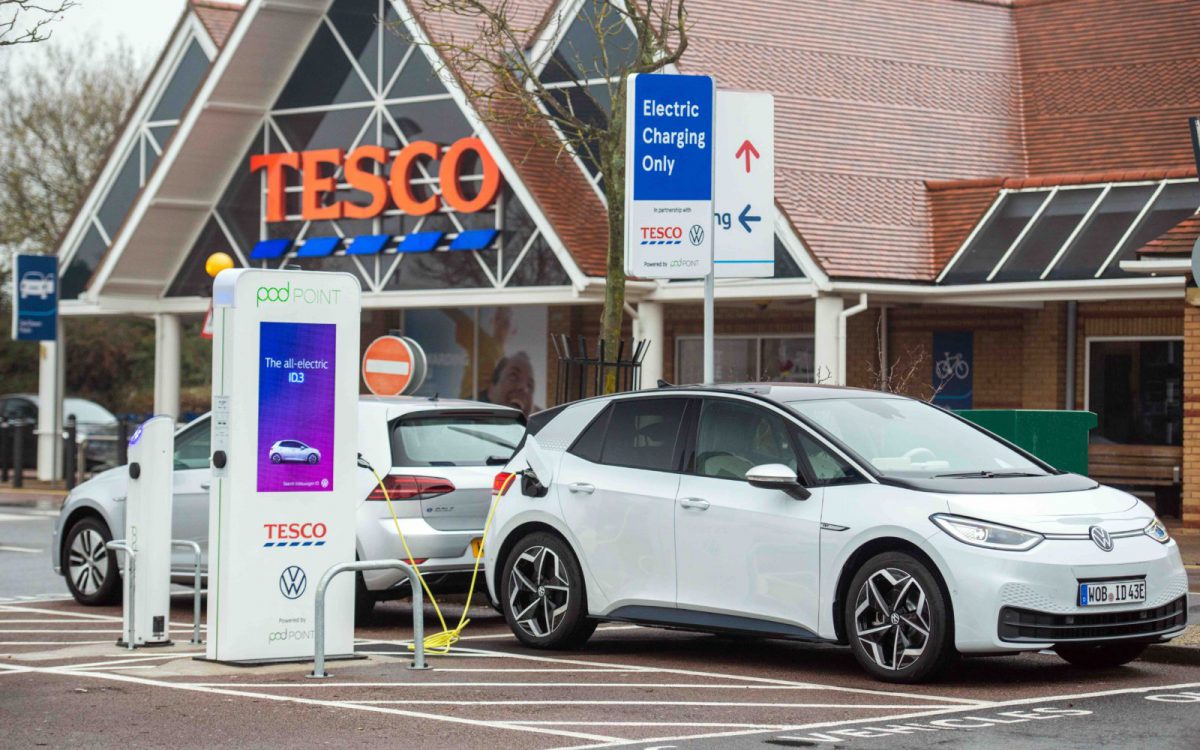
POD Point Rollout at Tesco Stores (Image: Tesco/POD Point)

END of British petrol station: UK urged to ditch iconic locations as revolution looms

PETROL stations are predicted to become a thing of the past as electric vehicles allow drivers to fit charging more around their lifestyles.

As electric vehicles become more popular drivers will be able to incorporate charging into day to day activities such as visiting a supermarket or while they are at work. That’s the view of leading UK charging provider Pod Point who have partnered with Tesco to provide charging facilities in hundreds of branches around the country. Their CEO Erik Fairbairn told Express.co.uk many people assumed they would charge an electric vehicle in something resembling a petrol station, however this often didn’t match reality. Instead he explained charging would likely come in a variety of settings to reduce the time taken out of peoples’ days.

“We say about 97 percent of all energy flows into electric cars at something other than something that feels a bit like a petrol station.”

POD Point Rollout at Tesco Stores (Image: Tesco/POD Point)

A number of forecourts have begun to feature electric charging options with Shell opening its first all electric charging hub in Fulham.

Mr Fairbairn said in general terms such an approach could be a dead end although there would still be a role for service station style options for long distance journeys.

“It’s not fair to say none are required but it’s certainly significantly the minority and the future of the petrol station network in the UK in 10 or 20 years looks nothing like what we’ve got now” he explained.

“The vast majority of petrol stations in my view probably don’t really have a role to play in the electric vehicle future.”

In the long run companies such as Pod Point want to rollout charging points in every parking bay however this would require a big increase in the number of electric vehicles to encourage the investment.

Read more: Express

It’s Time to Go Green!

If you would like to know more about Solar Panels and the PowerBanx range of home battery systems, and get a free instant quote, please complete our online form:

VW e-Golf (Image: Volkswagen.co.uk)

The 10 best electric cars to buy for the new 22 registration and their benefits

We have picked the top EVs you can buy now in terms of range, efficiency and desirability ahead of a ban on fossil-fuelled cars by 2030

Thinking about buying an electric car? You’re not the only one. Plenty of British buyers are wondering about when to switch from petrol or diesel to an electric model and it will be interesting to see the percentage of EVs sold in March with the advent of the new 22 registration.

There’s good news if you’ve decided to make the leap: the market is brimming with brilliant options. Indeed, it feels like each week a new electric car (EV) comes out that brings with it more range, more equipment, a lower price or even a combination of all three.


To keep up, we’ve revised our list of the 10 best electric cars to buy for 2022. This list, of course, is not exhaustive; there are plenty more excellent EVs on sale, and indeed, it’s taken us no small amount of teeth-gnashing, hair-pulling and some heated discussion to come up with this ranking.

With that in mind, it’s important to remember that these cars are very closely matched; there are no bad cars in this list, and what’s more, several very good EVs missed out by mere fractions of a hair’s breadth; honourable mentions must therefore go to the incomparably affordable MG ZS EV, the brilliantly practical Vauxhall Combo-E Life, a glut of much-vaunted Teslas, the quietly competent Skoda Enyaq and the surprisingly sporty Ford Mustang Mach-E.

Read more: The Telegraph


It’s Time to Go Green!

If you would like to know more about Solar Panels and the PowerBanx range of home battery systems, and get a free instant quote, please complete our online form: