Category Archives: Charging

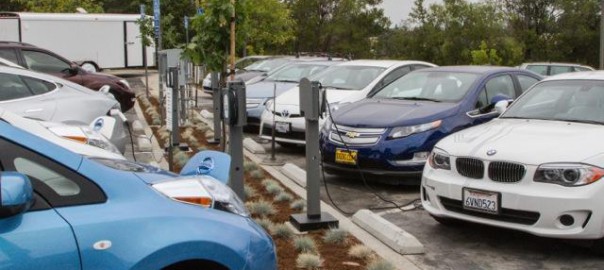
Workplace charging (Image: J. Kalb/Plug In America)

£35 million boost for ultra low emission vehicles

Funding committed to low emission taxis and motorbikes, plus more chargepoints for workplaces and residential streets.

Workplace charging (Image: J. Kalb/Plug In America)

A major £35 million package to boost the uptake of ultra-low emission cars and scooters was unveiled by Transport Minister John Hayes today (13 October 2016).

The fresh funding commitment will see thousands more electric vehicle chargepoints installed on streets and at workplaces across the UK – after the number of new ultra low emission vehicles registered rose by 250% in just 2 years.

The government is also buying 2 brand new Nissan LEAF electric cars for the Government Car Service – on top of 4 that are already in use.

The vehicles are built at the Nissan motor manufacturing plant in Sunderland – a symbol of our world-leading automotive industry which the government is committed to supporting.

The announcement is part of the government’s plans to improve air quality, and it comes as Defra launch a new consultation on introducing clean air zones in Birmingham, Leeds, Nottingham, Derby and Southampton by 2020 – delivering on the government’s commitment to create cleaner air and reduce emissions.

Transport Minister John Hayes said:

No matter what mode of transport you need – a scooter to get to work, a car or a van to run your business – we are here to help you do it with zero emissions.

The number of ultra-low emission vehicles on our roads are at record levels and new registrations have risen by 250% in just over 2 years.
We are committing £35 million to help install new chargepoints and offer new grants as we aim for nearly all cars and vans on our roads to be zero emission by 2050.

The funding announced today includes:

  • next steps of a £20 million competition that will help councils roll out chargepoints for ultra-low emission taxis
  • up to £10 million funding for chargepoints outside workplaces and homes where there is no off-street parking
  • launch of an initial £3.75 million scheme to encourage uptake of zero emission motorcycles and scooters
  • £2 million awarded to public and private sector organisations to deploy hydrogen fuel cell vehicles
Plans for an electric car charging point in every new home in Europe

Car manufacturers welcome plans by the EU to boost the convenience of electric cars by increasing recharging facilities

Every new or refurbished house in Europe will need to be equipped with an electric vehicle recharging point, under a draft EU directive expected to come into effect by 2019.

In a further boost to prospects for the electric car market in Europe, the regulations due to be published before the end of the year state that by 2023, 10% of parking spaces in new buildings in the EU zone will also need recharging facilities.

The EU initiative is intended to lay the infrastructure for the sort of electric car boom envisaged by Norway and the Netherlands, which both plan to completely phase out vehicles with diesel engines by 2025.

As well as extending the driving range and convenience of electric cars, the mushrooming number of recharge stations would allow vehicles to feed their electricity back into the grid.

That in turn would open the door to a futuristic world in which cars supply energy to Europe’s power network at all times of the day and night, balancing shortfalls from intermittent renewable energies when the sun is not shining and the wind not blowing.

“This kind of market stimulus is not just positive, it is mandatory if we want to see a massive rollout of electric vehicles in the near future,”

said Guillaume Berthier, sales and marketing director for electric vehicles at Renault, which recently unveiled an electric vehicle with a 250-mile range.

“The question of how you recharge your car when you live in an apartment within a city is a very important one.”

Read more: The Guardian

Charging at Cherwell (Image: T. Heale)

Rapid Charging an Ioniq eMotor?

Where were we? Ah yes. I have my Ecotricity* Android App and my Chargemaster Polar RFID card. I’m ready for the big leagues. Rapid high current charging here I come. “Gather yourself woman!” I said. “We’re off into the countryside”.

An hour out from Milton Keynes, we’re tootling down the M40 on a misty Saturday afternoon and the Memsahib challenges Satnag to guide us home. Duly programmed Satnag does its thing and Ioniq interrupts proceedings with a message of gloom and disaster.

“You will never see your destination. Doom! Doom again! Woe betide the fool that tries to… ”.

Well that’s what it felt like and now I know what Range Anxiety (RA) can do to a fella. It’s not nice.
The actual message? “You have insufficient charge to reach your destination”. And then as an afterthought “Would you like to know the nearest defibrillator?” or did it say “charge point”? You get how I’m feeling.
Five miles later we arrive at Moto Cherwell Valley. Some semblance of cognition kicks in as I remember that electric charge points aren’t located near the liquid fuels and we play hunt the charge point in the car park.

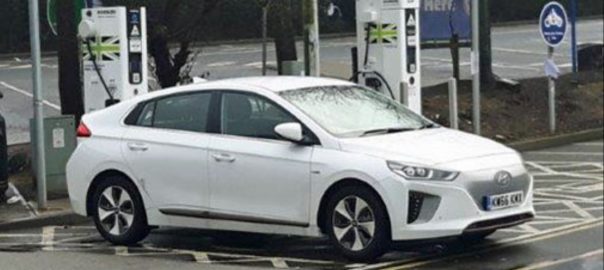
Look, as evidenced in this image…  We won 🙂

Charging at Cherwell (Image: T. Heale)

We didn’t know yet but something was wrong. Not the process, no, that was fine. Introductions went well:

  • Phone, App – Say hello to – Charge point.
  • Charge point – Phone App.

Electronic handshaking takes place. This is so much easier than I expected. “Do you accept the cost?”. I accepted. Grudgingly. I don’t have my free charges yet but £6 is still a bargain.
Found the AC connector. It looked exactly like the one at home (some of you are jumping ahead) and Click! The blue charging lights coming on the App assures me I’ll be told when to come back.

RA sorted, I notice that my back teeth are floating and the cold isn’t helping. Time to get in out of the cold and find the toilets.

Just consider that a moment. Find the toilets.

Why would I have to try to find the toilets? More to the point why would any public place hide the ^%$%ing toilets? I have visited facilities in many service stations. They’ve always been near the entrance and clearly labelled. Moto Cherwell Valley believe otherwise**. Plan accordingly if you stop there.

Mind, body and spirit at ease we look dotingly out of the window at eMotor suckling at the Ecotricity teat. All is well with the world. You know it isn’t but we don’t. Yet.

Let me offer you some simple advice for these times. Bring a book or magazine or something. If it’s going to be a flask and some sandwiches stay in the car so as to avoid being turfed out for not buying anything.

Forty minutes later, I’m feeling concerned. There has been no word from App. We go back to eMotor and the charge lights are off. I’m not concerned any more. We can be on our way and I’ll take App to task later.

In five minutes time I will be talking to a helpful young man (Victor) at ecotricity.

Pre-launch checks show we now have sixteen more miles than what we came in with.
What? Sixteen? One six? Not six zero? Grrrrr at all things electric!
“Breathe” She says. I breathe.
“That cost me six quid!” I breathe again.
“Where’s my phone?” I breathe again.
There’s a number on the charge point if you have any problem.

Turns out that there were two charge points and I parked at the wrong one. You live and learn.

This is for slow charges (Image: T. Heale)
This is for rapid charges (Image: T. Heale)

BTW – The Ioniq eMotor? It is a fantastic machine. Pure pleasure to drive.

Bye for now. I’ll be in touch.


*Yes their logo is ecotricity but I believe in Capitalization for proper nouns.

** Enter building***. Fight through crowd. Pass the hot drinks turn right. Fight through crowd armed with hot drinks and food. Look into the distance on the left side there is a small sign about two thirds of the way down.  Small sign with even smaller logos representing the genders.

***If you exit the building to the outdoor seated area the doors open automatically so you can look at you eMotor unobstructed. When you walk back in mind your nose (or other protuberance), the doors do not open of their own accord.

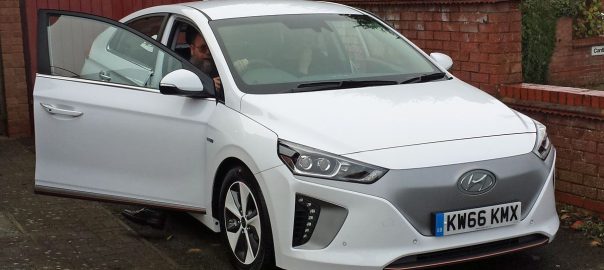
Trevor Heale at home in his new Ioniq Electric (Image: T. Larkum)

So I Own an Ioniq eMotor (Electric Vehicle)

One week into the new and exciting world of my new eMotor and I’m looking to venture further afield.

Trevor Heale at home in his new Ioniq Electric (Image: T. Larkum)

Home charging is easy, if a little long with a 13amp plug and I eagerly await my 32 amp POD Point to take advantage of cheap night rate electricity. It’s still called Economy 7 you know, just like it used to be way back when.

I mentioned in my previous post I was tackling range anxiety. Doing so within the confines of Milton Keynes (MK) seemed sensible. It was fun using sport mode to drain the battery 🙂
At eighteen miles range remaining all the appropriate warning lights went off (came on?) and…

I continued driving!

Yup. I continued. I’m that kind of chap.
Brave huh? Yes, for a given value of brave. Eco mode made me feel a little more secure.
After a couple of miles of tormenting lights, prudence reared her head and I agreed with her. It was time for me to tackle my first rapid charge.

Dear reader please forgive me as I wave my ignorance at you in the following.

I pulled over, stopped and pressed lots of buttons* (no manual yet). Within moments I had a map of Milton Keynes and dozens of choices to hoover up some power. Ooh how happy and clever I felt.

It didn’t last.

Broughton is a newer area in MK so I chose to explore it and fill up there. Yes, since you ask, it happened to be the nearest point. Remember, I’m working on my range anxiety.

If I’d known the area I would’ve stayed on the main road and seen the chargers by the local shops. I didn’t. Satnag** said turn right into Cavan Way and I did. The location of the charger and the satnav were at odds by approximately one road and two hundred yards. I’ll remember that in future searches.

I parked (reversing cameras are great) and tackled the Monolith. Which cable/connector to use? Easy I know my plug options. Now, where do I pay? Ok. Sigh. I’ll read the instructions. Bu**er!

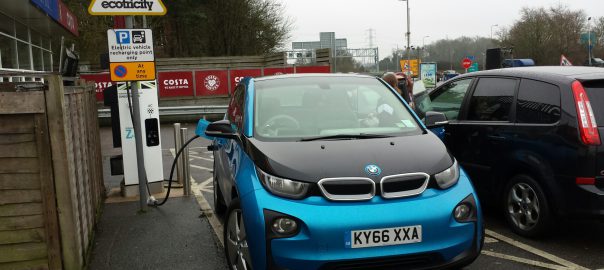
One of the many Polar rapid charge points around Milton Keynes, this one is in Central MK (Image: T. Larkum)

Yeah, I knew somewhere in the back of my mind you needed a card but surely I can just buy some electric? Just a little bit for cash? Eh? Hole in the wall technology right? Wrong. Holes in the wall are mostly for getting money out not for putting it in.
I closed my recharging flap (that’s not a euphemism) and did the walk of ignorance and shame back to my comfy leather seat. It felt further than the three paces. The heated seat and steering wheel cheered me until I was back at home with my three pin plug.

So take heed brave new adventurers, preparation is required to charge away from home.

I have now joined the Chargemaster Polar Network and Ecotricity (for the motorway free charges). Currently the Polar network has a six month offer free of standing charge. I’ll review my use of their service in May 🙂

One other thing. eMotors are eligible for free parking in MK once you have a green permit. Apply on line at the MK Council website.

BTW – The Ioniq eMotor? It is a fantastic machine. Pure pleasure to drive.

Bye for now. I’ll be in touch.

* The next day I noticed a horrible whining noise. My shock and disappointment convinced me a motor bearing was on the way out. Hang on what’s that light? Virtual Engine Sound System (VESS) active. Not now it isn’t.

** Thank you Lewis Randall for “Satnag” 🙂

[The next part is here.]

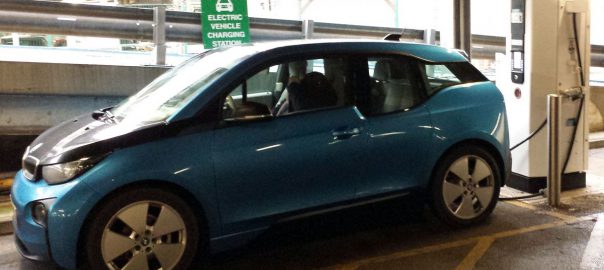
i3 charging at Frimley Hospital (Image: T. Larkum)

Rapid Charging at Frimley Park Hospital

[Part 1 is here]

As expected we got most of the way to our destination in Surrey without having had a chance for a proper rapid charge. The plan was to charge at Frimley Park Hospital, and if that failed to go to Church Street car park in Fleet. Driving an EV long distance is all about having a plan and a backup plan!

i3 charging at Frimley Hospital (Image: T. Larkum)

We needn’t have worried – Frimley turned out fine, eventually. We knew the charge point was in the covered part of the (very large) car park and found it pretty easily. However, things did then get a bit tricky. Zap-map indicated that there were two CCS-capable charge points there, with one of them offline. In fact there was only one (the other charge point could only do AC and Chademo) and it was showing an error on the screen; naturally I was worried that this was actually the offline unit.

I cancelled the apparent charge session and re-initialised it (just following instructions on the screen) and it seemed to clear. I started a new session using my Polar RFID card (it’s a CYC charge point, but CYC is now part of Polar). When I first connected the i3 and began a charge, however, it only lasted about a minute, and then stopped with an error on the dash. Anyway, I persisted and the second time it worked fine.

We were fully charged about 45 minutes later – that was longer than I expected, particularly as we plugged in with 32% charge, so that implies to me that the charge point may not have been giving its full 50kW power (perhaps as a result of the initial failed charge?). Nonetheless, it’s hard to complain when the charge was free, and even £3 for the parking seemed reasonable as we were able to pass the time sitting in the nearby hospital cafe with a cup of tea and a slice of cake.

The charge issues and long charge time notwithstanding, it was a pretty good experience and I’m sure we’ll use Frimley again. We left with 99% charge and had enough not just to get to Surrey but to show off the i3’s acceleration a few times while there, and then return all the way back to Northampton without a further charge. Hats off to the i3 once again!

AC Rapid Charging an i3 94Ah

We’re currently on our way in the i3 from Northampton to Surrey, to visit relatives for New Year’s Eve. It seems like most of the few CCS charge points operated by Ecotricity at motorway services are offline today.

I have therefore planned to charge at public charge points near our destination. However, since we always stop at Toddington services going south for the toilets anyway, I thought I’d try an AC charge here (Toddington has no CCS/DC cable).

The i3, of course, does its slow charging on AC (alternating current) like all electric cars and its rapid charging on DC (direct current) like all electric cars except the Renault ZOE. However, the new i3 (the ’94ah’) has a trick up its sleeve – it can ‘medium charge’ on 3 phase AC (a feature shared only with the Tesla).

After about 10 minutes of mucking about with the Ecotricity app on my ‘phone it finally loaded, and the car started charging from the Type 2 cable (intended for rapid charging a ZOE). About quarter of an hour later, when we were ready to leave, we had taken on 2.5kWh of electricity. 2.5kWh in 14 minutes equates to about 11 kW charging power, which is what the i3 can theoretically achieve so it’s encouraging to see it working in a real situation.

2.5kWh charge after 14 minutes (Image: T. Larkum)

Having said that, we only gained about 10 miles of range (so about 40 miles per hour). That’s certainly better than nothing, but doesn’t compete with true DC rapid charging where that’s available.

[Part 2 is here]

Public want ‘positivity’ lamp posts, electric car charging points and fingerprint-activated door locks in future neighbourhoods

Electric car charge points will be central to future neighbourhoods

There are already over 60,000 home charge points for electric cars in the UK, and new research finds these sockets will be one of the most desirable features of neighbourhoods in the future.

Public want ‘positivity’ lamp posts, electric car charging points and fingerprint-activated door locks in future neighbourhoods

The study, conducted by electric car campaign Go Ultra Low, suggests technologies such as electric car charging points, ‘positivity’ lamp posts which beam colourful lighting during winter to combat SAD (seasonal affective disorder) and fingerprint-activated door locks could be some of the most sought-after features for house buyers in two decades’ time.

Electric charge points on homes aren’t just a trend for the future. Government statistics show there are already over 60,000 home chargers in the UK as motorists take advantage of a £500 government grant towards installing one. Data from charging providers shows that around 90% of electric car charging is done at home.

The survey shows the most desirable feature of future neighbourhoods is next generation smart lamp posts (chosen by 52% of respondents). However, a close second is having electric vehicle charge points on every house – chosen by 49% of people surveyed. These were followed by front door locks which can be opened using fingerprint technology (37%), communal rainwater recycling technology (37%) and Wi-Fi emitting trees (22%).

The results also show that most people think electric cars will become an essential part of housing developments across the country. Nearly three quarters (72%) said they expect electric vehicles to be the most common type of vehicle on residents’ driveways. According to just over a quarter (26%) of people, hydrogen cars will also be a more familiar fixture in the future.

Those surveyed predict that technology will make them more willing to share a car with their neighbours over the next 20 years. Almost half (48%) of people expect to be sharing electric cars with other people who live on their streets, with over a tenth of people agreeing that this could lead to stronger relationships between neighbours.

The 10 most desired features for future neighbourhoods from the research are as follows:

  • ‘Positivity’ smart lamp posts using colourful hues to combat Seasonal Affective Disorder (52%)
  • Electric car charge points on every house (49%)
  • Locks on front doors which can be opened by fingerprint (37%)
  • Water recycling capabilities (37%)
  • Rainwater harvesting technology (34%)
  • Outdoor solar powered charging stations (28%)
  • Electric car sharing schemes (24%)
  • Trees emitting Wi-Fi (22%)
  • Fox proof bins (20%)
  • Robotic gardeners (11%)

Maxwell Hutchison, architect and former president of the Royal Institute of British Architects, said:

“Green technology that enhances our lives will fuel neighbourhoods of the future. Whilst ‘positivity’ lamp posts and robotic gardeners may be a way off, developments such as electric car charge points, electric car schemes and rainwater harvesting technology are starting to be implemented by new cutting-edge housing developments.

“The UK already has its first eco town being developed in Oxfordshire, and there are others on the horizon, with features that include shared electric car sharing schemes and electric car charge points for every house.”

Poppy Welch, Head of the Go Ultra Low campaign, said:

“Electric cars are on track to become an essential part of everyday life, and our research backs this up with strong demand for charge points and EV sharing schemes.

“Electric cars are high performing, fun, exciting and financially compelling. There are currently over 75,000 on UK roads, a growth of 37% in a year, based on sales from January to September. Their role both now and in the future is unquestionable, as indicated by the £80m invested by government in further improving the nation’s electric vehicle infrastructure.”

Source: Go Ultra Low

Electric cars could be charged at Shell service stations from 2017

Emails released under FoI suggest the company is in advanced preparations to introduce the chargers on its forecourts from next year

Shell said it is examining the potential to introduce electric vehicle charging points across some parts of its UK retail network from early 2017 (Image: P. Byrne/PA)

Electric car charging points could appear alongside petrol pumps at Shell’s UK service stations as soon as next year, the oil giant confirmed after emails between the company and government officials revealed discussions on introducing them.

The company also asked the government how serious it is about wireless charging roads which could top up an electric car without the need to plug in, as mooted by Conservative MP Oliver Letwin.

The diversification into infrastructure for battery-powered cars would mark a new departure for the company, which has largely backed biofuels as a greener alternative to petrol and diesel in the past. It could also suggest a softening of stance from an industry which Telsa co-founder Elon Musk has accused of using misinformation campaigns against electric cars.

Emails released after a Freedom of Information request by DeSmogBlog, a site which monitors fossil fuel lobbying, shows that Shell staff and government transport officials discussed both electric cars and hydrogen fuel this year.

Read more: The Guardian

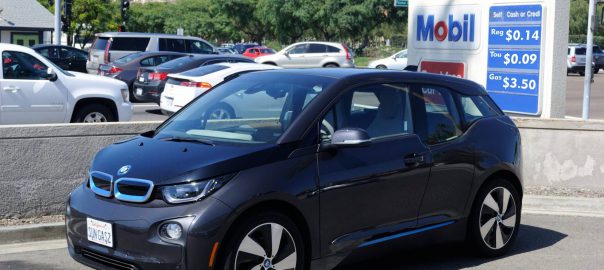
My Fuel Station, 14 cents for regular, 9 cents for off-peak

Shell Ponders Charging Station Rollout In UK

Oil company Shell says that it’s “examining the potential” for installing charging stations “across some parts of its UK retail network” beginning in early 2017. And by “potential” we assume that to mean, potential to recover some lost petrol money from the ongoing plug-in vehicle onslaught.

My Fuel Station, 14 cents for regular, 9 cents for off-peak

The UK retail network implies gas stations, which would be big news and a huge win for electric cars if Shell actually gives the program the go ahead.

As Engadget reports:

“In a statement to the Guardian, the company confirmed that it’s “examining the potential” of putting chargers “across some parts of our UK retail network” from early 2017.”

“The comments follow a slew of emails, retrieved by DeSmogBlog through a Freedom of Information request, between Shell and the British government.”

A Shell employee sent an email with this statement:

“I have been asked whether Shell will need an electricity supply license if we are to provide a service to customers to charge their electric cars.”

From this exchange (which we don’t know who the sender or recipients are), it’s assumed that Shell is at least interested in proving charging services for electric cars at its gas station locations.

We’ve seen chargers at gas stations before, but never in what’s expected to be a mass rollout, perhaps even UK-wide.

Source: Engadget via Inside EVs