Category Archives: Charging

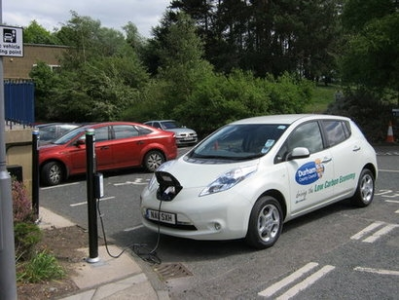
Nissan Leaf (Image: Qurren/Wikipedia)

More electric car charging stations than fuel stations by 2020

More electric car charging stations than fuel stations by 2020

Nissan Leaf (Image: Qurren/Wikipedia)
  • Number of electric car charging locations to overtake petrol stations by August 2020.
  • UK has lost more than 75% of petrol stations in four decades, whilst electric charging points have gone from hundreds to thousands in just a few years.
  • Edward Jones, EV Manager, Nissan Motor (GB) Ltd., said; ‘We believe the tipping point for mass EV uptake is upon us.’
  • Nissan was the first manufacturer to introduce a mass-produced electric vehicle and has sold more EVs than any other car brand worldwide.

There will be more public locations to charge electric cars in the UK than there are petrol stations by the summer of 2020, according to new analysis by Nissan.

At the end of 2015, there were just 8,472 fuel stations in the UK, down from 37,539 in 1970. Assuming a steady rate of decline, Nissan predicts that by August 2020 this will fall to under 7,870.*

In contrast, the number of public electric vehicle charging locations is expected to reach 7,900 by the same point in time. However, the accelerating adoption of electric vehicles means this crossover could happen a lot sooner.

Just over 100 years since the first fuel station opened – November 1919 at Aldermaston in Berkshire – the number in the UK has peaked, declined and is expected to be overtaken by charging stations designed for battery, not combustion, powered cars.

More than 75% of UK petrol stations have closed in the last 40 years, whilst the number of electric vehicle charging locations has increased from a few hundred in 2011 to more than 4,100 locations in 2016, as electric car sales take off.

According to Go Ultra Low, the joint government and car industry campaign, more than 115 electric cars were registered every day in the first quarter of 2016, equivalent to one every 13 minutes. The campaign also believes electric power could be the dominant form of propulsion for all new cars sold in the UK as early as 2027, with more than 1.3m electric cars registered each year.

Read more: Nissan GB

Electric vehicle charging hub approved

Planners have given the green light for a new electric vehicle charging hub near the centre of Dundee.

Images have been released showing how the charging hub would look in what is currently a vacant yard

Solar canopies and charging points will be installed at the site in Princes Street, which is currently a vacant yard.

The chargers will be available to the public, taxis, NHS vehicles and local businesses.

Dundee City Council now has an 83-strong fleet of electric vehicles, the biggest of any UK local authority.

Funding for the hub, as well as charging points at eight other locations, was part of a £1.86m award made to the city by the Office of Low Emission Vehicles (OLEV) last year.

Mark Flynn depute convener of Dundee City Council’s city development committee said:

“Our use and encouragement of electric vehicles in Dundee has been something of a quiet revolution and in leading the charge we have been meeting many social and economic priorities.

“Zero and low emission vehicles reduce cost, congestion and carbon emissions as well as improving air quality and the charging hub will help us to continue our journey.

“The council’s extensive use of such vehicles is encouraging other public bodies and private individuals to buy and use them as a real practical alternative to fossil fuelled cars.”

The council owns 58 charging point at eight publicly available charging locations, including Scotland’s first rapid charger.

Work on the new charging hub is expected to start in autumn and it is planned to be up and running by the end of the year.

Source: BBC News

London Mayor announces doubling of EV charging points across London

Electric vehicle (EV) drivers in London, UK will soon be able to access 1,500 new EV charging points across the city thanks to a £4.5 million investment announced by London Mayor Sadiq Khan.

The residential charge points being installed across 25 London boroughs are aimed at Londoners currently without access to off-street parking, in a bid to try and encourage more citizens to transition from polluting fossil-fuel vehicles to new zero-emission vehicles.  They will add to the rapid charging points that Transport for London (TfL) is already installing, the full complement becoming available for drivers by 2020.

“This substantial investment in electric charging points will make a real difference, making electric vehicles an easier and more practical option for Londoners across our city”

said Mr Khan.

“We have a bold ambition to make London’s transport system zero emission by 2050, and working with boroughs to roll out more charging infrastructure is a vital part of making this a reality”.

But it’s not only in London that momentum towards an electric vehicle future is increasing. Auto Express reported recently that the Government is to pass a new bill requiring motorway and major fuel stations to install charging points. The Automated and Electric Vehicles Bill was announced in the 2017 Queen’s Speech. It also requires easy access to charging points, establishing a seamless network of points across the UK that conform to the same technical standards.

An investigation by Auto Express has found that charging infrastructure is struggling to keep up as EVs become more popular. Ownership of electric and plug-in cars has increased dramatically from 2,254 vehicles in 2012 to 85,983 in December 2016.

A report by the Committee on Climate Change (CCC) predicts that there will be around 700,000 EVs on Britain’s roads by 2020, meaning that an additional 60,000 chargers will be required over the next three years to service them.

Source: Renewable Energy Magazine

Solar Charge Points charging electric cars (Image: T. Larkum)

Charging Our Car at Devon Cliffs

We are currently holidaying in the Devon Cliffs Holiday Park at Sandy Bay, Exmouth. We arrived last week from Northampton, having charged on the M4 at Chieveley and on the M5 at Sedgemoor.

The Solar Charge Points at Devon Cliffs - and only 2/3 of the cars shouldn't be parked there! (Image: T. Larkum)
The Solar Charge Points at Devon Cliffs – and only 2/3 of the cars shouldn’t be parked there! (Image: T. Larkum)

On arrival we found a pleasant surprise – a solar powered charging bay in the main reception car park. I have since learned that it was installed about a year ago in a joint venture with Bourne Leisure (owners of the park), Solarplicity and POD Point.

Having last charged at Sedgemoor, about 60 miles back, we didn’t need to charge again for the first few days. Then I started looking into how to start a charge – doing some Googling, searching on the POD Point online map (which didn’t show the charge point), installing the POD Point app, etc.

However, it all turned out to be unnecessary – I called POD Point and they explained that it was a private charge point – hence not on the public map – and that it was free to use. In hindsight I should have just plugged in and tried it!

The POD Point charge points at Devon Cliffs (Image: T. Larkum)

We have since made good use of the charge point, leaving the car on charge overnight most days. It is marked as a 7kW point which should charge our i3 in about 4 hours. In fact I am seeing charge times significantly longer than that so I would guess it is actually running at about half that, 3.5kW. Perhaps that has something to do with being solar powered, e.g. a reduced charge outside sunny hours, I don’t know. Anyway, the car is fully charged every morning so it doesn’t really matter.

The charge point has been a real boon – allowing us to go on long trips out most days without needing to find anywhere else to charge.

And all our holiday motoring for free.

Number of electric car charging points in London to double in 2018

The prospect of thousands of electric cars driving round London’s streets came a step closer today as Sadiq Khan announced a £4.5 million investment in 1,500 new charging points across the capital.

Sadiq Khan announced a £4.5 million investment in 1,500 new charging points PA

Transport for London and the capital’s town halls will roll-out the new green charging infrastructure – which will almost double the number of points – over the course of 2018.
It comes after the Government last week announced a ban on sales of petrol and diesel cars from 2040 to help tackle the country’s toxic air problem.

But Mr Khan, environmentalists and some motoring experts accused it of falling short of what is needed to deal swiftly with toxic air — which is blamed for a death toll of about 9,000-a-year in the capital alone.

The chosen boroughs – 25 of London’s 32 – will each receive up to £300,000 of government cash to install the standard charging points, which take between four and eight hours to charge a family car, in residential areas.

Town hall officials will now identify sites where charging points could be installed. Some of the cash could be spent on new approaches such as using lamp posts as the base and power supply for charge points, which would be cheaper and quicker to roll out with less impact on the streetscape.

They believe the scheme will help motorists without access to off-street parking to make the switch from polluting vehicles to zero-emissions ones more easily. More money will follow next year if the scheme is successful.

The new points will be in addition to the network of 150 rapid charge points for taxis and commercial fleets that TfL is installing by 2018.

Mr Khan, who wants all new road vehicles driven in London to be zero emission by 2040, said:

“This substantial investment in electric charging points will make a real difference, making electric vehicles an easier and more practical option for Londoners across our city.

“We have a bold ambition to make London’s transport system zero emission by 2050, and working with boroughs to roll out more charging infrastructure is a vital part of making this a reality.”

The money for this tranche of charging points comes from the Government’s Office for Low Emission Vehicles’ ‘Go Ultra Low City’ scheme.

Read more: Evening Standard

Energy supplier Ovo launches tariff for electric vehicle drivers

LONDON, Aug 1 (Reuters) – British electricity and gas supplier Ovo Energy has launched a new tariff aimed at drivers of electric vehicles, hoping to tap a growing market days after Britain announced a ban on the sale of new diesel and petrol cars from 2040.

Ovo Energy’s EV Everywhere tariff offers customers a two-year fixed energy rate that also includes free membership of the POLAR network of charging stations over that period.

Electricity consumption by electric cars is expected to rise as consumers opt for more environmentally friendly transport and the cost for batteries used in the cars falls.

Britain said last week it would ban the sale of new diesel and petrol cars from 2040 in an attempt to reduce air pollution.

Ovo estimates Britain will have at least one million electric vehicles on its roads by 2022, up from about 110,000 now.

“Mass adoption of electric vehicles will completely revolutionise the energy sector,”

said Ovo Energy CEO Stephen Fitzpatrick, who set up the energy company in 2009.

Users of Ovo Energy’s new tariff will receive electricity from renewable energy sources, guaranteed by certificates proving its origin. The company said it was only Britain’s third energy tariff targeted at electric vehicles.

Green energy company Ecotricity and renewable energy supplier Good Energy also have tariffs for electric car users.

Alongside the tariff launch Ovo also announced two acquisitions: electric vehicle charging point installer ChargedEV and electric vehicle technology research company Indra Renewable Technologies.

Ovo declined to disclose financial details of the deals.

The independent supplier made its first acquisition earlier this year when it bought U.S. smart grid startup VCharge. (Reporting by Karolin Schaps; editing by Jane Merriman)

Source: REUTERS

BP in talks with electric carmakers on service station chargers

LONDON (Reuters) – BP (BP.L) is in talks with electric vehicle makers on partnering to offer battery re-charging docks at its global network of fuel service stations as it seeks to benefit from the move away from diesel and petrol cars, Chief Executive Bob Dudley told Reuters on Tuesday.

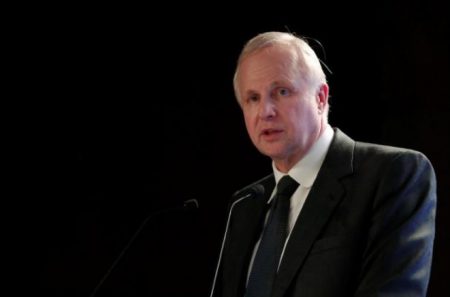
BP Chief Executive Bob Dudley addresses the gathering during a media interaction in New Delhi, India, June 15, 2017.

The expected rapid growth in the use of electric vehicles in the coming decades is threatening oil companies’ business model as demand for some road fuels could plateau as early as the late 2020s, according to some oil company estimates.

Looking to take a slice of the growing market, London-based BP is however examining different ways to get involved in the sector.

“We have discussions going on with a lot of the EV manufacturers to have a tie-up with our retail network for charging,”

Dudley said in an interview.

Rival Royal Dutch Shell (RDSa.L) has already launched a pilot scheme to install battery charging docks at a few of its service stations in Britain and the Netherlands.

The number of electric vehicles on roads is forecast to grow significantly in the coming decades, particularly in cities, with BP estimating that there will be 100 million by 2035, up from 1.2 million in 2015.

Dudley has been a vocal advocate of the oil and gas industry’s need to take part in the move away from fossil fuels toward using cleaner sources of energy in order to combat global warming.

But BP, along with rivals including Shell have yet to come up with a clear plan for increasing their interests in renewable energy production such as solar and wind.

“We’ll be ready for this world but we’re not going to dive in too deeply,”

he said, referring to BP’s previously unsuccessful ventures into renewable energy, including solar power.

BP will make investments in future technologies but these will be small percentage stakes in companies or partnering with them, he said.

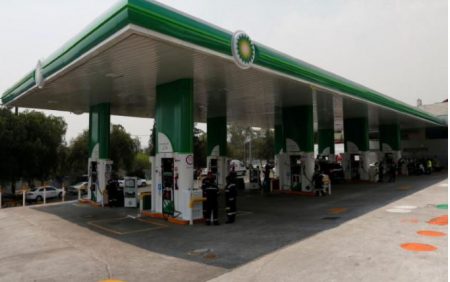
FILE PHOTO: A general view of a new BP petrol station on the outskirts of Mexico City, Mexico, March 9, 2017.

Dudley said BP was also studying autonomous vehicles and the potential for combining natural gas with solar power generation.

Read more: REUTERS

POLAR charging network to be powered with 100% renewable electricity

  • UK’s largest electric vehicle charging network switches to 100% renewable energy
  • Electric drivers benefit from a reduced emissions footprint from POLAR charging points
  • Cost of POLAR network membership remains the same with no price increase

The UK’s largest electric vehicle (EV) charging network, POLAR, which includes Charge Your Car sites, is switching to 100% renewable electricity from 1st August.

The electricity consumption of the POLAR network, operated by Chargemaster, will be certified and matched to energy generated from renewable sources by OVO Energy, one of the UK’s largest independent energy providers. It means that every mile driven by EVs charging on the POLAR network will be matched by renewable energy.

The electricity consumption of the POLAR network, operated by Chargemaster, will be certified and matched to energy generated from renewable sources; meaning every mile driven by EVs charging on the POLAR network will be matched by renewable energy.

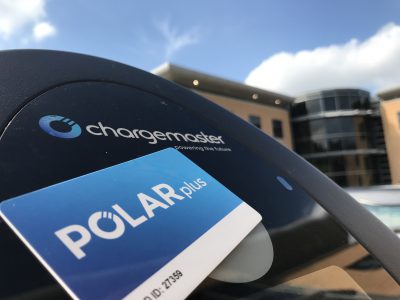
Chargemaster, the UK’s largest provider of electric vehicle charging infrastructure, provides over 40,000 EV drivers with access to more than 5,600 public charging points in the UK across the POLAR and Charge Your Car networks. Combined, they represent more than 40% of all the charging points in the UK and, in the first half of 2017 supplied vehicles with more than 500,000 kWh of electricity.

The POLAR network is growing significantly, with Chargemaster installing more than 250 of its UK-manufactured Ultracharge rapid chargers this year. POLAR plus membership, which provides unlimited access to charging points in the network (over 85% of which are free to use) costs just £7.85 per month and will not increase with the switch to renewable energy. In addition, new members benefit from free membership for the first three months.

Electric vehicles already reduce local air pollution, as pure electric vehicles, and plug-in hybrid and range-extender models running in electric mode, produce no tailpipe emissions.

Even when charged with electricity from the National Grid, the emissions footprint of electric motoring is still lower than the average new car in the UK. However, this benefit is increased if electric vehicles are charged using renewable energy, which ensures that electric motorists are truly ‘zero emission’, with no fossil fuel-generated electricity used when charging.

David Martell, Chief Executive of Chargemaster said,

“Switching POLAR, the UK’s largest EV charging network, to renewable energy is great news for EV drivers in the UK. It reduces the overall emissions of electric motoring, removing the upstream footprint of electricity generation in the same way as drivers have eliminated their tailpipe emissions.”

Source: Chargemaster

Ubitricity | Fully Charged

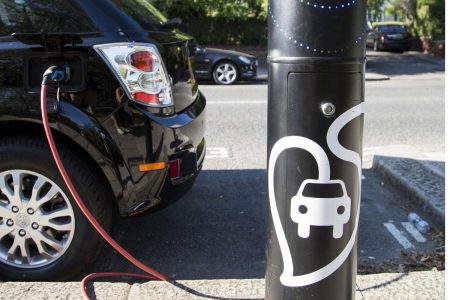
The simple and very commonplace lamp post will soon become a ubiquitous charge point for electric cards.

They charge at about 5 kW, or 16 amps, not super fast but overnight charging is all most drivers need.

Ubitricity is a German based company who’ve come up with a simple, cheap to install and well managed system for more people on more streets to adopt electric cars.


Electric Cars are Getting Too Popular!

As sales of electric cars keep increasing we are seeing more and more of them on the road. That simply reflects the rising demand as everyone now knows they will be transitioning away from fossil-fuel cars.

We saw one result of that today. We’re on our way to Devon on holiday in our i3, and called in at Chieveley Services to charge.

On arriving, there was a Tesla Model S charging at one of the Ecotricity pumps, the one with the CCS connector that the i3 needs. After a brief discussion he kindly agreed to move to the other pump so we could charge.

Once we were charging we went inside for lunch, and I monitored the charging on my phone. As it approached 100% we headed back to it only to find a charging queue for the first time ever!

The Tesla had gone and been replaced by a Nissan Leaf. Waiting to charge were a second Leaf and a Renault ZOE. We moved out of the way for the second Leaf, but the ZOE probably had a half hour wait ahead of it.

This type of situation will probably become increasingly common as more EVs hit the road, at least in the short term. Eventually it is hoped that we’ll see all petrol stations, and perhaps most parking spaces, changed over to be charging points.